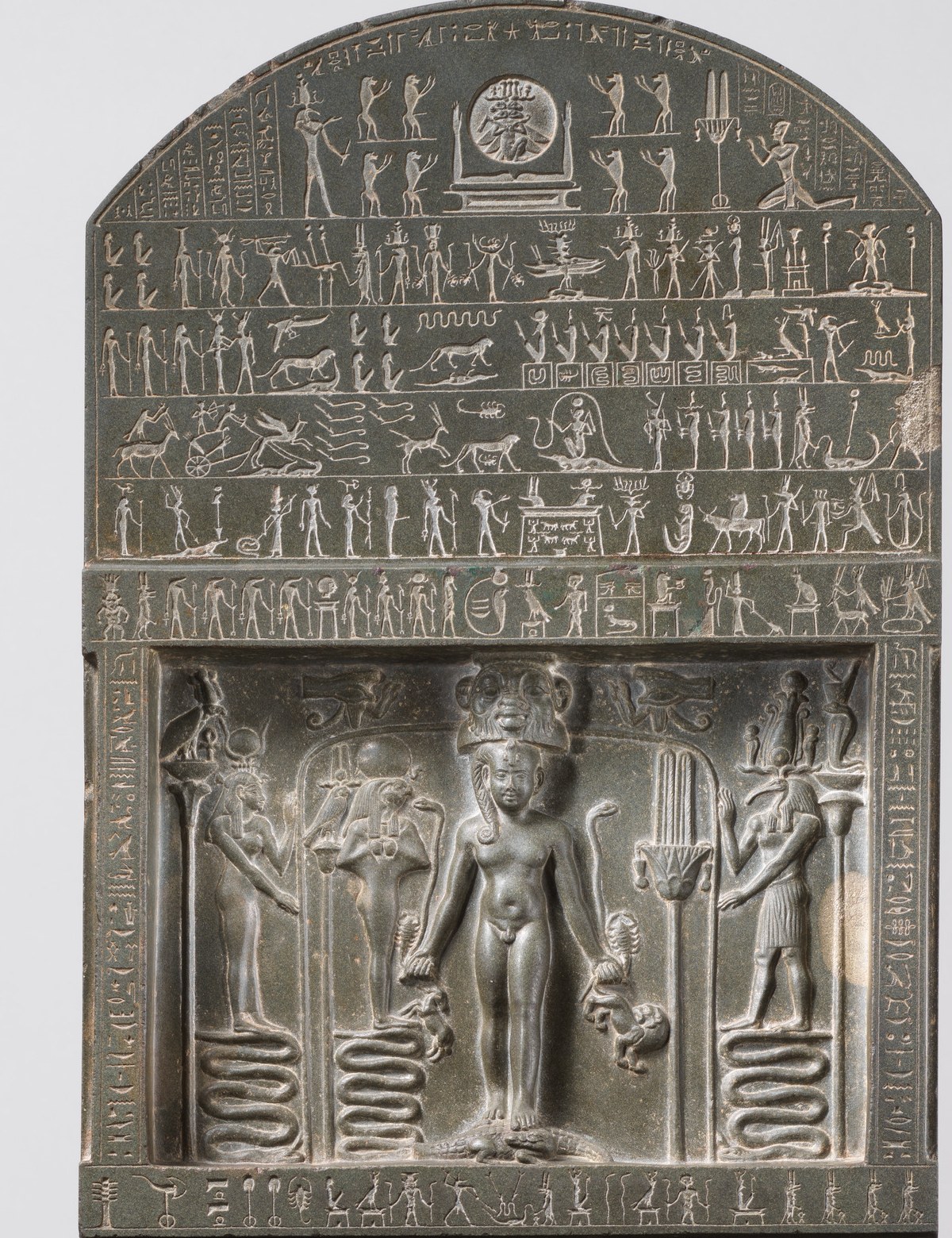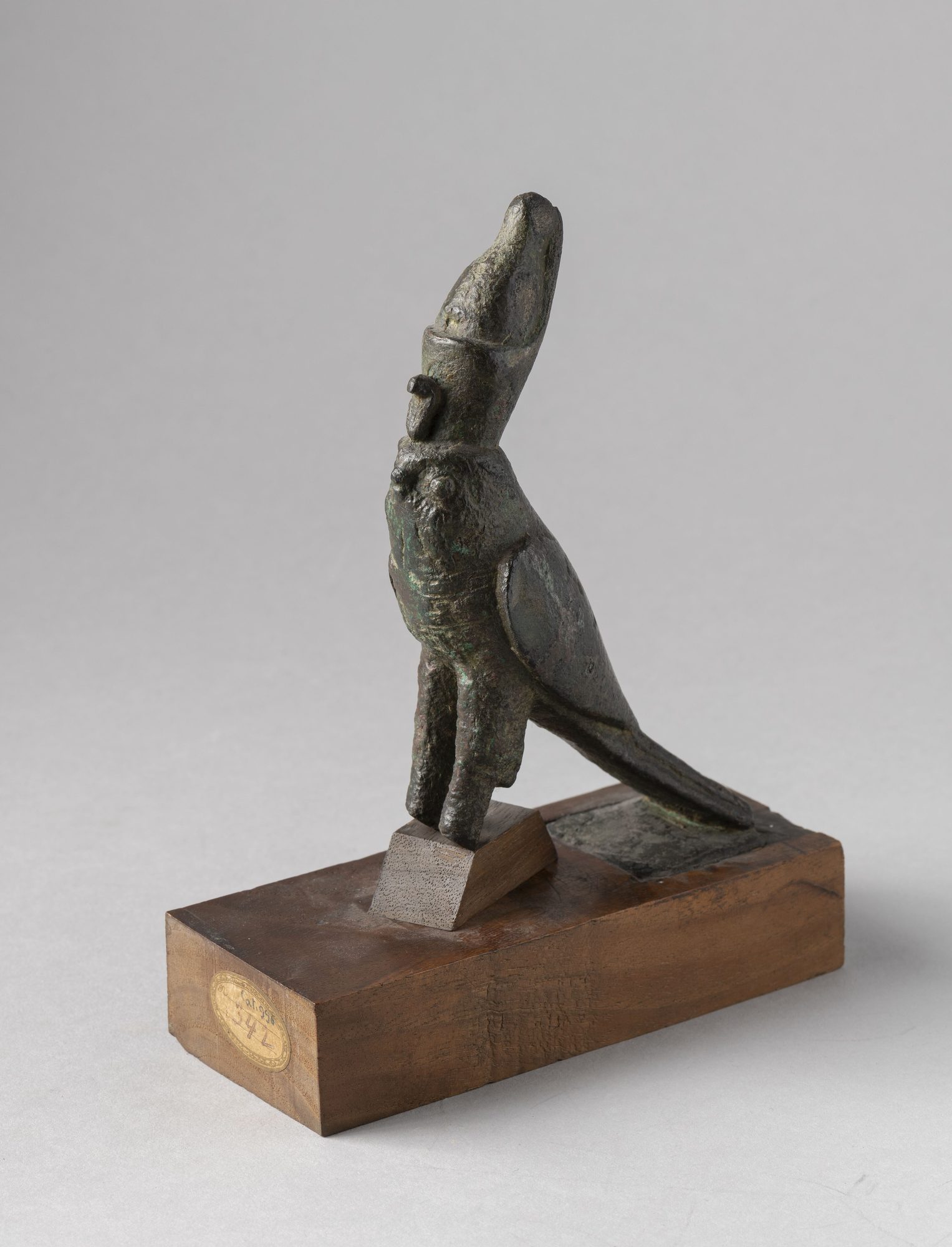
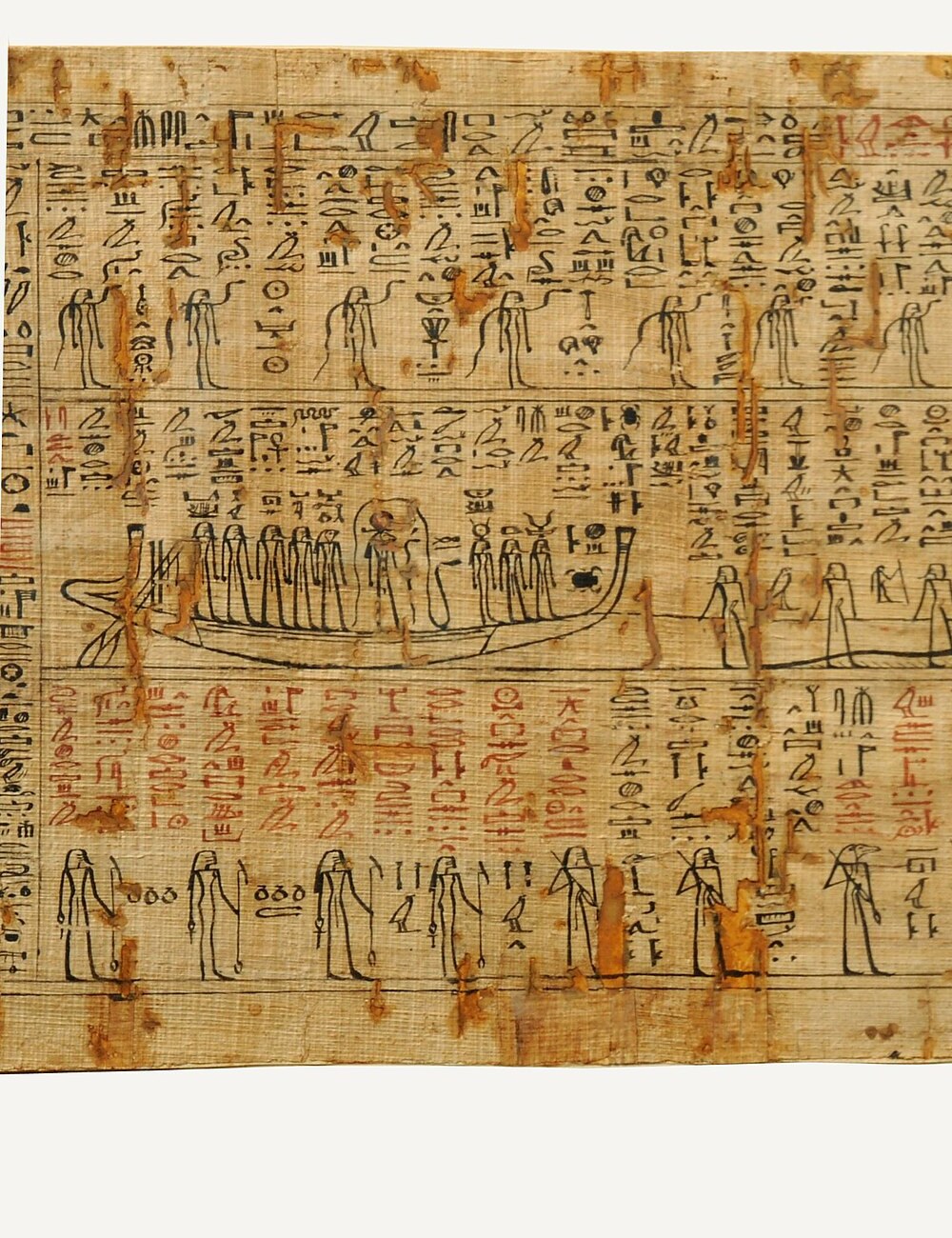
The sun goes down, and the god who was a blazing disk at noon is now a tired old ram-headed man standing in a shrine on the deck of a boat, waiting to be pulled through the dark. Ahead of him lies a valley the width of the night, a river-country of the dead split lengthwise by its own black water, and he will not sail it under his own power. The boat is hauled by ropes, region by region, through twelve chambers of the underworld, and only if it reaches the far end will there be a morning. This is the Duat, and every night the sun must die into it and fight its way out.
The Egyptians had more than one name for the place. In the funerary papyri it is the Tuat, and also Amenta, the West,
the country the setting sun enters and the dead go down to. It is one realm under several names, not a scatter of separate hells, and it resists a tidy map in another way too: it is imagined at once as a buried valley beneath the western horizon and as the night sky the sun crosses in the hours of darkness. Egyptian cosmology never cleanly split the two, and it is truer to hold both pictures together than to force one.
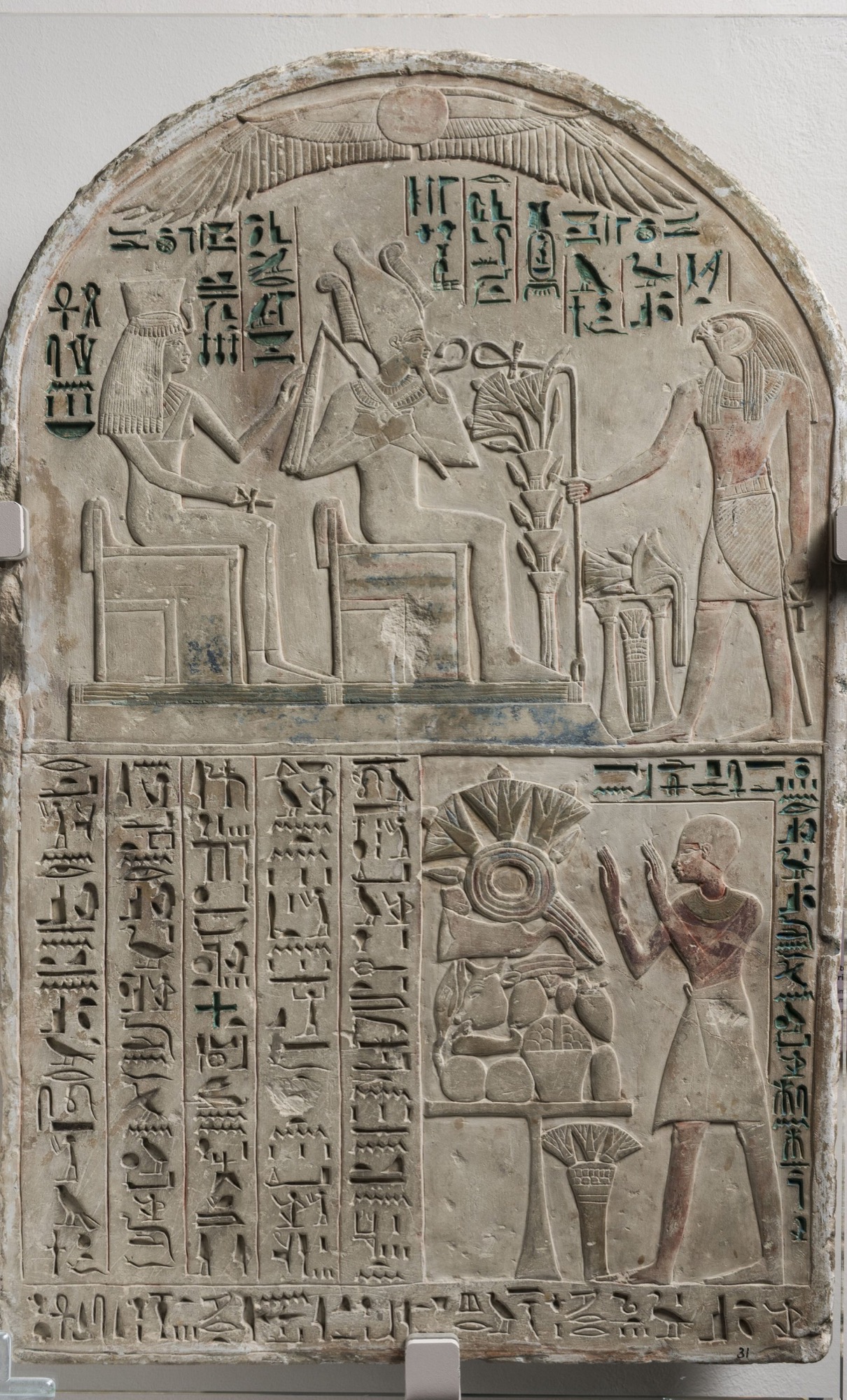
Two very different books lead into this country, and it matters that they are kept apart. One is the Book of the Dead, a papyrus placed in a private tomb, a personal handbook of spells for the deceased to open the gates, answer the doorkeepers and survive the courtroom of judgment. The other is the Amduat, painted on the walls of pharaohs’ tombs, a royal chart of the sun-god’s cosmic voyage hour by hour.
They share the setting and little else. The Book of the Dead climaxes in a moral verdict, the Amduat in the rebirth of the sun. Modern retellings love to weld the two into a single story, the weighing of the heart followed by the night voyage, but they are different texts for different owners, best read as two lenses on the same dark realm rather than one continuous plot.
The chart of the hours
The Amduat divides the underworld into twelve Divisions, one for each hour of the night, and the sun-boat passes through one per hour. Its own title states what it is for: the knowledge of the souls of the Tuat, of the doors and the ways on which the great god journeys, and of the hours and their gods. The First Division is the Western Vestibule, where the sun enters at dusk; the Twelfth is the Eastern Vestibule, where it comes out at dawn. The whole book runs from sunset in the west to sunrise in the east, each Division carrying its own ancient name.
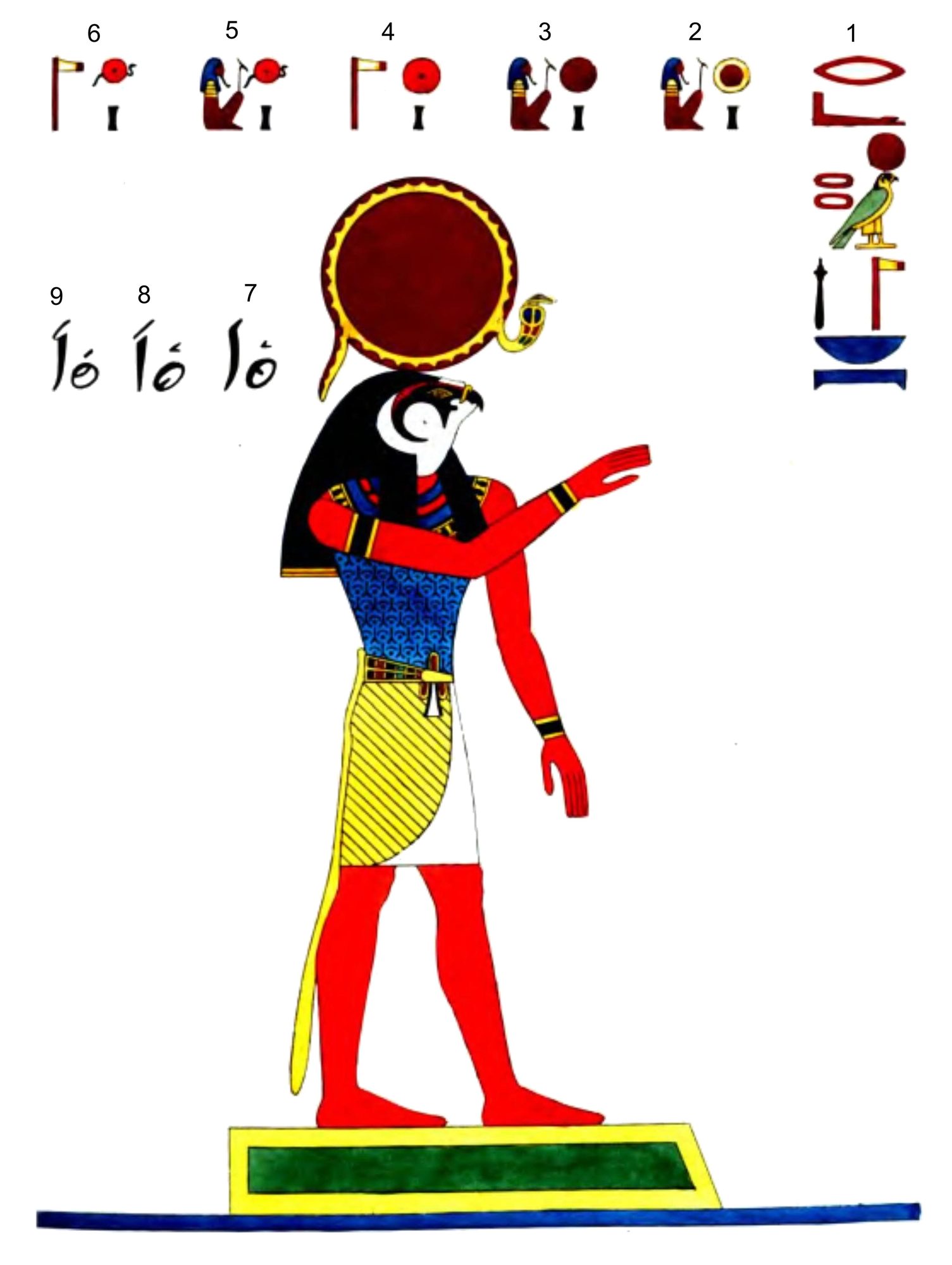
The traveller is the night form of the sun. He is Af, or Afu-Ra, the dead Sun-god,
a ram-headed man with a disk on his head, standing inside a shrine on the deck of the Sektet boat, the evening bark. On its high prow hangs a curious object the ancient artists could not agree on, a carpet to some, a reed mat to others, and near the curve a single painted Eye watches the way ahead. He does not travel alone: a named crew works the boat, and an escort of gods marches ahead of the hull, the two goddesses of Truth for South and North and the lioness Sekhmet among them.
Into the hidden desert
Midway through the night the river fails. The boat reaches the Kingdom of Seker, a hidden desert region where the ordinary channel gives out and the god’s course no longer runs straight. It zig-zags diagonally through a corridor called Re-stau, the road of the secret things,
sealed by named doors. Here the sun-god passes a place so sealed off that he cannot enter it in the flesh: he does not pass through the leaves of the door, the text says, but they hear his voice. This is the country of Seker himself, the falcon-god of the necropolis, on his sand,
his body the image which is hidden, and is neither seen nor perceived.
Then comes the deepest point, the Sixth Division at the midnight hour, and the whole journey turns on it. The boat arrives at the place of the body of Osiris,
a cluster of hidden houses that contain the image of the murdered god, and there the ram-souled night-sun comes to rest within the coils of a great serpent.
This is the theological heart of the voyage: the living sun has come down to the dead body of the king of the underworld, and from that meeting in the pitch dark the whole regeneration proceeds. The Amduat gives only the meeting-place; the outright doctrine that the two merge into one, Ra who is Osiris, is spelled out elsewhere, in the funerary hymns where Ra setteth as Osiris.
Midnight is the pivot: the sun touches death, and begins to turn back toward life.
The serpent and the knives
The turn does not come unopposed. In the Seventh Division the boat is ambushed. The great serpent of chaos, Apophis, lies in wait, here in a fettered form called Neha-hra, Terrible-of-Face.
He encircles his own district, a square of the underworld named Tchau, four hundred and forty cubits on each side.
He is beaten not by force but by knives and magic: the scorpion-goddess Serqet is stationed at his head, the god Her-tesu-f fastens a fetter about his feet, and behind it all stand the words of power that Isis has taken possession of. In Budge’s plate the serpent lies pinned to the ground by six knives. The sun survives the night not by out-fighting the dark but by binding it, cutting it, and out-speaking it.
The reward for surviving comes in the last hour. In the Twelfth Division, the Eastern Vestibule, the sun is reborn, and the image the Egyptians chose is startling. Twelve goddesses take up the tow-ropes and drag the boat in through the tail of a monster serpent named Ka-en-Ankh-neteru, Life of the Gods,
and out again renewed. The gods enter into this hidden image
and come forth in the renewed forms of Ra every day.
The sun is born again by passing bodily through the serpent, rising in the east as Khepri, the scarab of the dawn, while behind it the paddling gods drive the beaten Apophis to the back of the sky.
The courtroom of the dead
The private dead do not ride the sun-boat; their journey through the same country is a trial, not a rebirth. The Book of the Dead brings the deceased to the Hall of the Two Truths, before a mighty god, lord of Righteousness,
where the soul must know and name the forty-two gods who appear with him in the hall. What follows is the negative confession,
a litany of innocence recited sin by sin.
I am not a doer of wrong to men,
the dead person declares; I am not a murderer; I am not an adulterer; I put not pressure upon the beam of the balance; I snatch not the milk from the mouth of infants.
The homely texture of the crimes disavowed is what makes it unforgettable: I drive not the cattle from their pastures, I extinguish not the lamp during its appointed time, I stop not the water at its appointed time. Then the soul turns to the assessors one by one, each addressed by name and district.
The verdict itself is a weighing. Passage is granted when no lightness of his in the scale has been found and the Balance is relieved of his case,
and only then does the doorkeeper admit the justified soul: Thou mayest now enter through the door of the hall of Righteousness.
Even the doors resist. I do not announce thee, saith the Doorkeeper, unless thou tell my name.
And the soul answers with its own purity, insisting over and over, I am pure, I am pure, I am pure, I am pure,
a purity likened to that of the great Bennu-bird, the phoenix.
It is worth saying plainly what this text does and does not contain. The famous picture that hangs in every museum, the heart weighed against a single feather with Anubis at the balance, Thoth recording and the monster Ammit crouched to devour the failed heart, is the standard illustration that accompanies this chapter in papyri like that of Ani, but it is not in the words read here. The verbatim text gives the negative confession, the forty-two assessors, the Hall of the Two Truths and a general balance-verdict. The full tableau is real Egyptian religion; it belongs to the vignette rather than to these lines.
Reeds, not fire
And what lies beyond the trial is not a torment. The justified dead pass to the Fields of Aaru, the Egyptian paradise, and here it is worth dispelling the commonest modern error about the realm: the Duat is not simply the Egyptian hell.
Aaru is farmland, an idealised country of abundance, and the soul that has come through judgment seeks its allotment in the Fields of Aarru
and learns the mysterious paths and the gates of Aarru,
the gardens the old translators glossed as the Elysian fields.
Punishment is real in these texts, but it falls inside the Tuat on Apophis and the damned, not in a separate hell set apart. The underworld the Egyptians built was never a single destination: a night to be survived, a court to be answered, and, for the vindicated, a green field on the far side of the dark.
Let the caverns of Shu be opened, that he may come forth at large, and that I may issue from my funereal pit to my seat which is at the prow of the Bark of Rā. (Book of the Dead LXVII, trans. Renouf)
- The Book of the Dead (Theban recension), Chapters I, VIII–IX (opening the Tuat), XV (the Sektet boat and the hymns to Ra), LXVII (opening the caverns of Nu and Shu), CX (the Fields of Aaru), CXXV (the Hall of the Two Truthsthe negative confession, the forty-two assessors and the balance verdict) and CLXXX (Ra and Osiris in the Tuat), read verbatim in P. Le Page Renouf & Édouard Naville, The Egyptian Book of the Dead (Society of Biblical Archaeology, 1904), Project Gutenberg ebook 69566. Supplies the private dead’s route through the Tuat: the terminology (Tuat, Amenta), the doorkeepers, the courtroom of judgment, and the reward of the Field of Reeds.
- The Book of Am-Tuat (Amduat), the New Kingdom royal guide to the sun-god’s twelve-hour night voyage, read verbatim in **E. A. Wallis Budge, The Egyptian Heaven and Hell, Vol. IThe Book Am-Tuat (1905)**, archive.org id
in.ernet.dli.2015.22181. Supplies the cosmic voyage: the twelve Divisions and their names; the ram-headed Af in the Sektet boat; the Kingdom of Seker and the Re-stau corridor; the body of Osiris at the Sixth Division (midnight); Apophis as Neha-hra fettered by six knives in the Seventh; and rebirth through the serpent Ka-en-Ankh-neteru with emergence as Khepri in the Twelfth. - The Book of Gates, the parallel New Kingdom night-journey composition organised around twelve guarded gates, each with its own serpent-keeper and its own Osiris-judgment tableau, in E. A. Wallis Budge, The Egyptian Heaven and Hell, Vol. II (1905), archive.org id
egyptianheavenhe0002budg. Named as the authoritative source for the gate-by-gate scheme but not read verbatim this pass; none of its gate-names or scenes are borrowed above or attributed to the Amduat. - Pyramid Texts (Old Kingdom), the earliest matrix for the two solar barks and the king joining Ra in the sky and the underworld, referenced only via secondary summary this pass (Breasted, per
ra-sun-god.md) and not read in a Pyramid-Texts edition here; no §-numbered line is printed as a direct quotation.