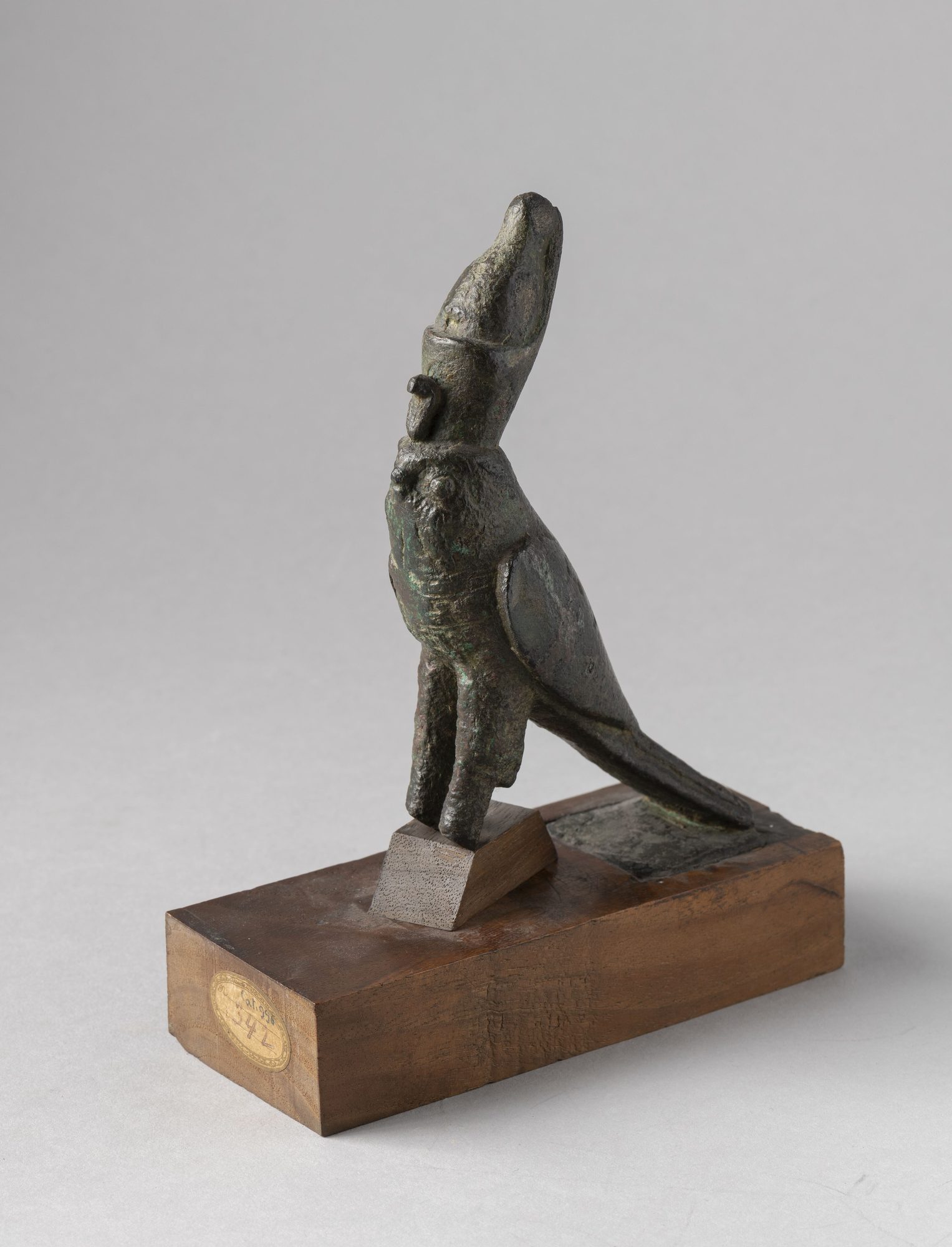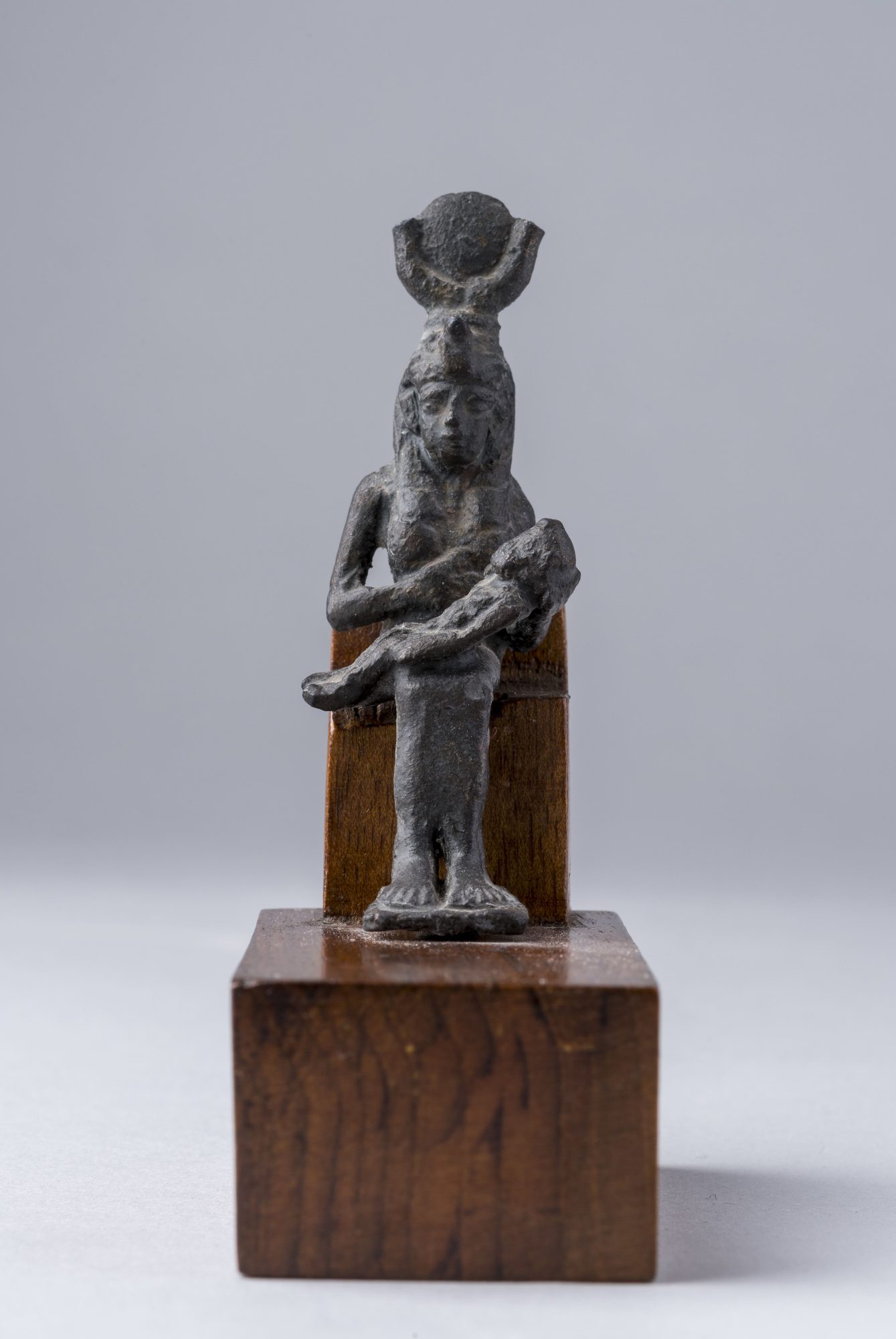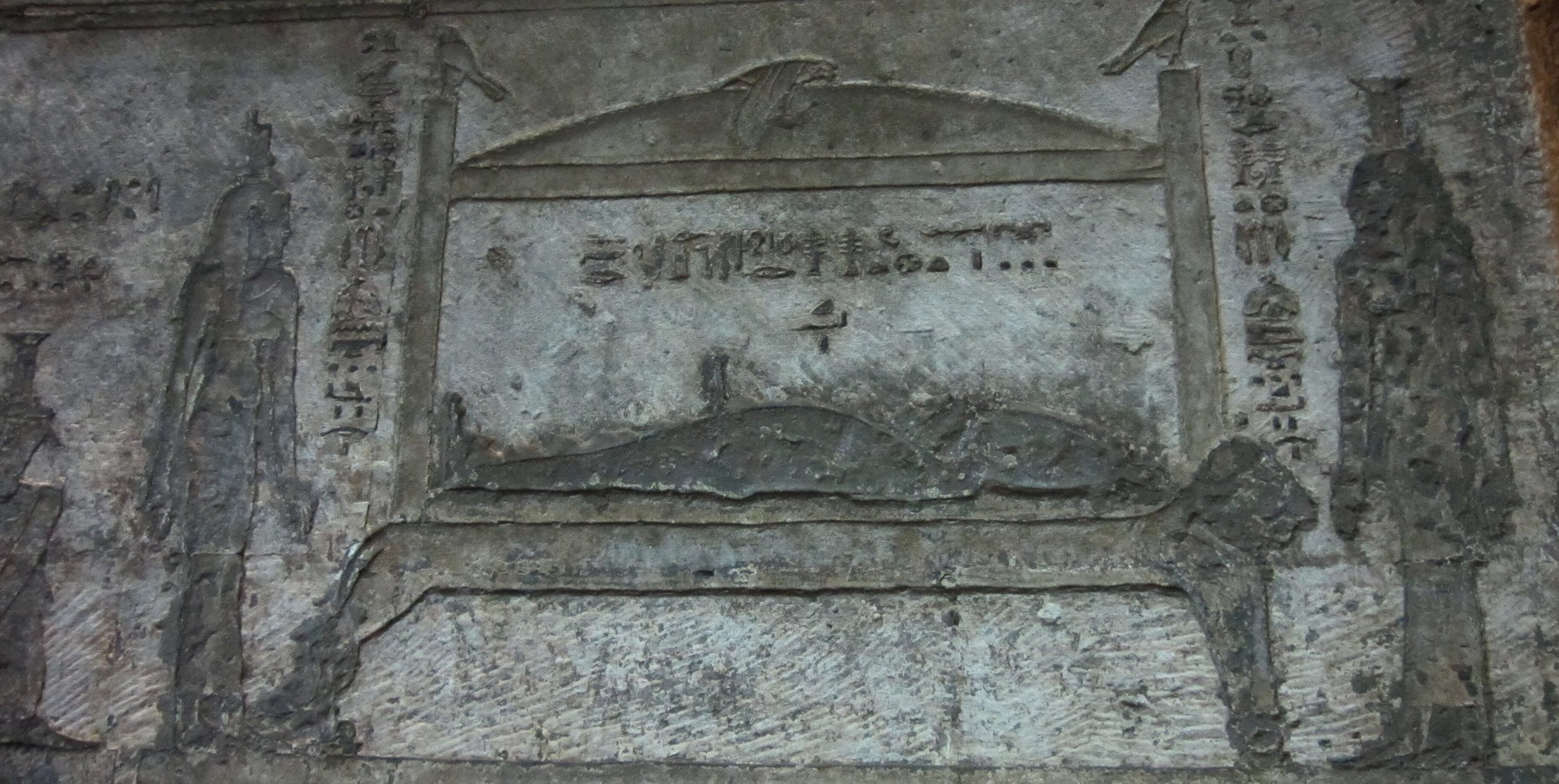
For a god this old and this widely worshipped, the strangest fact is what does not exist. Egypt kept Osiris at the centre of its idea of death for something like two and a half thousand years, from the Old Kingdom pyramids to the temples the Romans still funded, and in all that time no Egyptian scribe wrote down the story of how he died. The murder, the coffin, the scattering of the body: none of it survives as a connected Egyptian tale. What survives is a god addressed rather than described, in funerary spells that speak to him and let fragments of the story flash past without ever telling it in order. To meet Osiris on Egyptian ground is to meet a name spoken over the dead, a shape on a coffin, a star climbing the southern sky. The plot came later, and it came from strangers.
Foremost of the Westerners
He surfaces first in the 5th Dynasty, around 2400 BCE, and by the Pyramid Texts carved a little later in the tomb of Unas he is everywhere, the god with whom the dead pharaoh is made one. His great necropolis was Abydos in Upper Egypt, and the title he carries there was not his to begin with. First of the Westerners,
foremost of the blessed dead in the West where the sun goes down, belongs in the Pyramid Texts to a jackal: the dead king is to stand like Anubis, First of the Westerners.
Over the Old and Middle Kingdoms Osiris absorbed the older canine god of the Abydos cemetery and took his epithet, so that Khenti-Amentiu, Foremost of the Westerners, became a standard name for Osiris rather than for the jackal he replaced. The absorption marked the ground as well as the texts. At Umm el-Qaʿab, the archaic royal cemetery, the tomb of the 1st-Dynasty king Djer was re-identified in the Middle Kingdom as the grave of Osiris himself, and pilgrims came for centuries to heap it with votive pottery. A real king’s tomb had become a god’s.
He who is in Busiris
Abydos was not his only home, and possibly not his oldest. In the Delta stood Busiris, in Egyptian Djedu, and the Pyramid Texts already hail the god there in a litany of places: He who is in Busiris, chief of his nomes.
Which centre came first, southern Abydos or northern Busiris, scholars still dispute; both are primary in the earliest texts, and at each Osiris seems to have absorbed local gods, swallowing at Busiris an older Delta deity, Andjeti, named in the same texts beside Anubis.
Busiris was also the home of the Djed, the tall many-tiered pillar whose raising became one of the most enduring Osirian rites. In relief at the temple of Seti I at Abydos, carved around 1290 BCE, the king hauls the great column upright with ropes and sets it standing on its base: the ceremony is well attested even where its meaning is not spelled out.
Green skin and the crossed crook
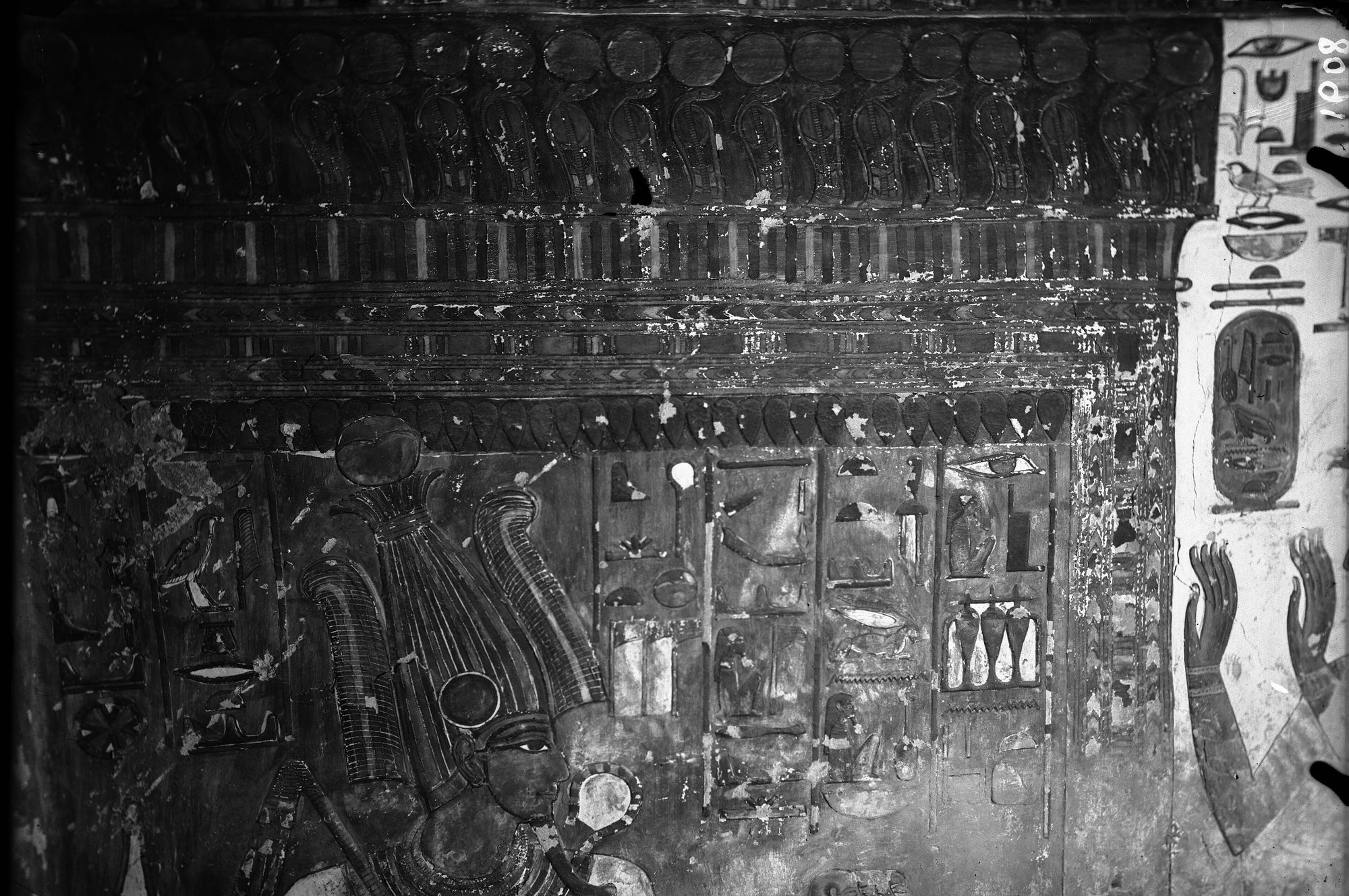
The image is unmistakable, and pervasive across New Kingdom tomb walls. Osiris stands wrapped as a mummy, his arms folded to hold the crook and the flail crossed at his chest, the shepherd’s hook and the herdsman’s scourge that mark him as a king. On his head sits the atef, the tall white crown of Upper Egypt flanked by two ostrich plumes, above a broad wesekh collar. His skin is painted green, or else black, and neither is an accident or a fading of pigment: green is the colour of new growth, of the shoot breaking the soil, black the colour of the Nile silt the flood leaves behind.
Both say the same thing about him. This is a god of coming-back, and the regeneration was literal as well as figurative. Osiris was a god of the grain, and Egyptians made corn-Osiris figures, mummiform frames of linen packed with Nile mud and sown with barley, watered until green shoots rose through the outline of the god’s own body; the famous one came from the tomb of Tutankhamun. They were made especially around Khoiak, the month of the returning flood, and to see those blades pushing up through the body-shaped tray was to see the dead god growing again.
Striding across the night sky
He rose in the sky as well as in the field. The Egyptians identified Osiris with the constellation the Greeks called Orion and they called Sah, and the dead king, risen as the god, is told in the Pyramid Texts: He who is in Sah; Thou sojournest in heaven; thou sojournest on earth.
Beside Orion rises Sirius, brightest of the fixed stars, whose reappearance at dawn each year heralded the flood; Sirius was Sothis, the pointed one,
and Sothis was Isis. So the whole drama plays out overhead each year: Osiris strides across the night as Orion, and Isis rises at his side as the star that summons the inundation. The resurrection is written into the calendar of the sky.
From the king alone to the Osiris Ani
The most revealing thing about Osiris is not fixed but moving, because who was allowed to share his fate changed across Egyptian history, and the change can be dated. In the Pyramid Texts of about 2350 BCE the Osirian afterlife belongs to the king alone. The dead pharaoh is identified with Osiris and made to echo him clause by clause, He lives, N. also lives; he dies not, N. also dies not… he judges, N. also judges,
seated on the throne of Osiris.
By the Middle Kingdom the same spells, once carved only in royal pyramids, appear on the coffins of provincial officials; the elite dead can now become an Osiris.
By the New Kingdom, from around 1550 BCE, the door is open to anyone who can afford a funerary papyrus, which is why such papyri prefix the owner’s own name with the god’s: the vindicated dead man is written as the Osiris Ani,
a small Osiris, once his heart is weighed and found true. He changed shape once more at the end, fused under the early Ptolemies around 300 BCE, by way of the Osiris-Apis of Memphis, into the hybrid Serapis of Alexandria, and carried across the Roman Mediterranean in the cult of Isis.
What the Greeks added
Only at the very end of that long span does the connected story appear, and it appears in Greek. The joined-up narrative of the murder, the dismemberment and the recovery survives in just two authors, neither an Egyptian priest, both writing more than two thousand years after the god’s first attestation. Diodorus Siculus set his version down around 60 to 30 BCE, roughly a century and a half before Plutarch composed his around 100 CE. Between them they supply everything the Egyptian record lacks: the coffin’s voyage to Byblos and the heath tree that grew around it, the three fish that ate the phallus lost in the river, and firm counts for the scattered pieces, fourteen in Plutarch and twenty-six in Diodorus.
No Egyptian text gives any of it, no Byblos, no fish, no number. Measure the distance honestly: Plutarch stands about two and a half thousand years from the Pyramid Texts, a gap far wider than the one between Homer and the travel-writer Pausanias. The Egyptians gave the god his image, his stars and his grain; the plot is a Greek inheritance.
“He lives, N. also lives; he dies not, N. also dies not… he judges, N. also judges.” (Pyramid Texts §167, Mercer trans.)
- Pyramid Texts (Old Kingdom, late 5th–6th Dynasty; Unas pyramid c. 2350 BCE), trans. Samuel A. B. Mercer, The Pyramid Texts in Translation and Commentary (1952), archive.org id
THEPYRAMIDTEXTSTRANSLATIONthe oldest evidence by far, and liturgical rather than narrative. The epithetFirst of the Westerners
attached to the jackal god Anubis, not yet to Osiris (§57d, §220c), the developmental key to the figure; the resurrection-and-judgement litanyHe lives, N. also lives; he dies not, N. also dies not… he judges, N. also judges
(§167a–d);He who is in Busiris, chief of his nomes
(§182a);He who is in Sah [Orion]; Thou sojournest in heaven; thou sojournest on earth
andthe pointed one
(Sothis) rising beside him (§186a–c); the dead king seated onthe throne of Osiris
(§134b, §757c). - Egyptian Book of the Dead (Theban recension, New Kingdom onward), trans. E. A. Wallis Budge (Papyrus of Ani 1895; Theban recension 1901)Osiris as
governor of those in the underworld, lord of Abydos, king of eternity
(ch. 173); the weighing of the heart in the Hall of the Two Truths (ch. 125), with Thoth recording the verdict (ch. 182); thethe Osiris [NN]
name-prefix by which a vindicated dead person becomes a small Osiris on a funerary papyrus. - Plutarch, De Iside et Osiride (Of Isis and Osiris) (c. 100 CE), trans. William Watson Goodwin (1878), ToposText work/274the fullest connected Greek narrative and the Serapis material (chs. 28–29). Cited here only as evidence about the sources, for what it adds that no Egyptian text has, the Byblos voyage and the heath-tree pillar, the three fish, and the count of fourteen pieces.
- Diodorus Siculus, Bibliotheca Historica 1.21–22 (c. 60–30 BCE), trans. C. H. Oldfather, Loeb Classical Library 1933, ToposText work/133the older of the two Greek witnesses, giving the twenty-six-piece variant and the wax-and-spice effigies distributed to the priesthoods.
- (Supporting, archaeological and interpretative, not primary text)Seti I Abydos reliefs (Calverley & Broome eds., 1933–58) for the raising of the Djed pillar; W. M. F. Petrie and D. O’Connor, Abydos (2009) for the Umm el-Qaʿab tomb-of-Osiris re-identification; Tacitus, Histories 4.83–84 for the Serapis foundation legend.