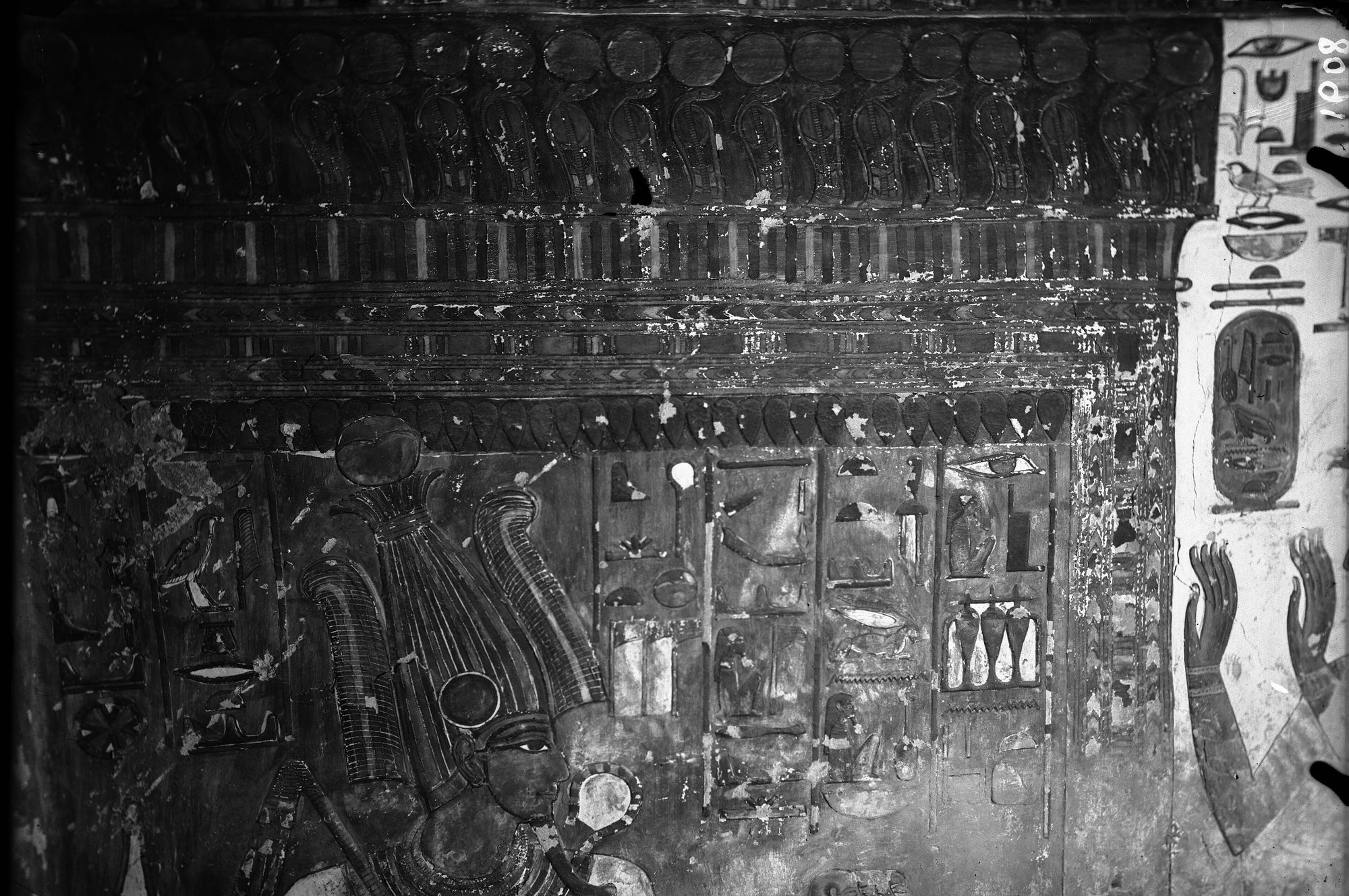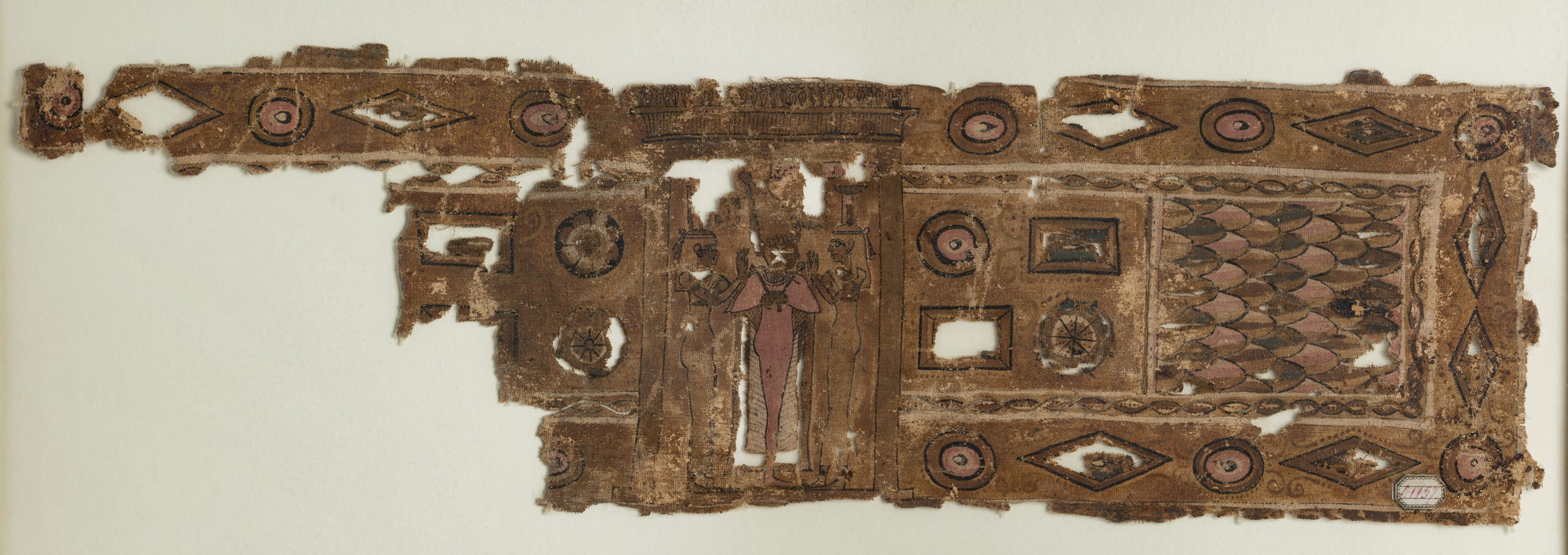
The order came down the river from the king: go up to Abydos, and make the god’s secret place beautiful with the gold brought back from Nubia. The man who carried it out was a treasurer named Ikhernofret, a courtier who had been made Companion of the King at the age of twenty-six, and he left behind a stone that tells us, in his own voice, exactly what he did when he got there. He dressed the body of the god in lapis and malachite and electrum.
He built a portable shrine of gold and silver and fragrant woods and called it the Bearer-of-Beauty. He refitted the sacred barque. And then, for the days of the festival, he took the part of the god’s son and helped act out the death and vindication of Osiris in front of the assembled town. His stone is the oldest close witness we have to what later ages would call the Mysteries of Osiris, and it is worth saying at once that it is not the only witness, nor a complete one.
What the treasurer would not say
Ikhernofret’s account is a list of offices, not a script. He tells us the names of the
processions and the parts he played, and he is deliberately silent about the thing at the
centre. The festival opened with what he calls the Going Forth of Wepwawet, the jackal
Opener of the Ways,
who went out, in the treasurer’s words, to champion his father. Here
Ikhernofret repelled the enemy from the sacred barque and overthrew the foes of Osiris.
Then came the Great Going Forth, the procession that followed the god out of his temple in the neshmet-barque, the funeral cortège of a murdered king carried through the crowd. He led the way to the tomb at a place called Peker, and there, on the day he names the Great Conflict, he slew all the enemies upon the flats of Nedyt, the mythic ground where Osiris was struck down. Last of all the god was brought home, back to his palace and his house, and set again upon his seat.
What the stone never does is describe a corpse or a resurrection. The killing, the mourning,
the reassembly of the body: none of it is narrated. The secret climax of the drama is left
unspoken, veiled behind the offices Ikhernofret performed around it. He championed Wennofer,
the perfect being,
and led him to the grave and home again, but the mystery itself stays
behind the curtain. This reticence is the point. A modern retelling wants a death scene; the
oldest source withholds one, and honesty means leaving that silence where the Egyptians put it.
A cow in black linen
For a scene of mourning we have to jump forward almost two thousand years and change languages. Around 100 CE the Greek philosopher Plutarch, drawing on what was practised in his own day, described a rite he places in the month of Athyr, the season when the flooded Nile pulls back off the fields and leaves the land bare. The priests, he writes, shroud a gilded image of a cow in a black linen robe and display her as a sign of mourning for the goddess, the cow standing for Isis and for the earth herself. They keep this up for four days running, from the seventeenth of the month.
Plutarch understood the mourning as grief for four losses at once, all of them the same loss in different dress: the going-out of the flood, the failing of the north winds, the shortening of the day against the night, and the stripping bare of the trees and the ground. This is the myth read as a calendar.
Osiris disappears when the water sinks and the green dies back, and the country puts on black for him. It is a Greek eyewitness parenthesis rather than an Egyptian temple text, and its dates do not line up neatly with the Egyptian liturgy, but the image it preserves is unforgettable: a golden cow draped in black, carried out for four days while a whole people mourns the death of the year.
The shout at the water’s edge
Then, on the nineteenth night, the grief breaks. Plutarch describes the priests and the keepers of the sacred robes going down to the sea after dark and bringing out a holy chest. Inside it is a small golden coffer. They pour fresh water into the coffer, and at that a great shout goes up from everyone present, a cry of joy that Osiris has been found. The god who was lost in the receding water is recovered from it; the finding is enacted at the very edge of the water that took him.
What they do next is the heart of the whole business, and it is the same act, in Greek dress, that the Egyptian temples were performing for themselves. They take fertile soil and knead it with the water, work in costly spices and incense, and shape from it a small crescent-shaped figure, which they then clothe and adorn. A little body of Nile mud and perfume, moulded into the sickle of the new moon: the found god made by hand, out of the very earth whose barrenness they had just been mourning. Plutarch is watching, from the outside, the Egyptian rite of making an Osiris.
The god grown from grain
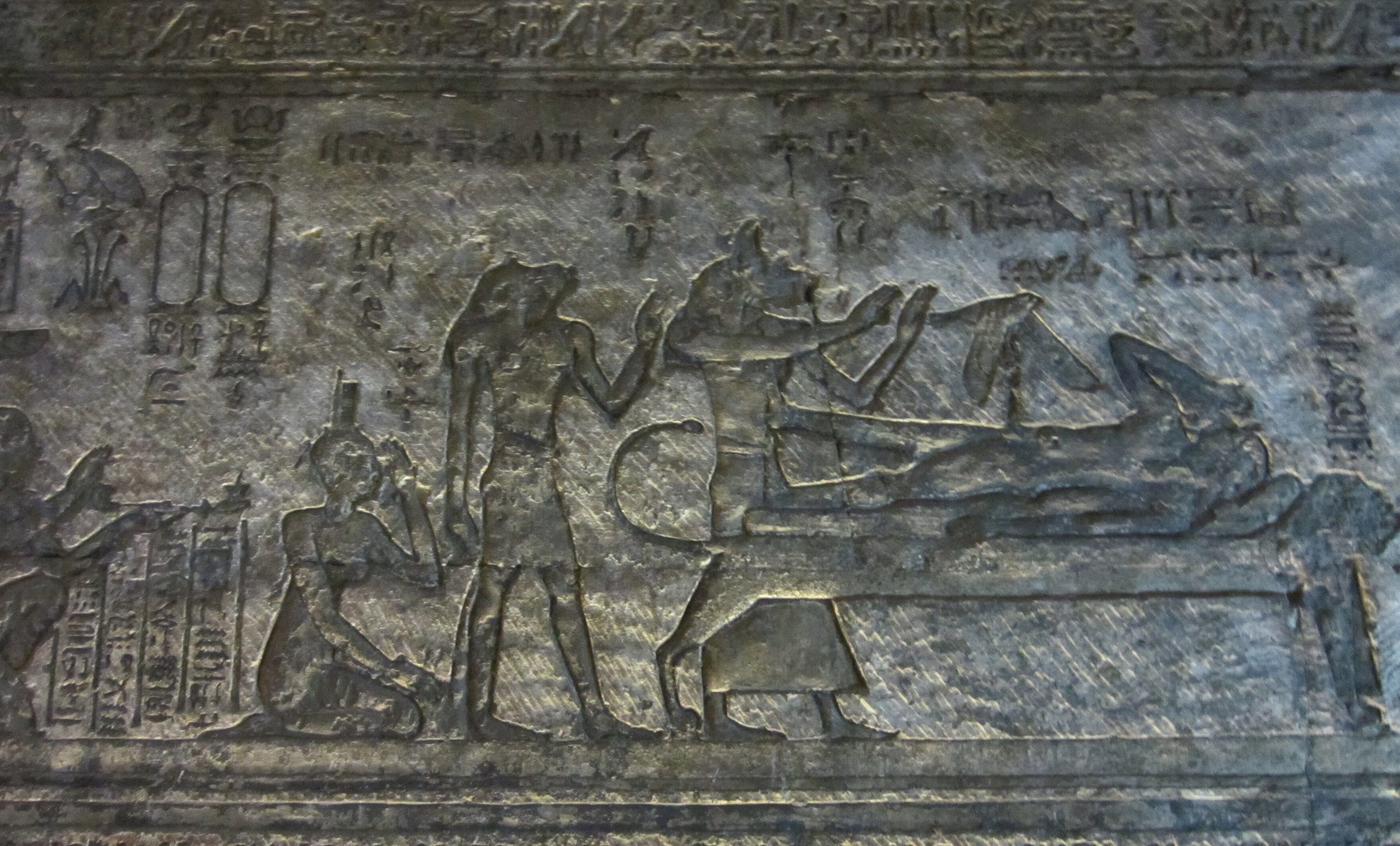
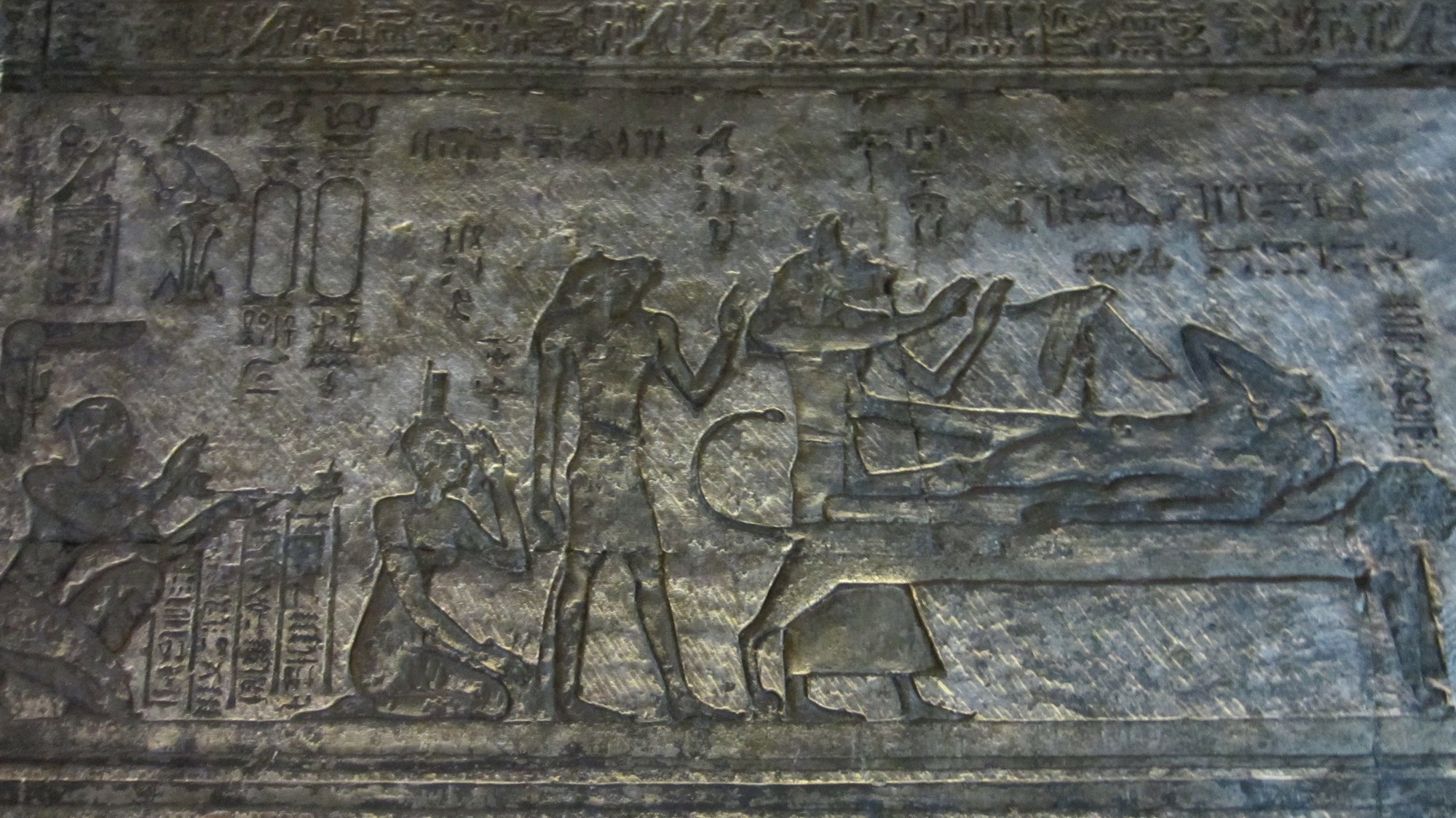
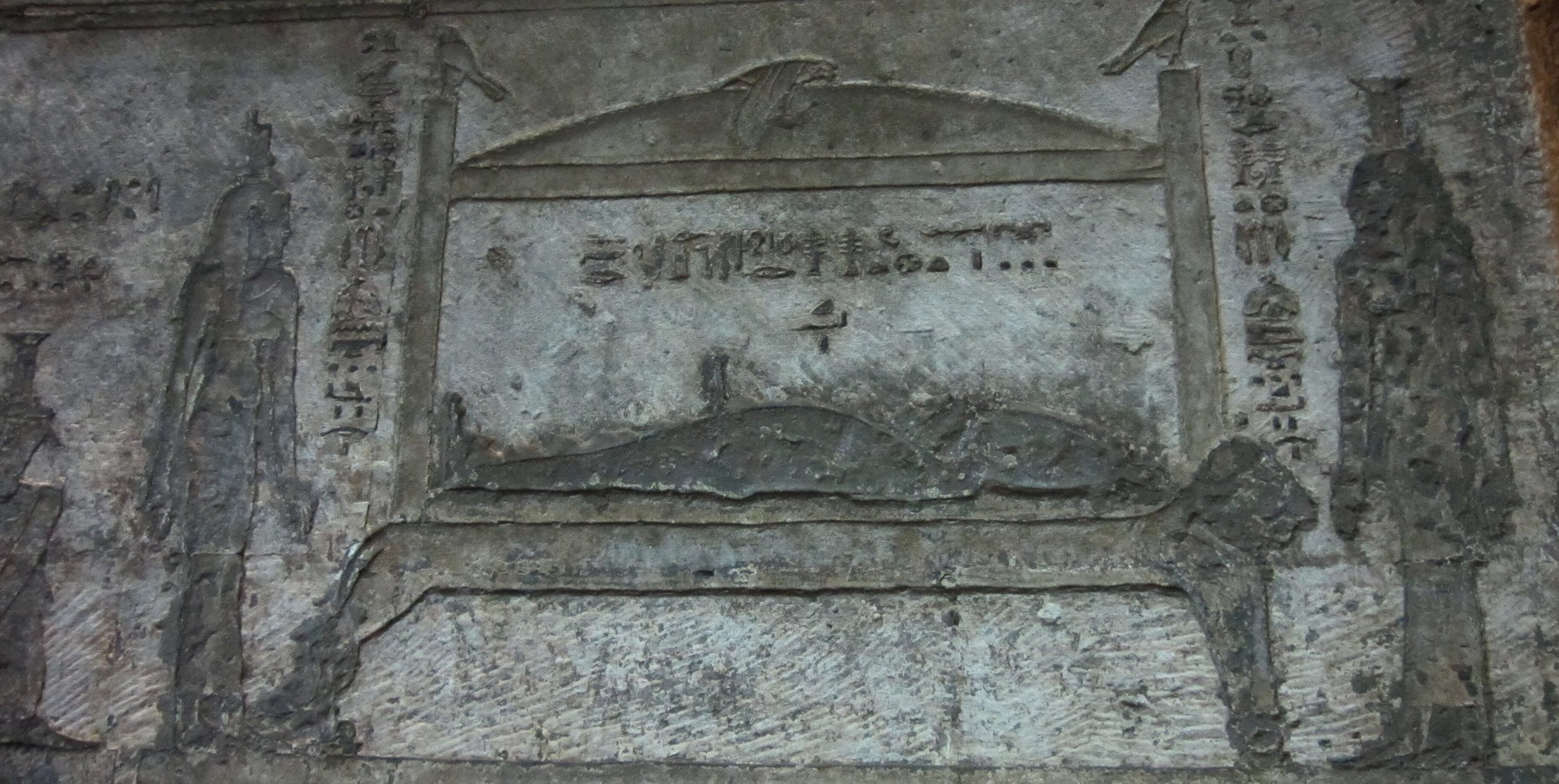
The Egyptian version of that rite survives in extraordinary, day-counted detail in the Osiris chapels at Dendera, whose walls carry a liturgy modern scholars call the Ritual of the Mysteries. This is a temple archive of the Ptolemaic and Roman period, later again than Plutarch and belonging largely to Busiris in the Delta rather than to Abydos, so it should not be silently folded into Ikhernofret’s Middle Kingdom drama. But it shows, better than any other source, what an Egyptian Osiris-figure actually was. It was two figures, in fact, made in parallel through the second half of the month of Khoiak.
One was moulded of barley and sand pressed together in a mould shaped like the god, then laid in a garden tank between rushes and watered every day until the grain sprouted green through the soil of his body. This is the germinating Osiris, the corn-mummy, and its meaning is written on its surface: the god is not walking again, he is growing again, sending up shoots like a field after the flood. The other figure was a composite mummy of a darker kind, worked from earth and date-pulp and myrrh and incense and pounded minerals and sacred-lake water, kneaded into a small dense body and kept in its coffin.
The temple texts count out the amulets laid on it, the strips it was wrapped in, the papyrus cords that bound its throat and legs and heart and crown. The exact measures and tallies in the Dendera text reach us at second hand and should be treated as provisional, but the shape of the rite is clear enough: the priests spent nineteen days building a god out of soil and grain and precious things, and at the month’s end they buried him.
Erecting the pillar
The month closed with a burial and a raising. The figures moulded the previous year, dried and wrapped and carried in a little boat through temple and precinct and cemetery under the jackal Anubis, were laid to rest in a crypt beneath a sacred mound, and on the last day of Khoiak the djed-pillar was set upright, the notched column that is Osiris’s own backbone.
A god laid down in the ground and a pillar stood up out of it, on the same day: death and stability in one gesture. Next year the whole cycle would begin again, a new figure moulded while the old one went into the earth, so that the god was perpetually dying and perpetually being remade.
None of this is a resurrection in the sense a later religion would give the word. No source shows Osiris getting up and walking. What the Egyptians staged, across every one of these witnesses, is something more precise and stranger: the limbs of the scattered god gathered back together, the grain sprouting from his buried body, the pillar of his spine raised firm, and his enthronement as king of the dead in the world below.
Ikhernofret’s Abydos, Plutarch’s seashore and the Dendera garden tanks are seventeen centuries and several cities apart, three witnesses to a tradition that kept changing shape. What holds across all of them is a single conviction: that the god who dies with the year can be made, mourned and grown again, and that a people willing to do the work of his burial would share in his return.
I celebrated the “Great-going-forth”; I followed the god at his going. I made the ship of the god to sail, Thoth [steering] the sailing. I equipped the barque “Shining in truth,” of the lord of Abydos, with a chapel; I put on his beautiful regalia when he went forth to the district of Peker. (Ikhernofret Stela, trans. J. H. Breasted, Ancient Records of Egypt I §669)
- Ikhernofret Stela, Berlin ÄM 1204, 12th Dynasty (reign of Senusret III / Sesostris III, c. 1850 BCE) — trans. James Henry Breasted, Ancient Records of Egypt, Part One, §§663ff, read here via the reshafim.org.il archive of Breasted’s translation. The source of the Abydos drama retold abovethe royal commission to make Osiris’s
secret place
beautiful with Nubian gold; Ikhernofret as Companion of the Kingat the age of twenty-six
acting the role of the god’s loved son (the Horus part); the gold, silver and lapisBearer-of-Beauty
shrine; the refitted neshmet-barque; theGoing forth of Wepwawet
whoproceeded to champion his father
; the repelling of the enemies from the sacred barque; theGreat-Going-Forth
; the leading of the god to his tomb before Peker;That Day of the Great Conflict
and the slaying of the enemies on the flats of Nedyt; Wennofer; and the return of the god to his house and seat. Breasted’s 1906 translation; the bracketed restorations (e.g.[steering]
) are his, and the stela is deliberately reticent about the secret climax, which it never narrates. - Plutarch, De Iside et Osiride 39 (Stephanus 366D–367A) — trans. Frank Cole Babbitt, Loeb Classical Library (Moralia V), read here via the Thayer/LacusCurtius reproduction. The source of the mourning-and-finding rite retold abovethe disappearance of Osiris in the month of Athyr; the gilded cow shrouded in black linen and displayed for four days from the seventeenth; the four things mourned (the Nile’s recession, the ceasing of the north winds, the shortening day, the stripping of the earth); the descent to the sea on the night of the nineteenth; the sacred chest holding a small golden coffer, the poured potable water, and the shout that
Osiris is found
; and the crescent-shaped figure kneaded from soil, water and spices. A Greek philosopher’s report of the rite in his own day (c. 100 CE), using Greek names (Typhon for Set), not an Egyptian temple text. - Dendera Osiris-chapel Khoiak inscriptions, the
Ritual of the Mysteries
(Books II–VII), Ptolemaic/Roman era — ed. and trans. Émile Chassinat, Le mystère d’Osiris au mois de Khoiak (2 vols, IFAO, Cairo 1966, 1968), revised by Sylvie Cauville; see also Cauville, *Le temple de Dendarales chapelles osiriennes* (IFAO 1997). The source of the two-figure corn-mummy liturgy retold above: the germinating Khenti-Amentiu figure of barley and sand pressed in a mould, watered daily in a garden tank until it sprouts; the composite Seker mummy of earth, date-pulp, myrrh, incense, minerals and sacred-lake water; its coffin, amulets, wrapping-strips and the four papyrus cords at throat, legs, heart and crown; the procession under Anubis; the burial in a crypt beneath a planted mound; and the erection of the djed-pillar on the last day of Khoiak. These Dendera details reach this piece at second hand through the Chassinat/Cauville translations as reproduced in reference literature, not read in the IFAO edition; the specific measures, counts and column references are provisional and localise the rite largely to Busiris, not Abydos. - **Katherine J. Eaton, “The Festivals of Osiris and Sokar in the Month of KhoiakThe Evidence from Nineteenth Dynasty Royal Monuments at Abydos,” SAK 35 (2006)** — New Kingdom, Abydos-specific evidence for the Khoiak festival; adduced for the Abydos setting, not read verbatim.
- Jan Assmann, Death and Salvation in Ancient Egypt (Cornell UP, 2005), pp. 227–229; Miriam Lichtheim, Ancient Egyptian Literature I (1975), pp. 123–125; William Kelly Simpson, The Literature of Ancient Egypt (Yale, 2003), pp. 425–427 — the scholarly interpretation of the four-part Abydos programme; cited for the shape of the drama, not read verbatim.