Watch the eastern rim of the desert at first light and you will see the thing the Egyptians drew. The land folds into two low hills, a notch opens between them, and up into that notch comes the disk of the sun, sitting in the cleft as if the earth were cupping it in two hands. That picture had a name and a written sign, and the two were the same word: Akhet, the horizon. It was not a line where the sky met the ground. It was a place, a band of country that belonged to neither day nor night, the seam through which the sun climbed into the world each morning and dropped out of it each evening. To stand at the Akhet was to stand at the edge of the living world, with the sky above, the earth below, and the underworld waiting just beyond the hills.
A sun cradled between two hills
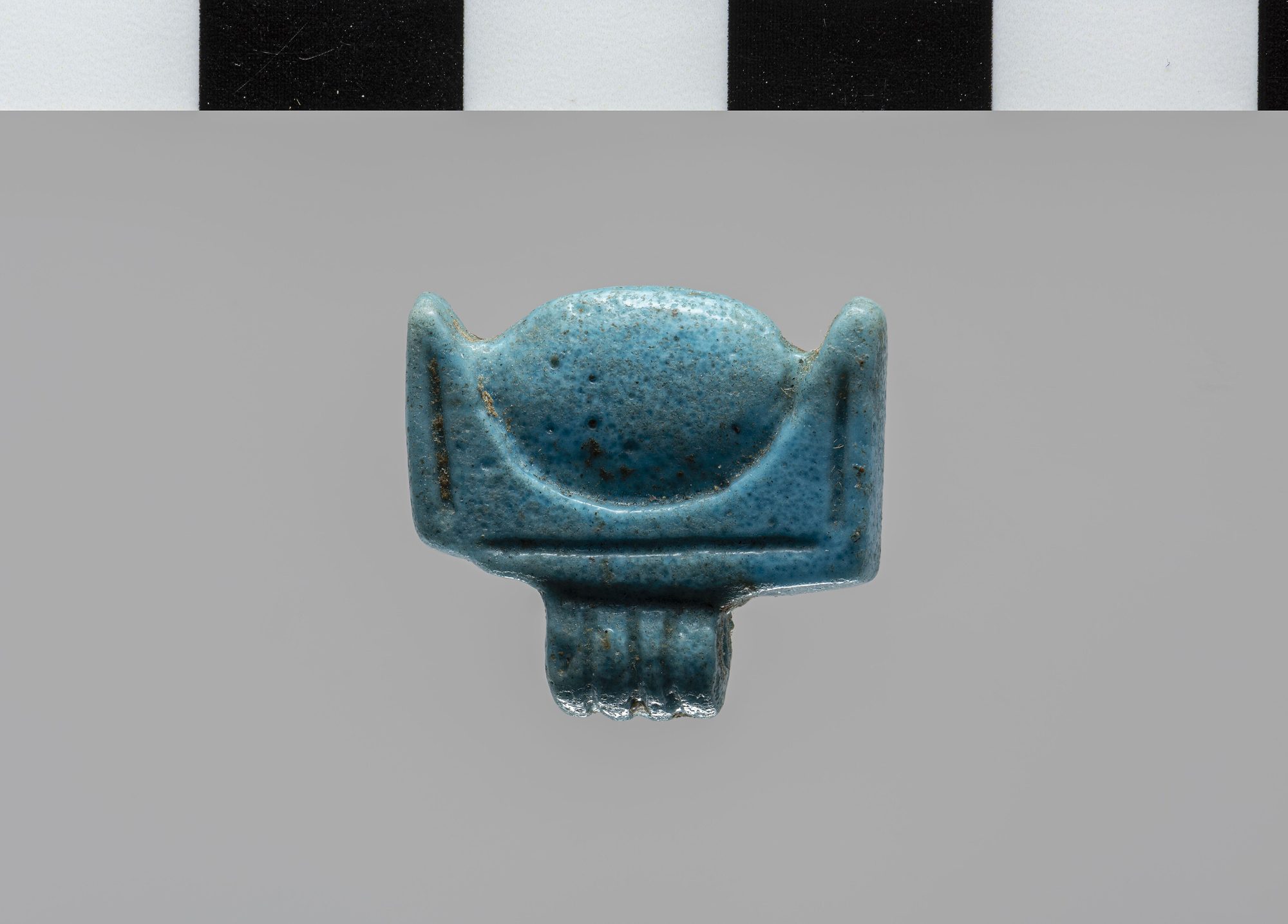
The Egyptian scribes had a single glyph for all of it, the sign the grammars catalogue as N27: a sun-disk resting in the dip between two rounded peaks, sometimes with the long sign for the sky arching over the top. It is one of those hieroglyphs that is also a small picture of the thing it names.
Egyptologists gloss it plainly as Mountain with the Rising Sun,
the ideogram for horizon,
and once you have seen it you cannot unsee it in the landscape: the double hill, the notch, the disk lifting into the gap. The word built on that sign, Akhet, carried the same image wherever it went. When a text says the dead rise in the horizon,
this is the scene behind the phrase, the sun cupped between the hills at the exact moment of coming and going.
That doubleness, a picture that is also a word, is why the horizon in Egypt was never merely a direction. It was a structure you could name, enter and leave. And because the sun did both in the same place, rising there and setting there, the Akhet became the great hinge of the cosmos, the point where the visible world turned over into the invisible one and back again.
The doors that swing on the sky
The oldest layer of Egyptian funerary writing, the Pyramid Texts carved inside Old Kingdom tombs, treats the horizon as a thing with hardware. It has doors, and the doors have bolts, and the spells are forever throwing them open for the dead king so that he can pass through with the sun. The two doors of the horizon are open,
one utterance announces, its bolts slide.
Another sets the dead man at the threshold itself: stand at the doorway of the horizon, it says, and open the double doors. The image is precise and physical. The horizon is a gate in the sky whose bolts draw back, and dawn is the moment the leaves swing wide.
What the king passes through them into is rebirth. The Pyramid Texts place his ascent squarely in this zone, reborn with the sun-god at the rim of the world. He is enveloped by the Duat, pure and living, in the horizon,
folded into the underworld and then let out of it at the same threshold, so that he may arise in the horizon, in a place which is pleasing to you.
The horizon is where the going-down and the coming-up meet. To die well, in this scheme, was to reach that gate, wait out the dark beyond it, and be among those the sliding bolts released at first light.
Twin lions holding the seam
The gate did not stand unguarded. At the seam where earth met sky crouched a pair of earth-lions, and they are old. Already in the Pyramid Texts the dead man is reassured against the jkr.w, the earth-gods, told that they shall not seize him, and this is the earliest textual layer of the horizon’s lion-guardians. These are creatures of the soil and the underworld, not of the sky. They belong to the ground the sun sinks into, and they crouch exactly where the world has its edge.
By the time of the Book of the Dead the pair has hardened into an emblem, two lions seated back to back, the horizon-sign with its cradled sun set between their shoulders, one beast looking east and one west. The sun-god’s daily road runs straight between them: as he shines on the beings of the underworld and goes down, Ra openest up the path of the double Lion-god.
A worshipper could claim that road as his own inheritance, and the deceased in Chapter XXXVIII does exactly that, saying I am the double Lion-god, the first-born of Ra.
The single recumbent lion of the earliest imagery and this later back-to-back pair are stages of one idea worked out over centuries, and the tidy paired icon should not be pushed back onto the Old Kingdom, where the earth-guardians appear only as the plural earth-gods, not yet the twinned emblem.
Yesterday on one side, Tomorrow on the other
Why two lions, and why turned away from each other? Because the horizon has two ends, and the Egyptians read them as the two ends of time. The vignette-painters of the Book of the Dead label the pair outright, the lion-gods of the horizon, one of whom is called Yesterday and the other To-morrow.
One faces the sun that has set, the other the sun about to rise; between them sits the disk at the turn of the day. The scene is time itself, straddling the world’s edge, the day gone on one flank and the day still to come on the other.
The same chapter then makes the pairing cosmic rather than merely calendrical. Yesterday is Osiris,
it glosses, and To-morrow is Ra, on the day when he shall destroy the enemies of Neb-er-tcher.
The set sun is Osiris, the god who is death, laid in his western tomb; the rising sun is Ra, climbing to renew the world and scatter its enemies. So the twin-lion horizon holds both meanings at once. Read across space it is east and west, the two ends of the sun’s road. Read across time it is yesterday and tomorrow, the corpse of the day just past and the newborn day ahead, with the disk balanced for one instant in the notch between them.
The mountain that catches the setting sun
The two ends of the horizon were concrete enough to be named as hills. The western peak, the one the sun drops into each evening, is Manu, the mountain where the sun set in the west,
and the hymns give it a strange courtesy: Manu receiveth him with satisfaction,
the earth taking the tired disk back gladly at dusk. The eastern counterpart, where the sun climbs out at dawn, is named Bakhu in the reference literature, though that eastern name comes to us through modern scholarship rather than a line read here word for word.
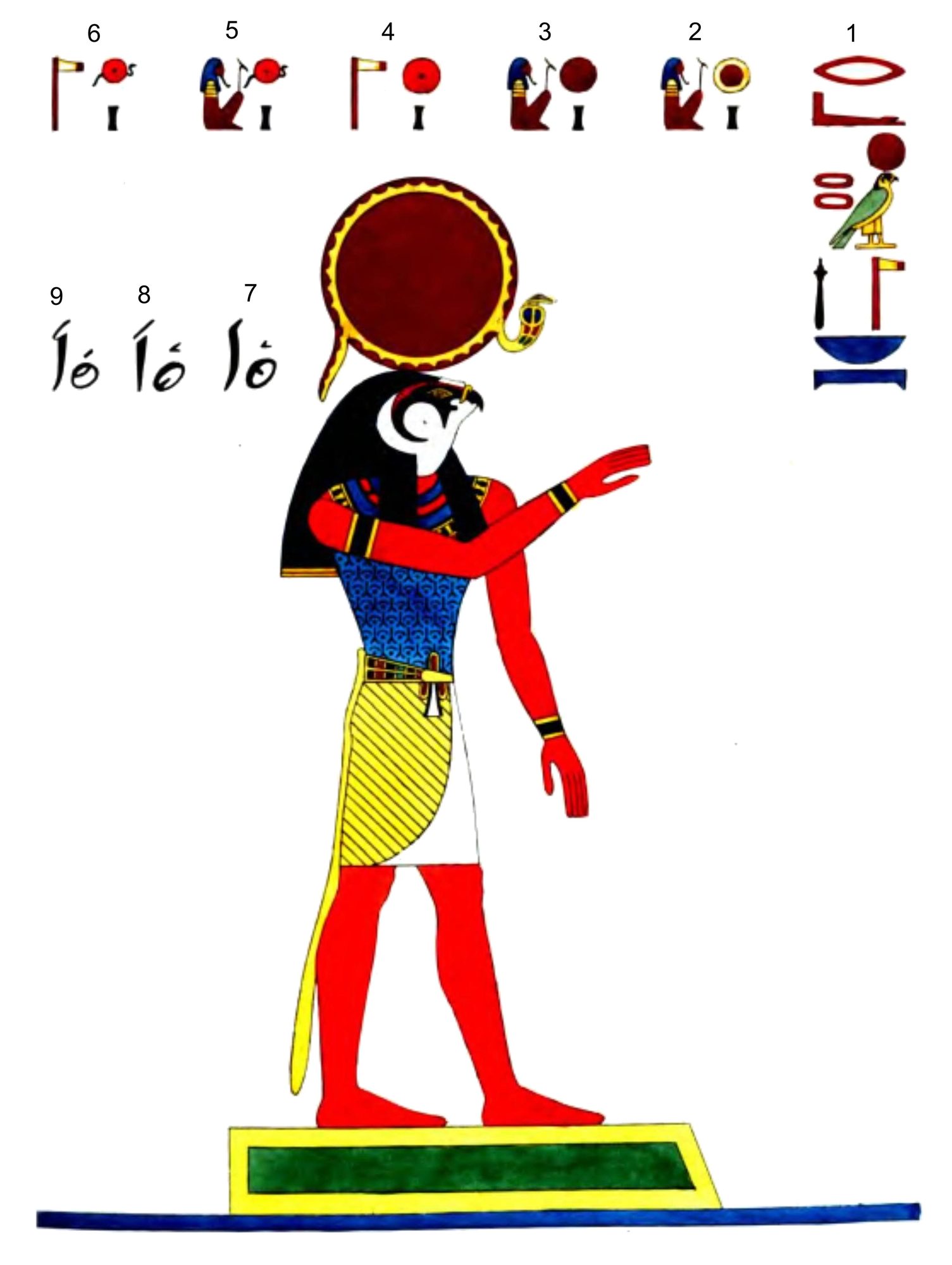
At the eastern rim stands the dawn form of the sun-god, the shape you would meet if you reached the horizon at first light: a falcon-headed god crowned with the disk, Heru-khuti, Horus of the Two Horizons, whose very title carries the Akhet in it. The later syncretism Ra-Horakhty, Ra-Horus-of-the-Horizons, builds the horizon-word directly into a god’s name. To the Egyptian eye the sun was not a single fixed body but a being with a morning face and an evening one, and the two mountains of the Akhet were the thresholds where you might catch it changing, sinking into Manu as an old god and rising over the eastern hill as a falcon crowned with fire.
A horizon built in stone
Because the Akhet was a real image and not just an idea, the Egyptians could build it. The temple pylon, that massive twin-towered gateway with the gap in the middle through which the rising sun could be sighted, was raised to mirror the horizon sign: two hills of masonry with the sun lifting into the notch between them, the whole temple front a horizon rendered in stone. The god’s house opened, in its very architecture, onto the place where the sun came into the world. A priest passing through the pylon at dawn walked through the Akhet itself, out of the ordinary land and into the charged zone where sky, earth and the underworld touched.
That is the reach of a single hieroglyph. The disk cradled between two hills began as the plainest observation, the sun coming up out of a notch in the eastern desert, and grew into a whole cosmology: a gate with sliding bolts, a pair of time-keeping lions, two named mountains, a falcon-headed dawn-god, and a temple front built to stand for the edge of the world. The Egyptians looked at the horizon every morning of their lives and saw, in that thin bright seam, the exact place where death and rebirth changed hands.
Yesterday is Osiris, and To-morrow is Ra, on the day when he shall destroy the enemies of Neb-er-tcher. (Book of the Dead, Chapter XVII, trans. E. A. Wallis Budge, 1901)
- Pyramid Texts, trans. Samuel A. B. Mercer, The Pyramid Texts (Longmans, Green & Co., 1952), read verbatim at archive.org id
THEPYRAMIDTEXTSTRANSLATION. The reborn king whoarises in the horizon, in a place which is pleasing to you
is Utterance 217, §152c–d; the ascentin the horizon,
enveloped by the Duat with Orion, is §151a–c (Utt. 216); the gated horizon,The two doors of the horizon are open; its bolts slide,
is §194a, withstand at the doorway of the horizon; open the double doors
at §255a; and the reassurance against the jkr.w earth-gods (that theyseize thee not
) is §658d, the earliest textual layer of the horizon’s lion-guardians. All read verbatim. - Book of the Dead, Chapter XVII, trans. E. A. Wallis Budge, *The Book of the Deadan English Translation* (London: Kegan Paul, 1901, Theban Recension), read verbatim at archive.org id
bookdeadanengli01budggoog. Supplies the sun-god whoopenest up the path of the double Lion-god
; the vignette namingthe lion-gods of the horizon, one of whom is called Yesterday and the other To-morrow
; and the temporal glossYesterday is Osiris, and To-morrow is Ra, on the day when he shall destroy the enemies of Neb-er-tcher.
The hymn to Ra in the Papyrus of Ani supplies the west mountain Manu,the mountain where the sun set,
whichreceiveth him with satisfaction,
and Heru-khuti, Horus of the Two Horizons, at dawn. Budge’s dated transliterations (Heru-khuti = Horakhty, Neb-er-tcher = Neb-er-djer, Tem = Atum) are kept only where a phrase is quoted verbatim. - Book of the Dead, Chapter XXXVIII (Budge 1901), read verbatim at the same archive.org id. The deceased’s self-identification with the twin lions,
I am the double Lion-god, the first-born of Ra,
belongs to this chapter, not to Chapter XVII. - Coffin Texts, Spell 335, in R. O. Faulkner, The Ancient Egyptian Coffin Texts, vol. I (Aris & Phillips, 1973) — the Middle-Kingdom ancestor of Book of the Dead Chapter XVII and the older source of its Yesterday/To-morrow and horizon material. Not read verbatimFaulkner’s edition is borrow-locked and no free verbatim English was available, so the material reaches this piece only through its direct descendant, BoD Chapter XVII (Budge 1901), which was read. Nothing here is quoted as Faulkner’s wording.
- A. H. Gardiner, Egyptian Grammar (3rd ed., 1957), p. 489 (sign N27); Maria Carmela Betrò, Hieroglyphics (1995), p. 161 — secondary, for the Akhet hieroglyph itselfthe sun-disk rising between two hills, glossed
Mountain with the Rising Sun,
the ideogram forhorizon.
- Geraldine Pinch, Egyptian Mythology (2004), p. 99; Pat Remler, Egyptian Mythology A–Z (2010), pp. 4–5; Christian Leitz, LGG vol. I (2002), pp. 83–85; Barbara Watterson, Gods of Ancient Egypt (2013), p. 59; Toby Wilkinson, Dictionary of Ancient Egypt (2005), p. 195 — secondary, cited for interpretationthe back-to-back twin lions (Aker/Ruti) as a Middle-Kingdom-and-later development of the paired image; the eastern horizon-mountain Bakhu paired with western Manu; the Ra-Horakhty etymology; and the temple pylon built to mirror the Akhet sign. These frame the piece; the quoted lines all come from the primary texts above.