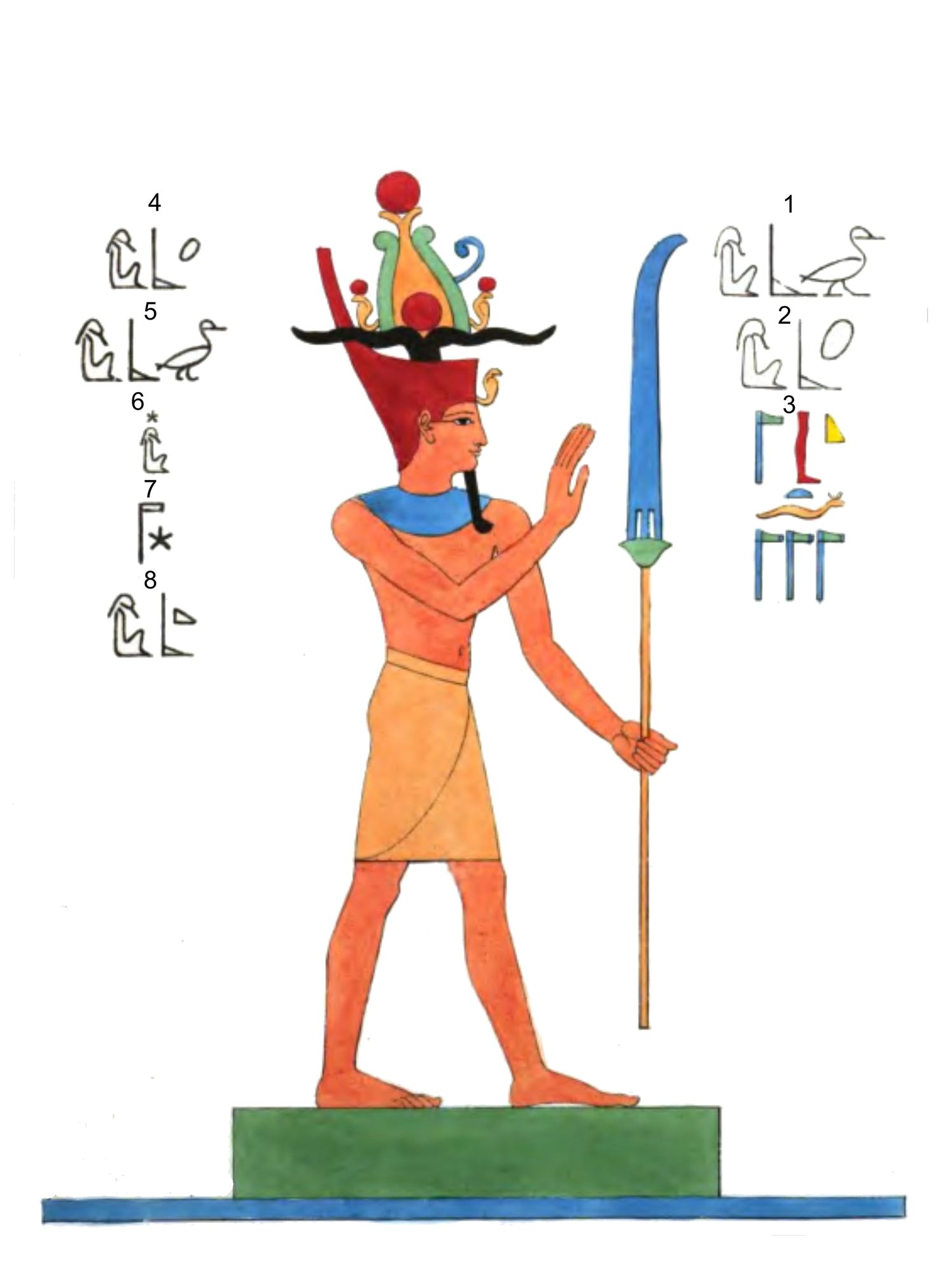
Bite down on the ground and you have bitten a god. This page follows Geb through the Pyramid Texts and Book of the Dead, where the earth-father is also judge, king and father; later Greek interpretations are named rather than folded into the pharaonic evidence. The oldest funerary spells the Egyptians ever carved say it with no metaphor and no softening: when the dead man closes his teeth on the dust of the tomb floor, the text records that he has bitten the earth,
and in the same breath that he has bitten Geb.
The two are one clause because they are one thing. Geb is not a god who rules the earth or lives in the earth or made the earth. He is the earth, the floor of the whole world, the ground your foot presses and your grave is dug into. Everything that walks or is buried, walks and is buried on the body of a single god.
That is the first strange fact about him, and it sets the terms for all the others. Most gods are somewhere; Geb is everywhere underfoot. He is the son of Shu, the air, and Tefnut, the moisture, the third generation of the Heliopolitan Nine, and the hymns call him the eldest son of Shu, his primogeniture.
His sister and wife is Nut, the sky arched over him, and the Pyramid Texts hail him with a farmer’s bluntness as bull of Nut,
the fertile male ground lying under the vault of heaven. Between the two of them the whole visible world is contained: her body the ceiling, his body the floor, and the living pressed like grain between.
Lord of the entire earth
Being the ground, it turns out, is also being a king. The central hymn to Geb, the long praise-poem of Utterance 592, is not addressed to a landscape but to a sovereign. Atum, the self-made creator at the head of the pantheon, hands his whole inheritance down to Geb: the text says Atum has given thee his heritage; he has given thee the whole Ennead,
the entire company of the gods passed into one god’s keeping.
From there the titles pile up like regalia. He is lord of the entire earth.
He is powerful over the Ennead and even over every god.
The god who is the dirt under your sandal is, in the same texts, the one to whom the creator signed over the family of heaven.
Two objects make the kingship visible, and they come out of his own head. The hymn watches a serpent-eye go forth from Geb’s brow and become the White Crown of Upper Egypt, then the Red Crown of Lower Egypt, the two halves of the country crowning a single skull. He does not merely rule the united land; he wears it. The floor of Egypt is the head that carries both its crowns.
The wise mouth that judges
There is a courtroom in these hymns as well as a throne. Geb is named Hereditary prince of the gods,
the erpat, the one who holds title by descent, and he is given a wise mouth
to go with it. The picture the text draws is precise and physical: he stands upon the earth, which is to say he stands upon himself, and from there judgest at the head of the Ennead.
The judge of the gods is not seated above the world in some remote court. He is planted on the ground, because he is the ground, and the whole company of heaven is arraigned before the floor they stand on.
His justice has a plainer, fiercer face too. One epithet calls him Horus who repeats not his work,
a god who turns aside every evil and does not let it come back a second time. When he moves to protect his murdered son Osiris, the gesture is the earth itself pressing down: Geb has put the sole of his foot on the head of thine enemy,
and in the mortuary formulae Seb hath set his sandal
on the foe. The verdict of the earth-god is delivered by the weight of the earth.
Father of the murdered god
For all the crowns and the courtroom, Geb matters most in the oldest texts as a father, and specifically as the father who hands the kingship on. He is the parent of the generation on whom the whole Osirian drama turns. The spells name him father of Osiris directly, calling the murdered god this thy son… Osiris, whom thou hast made
; they record that Geb has brought
Isis and Nephthys to the dead man’s side to mourn and mend him, and that Set too was conceived, Set by Geb.
The four great actors of the murder-and-vengeance cycle are his children, and the throne they fight over is his to give.
That is why the dead king’s hope runs through Geb. To die well is to go up to heaven to thy father Geb
; to reign is to sit on the thrones of Geb,
the very seats the god of the ground holds in trust. The inheritance the hymn watched Atum pour into Geb, Geb pours out again into Osiris and, through him, to Horus and to every living pharaoh. He is the hinge in the middle of the family tree, the ground the whole royal line stands on and the hand that passes the crown down it.
And because he is the ground, his stirrings are the beginning of the world’s work. In the Book of the Dead the creator’s power is that mighty thing… with which the god Seb hath opened the earth,
and when he advances the two divine nomes part asunder
and the ploughing of the fields is done. There is a persistent temptation, worth resisting, to make him more than the texts allow: to fuse him with the Great Cackler,
the primeval goose whose egg hatched the sun at Hermopolis.
But in the chapter that names them, the Egg belongs to the Cackler and Geb is named in the next clause over, a separate god beside it. The neat picture of Geb as the cosmic goose that laid the sun is a later tidying-up. The five children born on five days outside the year, likewise, is a Greek story from Plutarch, told a thousand years downstream, not a line from the pharaonic spells. What those spells actually give is stranger and simpler: a god you are standing on, who judges the gods, wears both crowns of Egypt, and fathered the family whose quarrel became the throne.
Thou art lord of the entire earth… thou art powerful over the Ennead and even over every god. (Pyramid Texts, Utterance 592, §1621a-b, tr. Mercer)
- Pyramid Texts, Utterance 592 (§§1615–1626) — Samuel A. B. Mercer tr., The Pyramid Texts (Longmans, Green & Co., 1952); public-domain scan, archive.org id
THEPYRAMIDTEXTSTRANSLATIONthe central Geb hymn. Read verbatim for Geb asthe eldest son of Shu, his primogeniture
(§1615c); heir of Atum, giventhe whole Ennead
(§1617a);lord of the entire earth
andpowerful over the Ennead and even (over) every god
(§1621a-b);Hereditary prince of the gods
with awise mouth
(§1618b) who,standing on the earth
,judgest at the head of the Ennead
(§1619a);the ka of all the gods
(§1623a-b); the White and Red crowns issuing from his head (§1624b-c); andHorus who repeats not his work
(§1622a-b). - Pyramid Texts, scattered utterances — Mercer 1952, same volume and scan§231a (
N. has bitten the earth; N. has bitten Geb
); §170a (Geb father of Osiris,this thy son is this one here, Osiris, whom thou hast made
); §301a (N. has inherited Geb
); §316a (O Geb, bull of Nut
); §577a (Geb brings Isis and Nephthys); §578b (Geb has put the sole of his foot on the head of thine enemy
); §144b (Thou art conceived, Set by Geb
); §779a-b (Geb, Nut and the Tefnut lineage); §317c (the thrones of Geb
); §655d (takes thee to heaven to thy father Geb
). Mercer prints the dead king asN.
, the placeholder for the royal name. - Book of the Dead, Chapter XVII — E. A. Wallis Budge tr., *The Book of the DeadAn English Translation of the Chapters, Hymns, etc., of the Theban Recension* (1898); public-domain scan, archive.org id
bookdeadanengli01budggoog:that mighty thing which hath come into being and with which the god Seb hath opened the earth
, and the Egg of the Great Cackler (Kenken-ur) at Hermopolis (Khemenu). In the read lines the Egg belongs to the Cackler and Geb (Seb) is named in an adjacent clause; the identification of Geb himself with the cosmic goose is a later synthesis, not stated here, and is flagged as such in the body. - Book of the Dead, Pepi-text / chapter-heading sections — Budge 1898, same scan
Seb advanceth, the two divine nomes part asunder
(with the ceremony of ploughing the earth ended), andSeb hath set his sandal
upon the enemy. Budge prints the god’s name asSeb
(alsoKeb
); Mercer printsGeb
for the same god, used as the modern standard in the narrative. - Plutarch, De Iside et Osiride 12 — the Greco-Roman account of the five children born on the five epagomenal days outside the 360-day year. A late Greek source (c. 100 CE), not the Pharaonic corpus; named in the body only as later tradition, and not attributed to the Pyramid Texts, Coffin Texts or Book of the Dead. Not read verbatim for this piece.
- Coffin Texts, Spells 76–80 (the Shu spells) — R. O. Faulkner, The Ancient Egyptian Coffin Texts vol. Ithe bibliographically correct anchor for the Shu/Geb/Nut separation cosmogony, but the standard English is borrow-locked (no free verbatim text available). NOT read verbatim here; no line, name or number is quoted from it. The separation itself is owned by the sibling
shu-separates-nut-and-geb; this figure entry does not re-narrate it.