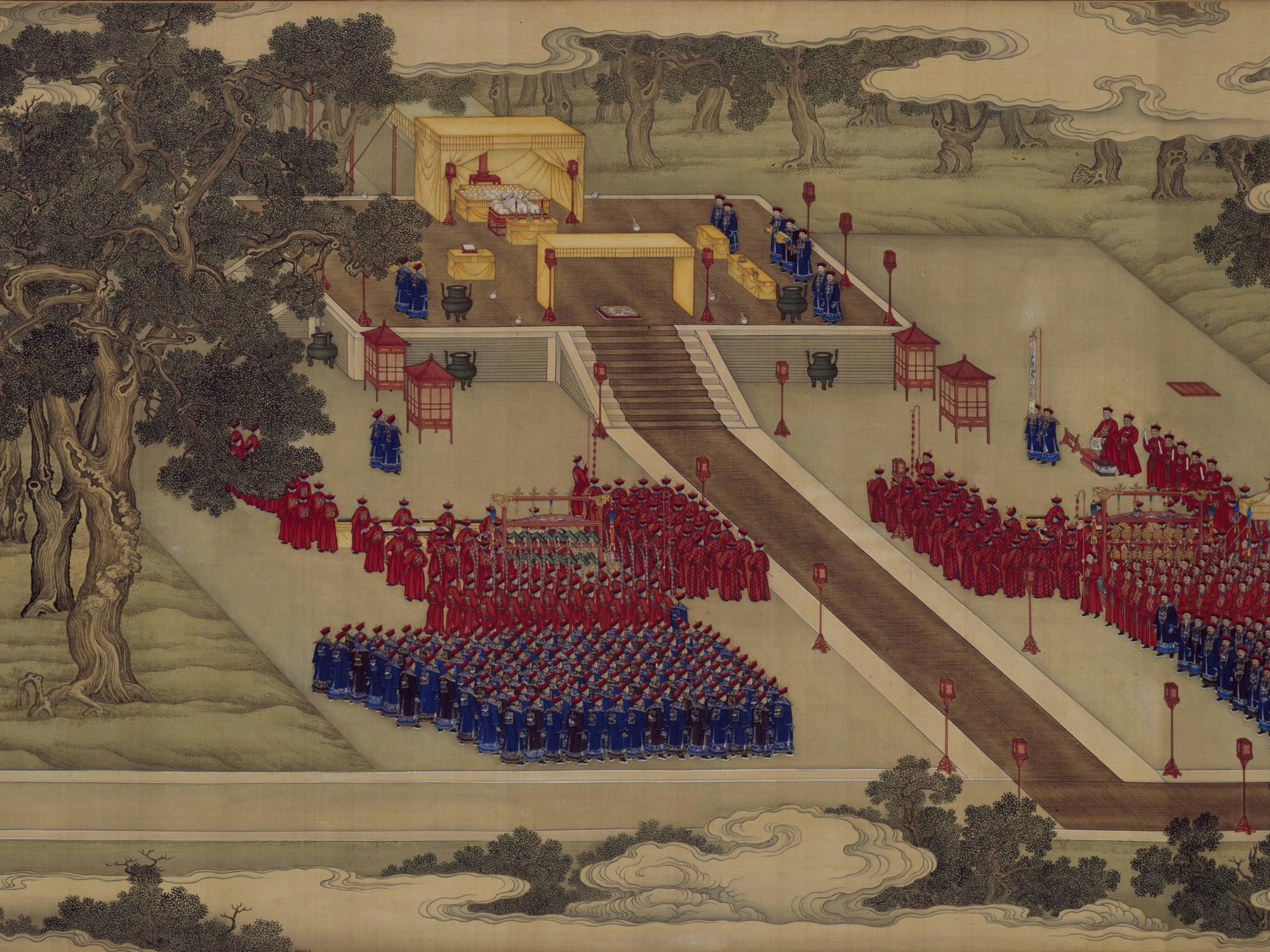
On the longest night of the year the Son of Heaven left the warmth of his palace and went out to the southern edge of the city. There, on the yang quarter of the world, the ground had been swept bare for the purpose. No hall stood over it, no marble tiered the approach; the offering was laid on raw earth, and the vessels waiting on it were of clay and of gourd. A single red calf had been led out, and around the fields nearby the people had kept torches burning against the dark. This was the jiao, the border or suburban sacrifice, and in its supreme form, at the winter solstice, it was the highest act of worship a Chinese ruler could perform: a great thanksgiving offered to Heaven at the moment the light began, by law, to return.
That is the picture the classical texts paint, and no single one of them paints the whole of it. The rite comes down to us through three books written centuries apart, each describing an institution older than itself, and they do not agree on everything. Before the calf is led out, the reader deserves to know whose account he is standing in.
The Liji explains what it never saw
The oldest layer the sources reach for is the Western Zhou court, somewhere around the eleventh century BCE. None of the three texts that describe it is anywhere near that old. The Zhouli, the Rites of Zhou, presents itself as the administrative blueprint of that early Zhou state and was long ascribed to the Duke of Zhou himself; but scholars now place its composition in the Warring States period, around the third century BCE, and read it as an idealised scheme rather than a record of anything observed, written perhaps seven or eight centuries after the court it depicts.
The Liji, the Book of Rites, whose Jiao Te Sheng
chapter supplies most of the detail below, survives in a Han recension assembled around the first century BCE from essays of the preceding centuries. It is a book of ritual meaning, not an order of service: it explains why the victim is single and the ground is swept, roughly a thousand years after the practice it interprets. Only the third text, the Shiji of Sima Qian, completed about 91 BCE, reports sacrifices that emperors were actually seen to make, and even it stands a millennium downstream of Zhou.
So when this article says the rite was done thus,
it means the classical ideal reconstructed in these texts, not a filmed record of an ancient morning. The sources themselves diverge, and the most famous image of all belongs to only one of them.
The swept ground and the round mound
The scene most people carry in their heads is an emperor kneeling at dawn on a round, tiered altar. That altar is real, but it is late and it is textual. The word for it, the round mound, comes from the Zhouli, which prescribes that at the winter solstice the music be performed on a round mound upon the earth, paired with a square mound in a marsh for the summer offering to the powers of the earth.
The Liji’s Jiao Te Sheng,
the chapter that gives us nearly every concrete detail of the rite, does not contain the phrase at all. It says only that the altar was marked out in the southern suburb, the place most open to the brightness and warmth,
and that the offering was made on swept ground, to mark the simplicity of the ceremony.
Two different pictures, then, from two different books: the Zhouli’s round earthen mound and the Liji’s bare swept patch of southern suburb. The three-tiered marble Circular Mound Altar that visitors climb at Beijing’s Temple of Heaven is later still, a Ming and Qing structure begun in 1530 and rebuilt in 1749, and no part of anything the classical texts describe. The dawn tableau familiar from photographs is a composite of all three eras; it is fair to evoke it, but no ancient book is its author.
A single red calf, and vessels of clay
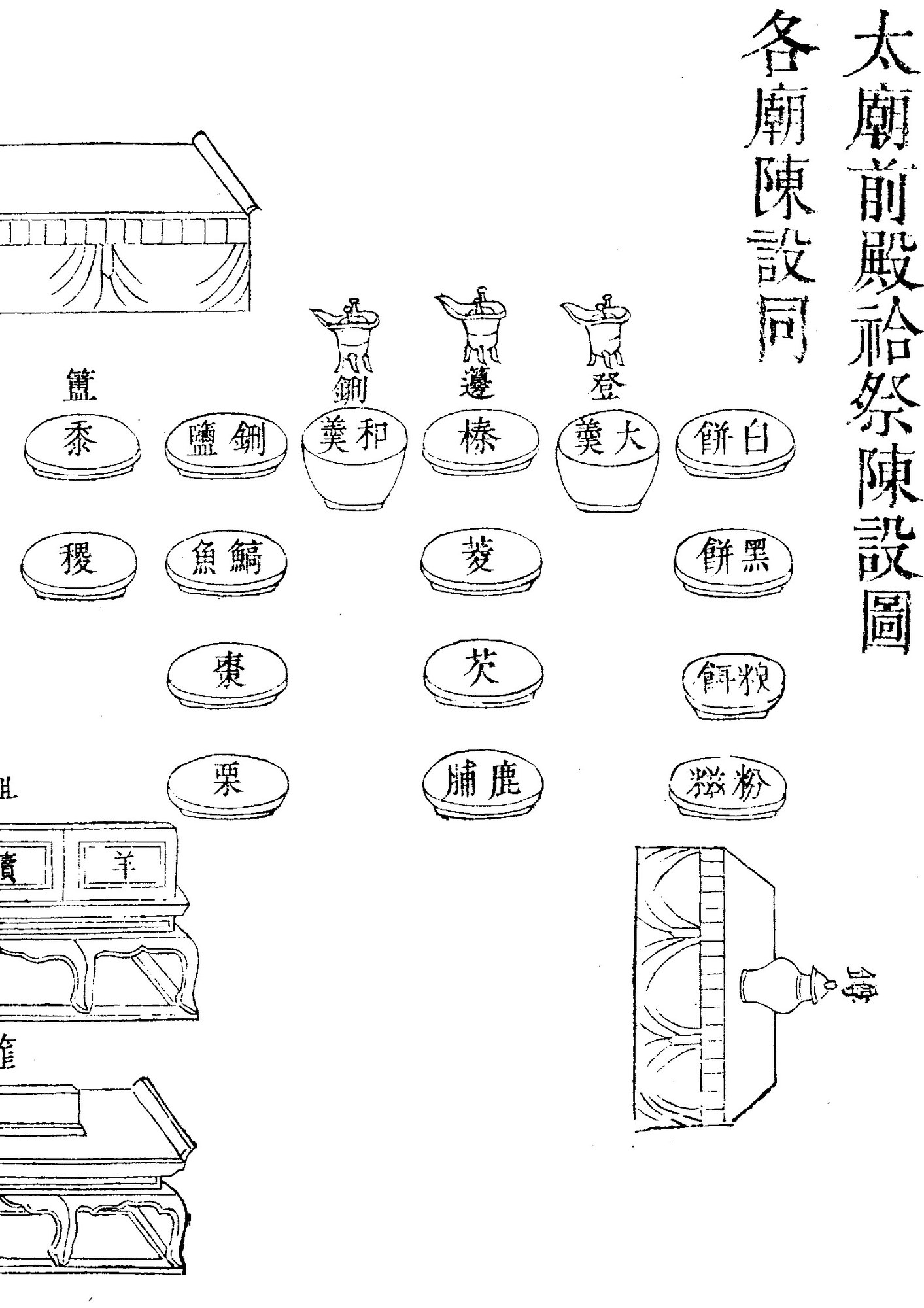
Whatever the shape of the ground, the Liji is precise and consistent about what stood on it, and the whole vocabulary is one of studied plainness set against the grandeur of the occasion. The vessels used were of earthenware and of gourds,
Legge translates, to emblem the natural productive power of heaven and earth.
The Son of Heaven rode out not in state but in the plain carriage, because of its simplicity.
The victim carried the same message. The victim was red, that being the colour preferred by the Zhou dynasty; and it was a calf, to show the estimation of simple sincerity.
One animal, not the full complement: the point of the chapter’s very title, The Single Victim at the Border Sacrifices,
is that at the border sacrifices a single victim was used,
where the altars to the land and grain took three. The calf was chosen young for its guilelessness, an unspoiled thing offered to an unspoiled power.
Nor was any calf good enough. The animal intended for Heaven had to be kept apart in a clean stall for three months; if it showed anything inauspicious, it was demoted to serve at the offering to Hou JiThe Zhou royal house's mythic first ancestor and patron of husbandry, seated as Heaven's correlate at the sacrifice so that reverence and filial piety join in one act., the ancestral victim, which needed only to be perfect in its parts.
The Liji is explicit about what that two-tier care encoded: This was the way in which they made a distinction between the spirits of Heaven and the manes of a man.
A stricter purity was owed to Heaven than to any ancestor, however royal.
The robe of the ascending dragons
Against all that plainness the king himself was a blaze of cosmic symbol, and here the two texts prescribe different clothes. In the Liji he assumed the robe with the ascending dragons on it as an emblem of the heavens,
and wore the cap with the pendants of jade-pearls, to the number of twelve, which is the number of heaven,
twelve for the months of the year.
From his banner too hung twelve pendants, and on it was the emblazonry of dragons, and the figures of the sun and moon, in imitation of the heavens.
The Zhouli’s office of robes prescribes something else for the same rite: a great fur robe and cap for the offering to the August-Heaven Lord-on-High. Later commentators reconciled the two, fur beneath and dragon-robe over, but the source texts simply name different garments, and it would be false neatness to pick one and call it the rite’s dress.
What the king carried into all of this was a single idea, which the Liji states as its interpretive climax. Heaven hangs out its brilliant figures, and the sages imitated them. This border sacrifice is the illustration of the way of Heaven.
The dragons and sun and moon on robe and banner were not decoration but argument: the sovereign wore the sky he served.
Whom the rite is for
Two figures stand at the centre, and the sources are careful about how they relate. The addressee is Heaven, called Tian, or the Lord-on-High, Shangdi, which Legge renders simply as God
; in the Zhouli’s more solemn register, Haotian ShangdiThe August-Heaven Lord-on-High, the supreme addressee of the rite in the Zhouli; Legge renders the plainer 上帝 as "God" and 天 as "Heaven"., the August-Heaven Lord-on-High. To this power the Da ZongboThe Grand Director of Rites, chief of the Offices of Spring, who in the Zhouli's scheme officiates the burnt-offering to the August-Heaven Lord-on-High. makes a fragrant burnt-offering that sends its smoke upward, the first and highest of all the auspicious rites.
Beside Heaven stands a man. All things originate from Heaven,
the Liji reasons; man originates from his great ancestor. This is the reason why Ki was associated with God at this sacrifice.
Ki is Hou Ji, Lord Millet, the Zhou royal ancestor and father of husbandry. Sima Qian confirms it from the historian’s side: when the Duke of Zhou was minister to King Cheng, he made the jiao to Hou Ji as correlate to Heaven. In one act the rite bound the highest cosmic reverence to the deepest filial piety, seating the founding ancestor at Heaven’s side.
The Liji is delicate, too, about what exactly was being worshipped, and preserves the uncertainty rather than resolving it. Its own words are that the sacrifice welcomed the arrival of the longest day. It was a great act of thanksgiving to Heaven, and the sun was the chief object considered in it.
That last clause has troubled every reader.
Legge first translated it as the sun being the principal object regarded,
then revised the sense to the sun being taken, for the occasion, as the residence of the spirit of Heaven,
a spirit-tablet rather than a god in its own right. The French scholar Callery thought the passage proved the ancient Chinese rendered a true cult to the sun
; Legge flatly disagreed, saying the text conveyed no such idea to him. The readings differ, and the rite is not simply sun-worship: on the darkest night, the returning sun stood in for the Heaven that sent it.
The ideal and the messier practice
There is one last gap to keep open, and it is the widest. The rite described so far, a single supreme Heaven honoured with a single red calf, is the classical ideal of the Liji and the Zhouli. What Qin and Han emperors were actually seen to do was messier. Sima Qian records that the Qin worshipped four coloured Lords, White, Green, Yellow and Red, at Yong; when the Han founder Gaozu was told that Heaven has five Di yet only four are worshipped,
he declared it had been waiting for me to complete the five
and instituted a Black Lord of the north.
That is a polytheistic cult of coloured emperor-gods, a different theology from the one supreme Heaven of the classical texts, and the historian sets it down beside the ideal without flattening the two together. What rulers did, in the one book that watched them do it, kept wandering off the pattern.
The rite was hedged all round with signs of its weight. The day itself was chosen by its stem, a hsinThe eighth of the ten heavenly stems: the day-sign on which, by the Liji's account, the border sacrifice was always offered. day, because when Zhou first offered the border sacrifice it fell on such a day at the solstice.
On the day of the sacrifice those in mourning did not dare to wail, and those wearing mourning dress did not dare enter the gate of the capital, which the Liji calls the highest expression of reverence.
Beforehand the king divined the rite in his ancestor’s fane and had the tortoise-shell burned in his father’s, then stood by the moated college to hear the omen read aloud.
And in the Zhouli’s most numinous cue, the music ran through six changes, and at the sixth all the heavenly spirits descend
and could be given their honour. On the longest night, on swept ground, with clay and gourd and a single red calf, the sovereign called the light back, and the tradition said the spirits came down to meet him.
The sacrifice was offered on the ground which had been swept for the purpose, to mark the simplicity of the ceremony. The vessels used were of earthenware and of gourds, to emblem the natural productive power of heaven and earth. (Liji, “Jiao Te Sheng,” tr. James Legge)
- Liji (Book of Rites 禮記),
Jiao Te Sheng
郊特牲 (The Single Victim at the Border Sacrifices
) — Han recension (Dai Sheng 戴聖), c. 1st c. BCE, from materials of the 3rd–1st c. BCE. The source of nearly every concrete detail abovethe winter-solstice great thanksgiving to Heaven with the sun as chief object (郊之祭也,迎長日之至也,大報天而主日也); the swept southern-suburb ground taking the yang position (兆於南郊,就陽位也 / 掃地而祭); the earthenware and gourd vessels (器用陶匏); the single red calf, red for the Zhou colour and a calf for sincerity (牲用騂,尚赤也;用犢,貴誠也); the single victim at the border versus three at the land-and-grain altars; the Heaven-ox kept three months in a clean stall and the demoted ancestral ox (帝牛必在滌三月,稷牛唯具); the dragon-robe and twelve-pendant cap and banner (王被袞以象天…璪十有二旒,則天數也); the interpretive climax (天垂象,聖人則之。郊所以明天道也); Hou Ji as correlate (萬物本乎天,人本乎祖,此所以配上帝也); the hsin-day rule (郊之用辛也); and the divination in the ancestral and paternal fanes. English quoted verbatim from James Legge, The Li Ki, Sacred Books of the East vol. 27 (Oxford, 1885),Book IX. The Kiao Theh Sang,
pp. 416–432; Chinese cross-checked against zh.wikisource 禮記/郊特牲. Legge’s older romanisation (Kiao
= jiao,Ki
= Hou Ji) is modernised in the narrative and kept inside verbatim quotations. - Liji (Book of Rites 禮記),
Ji Yi
祭義 (Book XXI) — the no-wailing, no-mourning-dress purity rule at the border sacrifice,the highest expression of reverence
(§16), with parallel wording inJiao Te Sheng.
EnglishJames Legge, The Li Ki, SBE vol. 28 (Oxford, 1885), p. 217; archive.org id sacredbooksofchi0028unse. - Zhouli (Rites of Zhou 周禮),
Chun guan
春官 (Offices of Spring
) — Warring States, c. 3rd c. BCE (composition disputed; the traditional Duke-of-Zhou ascription is now generally rejected, so the text is a normative blueprint, not observed practice). The office-and-procedure side, and the sole source of the round-mound imagethe Da Zongbo’s yin burnt-offering to Haotian Shangdi (以禋祀祀昊天上帝), first and highest of the auspicious rites; the Da Sikong’s winter-solstice music on the round mound, at whose six changes the heavenly spirits descend (冬日至,於地上之圜丘奏之,若樂六變,則天神皆降), paired with the summer square-mound; the Sifu’s great-fur-robe vestment (祀昊天上帝,則服大裘而冕). No public-domain English exists; the standard published translation is Édouard Biot, Le Tcheou-li ou Rites des Tcheou (Paris, 1851), French. The English renderings above are a labelled working gloss of the verified Chinese (zh.wikisource 周禮/春官宗伯), not a published translator’s words; and 圜丘, verified by search, occurs zero times in the Liji’sJiao Te Sheng,
so the round-mound altar is attributed to the Zhouli alone. - Shiji (Records of the Grand Historian 史記),
Fengshan shu
封禪書 (Treatise 6) — Sima Qian 司馬遷, c. 91 BCE. Cited for the textual bridge in which the historian quotes the Zhou Guan winter-solstice southern-suburb norm (周官曰,冬日至,祀天於南郊…); for the independent confirmation that the Duke of Zhou made the jiao to Hou Ji as Heaven’s correlate (周公既相成王,郊祀后稷以配天); and for the divergent imperial practice of the coloured Di at Yong, the Qin’s four Lords and Gaozu’s completing fifth Black Lord (天有五帝而有四 / 乃待我而具五也), a polytheistic cult distinct from the single-Heaven ideal. No public-domain English exists; the standard translation is Édouard Chavannes, Les Mémoires historiques de Se-ma Ts’ien, Tome III (Paris, 1899), French. The English here is a labelled working gloss of the verified Chinese (zh.wikisource 史記/卷028), not a published translator’s words. NotetheFengshan shu
is primarily the treatise on the feng and shan mountain rites, a distinct and exceptional imperial ceremony; it is drawn on here only for its jiao-relevant material, not as a description of the routine suburban sacrifice.