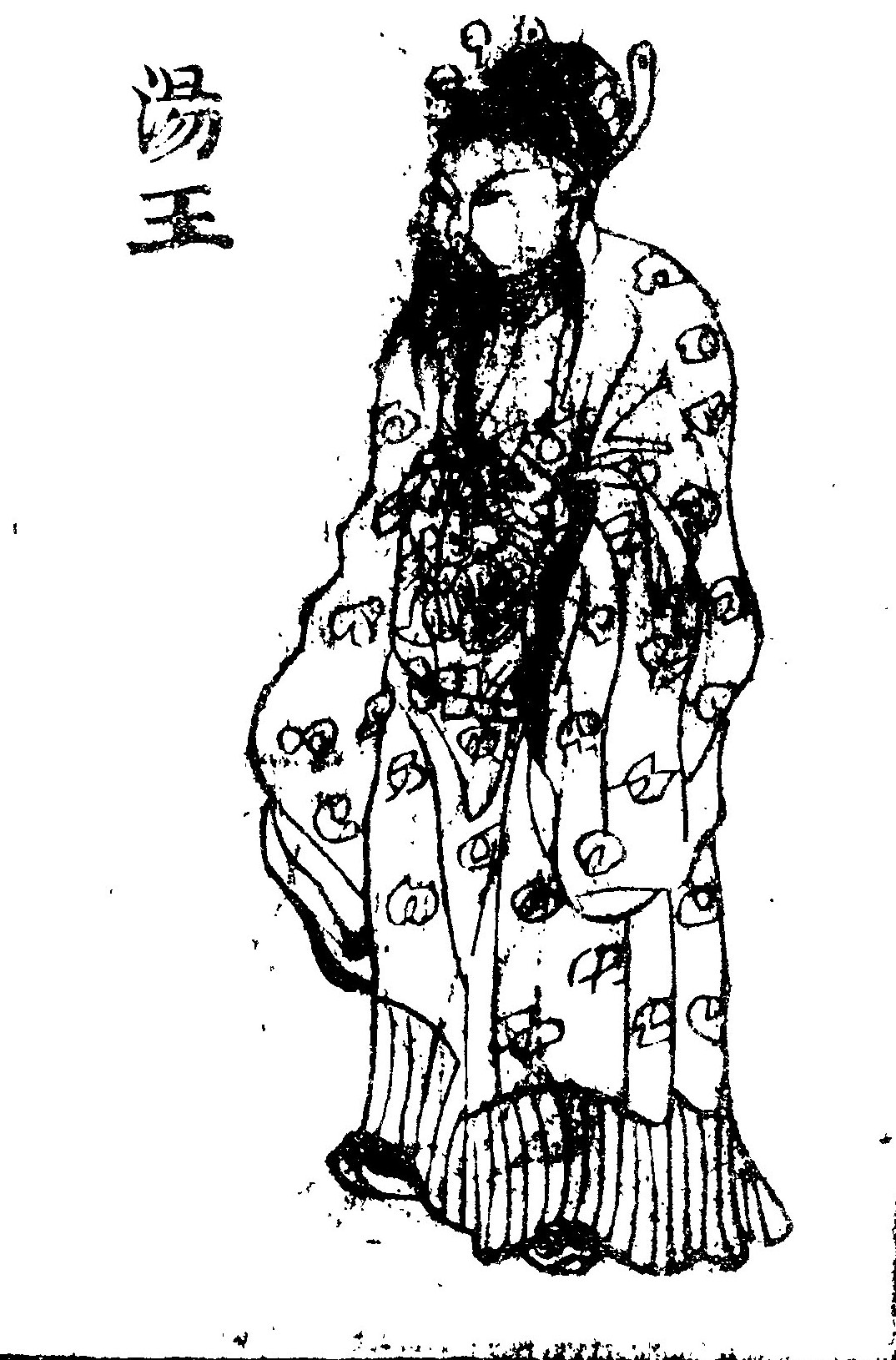
For years the rain had not come. The man who walked into the mulberry grove had beaten the tyrant JieThe last king of the Xia, remembered as a tyrant, whose overthrow by Tang founds the Shang dynasty in the traditional account. in the field and taken the realm, and none of it had bought a single cloud. The harvest had failed season after season, the granaries were emptying, and the founder of a new dynasty stood in a sacred grove with a decision no army could make for him. He took a blade to his own hair and cut it off. He bound his own hands. And he laid his body down where the sacrificial animal should have lain, offering himself, in the place of the beast, to the Lord-on-HighThe high god of the Shang (Shangdi 上帝) addressed in the prayer, said, with the ghosts and spirits, to govern whether rain and harvest reach the people..
This is the legend of Cheng Tang, Tang the Successful, first king of the Shang, praying for rain at Sanglin. It is not one ancient story told once. It survives as short passages scattered across the philosophers of the Warring StatesThe era of contending Chinese kingdoms, roughly 475 to 221 BCE, whose rival philosophers, among them the Mozi and Xunzi, preserve most of this legend. and the compendia of the Han, who disagree with one another on how it went and even on how long the sky stayed shut. What they agree on is the shape of the thing: a king who decides that a drought is his fault, and offers his own person to end it.
How long the sky stayed shut
The disagreement begins with the length of the drought, and it is worth pausing on, because the two numbers come from texts a long way apart in time. The oldest layer says five years. The Lüshi Chunqiu, compiled around 239 BCE, states plainly that after Tang set the realm in order for five years the harvest failed.
A second early witness backs it independently: the Mozi, in a chapter of the fourth century BCE, quotes a now-lost Book of Yin for the phrase Tang’s five-year drought.
The seven-year figure that most retellings use is younger by a century or more. It belongs to the Han. The Huainanzi, presented around 139 BCE, says in Tang’s time there was a seven-year drought,
and other Han writers followed it. So the round century between the Lüshi Chunqiu and the Huainanzi is also the distance between five years and seven, and the popular seven-year drought
is the later tradition, not the oldest one.
The king who made himself the victim
The scene itself, the hair and the bound hands and the body on the altar, comes almost entirely from that oldest source, the Lüshi Chunqiu. Tang went to Sanglin and prayed with his own body. He cut off his hair and pressed his hands together as if bound, and in the text’s exact words he made his own body the sacrificial victim, the 犧牲, the word that everywhere else names the pure animal led to the altar. A king does not usually lie where the ox lies. That is the horror and the point of it: he substitutes himself for the beast because he has decided that he, and not the beast, is what the ritual requires.
The logic of the offering is a formula of transferred guilt, and it is the most quoted line in the whole tradition. If the people have sinned, Tang prays, let the guilt rest on him, the one man; if he alone has sinned, let it not reach the myriad people. He asks the Lord-on-High not to let one man’s failures cost the lives of a whole people. The drought is treated not as weather but as a verdict, and the king’s answer is to stand between the verdict and everyone else.
Then the turn. The Lüshi Chunqiu says the people were greatly gladdened, and the rain came down in abundance. The Han Huainanzi, telling the same beat at cosmic scale, has clouds gathering from the four seas and rain arriving from a thousand li away. The self-offering is accepted; the sky opens.
The other prayer, with a black bull
Set beside the Sanglin scene there is a second, separate strand that is only a prayer, with no grove and no shorn hair. The Mozi preserves it as the Speech of Tang,
and the Analects preserves nearly the same words, which tells us it circulated as a fixed liturgical text older than either book. Here Tang does not offer his own body. He offers a black bull, a dark-coloured male victim, and announces to the sovereign Lord above that if the myriad regions have guilt it should fall on his own person, and if his person has guilt it should not reach the myriad regions.
It is the same substituted-guilt formula, almost word for word, attached to a different offering. In the grove strand the king is the victim; in the liturgy strand a bull is. The two should not be blended into one image, tempting as it is to picture Tang cutting his hair over a slaughtered bull. The sources keep them apart, and so should the retelling.
A ruler auditing himself
The Xunzi gives a third version, and it is the strangest, because there is no offering in it at all, only a ruler cross-examining his own reign. Tang’s drought-prayer there is six anxious questions asked into the dry air. Is my government not moderate? Are the people made to suffer? Are the palaces too splendid? Are the court-women’s petitions too many?
Is bribery abroad? Are slanderers on the rise? Each is a possible reason the rain has failed, and each is a charge the king lays against himself. It is the same conviction as the grove and the bull, that a drought is a mirror held up to the throne, but here the mirror shows a checklist of misrule rather than a body on an altar.
One more thing is worth saying about where this legend does not appear. Sima Qian’s Shiji, the great early history of the Shang founding written around 91 BCE, tells the story of Tang and never mentions the drought or the sacrifice at Sanglin at all. The word for drought does not occur in the chapter, nor the word for prayer. The self-offering that the philosophers made famous simply is not in the historian’s account. This is not a gap in our reading; it is a fact about the legend. It lived in the masters and the encyclopedias, as a moral image of what a ruler owes his people, and never crossed over into the dynastic record as history.
If I, the one man, have sinned, let it not reach the myriad people; if the myriad people have sinned, the guilt is on me, the one man.
- Lüshi Chunqiu (呂氏春秋),
Shunmin
順民 chapter, c. 239 BCE (compiled under the patronage of Lü Buwei). The fullest self-immolation narrativethe five-year drought (五年不收), the prayer of transferred guilt, the cut hair (翦其髮), the bound hands (櫪其手), the body made the sacrificial victim (以身為犧牲), and the rain thatcame down in abundance
(雨乃大至). Chinese read verbatim (zh.wikisource 呂氏春秋/卷九); English renderings are the writer’s literal working translations of the verbatim Chinese. - Huainanzi (淮南子),
Zhushu xun
主術訓, c. 139 BCE (court of Liu An, King of Huainan). The Han versionthe seven-year drought (七年旱), the body-offering at Sanglin, and the cosmic rain,clouds massed from the four seas and rain came from a thousand li away
(四海之雲湊,千里之雨至). Chinese read verbatim (zh.wikisource 淮南子/主術訓). - Mozi (墨子),
Jian’ai xia
兼愛下 (Universal Love III), Warring States, 4th c. BCE. TheSpeech of Tang
(湯說) prayer strandthe black bull (玄牡) and the transferred-guilt formula (萬方有罪,即當朕身。朕身有罪,無及萬方). No hair-cutting, no Sanglin. Chinese read verbatim (zh.wikisource 墨子/兼愛下). - Mozi (墨子),
Qihuan
七患 (Seven Causes of Worry), 4th c. BCE. Quotes a now-lost 《殷書》 (Book of Yin),湯五年旱
(Tang’s five-year drought)an independent early witness to the five-year figure. Chinese read verbatim (zh.wikisource 墨子/七患). - Xunzi (荀子),
Da Lüe
大略篇 (The Great Compendium), Warring States, 3rd c. BCE. The distinct six-question self-examination prayer, with no self-offering. Chinese read verbatim (zh.wikisource 荀子/大略篇). - Lunyu (論語, Analects),
Yao yue
堯曰 20.1, compiled c. 5th–3rd c. BCE. Embeds the sameTang shuo
prayer (履 / 玄牡 / the guilt formula), showing it circulated as a fixed liturgical formula. Chinese read verbatim (zh.wikisource 論語/堯曰第二十); English quoted verbatim from James Legge, The Chinese Classics vol. 1 (1861), XX.1.8 (public domain). - Shiji (史記),
Yin Benji
殷本紀 (juan 3), Sima Qian, c. 91 BCE. Cited as a negative controlthe canonical early history of the Shang founding contains neither the drought nor the Sanglin sacrifice (zero occurrences of 旱 or 禱 in the chapter). Chinese read verbatim (zh.wikisource 史記/卷003). - Editions and translations. Original Chinese from Chinese Wikisource (zh.wikisource.org), public-domain classical texts. Only the Analects 20.1 line is quoted from a published English translation (Legge, 1861, public domain); the English renderings of the Lüshi Chunqiu, Huainanzi, Mozi and Xunzi are the writer’s literal working translations of the verbatim Chinese, the standard modern translations being in copyright and not consulted.