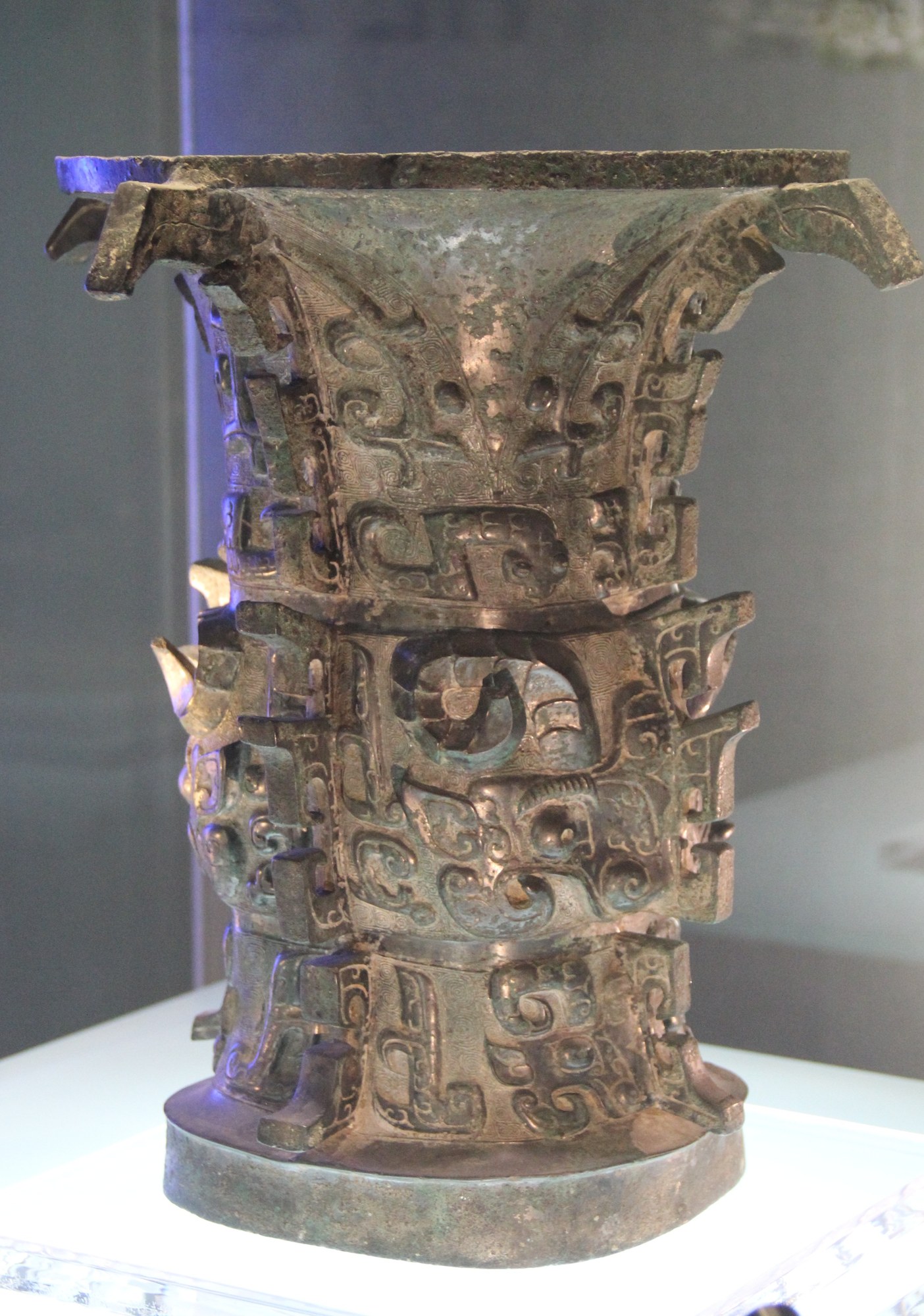
Six days after the full moon of the second month, a king came in the morning from one city to another, and a great officer walked out over raw ground with a tortoise-shell to ask Heaven a question. The shell was heated until it cracked; the cracks read favourably; and on that consecrated site the officer laid out the streets of a new eastern capital, setting the conquered people of a fallen dynasty to prepare the ground they had lost. Then the sacrifices went up: two bulls in the northern and southern suburbs, and at the altar of the spirit of the land, a bull, a ram and a boar. The doctrine that would bind every Chinese sovereign for three thousand years to his own conduct was not born in the abstract. It was proclaimed here, at a building site, by men who had just won a war and needed to say why winning had been right.
Why the winners had to explain themselves
The war was the Zhou conquest of the Shang, whose kings the founding documents, gathered in the ShujingThe Book of Documents, China's oldest collection of state prose; its early Zhou chapters are among the first datable prose in the tradition, though the book also holds later layers of disputed authenticity. or Book of Documents, call the Yin. The conquest is traditionally dated to around 1046 BCE, though the exact year is disputed. The Zhou had beaten the last Shang king in the field and taken his realm, and a conqueror who stops there has explained nothing: force proves only that you were stronger, and the next stronger man may come for you on the same terms. So the Zhou reached for something larger. They claimed that Heaven itself had taken the right to rule from the Shang and handed it to them.
The word for that right is ming: a decree, a charge, an appointment, the thing Heaven confers. It is not, in these earliest texts, the tidy capitalised Mandate of Heaven
of the schoolbooks; that phrase is a convenience of later English. The documents speak case by case of Heaven’s charge, and they speak of it as a completed divine act. God, dwelling in the great heavens, has changed his decree respecting his great son and the great dynasty of Yin,
runs the announcement at the new capital. Our king has received that decree.
A dynasty had been fired and a dynasty hired, and the whole of Zhou legitimacy rested on the claim that the hiring was Heaven’s doing.
The engine: rule forfeited by conduct
The next question answers itself only if you already believe the winners, so the documents supply a reason, and the reason is the doctrine’s beating heart. The Shang did not lose the mandate by bad luck or weak armies. They lost it by their conduct, and they were not the first: the Xia, the house before them, had lost it the same way. Of both fallen dynasties the announcement gives one cause, stated flatly. The fact simply was, that, for want of the virtue of reverence, the decree in its favour prematurely fell to the ground.
That last image is worth holding. The mandate does not evaporate or expire; it falls to the ground, dropped like a thing a careless hand lets go. And the carelessness has a face. Under the last Yin king, the documents say, the poor people in such a case, carrying their children and leading their wives, made their moan to Heaven. They even fled away, but were apprehended again.
A ruler who drives his people to flee and then hunts them down has already let the decree slip from his fingers. Misrule is not a symptom that Heaven has withdrawn its favour. Misrule is the withdrawing.
If loss came from vice, the winning came from virtue, and the Zhou located theirs in a single ancestor. The mandate was granted to King Wen, the founder-sage of the line, because “it was your greatly distinguished father, the king Wan, who was able to illustrate his virtue and be careful in the use of punishments. The fame of him ascended up to the high God, and God approved. Heaven accordingly gave a grand charge to king Wan, to exterminate the great dynasty of Yin, and grandly receive its appointment.” Bright virtue rose like incense; Heaven answered with a charge, and the conquest was a commission fulfilled.
The blade cuts both ways
Here the argument turns on the men who made it, and this is what lifts the Mandate of Heaven above ordinary propaganda. Tradition credits these announcements to the Duke of ZhouDan, brother of the conquering king and regent for the boy-king Cheng; the founding statesman whom tradition credits with turning the Zhou victory into a doctrine., regent for the boy-king Cheng, and he was clear-eyed enough to see what he had built. A law that strips a dynasty of its throne for failing in virtue does not stop working once your own dynasty holds it. It hangs over you exactly as it hung over the men you replaced.
So the same document that justifies the Zhou then threatens them. Heaven’s charge is not a possession and not a birthright. In the announcement to the Prince of Kang the point is put in four blunt graphs, 惟命不于常, which LeggeJames Legge (1815 to 1897), the Scottish missionary-scholar whose Victorian English still carries most of these founding texts to readers who have no classical Chinese. renders Heaven’s appointments are not unchanging.
The Book of Poetry sharpens it into the most famous phrasing of all, 天命靡常, the appointment of Heaven is not unchangeable,
and drives it home: Look to Yin as a beacon; the great appointment is not easily preserved.
Look at the smoking ruin of the house you destroyed, the poem tells its own kings. That is what a lost mandate looks like, and nothing exempts you from becoming it.
The remedy the documents offer is not ritual insurance but continued virtue. The young king is told to sedulously cultivate the virtue of reverence,
and only then may pray to Heaven for a long-abiding decree in his favour.
The mandate must be worked at and prayed for, or it drops. The Duke tells the boy-king that his reign is like the birth of a son, in whom everything depends on the training of his early years.
And in a line whose nerve is easy to miss, he urges that the Zhou should by all means survey the dynasties of Hsia and Yin,
studying the two houses they had watched fall as mirrors of their own possible fall. The doctrine that legitimised the Zhou was also the one instrument that could condemn them, and the man who forged it knew it.
How Heaven makes its choice known
The founding documents leave one question open: if Heaven grants and revokes the mandate, how does anyone know which way it has moved? The early answer is frankly theistic. God changed the decree, gave the charge, approved. Heaven acts like a person who has made up his mind.
The classic reframing of that question comes roughly seven hundred years later, and the gap is the most important fact in this whole story. The founding announcements were composed around 1000 BCE, within a generation or two of the conquest they interpret; the philosopher Mencius wrote around 300 BCE, seven centuries downstream of the men at the building site. He is not repeating the doctrine.
He is re-thinking it. When a student pressed him on whether the sage-king Yao had simply given the empire to his successor Shun, Mencius refused the whole premise. Heaven does not speak,
he said. It simply showed its will by his personal conduct and his conduct of affairs.
Heaven issues no verbal command; it reveals its choice through what a man does and how the world answers him.
And the world’s answer, for Mencius, comes in two registers that together are the mandate. Shun was set over the sacrifices, and the spirits were pleased: so Heaven accepted him. He was set over the conduct of affairs, and the people reposed under him: so the people accepted him. Heaven gave the throne to him. The people gave it to him.
The two are one act. Mencius even offers a homely proof: after Yao’s death Shun withdrew, yet the nobles seeking audience, the litigants seeking judgment, and the singers all turned to him and not to Yao’s son.
Singers sang not the son of Yao, but they sang Shun.
Behind this Mencius sets a line he quotes as scripture, though the chapter that now carries it is a later reconstruction and only his quotation proves the words genuinely old: Heaven sees according as my people see; Heaven hears according as my people hear.
The voice of Heaven had become the voice of the people.
The god behind the doctrine
It is worth being careful about what Heaven
is doing here, because the texts and their readers are careful. In the founding announcements Tian is close to a personal deity, the high God
who is pleased, who approves, who changes his mind, and Legge and the commentators he follows read it that way, rejecting a rival reading that would flatten Heaven into impersonal fate.
Yet by Mencius the same word floats between a personal God and an impersonal moral order within which reason and destiny both sit. The old commentaries already argued over it, and the site does not smooth the argument over: Heaven
here is neither simply a god who speaks nor simply the way things are.
Two temptations should be resisted at the end. The first is to picture the mandate as a checklist of omens, so that a flood or an eclipse formally cancelled a dynasty’s licence. That machinery of portents is a Han-dynasty elaboration from centuries later; the founding documents ground the loss in moral failure, not in a catalogue of signs. The second is to hear a modern right of rebellion.
The Zhou did not proclaim a right to revolt; they proclaimed, after the fact, that Heaven had already acted, and left the winner to explain why his victory had been just. What makes their version haunting rather than self-serving is the twist the Duke of Zhou put in its tail: he turned the same blade he had used on the Shang against his own house, and told his king to watch the ruins and be afraid.
The doings of high Heaven have neither sound nor smell. Look to Yin as a beacon; the great appointment is not easily preserved. (Shijing, “King Wen,” tr. James Legge)
- Shujing (Book of Documents),
Announcement of the Duke of Shao
(Shao Gao 召誥), Book XII of the Zhou shu, c. 1040–1000 BCE (early Western Zhou; New-Text chapter, accepted as genuine). The founding-of-Luo proclamationHeavenchanged his decree
from Yin to Zhou; both Xia and Yin lost itfor want of the virtue of reverence
; the mandatefell to the ground
; the king must cultivate reverence andpray to Heaven for a long-abiding decree
; the founding sacrifices and the fleeing poor. Chinese: Wikisource 尚書/召誥. English: James Legge, The Sacred Books of the East vol. 3 (Oxford, 1879), pp. 181–188. - Shujing,
Announcement to the Prince of Kang
(Kang Gao 康誥), Book IX of the Zhou shu, c. 1040–1000 BCE (early Western Zhou; New-Text chapter, genuine). King Wenable to illustrate his virtue and be careful in the use of punishments,
to whomHeaven accordingly gave a grand charge… to exterminate the great dynasty of Yin
; the aphorismHeaven’s appointments are not unchanging
(惟命不于常). ChineseWikisource 尚書/康誥. English: Legge, SBE vol. 3 (1879), pp. 165–171. - Shijing (Book of Poetry), Major Odes, Ode 1
King Wen
(Wen Wang 文王), c. 11th–10th century BCE (Western Zhou; roughly contemporary with the two announcements).The appointment of Heaven is not unchangeable
(天命靡常);Look to Yin as a beacon; the great appointment is not easily preserved
;The doings of high Heaven have neither sound nor smell.
ChineseWikisource 詩經/文王. English: Legge, SBE vol. 3 (1879), pp. 378–380. - Mengzi (Mencius), Book 5A (
Wan Zhang
Part I), chapter 5, c. 300 BCE (Warring States; roughly 700 years after the announcements above).Heaven does not speak; it simply showed its will by his personal conduct and his conduct of affairs
; the double test (the spirits accept the sacrifices; the people repose under his administration);Heaven gave the throne to him. The people gave it to him
; Shun and the singers; and theGreat Declaration
lineHeaven sees according as my people see; Heaven hears according as my people hear.
ChineseWikisource 孟子/萬章上 §5. English: Legge, The Chinese Classics vol. II, The Works of Mencius (Oxford, 1895 reprint), pp. 354–357. - Mengzi 5A.6, for the type of the discarded rulerthe one whom Heaven casts off
must be like Jie and Zhou (Xin)
(天之所廢,必若桀紂者也). The idea is stated in the body; Legge’s exact English of this clause was not read word-for-word this pass, so it is paraphrased here rather than quoted. Same Legge Mencius volume. - On the
Great Declaration
(Tai Shi 泰誓). The line Mencius quotes is genuinely pre-Qin (his quotation, c. 300 BCE, proves it), but the received Tai Shi chapter now in the Shujing belongs to the disputed Old-Text (古文) layer widely judged a later (c. 4th c. CE) reconstruction. It is cited above asquoted by Mencius,
not as an independent early-Zhou document. - Editions and romanisation. Original Chinese from Chinese Wikisource (zh.wikisource.org), public-domain classical texts. English from James Legge, SBE vol. 3 (1879) for the Shujing and Shijing, and The Chinese Classics vol. II (1895 reprint) for Mencius; his Victorian diction is quoted as his. Legge’s older romanisation (
Kâu
= Zhou,Yin
= the Shang,Wan
= Wen,Khang
= Kang) is modernised to pinyin in the narrative and kept inside verbatim quotations.