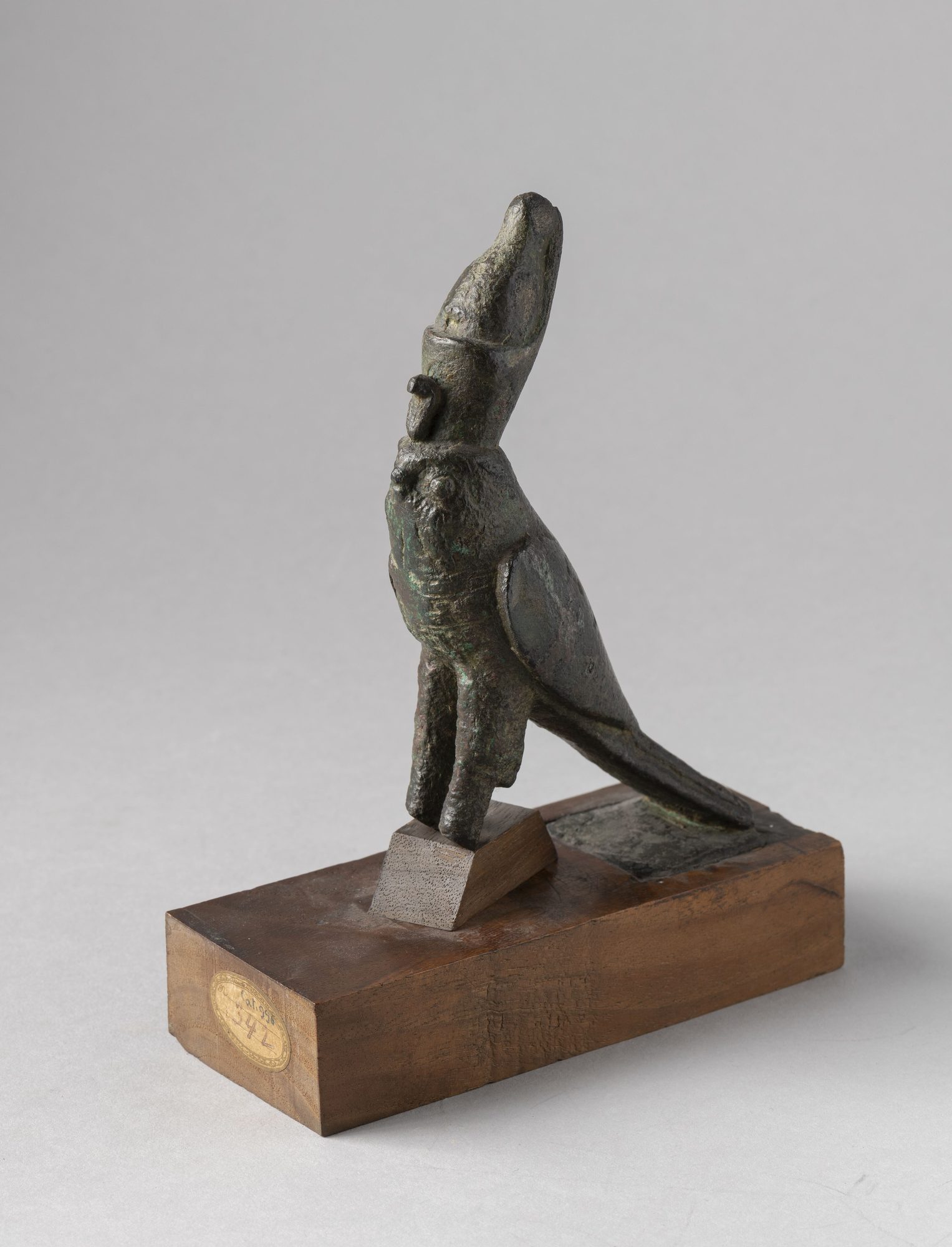
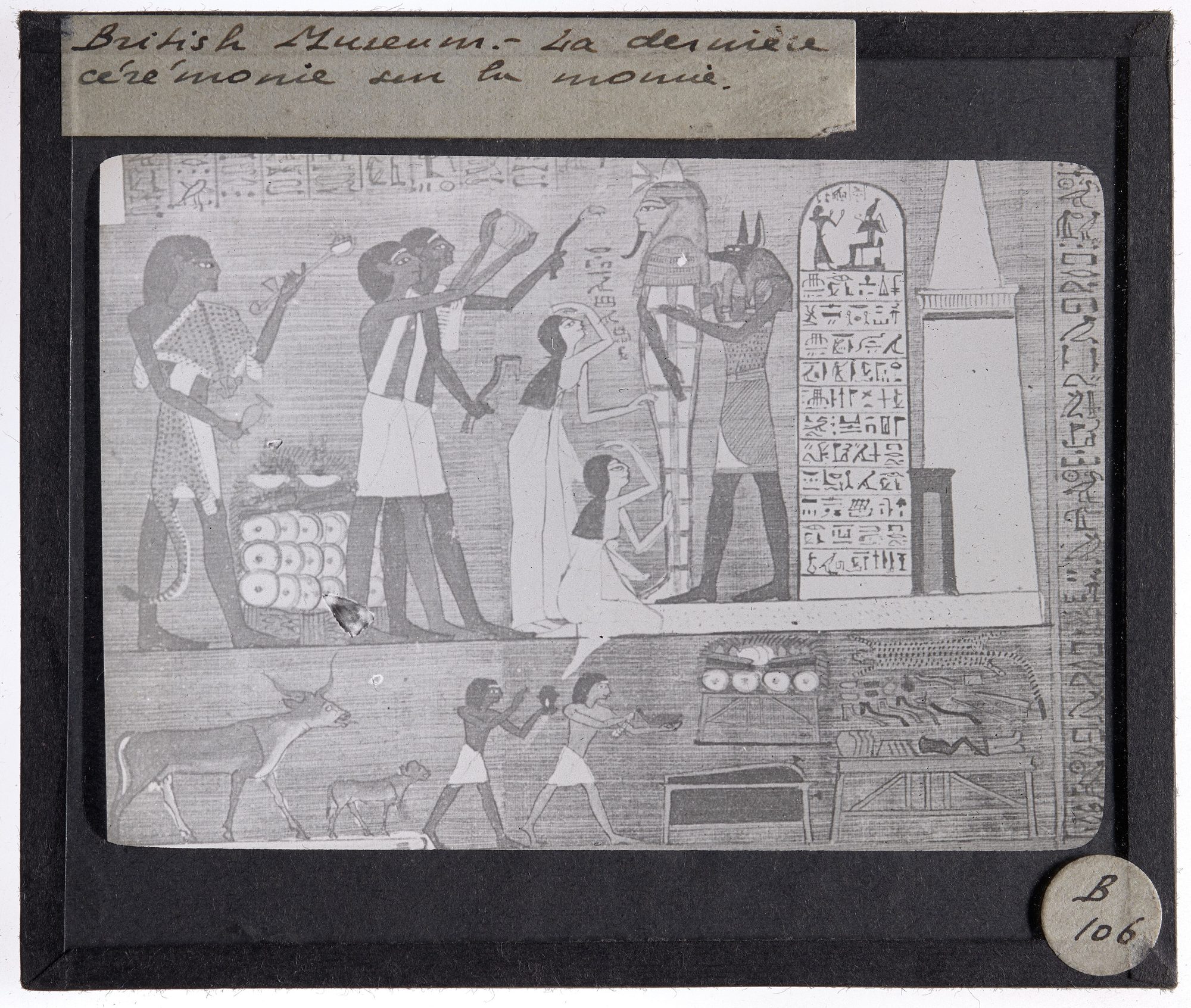
Out where the black soil ends and the desert begins, on the ridge above the tombs, a jackal sits and watches. This is the country of the dead, and it belongs to him. The Egyptians gave him a title that says exactly that: he is the one who is upon his mountain, the god crouched on the necropolis hill with the graves at his feet. His head is a jackal’s, long-muzzled and sharp-eared, and it is black. Not the tawny grey of the real animal that trots the cemetery margins at dusk, but a deliberate, ritual black, the colour of fertile Nile silt and of a corpse dressed in embalmer’s resin. Anubis is the god of that work, and the black is the badge of his office.
He learned the office on the most important body there ever was. When Osiris lay murdered, it was Anubis who made him ready for eternity, and the oldest funerary texts remember the act in cultic detail. The dead king’s entrails, the Pyramid Texts say, have been washed by Anubis; the embalming of Osiris has been performed. Every mummy afterward was a repetition of that first one. To be embalmed was to be treated as Osiris had been treated, by the same hands, and so the god who did the washing and the wrapping stood at the head of the whole apparatus of Egyptian death.
The Egyptians layered epithets on him the way they layered linen on the dead. He is Foremost of the Westerners, chief of the blessed dead in the West, where the sun goes down and the tombs face; the Pyramid Texts want the newly dead king to stand among the spirits exactly as Anubis stands, first of that western company. He is the one who presides in the god’s-booth, the embalming pavilion where the body was opened and dried and bound. He is the one who dwells in the city of embalmment. Each name fixes him to a station in the machinery of burial: the ridge, the tent, the West, the door.
The counter of hearts
Long before there were painted scales, Anubis was already reckoning the dead. The Pyramid Texts give him one of his strangest names, the counter of hearts, and set him to work: count their hearts, they say, in this thy name of Anubis counter of hearts. Elsewhere he is powerful over the best of the hearts, and in another passage he deducts the dead man from among the gods, subtracting a soul from one column and entering it in another like a clerk of the afterlife. This is arithmetic, not yet drama, and it comes centuries before anyone drew the balance-beam and the feather.
That developed picture, the one carved into memory, is a New Kingdom scene, and it is worth being honest about the gap. The full Weighing of the Heart, with its upright scales, its single feather of Maat and the devourer waiting by the beam, belongs to the Book of the Dead, not to the older texts. The Pyramid Texts supply the idea, the god who counts hearts, but not the illustration.
In the developed scene his role is precise. The heart of the dead man goes into one pan; into the other goes the feather of truth, the emblem of Maat, and Anubis crouches at the balance to work it. In the Papyrus of Ani he tests the tongue of the balance, watching where the beam will settle, while ibis-headed Thoth stands ready to record the verdict and the devourer waits for a heart that fails.
The test is not whether the heart outweighs the feather but whether it can balance it exactly, a life light enough to sit level against truth itself. This division of labour, Anubis at the scale, Thoth at the palette, is the standard arrangement of the New Kingdom papyri, though not the only one; in some rolls Anubis does the whole business alone.
Guardian of the body
His care for the dead is physical, hands-on, and it does not end when the body is in the ground. Anubis is the one who leads the funeral: he heads the procession, the texts say, exactly as he did when Osiris was buried at Abydos, so that every cortège walking to the tomb was walking behind him.
He guards what the embalming leaves behind, standing behind the chest that holds the inward parts of Osiris, the canopic viscera; and Egyptian funerary chests were literally topped with little figures of the crouching jackal, the god made a lid and a lock. Through the dangerous dark he keeps watch over the corpse itself. The spell has him keeping watch at your moment, and instructs that it be recited over a modelled figure of Anubis set by the body, a guardian in effigy standing sentry over the mummy through the night.
He is also the keeper of the door. When the dead man reaches the Hall of the Two Truths, it is Anubis who admits him, and admission is not automatic: the god makes him declare the secret names of the two leaves of the door before he will let him in. The guardian of the tombs is also the gatekeeper of the judgment, checking that the newcomer knows the passwords of the dead.
All of this together, leading the procession, opening the way, standing at the door of the hall, is why he is called a guide of the dead. The Greek word for such a figure, psychopomp, came later with the Hellenised Anubis; the Egyptian truth of it is simpler and older, the jackal who walks ahead and knows the road.
He was not always at the head of that procession alone. In the pavilion he keeps company with Wepwawet, the other canine god whose name means Opener of the Ways, and the Pyramid Texts pair them at the embalming-booth. And the tenderest figure in his orbit is his daughter Kebehut, a small goddess of cool water: she comes to the dead, the texts say, with her four jars, and she refreshes the heart of the great god on the day of awakening. After the reckoning and the wrapping and the long night, someone brings water. She is the one who brings it.
Where Anubis comes from, the sources cannot agree, and Egypt never forced them to. In the older tradition he is a son of Ra. In others he is born of the cow-goddess Hesat, or of cat-headed Bastet. The Osirian strand, common in later periods, makes him the son of Osiris and Nephthys, and it is this version that the Greek writer Plutarch retold, centuries afterward, as the story of a child got by mistake when Osiris took Nephthys for Isis, abandoned in fear of Set, tracked down with the help of dogs, and raised by Isis to be her guardian.
That is a late, outside retelling, and should be read as what it is. The competing parentages are not a puzzle to be solved. They are the sediment of a very old god who was folded, again and again, into other families without ever quite losing the shape he had before them: the black jackal on the ridge, first of the Westerners, watching over the dead.
Anubis, the counter of hearts, deducts Osiris N. from the gods. (Pyramid Texts §1523c, trans. Mercer)
- The Pyramid Texts (Old Kingdom, c. 24th–22nd century BC), trans. Samuel A. B. Mercer, The Pyramid Texts (Longmans, Green & Co., 1952)the earliest layer of Anubis’s cult, read by paragraph. §57d, §220c and §745a (Anubis
First of the Westerners
); §157b–c (the embalmer-priest masked as Anubis to count hearts); §1122c–d (the entrails washed by Anubis and the embalming of Osiris); §1180b–d (Kebehut, his daughter, and her four cool-water jars refreshing the heart on the day of awakening); §1287a–c (Anubis the counter of hearts, who presides in the god’s-booth, paired with Wepwawet); §1523c (Anubis deducts the dead from among the gods); §1549b (Anubiswho is upon his mountain
). - The Book of the Dead / Book of Coming Forth by Day (Theban Recension, New Kingdom), trans. **E. A. Wallis Budge, *The Book of the DeadAn English Translation of the Theban Recension* (London, 1898/1901)**: Chapter I (Anubis leads the funeral procession at the burial of Osiris in Abydos); Chapter XVII (Anubis behind the chest that holds the inward parts of Osiris); the heart-chapters and the Papyrus of Nebseni vignette (
Anubis who dwelleth in the city of embalmment
); Chapter LXIV (I am Anpu on the day of reckoning
); and Chapter CXXV — the Judgment in the Hall of the Two Truths, Anubis testing the tongue of the balance against the feather of Maat, keeping nightly watch over the corpse, and standing as doorkeeper of the hall. Budge’s 1898 renderings and running commentary are dated Victorian Egyptology: thetests the tongue of the balance
and heart-must-balance-the-feather phrasings come from his descriptive prose about the Ani vignette, not from a verbatim line of the ancient spell. - Plutarch, De Iside et Osiride (On Isis and Osiris), c. AD 100a later Greek source, interpretatio graeca rather than native Egyptian mortuary text, preserving the Osiris-and-Nephthys parentage and the story of Anubis’s abandonment and adoption by Isis. Used for the parentage tradition only, and flagged as external and late.