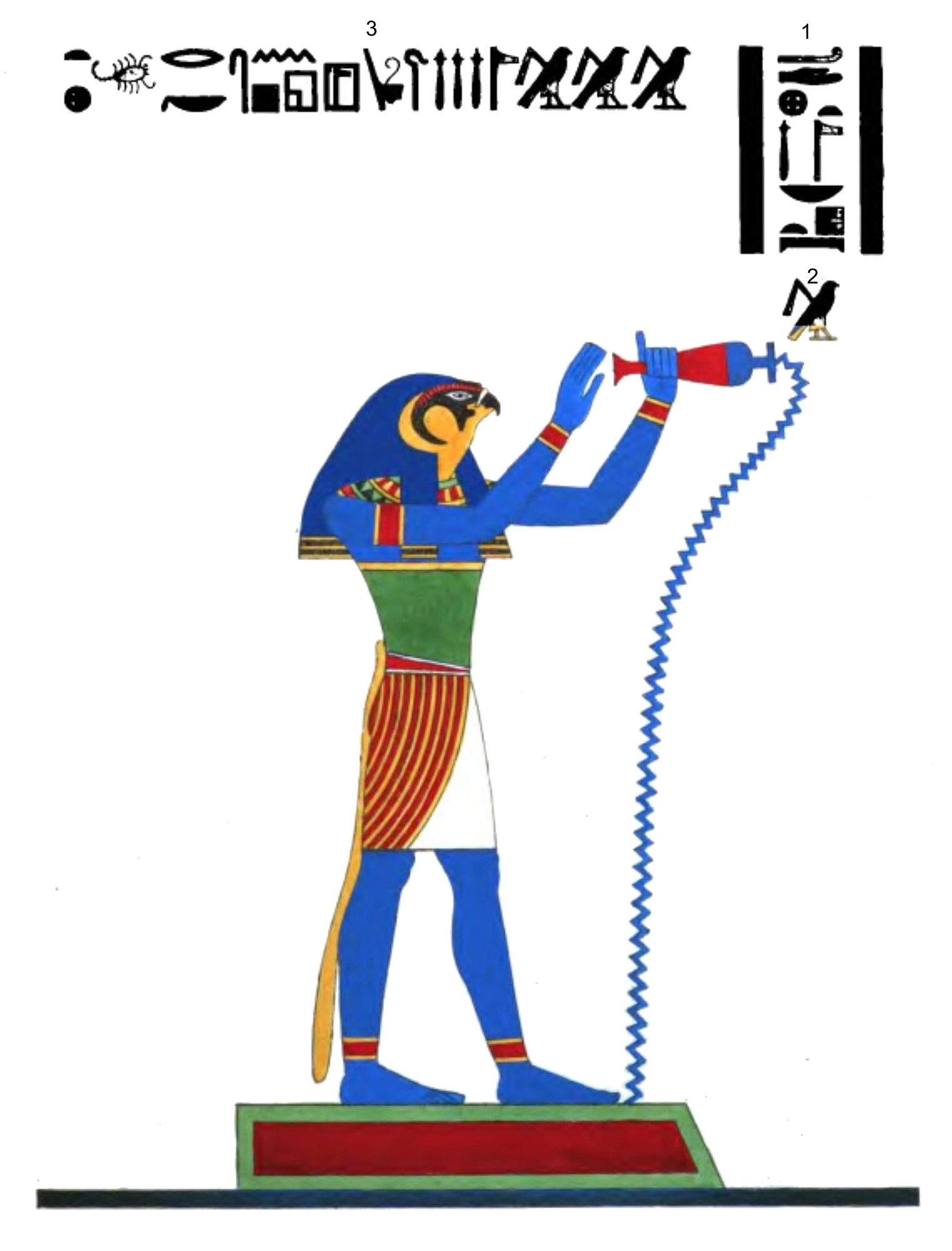
The heart has already gone into one pan of the scales and a single feather into the other, and the dead man stands waiting to learn what he was. Off to the side of that terrible balance a god watches, reed-pen poised over a scribal palette. He has the long curved beak and narrow head of an ibis, and his whole posture is that of a clerk about to write. When the beam settles he will set down the result, and then, in the same breath, turn to the assembled gods and tell them what it means. This is Thoth, the scribe of the gods, and in the oldest description of the scene he holds in his hands his reed-pen and palette with which to record the result of the trial. Whatever the pans decide, it becomes true only when he has written it and said it aloud.
That double office is the key to him, and it is easy to get wrong. Thoth is not merely the recording clerk of the afterlife, filing paperwork while others do the judging. In the Papyrus of Ani he is both the pen and the voice. He records, yes; but he also proclaims, standing forth as the judge of Right and Truth of the great company of the gods who are in the presence of Osiris. Hear ye this judgment, he says, and delivers it like a verdict from the bench: the heart has in very truth been weighed in the Great Balance, and there has not been found any wickedness in him.
Only then does the great company confirm his report, and when they answer they grant his word a binding force of its own. That which cometh forth from thy mouth shall be declared true, they say of Thoth, who dwells in Khemennu, the city the Greeks would later call Hermopolis. This is why the dead man’s dearest hope is to be called true of voice. The scales establish a fact; Thoth’s pronouncement makes it a destiny.
The word that ordered the world
If a god’s speech can do that at the end of a life, it is because in the Egyptian imagination speech of that kind stood at the beginning of everything. Budge frames Thoth as the divine intelligence which at creation uttered the words that were carried into effect by Ptah and Khnemu: Thoth the mind and the word, other gods the hands. This is a modern synthesis of competing cosmogonies from rival cult centres rather than a single quoted spell, and the Memphite tradition gives the creative word to Ptah himself. But the instinct behind it is genuinely Egyptian. To this culture, a thing spoken by the right mouth was a thing made. Thoth is the god of that mouth.
He is also the god of measure. Time falls under his office: he was, in Budge’s summary, primarily the god of time and chronologer of heaven and earth. The primary passages read for this account touch that role only obliquely, and honesty requires saying so. The Pyramid Texts have the dead king traverse the sky in the manner of Thoth, but the fuller portrait familiar from later ages, Thoth as the moon that measures the month, patron of scribes and mathematics, keeper of the calendar, rests on Egyptological synthesis and on the Ptolemaic theology of his city rather than on a line quoted here. It is well founded. It is not, in the strict sense, quotable from these spells.
The advocate of Osiris
Long before the painted balance of the New Kingdom, Thoth already had a body to defend. In the oldest layer of Egyptian funerary writing, the Pyramid Texts, he is dispatched against the murderer of Osiris: Thot, go, carry off him who has injured Osiris. He is bound too, in that same ancient stratum, to the crossing of the sky, the dead king moving across heaven exactly as Thoth moves. And he is the one who does not sleep. The judge is awake, one utterance declares; Thot is up; the sleepers are awake. Even here he is the wakeful watcher, alert while the rest of creation drowses.
What he did for Osiris, the mortuary tradition asks him to do for everyone. The recurring litany of the eighteenth chapter of the Book of the Dead invokes him over and over: Hail, Thoth, who madest Osiris victorious over his enemies, make thou the dead man to be victorious over his enemies in the presence of the great and sovereign princes. His vindication of the murdered god becomes the template for the vindication of every soul that comes to the Balance. He is not a neutral referee. He is counsel for the defence, and he has already won the most important case there was.
He even writes the salvation out by hand. In a text appended to the Book of the Dead, the Book of Breathings from the Papyrus of Kerasher, Thoth does not delegate: he, the most mighty god, the lord of Khemennu, comes to the deceased and writes for him the Book of Breathings with his own fingers, so that the soul may breathe for ever.
The god of writing writes the very document that keeps you alive beyond death. His instrument is textual and physical at once, a reed-pen and a scribal palette held in the hands, and in one of his grandest self-descriptions he becomes the instrument itself, the writing-reed of the god Neb-er-tcher, the Lord of All, the lord of laws. He does not merely serve the pen. He is the pen.
Two heads and an open question
A word on his shape, because Egypt gave him two. Thoth’s primary head is the ibis, but he also wears the body of the hamadryas baboon, and in the Ani judgment the dog-headed ape on the standard of the scales is called the companion of Thoth: it reads the beam and reports the reading to him, who then declares it to the gods, a whole chain of custody from ape to scribe to assembly. Whether the baboon is Thoth’s associate or simply Thoth in another body is a knot the Egyptians never bothered to untie; both are his, and the full equation of baboon and god belongs more to standard interpretation than to any single line of these spells.
Where he came from, the sources will not say. Egyptian tradition gives Thoth no fixed genealogy: he is variously called self-created, reckoned among the first primeval gods, or born, in one strange strand, from the head of Set. None of these was confirmed from a passage read for this account, and it would be a small dishonesty to print one as fact. It is fitting that the god of the record leaves his own origin unwritten.
What the record does hold is certain enough. He is the scribe of the gods and the lord of Khemennu, the judge of Right and Truth whose spoken word the gods themselves let stand, the pen that wrote the world into effect and the pen that writes each soul its breath. At the Balance, when the beam goes level and the great company waits, it is his hand that moves and his voice that carries. That which comes forth from his mouth is declared true.
Thoth, the judge of Right and Truth of the great company of the gods who are in the presence of Osiris, saith: Hear ye this judgment. The heart of Osiris hath in very truth been weighed… There hath not been found any wickedness in him. (Book of the Dead, Papyrus of Ani, Judgment scene, trans. Budge)
- The Book of the Dead / Book of Coming Forth by Day (Theban Recension, New Kingdom), trans. **E. A. Wallis Budge, *The Book of the DeadAn English Translation of the Theban Recension* (London, 1898/1901)**: the Papyrus of Ani Judgment / Weighing-of-the-Heart scene, read verbatim. Thoth
the scribe of the gods
standing with reed-pen and palette to record the trial; Thoththe judge of Right and Truth of the great company of the gods
who proclaims the verdict (Hear ye this judgment… there hath not been found any wickedness in him
) before the gods ratify his report; the gods’ declarationThat which cometh forth from thy mouth shall be declared true,
of Thothwho dwelleth in Khemennu
(Hermopolis); the dog-headed apethe companion of Thoth
on the standard of the balance, reading the beam and reporting it to him; and the devourer Am-mit waiting beside the scales. Budge’s synthesising Introduction is the source (and is flagged as such) for thedivine intelligence which at creation uttered the words
carried out by Ptah and Khnemu, and for Thothprimarily the god of time and chronologer of heaven and earth
; these are Budge’s modern framing, not verbatim spells. - The Book of the Dead, Chapter 18, Budge trans., read verbatimthe litany
Hail, Thoth, who madest Osiris victorious over his enemies, make thou [the deceased] to be victorious over his enemies… in the presence of the great and sovereign princes
: Thoth as advocate and vindicator, whose defence of Osiris is asked for every justified dead. - The Book of the Dead,
Book of Breathings,
Papyrus of Kerasher, Budge trans., read verbatimThoth, the most mighty god, the lord of Khemennu, cometh to thee, and he writeth for thee the Book of Breathings with his own fingers,
whereby the soul breathes for ever. - The Book of the Dead, Chapter 182 (phrases quoted in Budge’s Introduction only, the chapter body not read line-for-line)Thoth
the scribe of right and truth who abominateth sin,
the writing-reed of the god Neb-er-tcher [Neb-er-djer, ‘Lord of All’], the lord of laws,
and the self-declarationI am Thoth, the lord of right and truth, who trieth the right and the truth for the gods, the judge of words in their essence.
Cited as quoted-via-Introduction, with chapter-internal context to be re-verified before it is treated as Chapter 182 proper. - The Pyramid Texts (Old Kingdom), trans. Samuel A. B. Mercer, The Pyramid Texts (Longmans, Green & Co., 1952), read verbatimthe oldest stratum of Thoth (Mercer’s
Thot
). §16,Thot, go, carry off him who has injured Osiris
(Thoth as the avenger dispatched against the enemy of Osiris); Utterance 210–211, §130d,N. traverses the sky like Thot
(the dead king crossing heaven in Thoth’s manner, the germ of the later sky- and moon-god); §126a,The judge is awake; Thot is up; the sleepers are awake
(the wakeful watcher-judge).