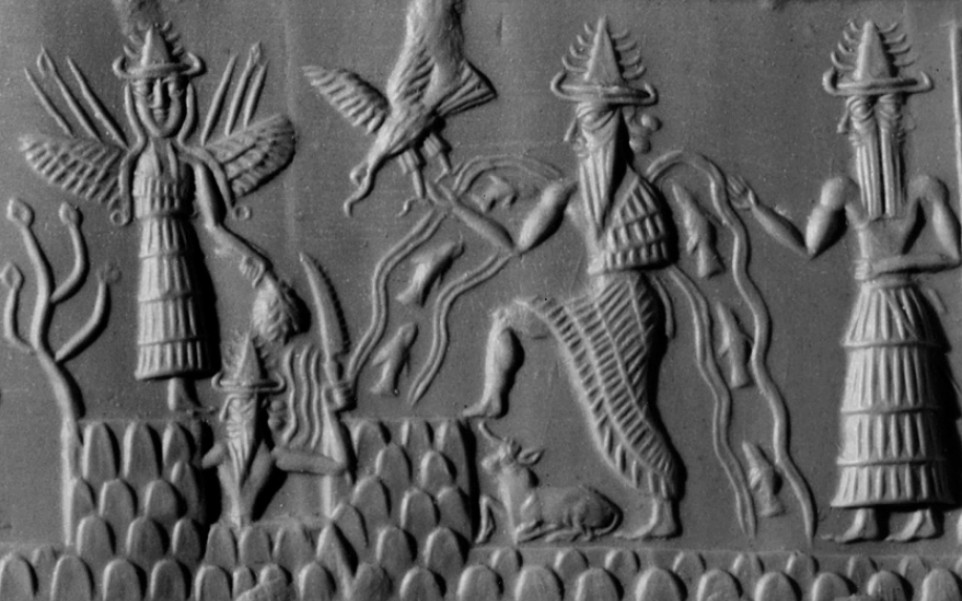
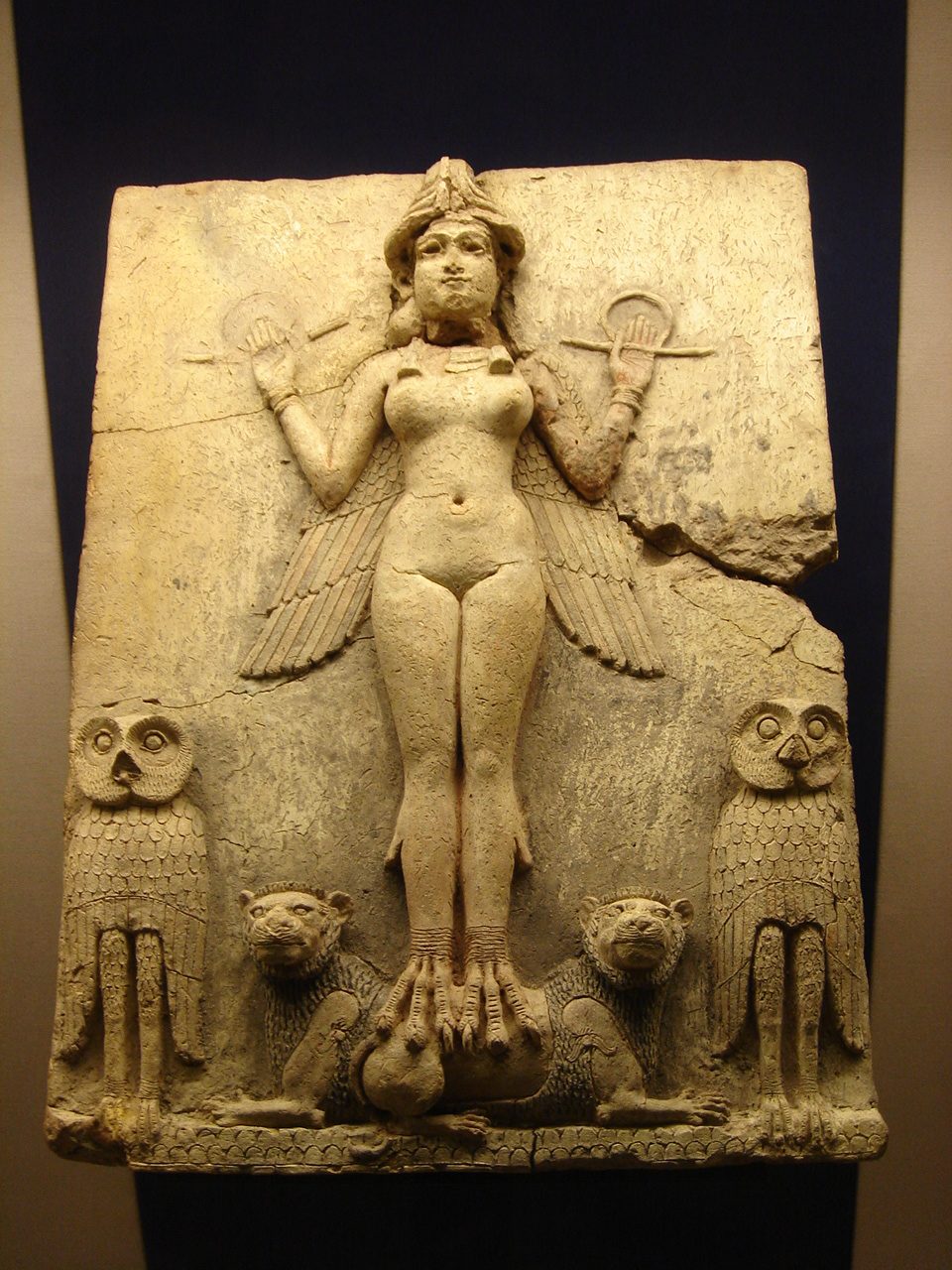
She set her mind on the great below, and left her temples to do it. City by city she abandoned the shrines that were hers and turned her face towards the one country from which no traveller returns. Before she went she dressed as if for a coronation, taking up the seven divine powers, the me: turban and lapis beads, the pala robe of a great lady, the gold ring, the measuring rod and line. Across her chest she fastened a pectoral whose name was an instruction, Come, man, come,
and painted her eyes with a cosmetic called Let a man come, let him come.
The goddess of desire armed herself in her own allure, and walked into the house of the dead by choice.
Love and war, never split in two
This is the deepest strangeness of Inanna, the Sumerian goddess the Akkadians called Ishtar. She was love and she was war, and the tradition never once tried to split her in two. In the hymns of her own priesthood she is the planet Venus, the morning and evening star, rising like Utu
the sun in daylight and brilliance and throwing down beaming rays. In the same breath she is the battle-goddess drenched in blood, rushing around in great battles,
who destroys mighty lands with arrow and strength.
The poet who praised her most closely, likely the priestess Enheduanna, credited her with power over the categories of things themselves: To turn a man into a woman and a woman into a man are yours, Inana.
She was the boldest of the great gods because she recognised no border she could not cross, not between the sexes, not between the living and the dead.
Craving is not grief
The Descent is her masterpiece of nerve. She planned for it. She told her minister Ninshubur that if Inanna was not back in three days, Ninshubur was to mourn and go begging first to Enlil, then to Nanna, then to Enki—the god who knows about the life-giving plant and the life-giving water
—to plead for Inanna’s life.
At the gate she gave her pretext: she had come for the funeral of Gugalanna, the Bull of Heaven, husband of her elder sister Ereshkigal, queen of the dead. Whether she came to mourn or to conquer, the text will not say. Enlil later accuses her of having craved the great below,
and craving is not grief. The Sumerians left the motive open, and it is a mistake to close it.
Naked and bowed in the throne room
Her sister’s answer was quieter than a battle and far more total. Ereshkigal had the seven gates bolted, and at each one an item of the goddess’s regalia was stripped away, until the Queen of Heaven stood naked and bowed in the throne room of the dead, let in only after every one of her powers had been taken from her. Even then she reached for the throne, and in that instant the Anuna, the seven judges, fixed her with the look of death. The afflicted woman was turned into a corpse. And the corpse was hung on a hook.
The most fearless of the gods hung dead on a nail for three days and three nights.
Then the plan she had left behind went to work. Enlil and Nanna both refused to help, saying whoever reaches for the powers of the underworld should expect to stay. But Enki could not leave her hanging. From the dirt under his fingernails he made two small sexless beings who belonged to no ordinary category and so could pass where the living could not, and armed them with the plant and water of life. They slipped in like flies,
asked for the corpse on the hook, and sprinkled it, and thus Inana arose.
The dead required a substitute
Nothing rises out of the land of no return for free. The dead required a substitute, and the demons came up with her to collect one. She spared those who had mourned her rightly, then came home and found her husband, the shepherd Dumuzid, clothed in a magnificent garment
and seated magnificently on a throne,
untroubled by her death. She turned on him the look of death,
the same the judges had turned on her, and gave him to the demons. Love and death in a single glance, from the goddess who was always both.
Dumuzid ran, begging the sun-god Utu to turn his hands and feet into snake’s hands and feet so he could wriggle free, and for a while he escaped. The poem softens at the end into a shared sentence: a fly shows Inanna where he is hidden, and a division is decreed, you for half the year and your sister for half the year.
Here is the seed of the god who dies and returns with the season, though the precision matters. Inanna herself is raised once and stays raised; it is Dumuzid, and his sister Geshtinanna after him, who go down and rise again on the turning of the year.
All coupling stops on the earth above
The Akkadians told the Descent too, with instructive differences. There the rescuer is Ea, who moulds a single eunuch, Asushunamir, to wheedle the water of life from Ereshkigal, and the vizier Namtar afflicts the trapped goddess with sixty diseases rather than hanging her on a hook. Where the Sumerian poem leaves the stakes implicit, the Akkadian spells them out: while Ishtar is dead below, all coupling stops on the earth above, the bull springing not upon the cow, the ass not over the she-ass. Take the goddess of desire out of the world, and the world stops making more of itself.
The shape you will be left in
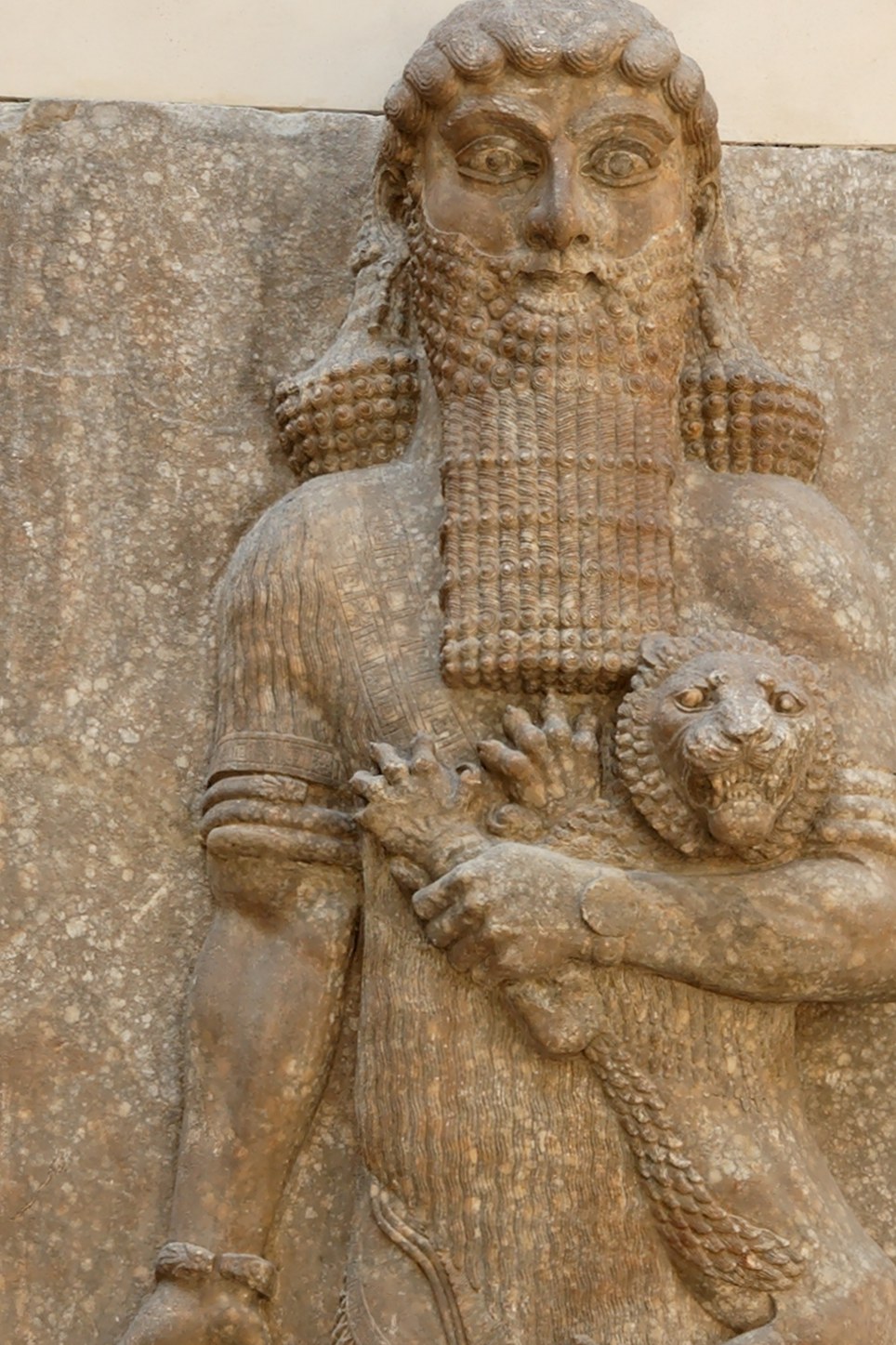
Her other great set-piece turns the same nature outward, and it is why she is remembered as the most dangerous lover in the ancient world. In the sixth tablet of the Epic of Gilgamesh, she saw the hero washed and crowned and radiant, and wanted him: be my bridegroom, she said, and I will harness you a chariot of lapis lazuli and gold. Gilgamesh refused by reciting the fates of the men she had loved before.
Tammuz, the lover of her youth, for whom she decreed wailing, year after year.
The roller-bird whose wing she broke; the lion she loved and dug seven pits for; the stallion she bridled with whip and spur; the shepherd she turned into a wolf, hunted by his own dogs; and Ishullanu, her father’s gardener, whom she struck into a blind mole. Love me, he was saying, and this is the shape you will be left in.
Ishtar did not argue. She went up to heaven to her father Anu and demanded the Bull of Heaven to trample the man who had shamed her, threatening, if refused, to smash the gates of the underworld and bring up the dead to eat food like the living,
until the dead outnumbered the living. It is the very threat she made at her own underworld gate, a fixed formula of hers. She got her Bull; Gilgamesh and Enkidu killed it, and Enkidu tore off its right haunch and hurled it in her face, and she and her temple women set up a wailing over the thigh of a dead bull. For that killing, the gods decreed that Enkidu must die.
Two great stories, one figure, and no contradiction in it. She is the morning star that is also the evening star, the same bright point seen at both edges of the dark, and the Mesopotamians did not find that troubling; they found it accurate. Desire and violence, they seem to have known, were never separate powers, and Inanna-Ishtar told the truth about them by being both at once.
To turn a man into a woman and a woman into a man are yours, Inana. (Inana C, ETCSL t.4.07.3)
- Inana’s Descent to the Nether World (Sumerian), ETCSL t.1.4.1 (Black, Cunningham, Fluckiger-Hawker, Robson, Zólyomi et al. trans., Oxford), read verbatimthe abandoning of her temples and the taking-up of the seven divine powers (me); the named cosmetics (
Let a man come, let him come
) and theCome, man, come
pectoral; Ninshubur’s instructions and the rescue-errand to Enlil, Nanna and Enki; the funeral of Gugalanna as her stated pretext; the seven gates and the stripping of her regalia;the corpse was hung on a hook
; Enki’s fingernail-dirt beings the kur-ĝara and gala-tura with the life-giving plant and water; the galla-demons and the law of the substitute; Dumuzid enthroned rather than mourning and thelook of death
; his snake’s-hands prayer to Utu; and the half-year division with his sister Geshtinanna. - Inana and Ebih (Sumerian), ETCSL t.1.3.2, read verbatim (ll. 1–24)Inanna the war-goddess,
drenched in blood, rushing around in great battles,
whodestroys mighty lands with arrow and strength
; and her astral, luminous aspect, risinglike Utu
in daylight and brilliance and casting beaming rays. - A hymn to Inana (Inana C) (Sumerian), ETCSL t.4.07.3 (associated with Enheduanna), key lines read verbatimher parentage as the
great daughter of Suen
(the moon-god Nanna/Sin); her rank among the gods; and her power over category,To turn a man into a woman and a woman into a man are yours, Inana.
- Epic of Gilgamesh, Standard Babylonian Tablet VI (Akkadian), read here in N. K. Sandars’ English prose rendering (
Ishtar and Gilgamesh, and the Death of Enkidu
)Ishtar’s marriage proposal and the chariot of lapis and gold; Gilgamesh’s refusal and his catalogue of her ruined lovers (Tammuz, the roller-bird, the lion, the stallion, the shepherd turned wolf, and the gardener Ishullanu turned mole); her demand to her father Anu for the Bull of Heaven and the threat to raise the dead; and the killing of the Bull that dooms Enkidu. The narrative beats are solidly attested, but the exact wording and the Bull’s numbers here are Sandars’ prose; for a line-numbered scholarly citation see A. R. George, The Babylonian Gilgamesh Epic (2003), Tablet VI, or Kovacs, and re-verify before quoting verbatim. - The Descent of Ishtar into the Underworld (Akkadian), trans. Morris Jastrow, The Civilization of Babylonia and Assyria (1915), read verbatimthe Akkadian parallel Descent, with the seven gates, Namtar’s sixty diseases, the failure of all mating on earth while she is dead (
the bull springs not upon the cow, the ass bows not over the she-ass
), Ea’s creation of the eunuch Asushunamir, the water of life, and Tammuz’s funerary rites. An older public-domain rendering; for modern spellings of the proper names compare Foster, Before the Muses or Dalley, Myths from Mesopotamia.