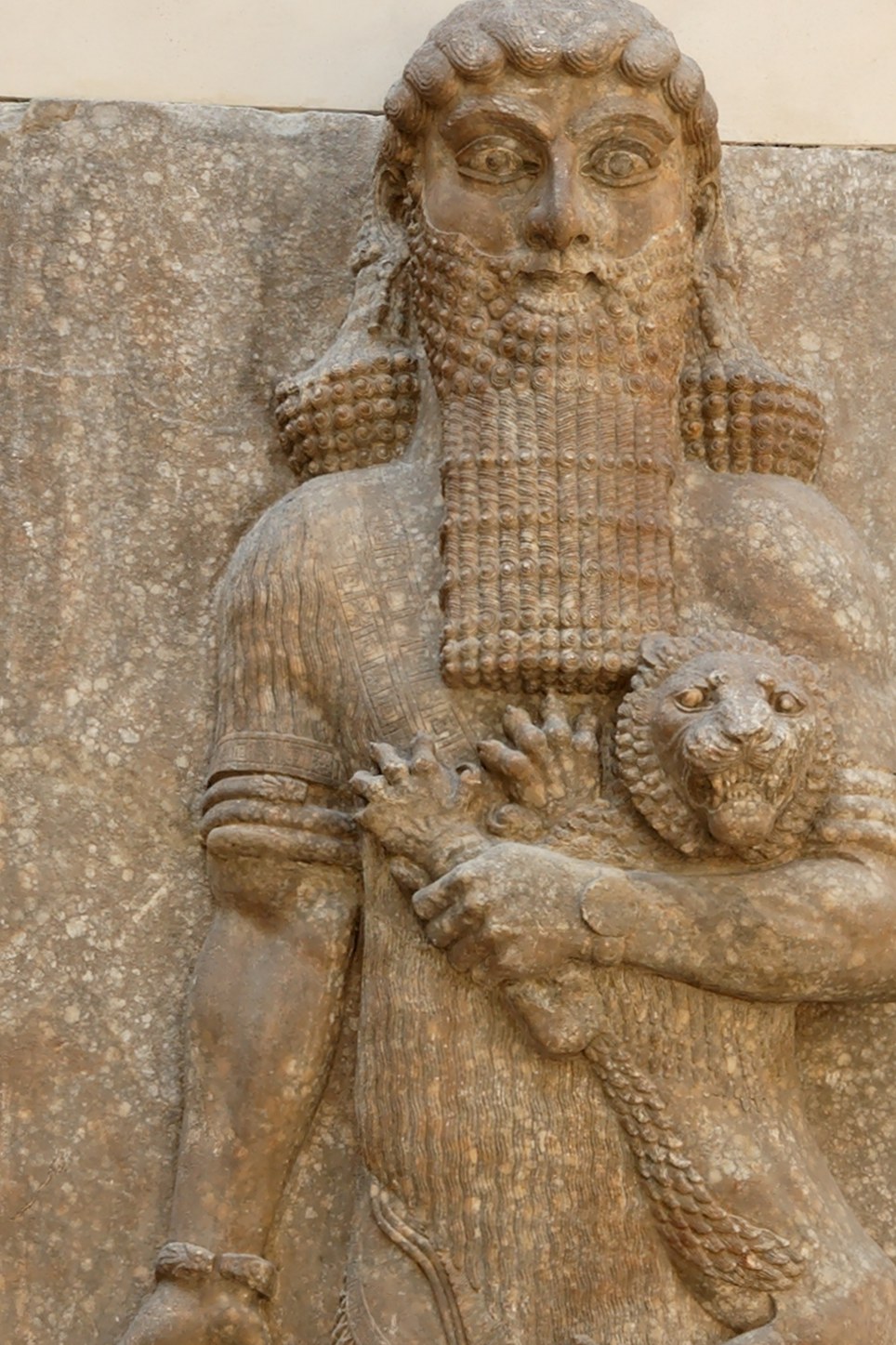
He was two parts god and one part man, and Uruk could not survive him. Gilgamesh had walls no army could breach and a body no man could match, and he used them to grind his own city down. He drove its young men at will, and left no girl to her bridegroom, taking the wedding night for himself before the husband could. The people did not rebel, because you cannot rebel against a wall. They did the only thing left to the powerless in a world of gods: they prayed. And the gods, hearing them, agreed that the trouble with Gilgamesh was that he had no equal, and set about making one.
Feeding on grass with the gazelles
The mother-goddess Aruru washed her hands, pinched off a piece of clay, and threw it down into the wild. From it she shaped Enkidu, and the shape she gave him was the opposite of a king. He came out of the earth covered in hair, his tresses long as a woman’s, thick as standing grain, clothed like a beast and feeding on grass with the gazelles, jostling the herd at the waterhole. He knew nothing of bread or beer, nothing of the city built to be his purpose. Made to match the strongest man alive, he began life on all fours among the animals, tearing the trappers’ snares out of the ground to set the game free.
Not a hunting party but a woman
It was a trapper, ruined by this wild man who kept emptying his pits, who carried the news to Uruk, and the answer Gilgamesh sent back was not a hunting party but a woman. Shamhat was a harlot of the temple, and what she brought Enkidu was not a weapon but knowledge. She lay with him for six days and seven nights, and when he rose the gazelles bolted at the sight of him and he could no longer keep their pace. He had begun to think like a man, and the animals knew it. The price of understanding was the wilderness, and he would never get it back.
Before they met, Gilgamesh dreamed of what was coming, twice: a lump of rock fallen from the sky, too heavy to lift or shift; then an axe lying in the street of Uruk that all the people gathered around and kissed. Both times the king bent over the thing as over a wife, caressing and embracing it, and both times his mother Ninsun, a goddess who read dreams, told him what it meant: a mighty companion was coming.
You will love him like a wife, she said, caressing and embracing him. The comparison is the poem’s own, set down four thousand years ago, not a thing later readers put there. The king who took every bride in Uruk was about to be given the one attachment he could not command.
A foot across the threshold
They met, and the first thing they did was try to break each other. Enkidu, told how Gilgamesh treated the brides of the city, stood in the door of a wedding house with his foot across the threshold so the king could not pass. Gilgamesh came for his night and found the doorway blocked by something his own size. They seized each other and fought in the street like bulls, and the door jambs shook and the wall shook with them. Then the fight simply stopped being a fight. They let go, took hold of each other again, differently, and from that grip they did not really separate again while both of them lived.
Enkidu had no family. Born from a pinch of clay, he had no father to name, no brother, no city. Ninsun repaired that too. She hung the temple’s holy emblems around his neck, took the foundling in, and declared him her own: I hereby adopt Enkidu, whom I love, as a son, and bade Gilgamesh treat him as a brother. The wild orphan was given, in a single speech, a divine mother and a king for a brother.
And they did a great deal together. They marched to the Cedar Forest, killed its guardian Humbaba, and felled the sacred cedar; and when the goddess Ishtar proposed marriage, he threw her own ruined lovers in her face. Enraged, she had the sky-god send down the Bull of Heaven, and they killed that too. Enkidu tore off one of the Bull’s haunches and flung it at the goddess. It was a magnificent thing to do, and it was the end of him.
One of the two must die
For the gods had been watching, and they took counsel. Two mortals had slain the forest’s guardian and the Bull of Heaven both, and a price was owed; the gods debated, and the verdict fell on Enkidu. The exact wording is lost, damaged in the tablets and pieced back from other versions, but its weight is not: one of the two must die, and it would not be the king.
Enkidu learned it first in a dream, dragged down to the house of dust, the seat of Irkalla that those who enter cannot leave, where the dead sit in darkness clad like birds in coats of feathers and even old kings crouch stripped of everything they were. Then he fell sick. He did not die in battle, sword in hand, as a hero of his strength should have; he lay on a bed and wasted for twelve days, cursing and then blessing the harlot who had made him a man, and died.
Veiling the face like a bride
Gilgamesh, who had killed monsters, could do nothing. He felt for the heartbeat and there was none, and now he veiled Enkidu’s face the way a groom lifts the veil of his bride. He circled the body like an eagle, turned back and forth over it like a lioness robbed of her cubs, tore out his own curled hair in fistfuls and threw down his fine clothes.
He summoned the whole world to grieve for one man, and had a statue of Enkidu made with eyebrows of lapis lazuli and a chest of gold. And he would not surrender the body to burial. For six days and seven nights, the same span Shamhat had once spent teaching Enkidu to be human, he sat with the corpse and refused it the ground, until a maggot fell from the dead man’s nostril and the fact of decay finally broke him.
What broke was not only grief but terror. If death could take Enkidu, strong as a fallen rock, his own second self, it was coming for Gilgamesh too. My friend, whom I love, has turned to clay, he said, and the horror of it is exact: the man Aruru had made from clay had gone back into it, and the same waited for the king.
That terror drove the rest of the epic, sending Gilgamesh after the one man who had escaped death, only to fail every test and come home empty-handed to the walls where the poem had begun. The wild man made to tame a tyrant did his work not by beating the king but by dying, and teaching him he was mortal.
Which Enkidu this is
A word about which Enkidu this is. In the older Sumerian poems, which call the hero by his earlier name Bilgames, Enkidu is not the king’s equal but his servant, with no wild-man origin and no clay, who in one poem goes down to fetch his master’s lost ball and mallet from the underworld, is trapped there, and returns only as a ghost. That is a different relationship in a different story, and the eleven-tablet epic framed by the walls of Uruk knows nothing of it. Its Enkidu is an equal, loved like a wife and mourned like a brother, and he stays dead.
(A twelfth tablet, added later, revives the servant-Enkidu for that descent; it is a separate tradition bolted to the end, not a continuation of the death.) Behind all of it there may have been a real king of Uruk who built the walls, whose name outlasted him and grew into legend. May have been: the epic is a legend raised on what is probably a historical foundation, and the honest thing is to leave that foundation half-seen. What the poem is sure of is the friendship, and the loss, and the walls still standing at the end, when the king who could not become a god comes home to be, at last, only a man.
You will love him like a wife, caressing and embracing him. A mighty companion will come to you, the saviour of his friend. (The Epic of Gilgamesh, Standard Babylonian Tablet I, trans. A. R. George)
- The Epic of Gilgamesh, Standard Babylonian version (the twelve-tablet series Sha naqba īmuru,
He Who Saw the Deep,
compiled by Sîn-lēqi-unninni c. 1300–1000 BCE), read in the English translation of Andrew R. George. Tablet Ithe prologue and walls of Uruk (I.3–12); Gilgamesh’s tyranny, no girl left to her bridegroom; Aruru fashioning Enkidu from a pinch of clay thrown into the wild (I.92–101); Enkidu’s wildness, hair-matted and grass-feeding among the gazelles (I.103–110); Shamhat and thesix days and seven nights
(I.194); the two omen-dreams (the fallen rock from the sky, the axe in the street) and Ninsun’s reading,you will love him like a wife
andmade your equal
(I.253–291). - Tablet IIEnkidu civilised; the wedding-house fight, his foot across the doorway and
the door jambs quaked, the wall shook
(II.109–115); the reconciliation and bond; Enkidu’s want of kith and kin (II.175–184). - Tablet IIINinsun adopts Enkidu as a son and commends him to Gilgamesh as a brother (III.124–128).
- Tablets IV–Vthe Cedar Forest expedition and the killing of the guardian Humbaba (Huwawa), summarised from George’s text-structure rather than quoted line-by-line here.
- Tablet VIthe rejection of Ishtar’s marriage proposal and the catalogue of her ruined lovers; the Bull of Heaven, sent by Anu and killed by the pair; Enkidu tearing off the Bull’s haunch and hurling it before Ishtar. The narrative beats are attested; the specific numbers and the exact lover-catalogue await verbatim verification against George before quotation.
- Tablet VIIthe divine council
taking counsel
(VII.1) and the decree that Enkidu must die for the slaying of Humbaba and the Bull; Enkidu’s curse and then blessing of Shamhat; and his underworld death-dream, thehouse of darkness, the seat of Irkalla,
whose dwellers areclad like birds in coats of feathers
and eat dust and clay (VII.184–190). The precise verdict is damaged in the SB manuscripts and reconstructed from the Hittite and parallel versions; it is given here asthe gods decreed Enkidu must die,
not as a quoted line. - Tablet VIIIEnkidu’s death and Gilgamesh’s lament: the still heart; the veiling of the face
like a bride
; the circlinglike an eagle
; the turninglike a lioness deprived of her cubs
; the torn tresses and cast-off finery (VIII.59–64); the statue with eyebrows of lapis lazuli and a chest of gold (VIII.68–73); and the great catalogue of mourners summoned from all nature (VIII.19ff). - Tablets IX–XIthe immortality quest driven by grief (Siduri, Urshanabi, the crossing of the Waters of Death, Utanapishtim and the Flood, the failed sleep-test, the rejuvenating plant lost to a snake, and the return to the walls of Uruk). In Tablet X Gilgamesh recounts refusing burial for
six days and seven nights
untila maggot fell from his nostril,
andmy friend, whom I love, has turned to clay
(X.55–56, 135–148). This Tablet-X wording sits in Gilgamesh’s repeated retrospective speeches and is reconstructed in places from the parallels; the death itself is Tablet VIII. - Tablet XIIan appended, near-literal Akkadian translation of part of the Sumerian netherworld poem, in which Enkidu is again a servant and is alive to descend: a separate, bolted-on tradition that contradicts his death in Tablet VIII and is not used to continue it here (George 2003, xxvii–xxviii).
- Gilgameš, Enkidu and the Netherworld (Sumerian
Bilgames
poem; incipitIn those days, in those distant days…
), ETCSL t.1.8.1.4the older stratum in which Enkidu is Gilgamesh’s servant, not his double; he volunteers to fetch the pukku and mekku (ball and mallet) from the underworld, is trapped, and returns only as a shade. Cited for the variant tradition, kept distinct from the Standard Babylonianequal / beloved
bond. - The other Sumerian Bilgames poems (Gilgamesh and Huwawa A/B, Gilgamesh and the Bull of Heaven, Gilgamesh and Aga, The Death of Gilgamesh), the Sumerian King List, and the Tummal Inscriptionthe pre-epic Sumerian stratum, and the (probably historical) Early Dynastic king of Uruk credited with the city walls. This is scholarship (George 2003; Dalley 1989), used as background only; the historical core is kept hedged, not asserted as fact.