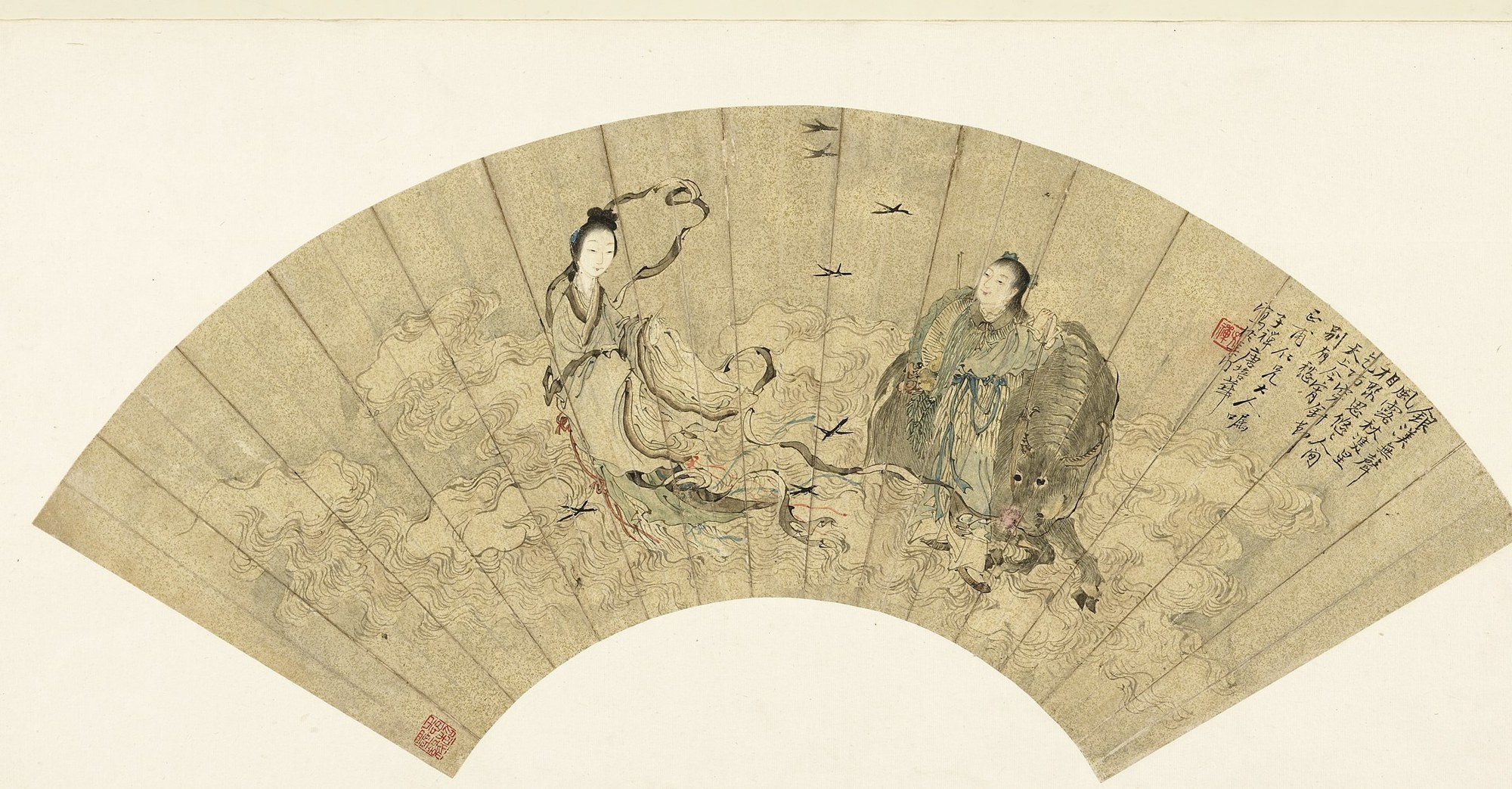
Look up on a clear summer night and the story is written across the whole sky. A pale band of light runs from horizon to horizon, and on either side of it burns a single bright star. The one to the west is Vega, and the Chinese called her the Weaving Girl. The one to the east is Altair, and they called him the Herd-Ox, the Cowherd. Between them lies the Silver River, the Milky Way, and the oldest telling of what passes between these two lovers is that nothing passes at all. They stand on opposite banks and cannot cross. That is the heart of it. But it took the better part of two thousand years for the sky to acquire a love story, and the earliest witnesses did not think these two were in love.
Two idle stars in a poem of complaint
The Weaving Girl and the Herd-Ox first appear together in the Shijing, the Classic of Poetry, in an ode from around the seventh century BCE. There is no romance in it whatsoever. The poem is a bitter complaint from the eastern lands about being drained by the capital, and the two stars are dragged in only as further proof that Heaven itself is useless. Slanting across the sky is the Weaving Girl, the poet says, and seven times a day she shifts her place at the loom, yet completes no patterned cloth.
Bright is the Draught-Ox, but it draws no cart. They are idle, ornamental, good for nothing. That is all the earliest source gives us: two named stars reproached for doing no work. No marriage, no separation, no yearly meeting, no bridge, no magpies. The romance the whole world now knows is not there at the beginning; it grew onto a pair of names that already existed.
The tears that fall like rain
Some seven or eight centuries later, under the Eastern Han, the same two stars turn up again, and now everything has changed. In the tenth of the Nineteen Old PoemsA celebrated set of anonymous Chinese lyric poems from the Eastern Han, whose tenth poem gives the two star-lovers their first note of grief. the Weaving Girl is no longer merely idle. She lifts her pale slender hands to the shuttle, the loom goes clack-clack all day, and still she finishes no cloth, because she is weeping. Her tears fall down like rain. The poet has taken the Zhou image of the woman who weaves nothing and asked why, and the answer is grief: she cannot work because the Herd-Ox is on the far shore and she cannot reach him.
What makes the poem unbearable is the geography. The River of Heaven that divides them is clear and shallow, hardly any water at all, and the two of them are set only a brimming span apart. The barrier looks like nothing. And yet they gaze and gaze across it and cannot even speak.
The distance between the Han poem and the Zhou ode it reworks is itself around seven to eight hundred years, longer than the gap between Chaucer and now; the reader watching these two poems side by side is watching the myth acquire its emotional core over a stretch of time longer than most whole mythologies survive. Still, even here there is no wedding, no punishment, and no fixed date for a meeting. There is only longing across a narrow, uncrossable strip of light.
A wedding, and a sentence
The date came next. In the third century CE the Western Jin writer Fu Xuan is the first to pin the encounter to a particular night, the seventh day of the seventh month, the festival later called Qixi七夕, the seventh night of the seventh lunar month, the one night a year the Cowherd and Weaver Girl are allowed to meet, later kept as a lovers' festival.. But the full story, the one with a plot, does not appear in writing until the sixth century, in a collection by the Liang-dynasty author Yin Yun, roughly twelve hundred years after the stars were first named as idle in the Shijing.
Yin Yun’s version is brief and complete. East of the Silver River lives the Weaving Girl, daughter of the Heavenly Emperor, and year after year she toils at loom and shuttle weaving cloud-brocade heavenly robes, with never a moment to tend to her own appearance. The Emperor pities her loneliness and marries her to the Herd-Ox lad on the western shore. And then the marriage undoes her: happy at last, she abandons the loom entirely.
The heavenly robes go unwoven. The Emperor, enraged, orders her back to her own side of the river and decrees that from now on the two may meet only once in a year. The love that the Han poem had spun out of an idle star is here given a cause. They are apart not by accident of the sky but by sentence, punished for the crime of loving each other too well to keep working.
The bridge of magpies
One thing is still missing from Yin Yun’s account, and it is the image every Chinese child now knows: the bridge. If the lovers meet once a year across a river neither can cross, something must carry them over. The answer is the magpies, and it is the strangest thread in the whole tradition, because it survives in no intact ancient book at all.
The motif is quoted, again and again, from works that once contained it and no longer do. A Tang encyclopedia cites a line from the Huainanzi, that great Han compendium, in which crows and magpies fill up the river to make a bridge and ferry the Weaving Girl across. Open a modern Huainanzi and the line is not there.
Another Tang collection quotes the Fengsu Tongyi, a customs-record from around 195 CE, for the fullest form: on Qixi the Weaving Girl must cross, and she presses the magpies into service as her bridge; and this, the text says, is why on the seventh of the seventh the magpies’ heads all go bald for no reason anyone can see, worn to the skin from ferrying the lovers across. Look for that passage in the surviving Fengsu Tongyi and it too is gone. The bald magpies are vivid and genuinely old in attribution, but every printed copy of the line traces back to a Tang scholar quoting a book we can no longer read whole. The bridge that saves the story reaches us only across its own kind of gap.
What the story is not
Almost everything else the modern version carries came later still, and much of it came from somewhere else. The tender folk tale most people know, in which Niulang is a mistreated mortal orphan with a magic ox, who steals the bathing Zhinü’s celestial robe so she cannot fly home, and who chases her into the sky carrying their two children in baskets, is a fusion with entirely separate tale-types. The stolen-feather-robe maiden belongs to a fourth-century story in Gan Bao’s Soushen Ji, where she is not called Zhinü and there is no bridge at all; the abused-cowherd plot only crystallised in late-Qing and early twentieth-century popular fiction and opera.
So did the crow who, sent to say the couple could meet every seven days, garbled the message into the seventh of the seventh month and cursed them to a single night a year. These are beautiful, and worth telling, but they are recent. The ancient sky holds something sparer: two stars, a river that looks shallow and is absolute, a punishment for love, and once a year a bridge of birds who go bald in the crossing.
The River of Heaven is clear and shallow: how far apart are they, after all? A brimming span of water between them; gazing, gazing, they cannot speak. (Gushi Shijiu Shou, poem 10, 「迢迢牽牛星」; author’s rendering from the Chinese)
- Shijing (詩經, Classic of Poetry), Xiaoya, ode 203
Da Dong
(大東), stanzas 5–6 — c. 7th c. BCE (Zhou): the earliest naming of the Weaving Girl (織女) and the Draught-Ox (牽牛), and the crucial one for reading the rest, because here they are idle STARS in a poem of social complaint, explicitly NOT a coupleslanting is the Weaving Girl, seven times all day she shifts her place. Though seven times she shifts, she completes no patterned web; bright is the Draught-Ox, but it draws no cart
(跂彼織女,終日七襄。雖則七襄,不成報章。睆彼牽牛,不以服箱). No love, no marriage, no meeting, no bridge. Chinese read verbatim (zh.wikisource). - Gushi Shijiu Shou (古詩十九首, Nineteen Old Poems), poem 10 「迢迢牽牛星」 — Eastern Han, c. 1st–2nd c. CE: roughly 700–850 years after Da Dong, the two stars have become a separated, yearning couple, though still with no magpie bridge and no explicit annual reunion.
All day she completes no web; her tears fall down like rain… A brimming span of water between them; gazing, gazing, they cannot speak
(終日不成章,泣涕零如雨…盈盈一水間,脈脈不得語). The Han poet deliberately reworks Da Dong’s idle weaver into a lovesick one (終日不成章 echoing 不成報章). Chinese read verbatim (zh.wikisource). - Fu Xuan (傅玄, 217–278 CE),
Ni Tian Wen
(擬天問) — Western Jin, 3rd c. CE: first fixes the meeting on the seventh day of the seventh month, QixiOn the seventh day of the seventh month, the Herd-Ox and Weaving Girl meet at the River of Heaven
(七月七日,牽牛織女會天河). Taken from the fragment as quoted in later scholarship; the short line is consistently transmitted but was not read from an intact Fu Xuan edition. - Yin Yun (殷芸), Xiaoshuo (小說) — Southern Dynasties, Liang, 502–557 CE: about 1,200 years after Da Dong and some 350 after poem 10, the earliest full marriage-and-separation plot — Zhinü the Heavenly Emperor’s daughter, weaver of cloud-brocade robes, married across the river, then ordered back for abandoning her loom and allowed to meet the Cowherd
only once a year
(但使一年一度相會). Preserved intact in the Ming Yueling Guangyi (月令廣義·七月令) of Feng Yingjing (馮應京). Chinese read verbatim. Commonly and wrongly credited to Ren Fang’s Shuyi Ji or to the Jingchu Suishiji; both attributions are errors, and this passage is Yin Yun’s. - Fengsu Tongyi (風俗通義) of Ying Shao (應劭) — Eastern Han, c. 195 CE: for the magpie bridge and the bald-magpies detail — the Weaving Girl
makes the magpies into a bridge,
and on the seventh of the seventh their headsall go bald for no reason, because they bridged the crossing
(使鵲為橋…七日鵲首無故皆髡,因以梁渡織女故也). But the line survives ONLY as quoted in Han E’s Tang-era Suihua Jili (歲華紀麗); it is absent from the received Fengsu Tongyi (今本無). Old in attribution, but with no intact ancient witness. - Huainanzi (淮南子) — nominally Western Han, c. 139 BCE: quoted for
crows and magpies fill up the river to make a bridge and ferry the Weaving Girl across
(烏鵲填河成橋而渡織女) in the Tang Baikong Liutie (白孔六帖). This line too is absent from the received Huainanzi (今本無, confirmed absent by direct check). A lost fragment of uncertain real date, reaching us only through a Tang encyclopedia over a thousand years later. - Gan Bao (干寶), Soushen Ji (搜神記), juan 14 (the feather-robe maiden, 毛衣女) — Eastern Jin, 4th c. CE: the SEPARATE tale-type (a hidden feather robe, a captured sky-maiden) later fused into the popular Niulang story. There the maiden is not named Zhinü and there is no magpie bridge. Cited only to date the stolen-robe, magic-ox, abused-cowherd plot as a later graft, crystallised in late-Qing and early twentieth-century fiction and opera, not part of the ancient myth.