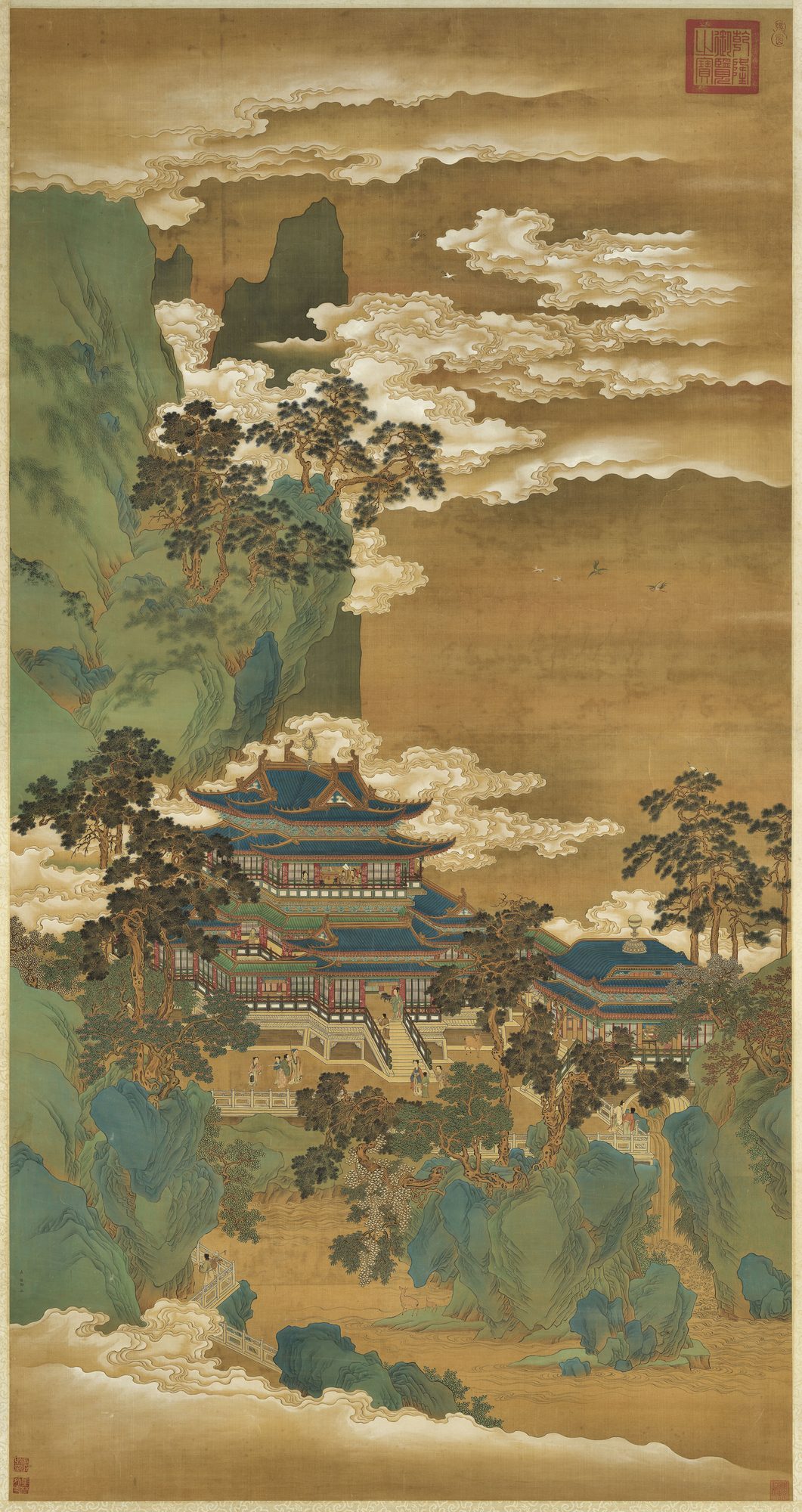
Set your face to the northwest, past the edge of the maps, and there is a hill that is not a hill. The oldest surveyor’s catalogue of the Chinese world, the Classic of Mountains and Seas, comes to it after four hundred li of walking and records it in a single flat, staggering line: this is the earthly capital of the God. Not a shrine to him, not a road toward him. His capital, set down on the earth, the one place where the divine world comes to rest against the ground. Everything else the text says about Kunlun follows from that first claim, and none of it is ordinary.
A tiger’s body, nine tails
You would not get in easily. The hill is kept by a god the text calls Luwu, and it describes him the way it describes everything, as a plain inventory of parts that add up to something you would not want to meet on a mountain path: a tiger’s body, nine tails, a human face, a tiger’s claws. His work is not guard-duty in any small sense.
He governs the nine regions of Heaven and keeps the seasons of the God’s private parkland, a divine gamekeeper with the sky itself as his estate. Guo Pu, reading the text four centuries on, thought Luwu was the same being another book called Jianwu, the god who dwells on the great mountain, and left the identification as a note in the margin rather than a correction. The mountain has always drawn commentary that circles it without quite pinning it down.
Where the Yellow River rises
Out of this one hill the whole watershed of the world is born. The rivers rise from its corners like taps opened at the four quarters: the Yellow River from the northeast, the Red Water from the southeast, the Yang Water and the Black Water from the northwest. To stand on Kunlun, in this reckoning, is to stand at the source of everything that flows.
The Huainanzi, coming later, keeps the picture but shuffles the list, swapping the Black Water for the Weak Water, the river so thin that nothing at all will float on it, not a feather, not a leaf, and calls the four together the god’s divine springs. Both books agree on the shape of the idea even where they disagree on the names: the water of the inhabited world drains down from a single sacred height.
A second description in the same Classic pulls back to show the scale, and the scale is deliberately impossible. The hollow of Kunlun is eight hundred li square and ten thousand ren high. On its summit grows what the text calls tree-grain, five xun tall and five spans around, a stalk of millet swollen to the size of a forest.
On each face are nine wells, and the well-heads are railed with jade; on each face are nine gates, and every gate is kept by the Kaiming beast, a thing with a tiger’s body and nine human-faced heads, all of them turned to the east. This, the text says without elaboration, is where the hundred gods dwell. It is a walled city of the divine, and the numbers are not measurements so much as a kind of incantation, nine and nine and ten thousand, a mountain built out of the most auspicious figures the language had.
The drug of no-death
And it is a place where death can be refused. Among its trees stands the deathless tree itself, and beside it the pearl-tree and the patterned-jade tree, an orchard of minerals bearing fruit. East of the gate-warden wait six shamans with names like a roll-call, Wu Peng and Wu Di and four more, and every one of them holds up the drug of no-death, warding death off at the summit of the world.
Almost nobody reaches them. The text is blunt about the difficulty: on the crag of the eight corners, at the edge of the Red Water, none but benevolent Yi, the great archer, could climb the rocks of that ridge. Kunlun is where immortality grows, and it is fenced by a cliff that only a hero out of legend has ever scaled.
A mountain that became a stair
That is one Kunlun, a colossal earthly mountain. The Huainanzi offers another, and rather than choose between them the honest thing is to set them side by side, because they are different cosmological registers of the same holy place. In the Huainanzi the mountain is not a mass but a stair. Climb to twice its height and you reach the Mountain of Cool Wind, and merely to stand there is to become deathless.
Climb twice as high again and you reach the Hanging Garden, and there you become numinous, able to command the wind and the rain. Climb twice again and you reach Heaven itself, and there you become a god, for this is the dwelling of the Supreme Thearch. The physical peak has turned into a three-runged ladder between earth and sky, each rung a higher grade of transcendence, and its top is not a summit but Heaven.
Beneath it the same book buries a second city. The flood-queller Yu, the sage-king who drained the great deluge, is said to have dug down under the hollow of Kunlun and found within it a walled inner keep of nine tiers, the Layered Wall, with four hundred and forty gates.
Its height is given with a lunatic, wonderful precision: eleven thousand li, one hundred and fourteen paces, two feet and six inches, a figure measured to the inch on a thing no rule could ever reach. And in its pool the Yellow Water circles three times and returns to its own source, and there they call it the Cinnabar Water, and of that water the text says only, drink it and you do not die.
At dawn he sets forth
The poets came here in the spirit, not the body. The spirit-flight to Kunlun is a fixed motif of the Songs of Chu, and in the Li sao the shaman-poet takes the road at a gallop: at dawn he sets forth, by dusk he has reached the Hanging Garden; he fords the White Water and tethers his horse on the height of Langfeng; he wheels his course toward Kunlun down a road that runs long and far, roaming all around; he crosses the Flowing Sands and lingers along the Red Water. It is the same geography the Classic mapped, now travelled as an inner journey, the mountain reached by ecstasy rather than by climbing.
The Tian wen, the Heavenly Questions, does the boldest thing of all: it refuses to answer. Kunlun and its Hanging Garden, where do they lie? The Layered Wall of nine tiers, how many li high? The gates of the four quarters, who passes through them? The northwest gate stands open, what breath flows through it?
The same vocabulary the other books used as fact, the nine-tiered wall, the Hanging Garden, the open gate in the northwest, is turned here into a string of unanswerable riddles. Three books, three Kunluns: a physical mountain of jade and monsters, a ladder whose top is Heaven, and a question mark set down in the far corner of the world. They never resolved into one picture, and the tradition is richer for leaving all three standing.
Xiwangmu on a separate peak
Xiwangmu keeps her seat in this landscape, though the earliest texts place her carefully at its edge rather than its centre. In the Classic she is on Jade Mountain, a separate peak, a tiger-toothed and leopard-tailed numen of plague and cosmic punishment; a little further on she is set north of the Kunlun void, leaning on her stool in the sheng headdress while three green birds fetch her food. The gracious immortality-queen enthroned upon Kunlun itself is a later fusion. In the classical sources the mountain does not belong to her. It belongs to the God, and to the water, and to the deathless trees, and to whoever is bold enough to climb.
Kunlun and its Hanging Garden: where do they lie? The Layered Wall of nine tiers: how many li high? The gates of the four quarters: who passes through them? The northwest gate stands open: what breath flows through it? (Chuci, “Tian wen”; author’s rendering from the Chinese)
- Shanhaijing (山海經, Classic of Mountains and Seas), Xishan jing · Xi ci san jing (西山經·西次三經, Third Classic of the Western Mountains): the Hill of Kunlun as
the earthly capital of the God
(帝之下都); its guardian god-beast Luwu (陸吾), tiger-bodied with nine tails, a human face and tiger’s claws, whogoverns the nine regions of Heaven and the seasons of the God’s parkland
(司天之九部及帝之囿時); the four rivers rising from its corners (河/赤/洋/黑); and the shatang tree whose fruit keeps one from drowning (食之使人不溺). The neighbouring Jade Mountain (玉山) is the seat of Xiwangmu. Compiled c. 4th–1st c. BCE, with Guo Pu’s (郭璞, 276–324 CE) commentary glossing Luwu as identical to Jianwu (肩吾). Chinese read verbatim (zh.wikisource.org). EnglishAnne Birrell, The Classic of Mountains and Seas (Penguin, 1999). - **Shanhaijing, Hainei xijing (海內西經, Within the SeasWest):** the monumental Kunlun — 800 li square and 10,000 ren high (方八百里,高萬仞), the tree-grain (木禾) on its summit, nine jade-railed wells and nine gates on each face, each gate kept by the Kaiming beast (開明獸, tiger-bodied with nine human faces, standing facing east);
where the hundred gods dwell
(百神之所在); the deathless tree (不死樹), pearl-tree and patterned-jade tree, and the six shamans east of Kaiming holding the drug of no-death (不死之藥); and the crag at the edge of the Red Water thatnone but benevolent Yi (仁羿) could climb.
Xiwangmu placed north of the Kunlun void (在昆侖虛北). Chinese read verbatim. - Huainanzi (淮南子), Dixing xun (墬形訓, Treatise on Topography), Book 4, comp. 139 BCE under Liu An (劉安): the three-tiered ascent — the Mountain of Cool Wind (涼風之山,
climb it and you will not die
), the Hanging Garden (懸圃,climb it and you become numinous, able to command the wind and rain
), and Heaven itself,the dwelling of the Supreme Thearch
(太帝之居); Yu’s (禹) digging beneath Kunlun’s base to reveal the nine-tiered Layered Wall (增城九重) with its 440 gates, its height given as11,000 li, 114 paces, 2 feet 6 inches
; the fourdivine springs
(帝之神泉, the list swapping the Weak Water 弱水 for the Classic’s Black Water); and the Cinnabar Water (丹水), the Yellow Water that circles thrice and returns to its source, of whichdrink it and you do not die
(飲之不死). Chinese read verbatim. EnglishJohn S. Major et al., The Huainanzi (Columbia UP, 2010). - Chuci (楚辭, Songs of Chu), Li sao (離騷, On Encountering Trouble), attrib. Qu Yuan (屈原), c. 3rd c. BCE: the shaman-poet’s spirit-flight — from Cangwu to the Hanging Garden by dusk (朝發軔於蒼梧兮,夕余至乎縣圃), the fording of the White Water and the tethering of the horse on Langfeng (登閬風而緤馬), the wheeling of his course toward Kunlun along a road
long and far, roaming all around
(邅吾道夫崑崙兮,路脩遠以周流), and the crossing of the Flowing Sands and lingering along the Red Water (遵赤水而容與). Chinese read verbatim. EnglishDavid Hawkes, The Songs of the South (Penguin, rev. 1985). - Chuci, Tian wen (天問, Heavenly Questions), attrib. Qu Yuan: Kunlun posed as an open cosmological riddle — the location of Kunlun and its Hanging Garden, the height of the nine-tiered Layered Wall, who passes the gates of the four quarters, and the breath flowing through the open northwest gate (崑崙縣圃,其凥安在?增城九重,其高幾里?四方之門,其誰從焉?西北辟啓,何氣通焉?). Note the shared vocabulary with the Huainanzi縣/懸圃 the Hanging Garden, 增城九重 the nine-tiered Layered Wall. Chinese read verbatim.