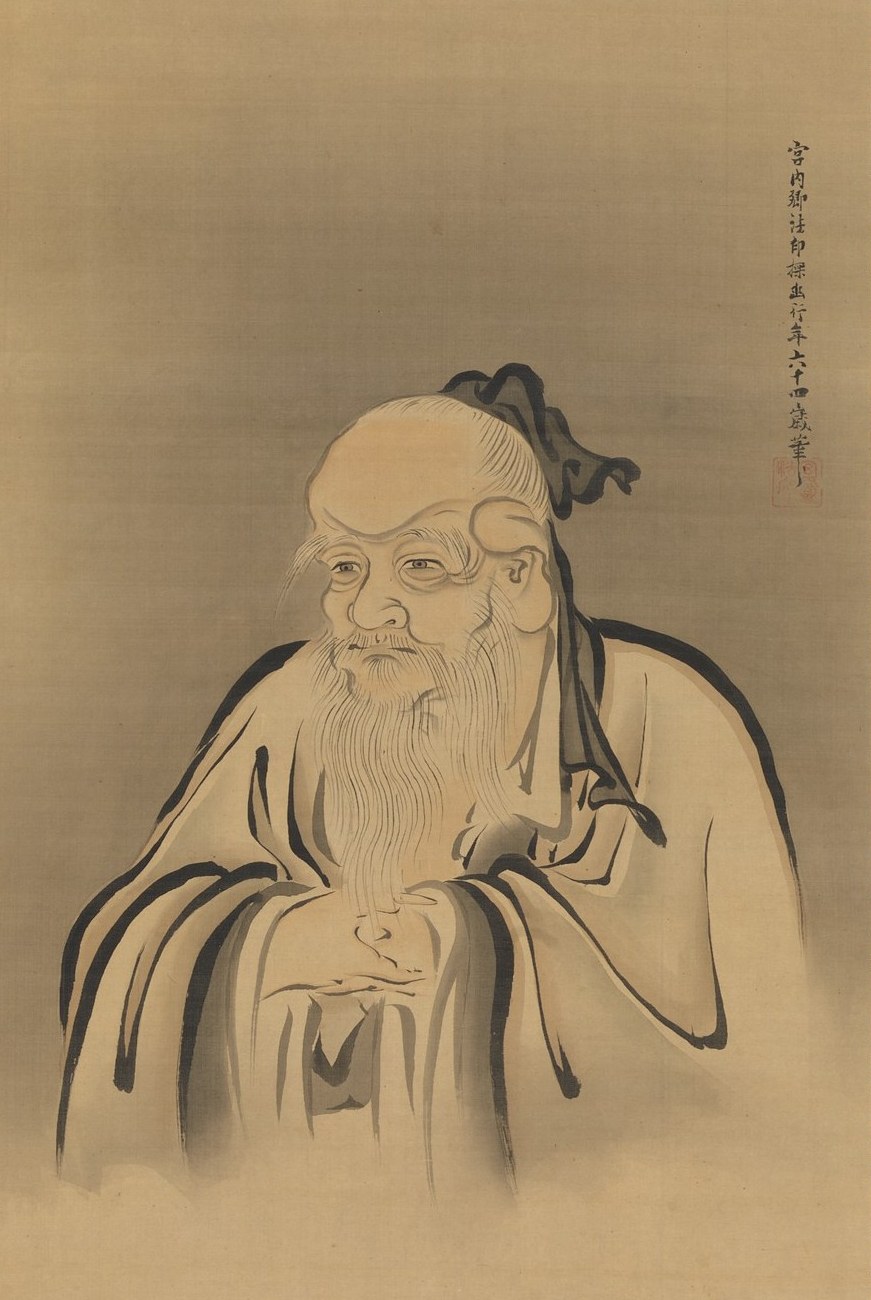
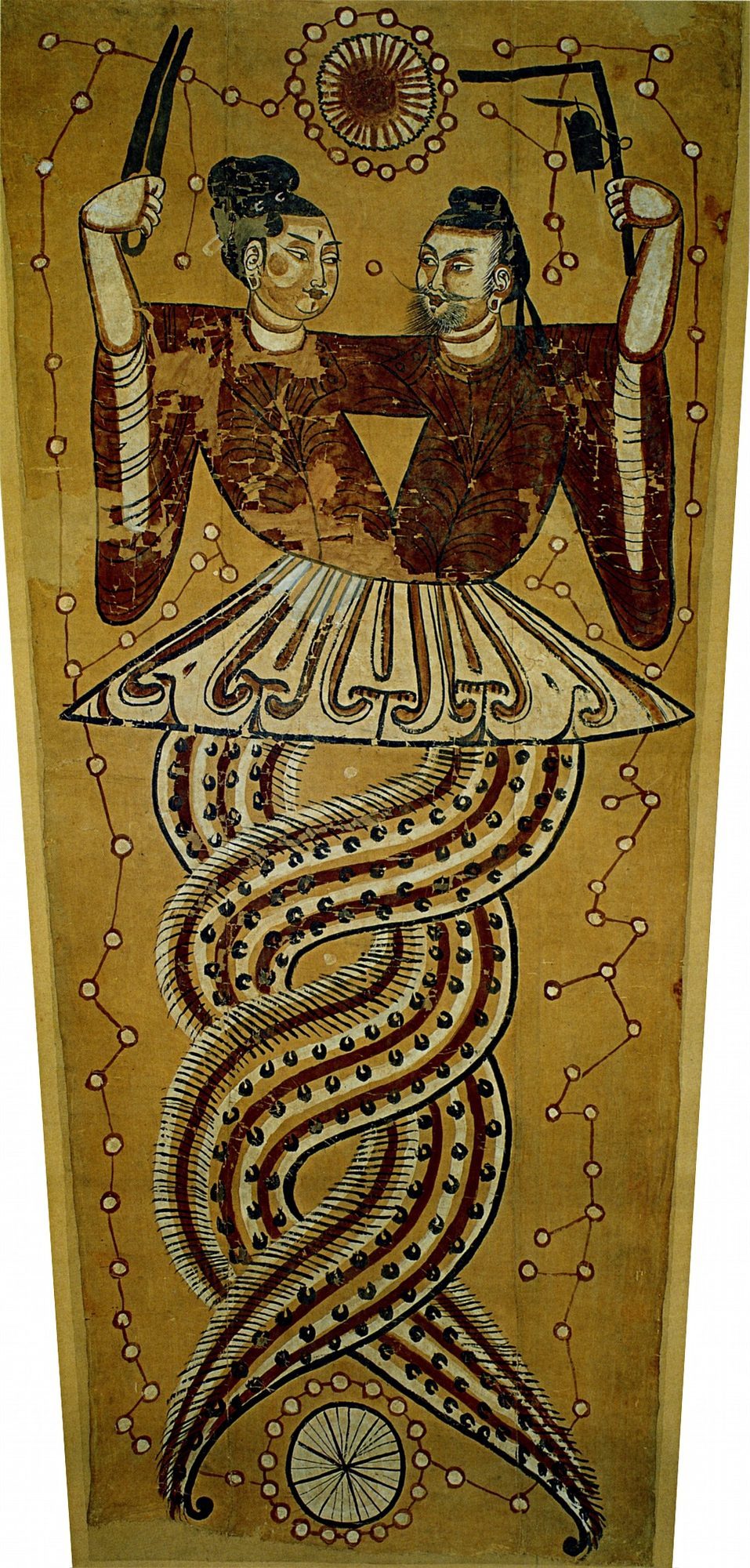
He ruled the world, the oldest account of him says, and he ruled it by looking. Looking up, he read the images hung in heaven; looking down, he read the patterns laid on the earth. He studied the markings on birds and beasts and the fitness of the ground, took what was near from his own body and what was far from the things around him, and out of all that watching he first made the eight trigrams. Three lines each, broken or unbroken, standing for heaven and earth, water and fire, thunder and wind, mountain and lake: a set of eight small diagrams meant to comprehend the powers of the spirits and to sort the dispositions of the myriad things. Before writing, before law, before the plough, there was a man who taught himself to read the cosmos and wrote down what he saw in the plainest possible marks.
This is Fuxi, and the passage that gives him to us is not one of the mythic compendia you might expect. It is the Xici, the Great Commentary appended to the Book of Changes, and it is worth pausing on how much of the standard Fuxi rests on this single stretch of text. The trigrams come from here. So does his next and equally famous invention.
In the same breath the commentary has him knot cords into nets and snares, using them to hunt and to fish, an idea it says he drew from the hexagram Li, the sign of fire and clinging and the mesh. The image is deliberately humble and exact: not a god hurling gifts down from a cloud but a figure sitting with lengths of cord, tying them into a lattice fine enough to hold a fish. The trigrams read the world; the net feeds the people who live in it. Both are the work of the same patient hands.
The sequence of sovereigns
The Xici also fixes his place in a sequence, and the sequence is the point. Fuxi is not a lone inventor but the first in a relay of sovereigns. When he passed, the commentary says, Shennong arose and shaped wood into a ploughshare and a plough-handle and opened the marketplace. Civilisation is handed down the line like a torch, and Fuxi holds it first.
He is counted, in the Han text that most clearly says so, as first of the Three Sovereigns, the sanhuang. That same text pauses to record its own uncertainty about the other two: the Three Sovereigns are Fuxi, Shennong and Suiren, it says, and then adds, some say Fuxi, Shennong and Zhurong. The lists disagree about who else belongs in the first age of the world. They do not disagree about who came first.
The husband-and-wife way
That Han text, the Baihu Tong, gives us the other half of Fuxi, the half that is about people rather than tools. Here he again looks up at the images of heaven and down at the forms of earth, but what he founds this time is the moral order. On the basis of the union of husband and wife he regulated the Five Phases, first fixed the way of humanity, and drew the eight trigrams to govern the world below.
Marriage is placed at the root of everything that follows, the first institution from which the rest of human order grows. The same book offers a folk etymology of his name to match: because he subdued the people and transformed them, he is called Fuxi, the fu being the character for subduing or bringing to rest. It is not sound linguistics, but it is the text’s own understanding of what he was for. He is the one who settled a wild humanity into shape.
Not the inventor of writing
There is a temptation, at this point, to hand him one more gift: writing. It is the natural fourth item after trigrams, fishing and marriage, and popular accounts award it to him freely. The sources will not allow it. The very passage that makes him the maker of the trigrams is careful about script. In high antiquity, it says, they governed by knotted cords, and later sages replaced these with written tablets.
Fuxi made the knotted cords, the ones he tied into nets; the writing that superseded them belongs explicitly to unnamed later sages, and the tradition of character-invention attaches not to Fuxi but to Cangjie, the four-eyed scribe of a different legend. What survives is only an oblique link, the much later notion that the trigrams were a kind of proto-script, the germ from which real writing grew. To say flatly that Fuxi invented writing is to say something his own foundational text quietly denies. His genuine inventions are strange and specific enough without it: the eight small diagrams, and the mesh of knotted cord.
Added by later hands
Around this textual core, later ages built the Fuxi most people can picture. In the cosmology of the Huainanzi he appears under another name, Taihao, the Great Brightness, as the green god of the East, presiding over Wood and over Spring, his aide Goumang wielding the compass and governing the season and the sunrise quarter of the sky. It is a gorgeous image, though the seam shows: that passage says Taihao, and it is later scholarship that fuses this eastern spring-deity with the culture-hero of the trigrams into a single Fuxi. The same book pairs him warmly with Nüwa, the two of them praised as rulers who set up no statutes and no regulations and yet left the highest virtue to the ages that came after.
And a birth-legend gathered around him too, in which his mother Huaxu conceives by stepping into the footprint of a thunder-giant at the Thunder Marsh. The oldest geography of China, the Shanhaijing, does describe a thunder-god there, dragon-bodied and human-headed, drumming on his own belly, but it never names Fuxi, never mentions Huaxu, and never ties the god to either. That connection was made by commentators long afterward, reaching back to borrow a vivid image the original text had left unclaimed. It is a good rule for reading him: the trigrams and the net are his in the earliest layer, and almost everything else was added by hands that loved him.
Fuxi looked up and observed the images in heaven, looked down and examined the patterns of earth; on the basis of husband and wife he regulated the Five Phases, first fixed the way of humanity, and drew the eight trigrams to govern the world below. (Baihu Tong, ch. 1; author’s rendering from the Chinese)
- Yijing (易經), Xici II / Great Commentary Part 2 (繫辭下) §2: the locus classicus for Fuxi. He observes the images of heaven and the patterns of earth, the markings of birds and beasts, and first makes the eight trigrams (始作八卦) to comprehend the powers of the spirits and classify the myriad things; he knots cords into nets and snares for hunting and fishing (作結繩而為罔罟,以佃以漁), an idea drawn from the hexagram Li (離); the relay to Shennong (the plough and the marketplace); and, crucially, writing (書契) assigned to later sages (後世聖人), not to Fuxi. Chinese read verbatim (zh.wikisource.org/wiki/易傳/繫辭下). For a citable English sentence, quote a named translation and re-verify; the wording above is the author’s own literal rendering from the Chinese.
- Baihu Tong (白虎通義), ch. 1 (號), attrib. Ban Gu, 1st c. CE: Fuxi as founder of marriage and the human moral order (因夫婦,正五行,始定人道,畫八卦以治下); the folk etymology of his name (治下伏而化之,故謂之伏羲也); and the Three Sovereigns list, with the source’s own recorded variant of the third name (Fuxi, Shennong, Suiren; or Fuxi, Shennong, Zhurong). Chinese read verbatim (zh.wikisource.org/wiki/白虎通/卷01). English translation for the marriage passageIvanhoe & Van Norden, Readings in Classical Chinese Philosophy (Hackett, 2nd ed. 2005) p. 379.
- Huainanzi (淮南子), Tianwen xun (天文訓), c. 139 BCE: Taihao (太皞) as god of the East, of Wood and of Spring, with the aide Goumang (句芒) who wields the compass and governs spring (執規而治春). The text names Taihao, not Fuxi; their identification is a Han-era synthesis. Chinese read verbatim (zh.wikisource.org/wiki/淮南子/天文訓).
- Huainanzi (淮南子), Lanming xun (覽冥訓): Fuxi (written 伏戲) and Nüwa as sage-rulers who set up no statutes or regulations yet left the highest virtue to later ages (不設法度而以至德遺於後世). Chinese read verbatim (zh.wikisource.org/wiki/淮南子/覽冥訓).
- Shanhaijing (山海經), Hainei Dong jing (海內東經): the thunder-god of Leize, dragon-bodied and human-headed, drumming his belly (雷澤中有雷神,龍身而人頭,鼓其腹) — background for the later birth-legend only. The Shanhaijing does not name Fuxi, Huaxu, or link them to this god; the Fuxi-at-Leize connection is later commentary. Chinese read verbatim (zh.wikisource.org/wiki/山海經/海內東經).
- **Anne Birrell, Chinese MythologyAn Introduction** (Johns Hopkins UP, 1993) p. 44: on the later merger of the eastern divinity Taihao with the culture-hero Fuxi. Scholarship, not a primary source.
- Diwang shiji (帝王世紀) (Huangfu Mi, 3rd c. CE): the later birth-legend of Huaxu conceiving Fuxi at Leize by stepping into a thunder-giant’s footprint. Later tradition; cited via summary, re-verify before quoting.