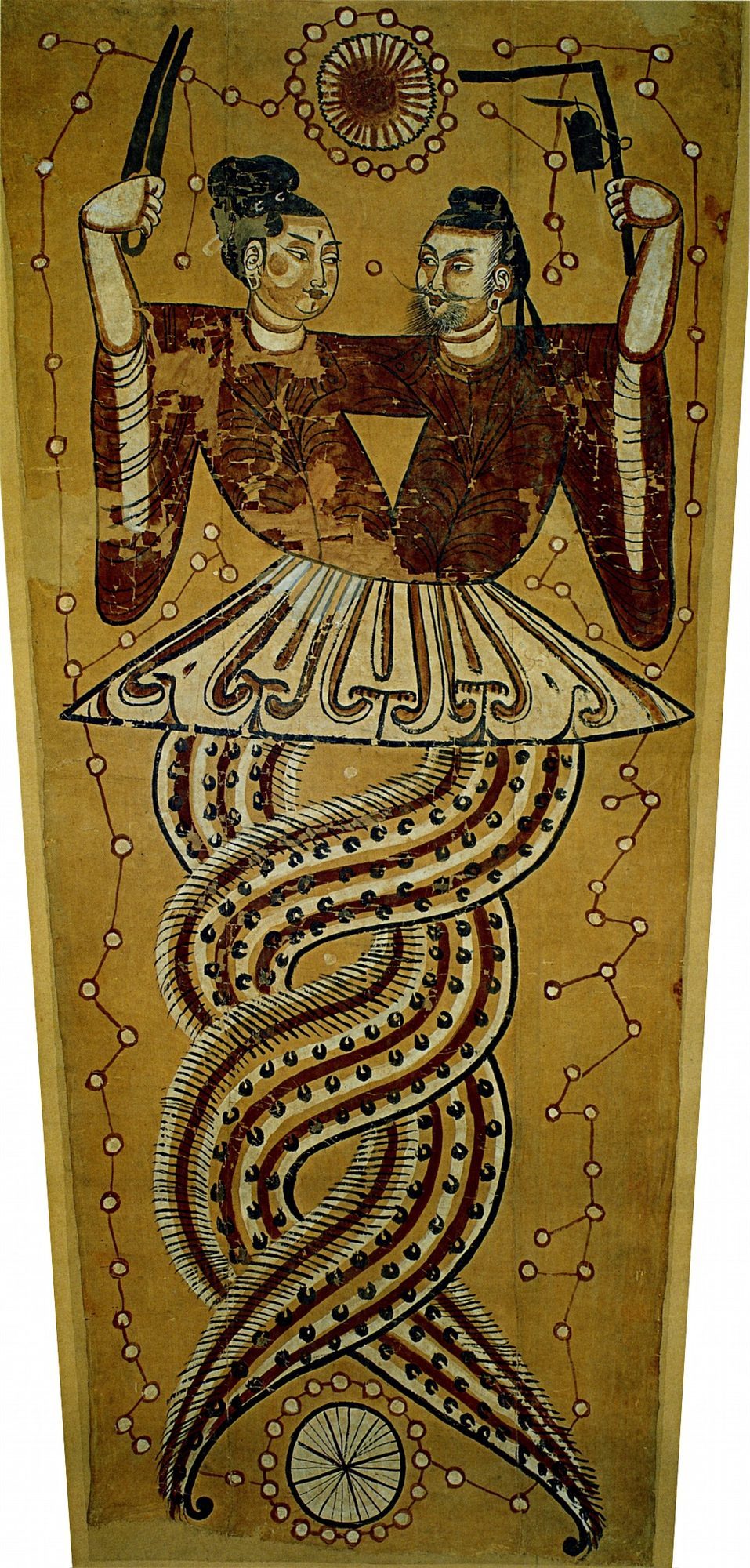
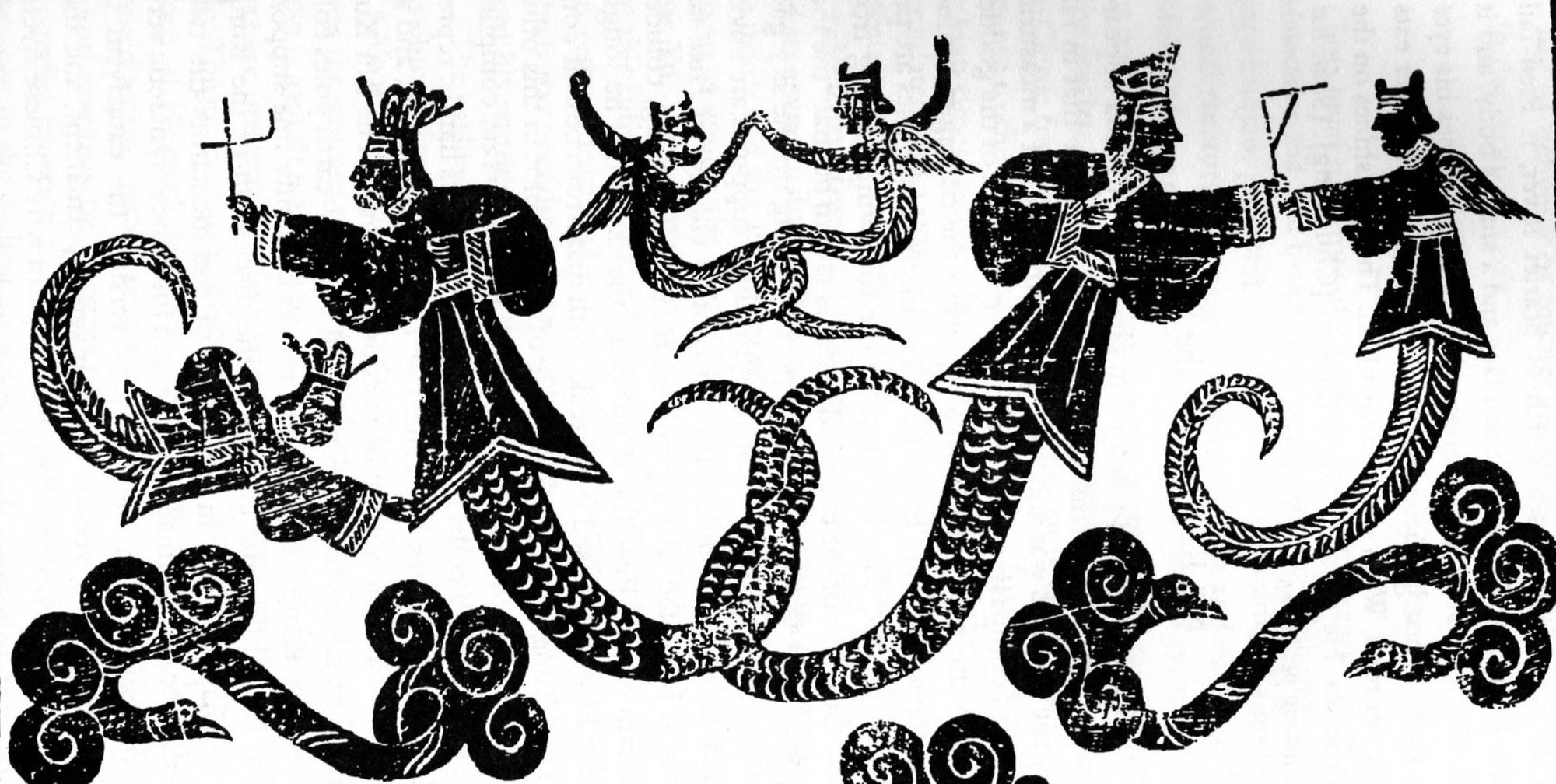
Look at the wall of a Han tomb and you may find them there, cut into the stone: two figures with human faces and human arms, and below the waist two long serpent tails that leave off being separate and wind about each other, loop over loop, like the strands of a twisted rope. Each figure holds a measuring tool, a carpenter’s square and a pair of compasses between them, the instruments for ruling a straight line and scribing a true circle, though which holds which varies from tomb to tomb. Above their heads float two small discs, the sun with its raven and the moon with its toad. This is the oldest picture we have of Fuxi and Nüwa as a couple, and it is a picture before it is ever a story. The stone shows you that they belong together, tail knotted into tail, long before any surviving text will tell you how.
Scaled body, serpent’s trunk
The earliest words to give the pair their reptile shape describe a painting too. Around the middle of the second century the poet Wang Yanshou walked through a palace hall in the old state of Lu and set down what was painted on its walls, and among the murals of the world’s first age he found this line: Fuxi with a scaled body, Nüwa with a serpent’s trunk. He placed them at the head of the line of first beings, beside the Five Dragons flying wing to wing and the nine-headed Human Sovereign, in the utmost antiquity of the beginning.
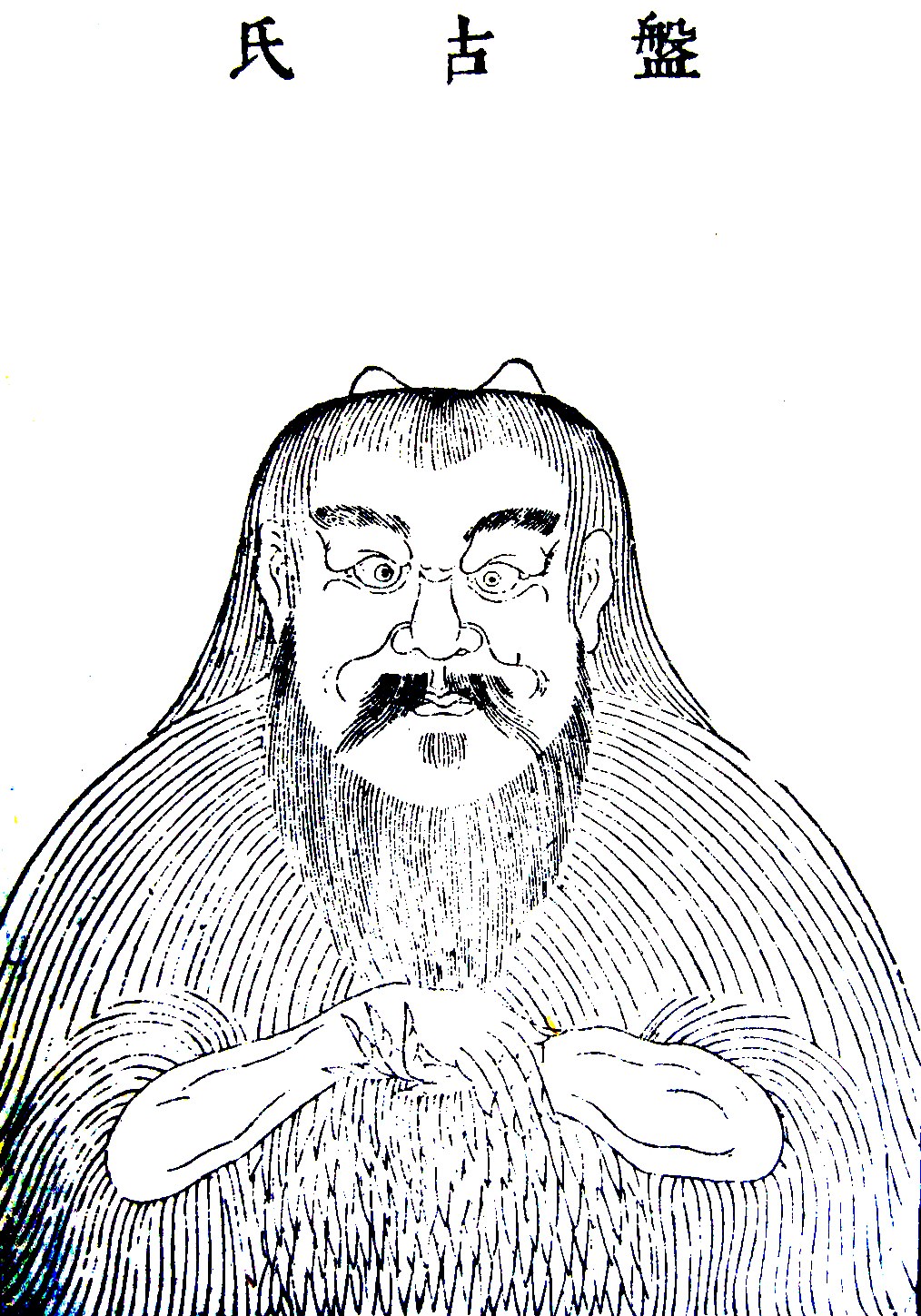
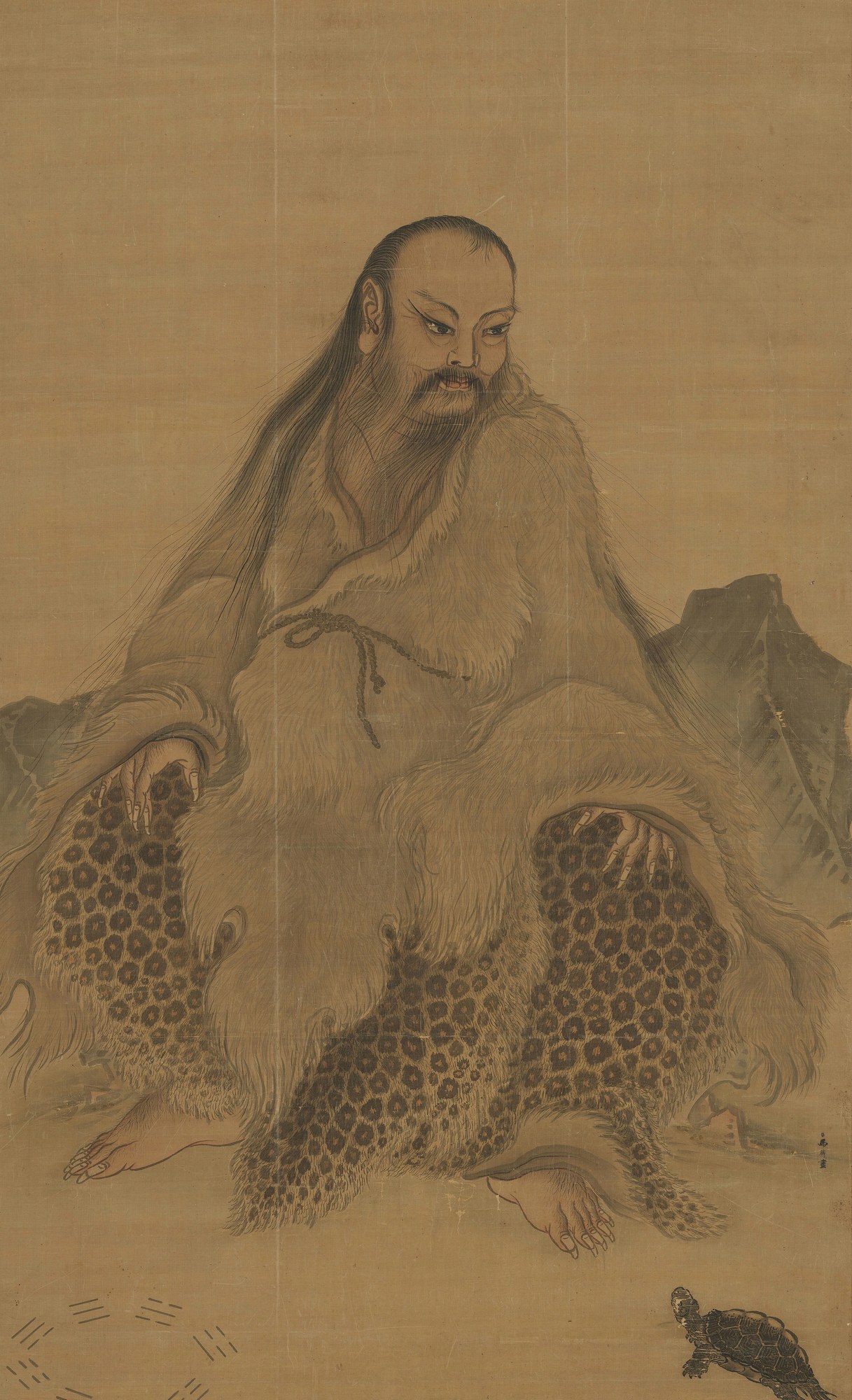
Even here, at the start, the sources will not agree on what the two of them looked like. A commentary preserves two older tags side by side: one book calls them both serpent-bodied and human-faced, another gives Fuxi a dragon’s body and keeps only Nüwa a serpent. A third tradition makes them both ox-headed and tiger-nosed. The human face we imagine for them is not in every early witness.
What all these witnesses share is the shape and the pairing. What none of them contains is a wedding. The image of the couple is old; the story of their courtship is not, and the gap between the two is the first thing worth being honest about.
Seven hundred years between the picture and the tale
The intertwined tails on the tomb walls are Eastern Han work, from around the second century of the common era. The tale of how Fuxi and Nüwa came to marry survives first in the Duyi Zhi, a Tang collection of zhiguaiA genre of short "records of the strange": brief anecdotal tales of the marvellous and uncanny, collected in China from the early medieval period onward. put together somewhere between 846 and 874. That is close to seven hundred years later, a longer stretch than separates us from the first printing press.
It is easy, looking at the knotted stone, to feel that the wedding must be as ancient as the image, and easy to write as though the carvers and the storyteller were describing one seamless myth. They were not, on the evidence that has come down to us. The Han gave us the bodies twined together; the Tang gave us the reason they twined. Read the two as one and you flatten seven centuries into a single afternoon.
The two fires on the mountain
Here is what the Tang storyteller records. When the cosmos had first opened there were only two people in all the world, Nüwa and her elder brother, living on Mount KunlunThe great mythic mountain of the Chinese west, an axis between earth and heaven and home to gods and immortals in the early tradition., and no human beings anywhere below them. They talked of becoming husband and wife, and were ashamed. So the brother took his sister up the mountain and put the matter to Heaven, laying the choice on a sign: if Heaven meant the two of them to marry, let the smoke of their fires gather together; if not, let it scatter. They lit their fires. The smoke rose and gathered into one column. And the sister came to her brother.
It is a small, exact piece of theatre. Two fires, two people, one question put to the sky, and the answer written in whether the smoke drifts apart or draws into a single rope of grey above the mountain. The prayer does not ask Heaven to permit what the couple already want; it asks Heaven to choose, and abides by the sign. The shame is not resolved by argument. It is resolved by an omen, and the omen consents.
A fan of woven grass
Then comes the detail the story is really built around. The sister, still ashamed, wove grass into a fan and held it up to screen her face. And the text closes with the line that turns the whole anecdote into an origin: that people today take a wife holding a fan is an image of this very event. A single woven object carries the entire etiology.
Every bride who has since gone to her husband with her face screened is repeating, without knowing it, the gesture of the first sister on Kunlun, hiding her face behind a fan of plaited grass because the only man in the world was her brother. The story does not excuse the union so much as explain a custom by it. This is why we do the thing we do; it began up there, in the smoke.
The Divine Matchmaker
Beside the courtship tale runs a second, drier strand that makes the point in the language of institutions rather than anecdote. A lost Han work, the Fengsu Tongyi, survives in a Song compilation in a single sentence: Nüwa prayed and sacrificed to the gods, prayed to become the marriage-broker, and so instituted marriage; the use of go-betweens clearly began from her. The same compilation’s own text has her assist TaihaoA title, "Great Brightness," under which Fuxi is worshipped in the received tradition as first of the Three Sovereigns., rectify the surnames, take charge of weddings, and promote the go-between, so as to give weight to the pairing of the myriad people, and for this she is titled the Divine Matchmaker.
The private act on the mountain and the public office are two faces of one claim: that the first marriage was between these two, and that every marriage after it, with its matchmaker and its screened bride, descends from theirs.
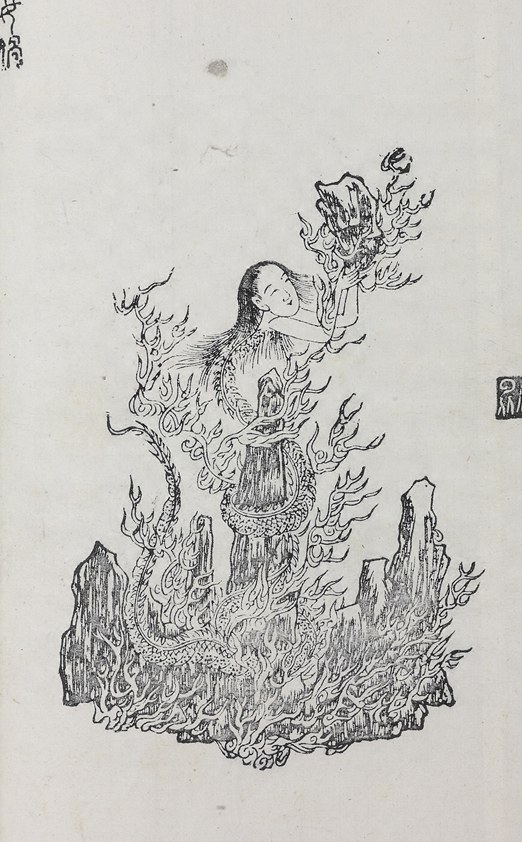
Not every source will grant even that the two were ever a couple. One early dictionary that glosses Nüwa’s name says nothing of a brother or a husband. Another tradition makes her not Fuxi’s wife but his successor on the throne, a Female Sovereign who inherited his institutions. A medieval writer is on record flatly denying that she was ever Fuxi’s wife at all. Sister, spouse, successor: the tradition holds all three at once and never quite decides. What it keeps returning to, in stone and in text alike, is the twist of the two tails, the sign that whatever else they were, they were a pair.
If Heaven sends the two of us, brother and sister, to be husband and wife, let this smoke gather together; if not, let it scatter. (Duyi Zhi, juan shang; author’s rendering from the Chinese)
- Wang Yanshou (王延壽),
Lu Lingguang Dian Fu
(魯靈光殿賦), in the Wenxuan (文選) juan 11: the line 伏羲鱗身,女媧蛇軀 (Fuxi with scaled body, Nüwa with serpent’s trunk
), from a description of murals in a Western-Han hall, placing the pair at the head of the first beings beside the Five Dragons and the nine-headed Human Sovereign (poet Eastern Han, fl. c. 124–148 CE; anthology comp. c. 520–530 CE; Li Shan commentary Tang, fl. 658 CE). Chinese read verbatim (zh.wikisource). - Li Shan (李善) commentary to the Wenxuan juan 11: the two earliest shape-tags — 列子曰:伏羲、女媧,蛇身而人面 (the Lieziboth serpent-bodied, human-faced) and 玄中記曰:伏羲龍身,女媧蛇軀 (the Xuanzhongji: Fuxi dragon-bodied, Nüwa serpent). The dragon/serpent variant is present from the start. Liezi and Xuanzhongji read only as quoted here, not in their own editions.
- Li Rong (李冘), Duyi Zhi (獨異志), juan shang (卷上), late Tang (c. 846–874 CE): the sibling marriage on Mount Kunlun, the smoke-omen (煙悉合 / 煙散), the grass fan, and the etiological close 今時人取婦執扇,象其事也. The earliest surviving full telling of the courtship; a zhiguai record, not a Han text. The mountain is Kunlun in the primary text; the relocation to Huashan is a modern retelling.
- Ying Shao (應劭), Fengsu Tongyi (風俗通義), c. 195 CE, quoted in Luo Bi (羅泌), Lushi (路史) juan 11 (Southern Song, c. 1170 CE): 女媧禱祠神,祈而爲女媒,因置昬姻,行媒始此明矣 — Nüwa as instituting marriage and the go-between, the Divine Matchmaker (神媒). A Song-transmitted quotation of a lost Han text, roughly a thousand years of transmission, not a Han manuscript.
- Huangfu Mi (皇甫謐), Diwang Shiji (帝王世紀), c. 3rd c. CE, quoted in the Taiping Yulan (太平御覽) juan 78: Nüwa 蛇身人首 and 承庖犧制度 (
inherited Fuxi’s institutions
), 是爲女皇 — the successor-sovereign framing alongside the spouse one. A Song-era quotation (TPYL comp. 983 CE), not the original. - Iconography (scholarly, not a primary quotation): the Wu family shrines (武梁祠) Han reliefs, Jiaxiang, Shandong (c. 2nd c. CE), and the Astana tomb paintings, Turpan (Tang) — the intertwined serpent tails, the flanking sun and moon discs, and the compass and square. Which tool goes to which deity is not fixed across the images; the common
Fuxi holds the square, Nüwa the compass
gloss is a modern interpretation, sometimes reversed. ReferenceN. Vampelj Suhadolnik, Asian Studies 7.2 (2019). No specific Wu Liang cartouche wording is quoted here, as the carved label text was not verified this session.