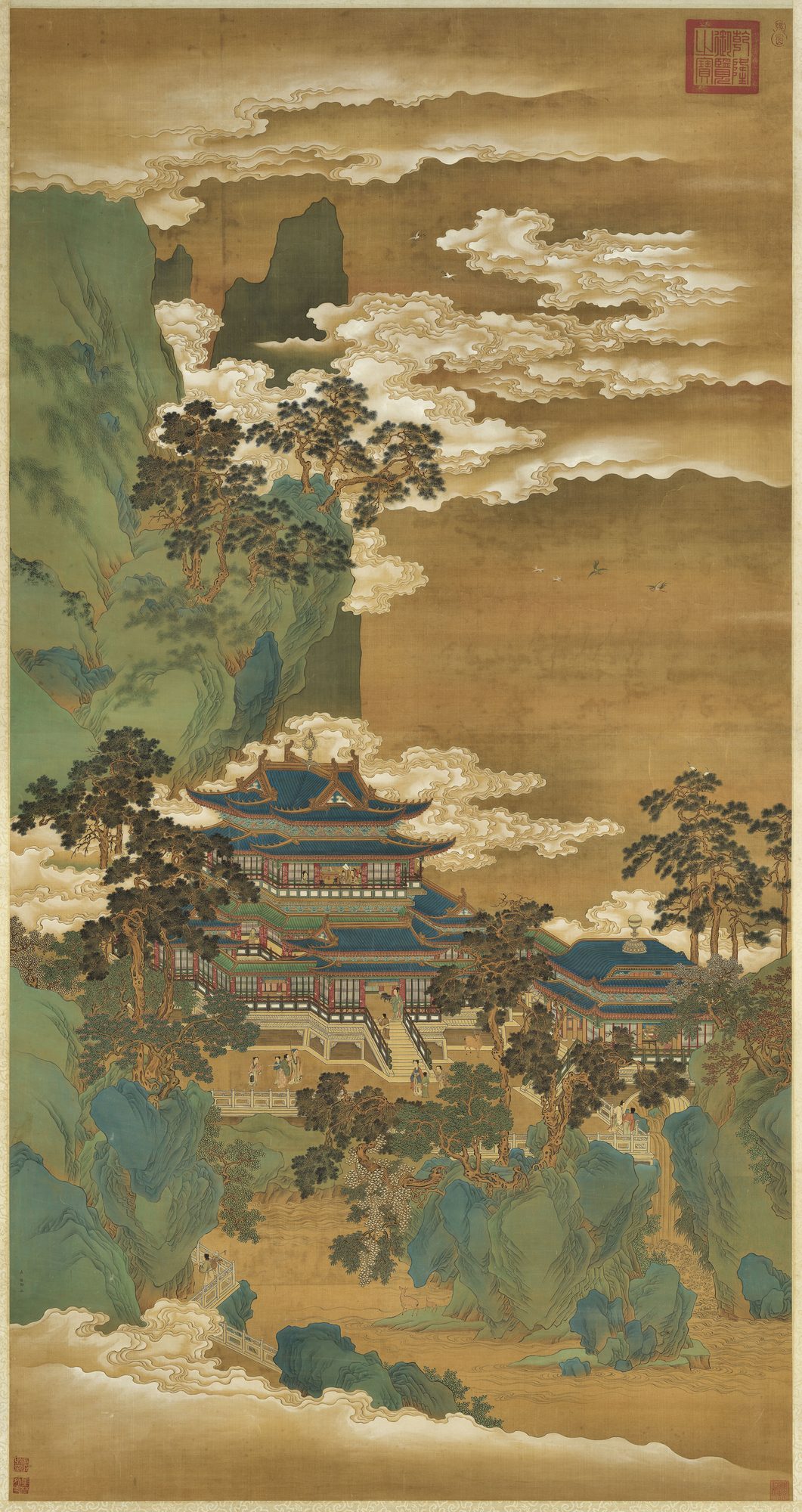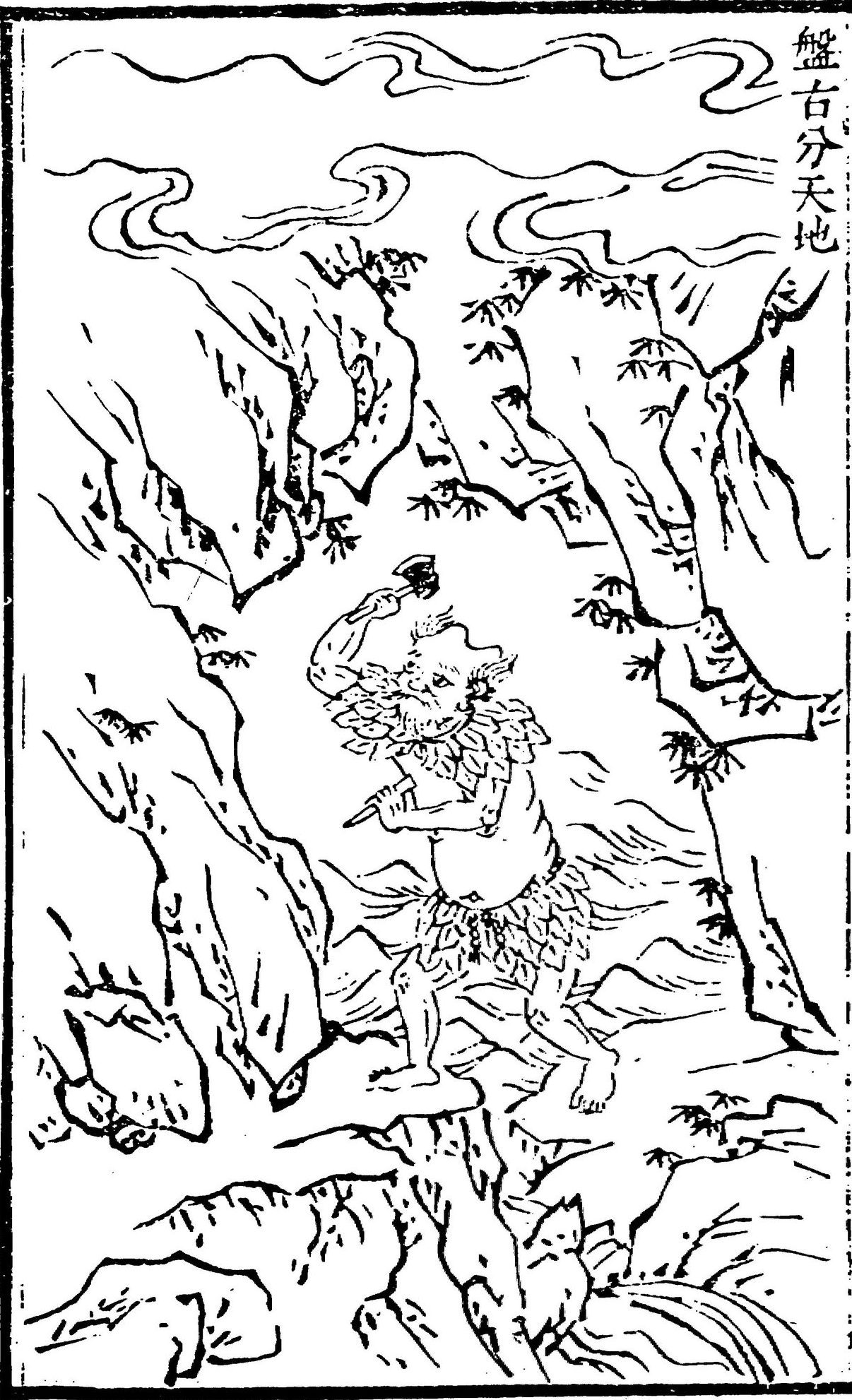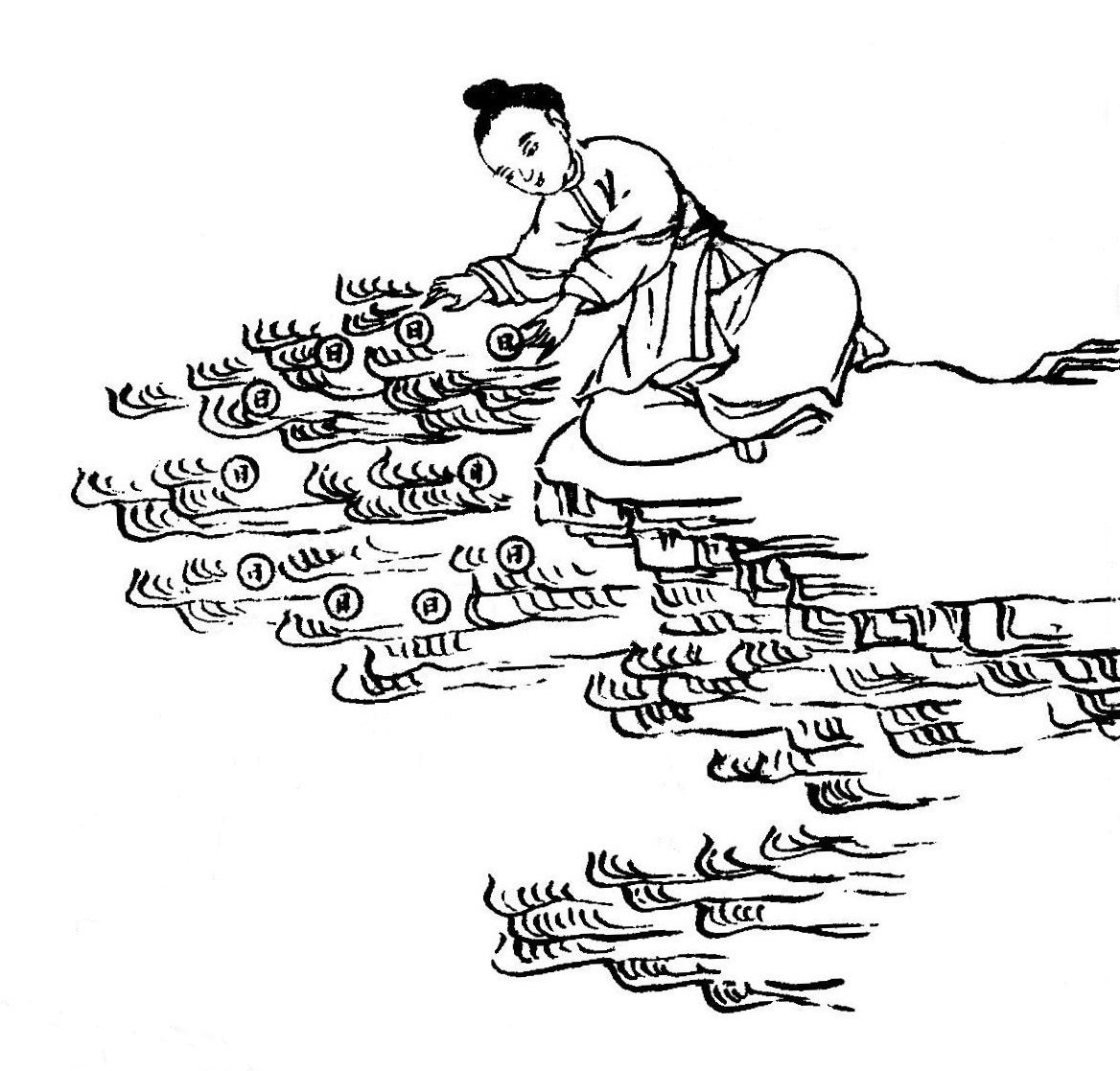
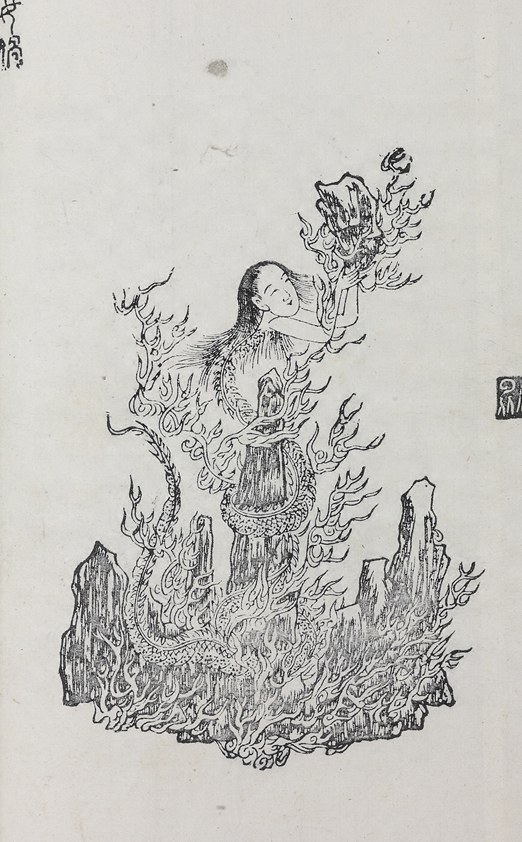
The world was already broken when she came to mend it. The four pillars that held up the sky had given way and the Nine Provinces lay cracked apart; Heaven no longer covered everything, Earth no longer bore everything up. Fire blazed and would not be quenched, water flooded and would not subside. Fierce beasts ate the living, and birds of prey stooped on the old and the weak. No text of this earliest layer says who caused the ruin. It simply hands us a cosmos coming undone and, in the middle of it, a goddess with a serpent’s lower body and a human face.
Four acts of cosmic carpentry
What she did next is the most famous thing in her story, told in four swift strokes in the Huainanzi, a text assembled around 139 BCE. She smelted stones of five colours and with them patched the azure sky. She cut the legs off the great turtle and stood them upright as the four poles of Heaven. She killed the black dragon to deliver the flooded province of Jizhou.
She piled up the ashes of burnt reeds and with them dammed the overflowing waters. Four acts, each a piece of cosmic carpentry: patch the roof, prop the corners, clear the threat, stop the leak. The order matters, and so does the strangeness of the materials. Not thunderbolts but smelted stone and hacked turtle-legs and reed-ash, the tools of a craftswoman rather than a warrior.
The beasts hid their fangs
The repair took. The sky was whole again, the four poles set right, the flood dried up, Jizhou made level; the crafty vermin died and the people lived. And then a stranger detail, easy to miss and impossible to forget once seen: in the aftermath the beasts drew in their claws and fangs, swallowed their venom, and lost the very appetite to seize and bite. The mending is not only structural.
It reaches down into the temper of living things and calms them. This is the deed later readers loved to pair with the water-god Gonggong, who in a separate passage of the same book cracks the sky-pillar by butting his head against Mount Buzhou. It is a natural fit, the vandal and the repairwoman, and popular tradition has long told it as one story. But the join is ours, stitched across two passages. The account of her repair names no culprit at all.
The potter of living clay
If the sky-mending shows her as the cosmos’s engineer, a different strand shows her as its potter. It survives only as a fragment, quoted centuries later in a Song encyclopedia but attributed to Ying Shao around the turn of the third century. In the beginning, it says, when Heaven and Earth had opened but there were as yet no people, Nüwa knelt and patted yellow earth into human shape. She made them one at a time with her hands until the labour outran her strength.
So she took a cord, trailed it through the wet mud, and lifted it out heavy and dripping, and the clots that fell from it became people too. From this the fragment draws a hard little moral: the rich and noble are the hand-made, yellow-earth people, and the poor and common are the cord-made ones. It is worth resisting the urge to smooth this into a single tender image of a mother shaping her children. The story is explicitly one of two batches, the crafted few and the mass-produced many, an origin myth with a class ceiling built in.
The first matchmaker
The same fragment gives her a third office. Having made people, she prayed at the shrine of the god and became the first matchmaker, the 女媒, and so instituted marriage. A parallel line preserved in the great Kangxi dictionary has her assist Fuxi, regulate the surnames, and take charge of weddings, for which she was called the divine matchmaker, the 神媒. She does not merely populate the world; she gives it the rule by which it goes on populating itself.
Strange fragments
Around this triple core the sources scatter stranger fragments. The Shuowen Jiezi, the first great Chinese dictionary, glosses her name in six characters that carry the whole weight of her nature: an ancient divine woman who transformed the myriad things. The Liezi files her among a handful of beings, serpent-bodied and human-faced, who wore no human shape yet held the virtue of the greatest sages, and a commentary tradition credits her with seventy transformations in a single day.
Even a musical instrument is hers: the Liji names her the maker of the sheng, the reed mouth-organ whose upright pipes still sigh in Chinese music. And in the one line the Shanhaijing spares her, the transformer is herself transformed, in the most literal way imaginable. Out in the wilderness of Liguang lie ten spirits, and their name is Nüwa’s Intestines: ten gods formed from her own guts, sprawled across the road. Whatever else she is, she is a body that turns into other things, down to her entrails.
Without a genealogy
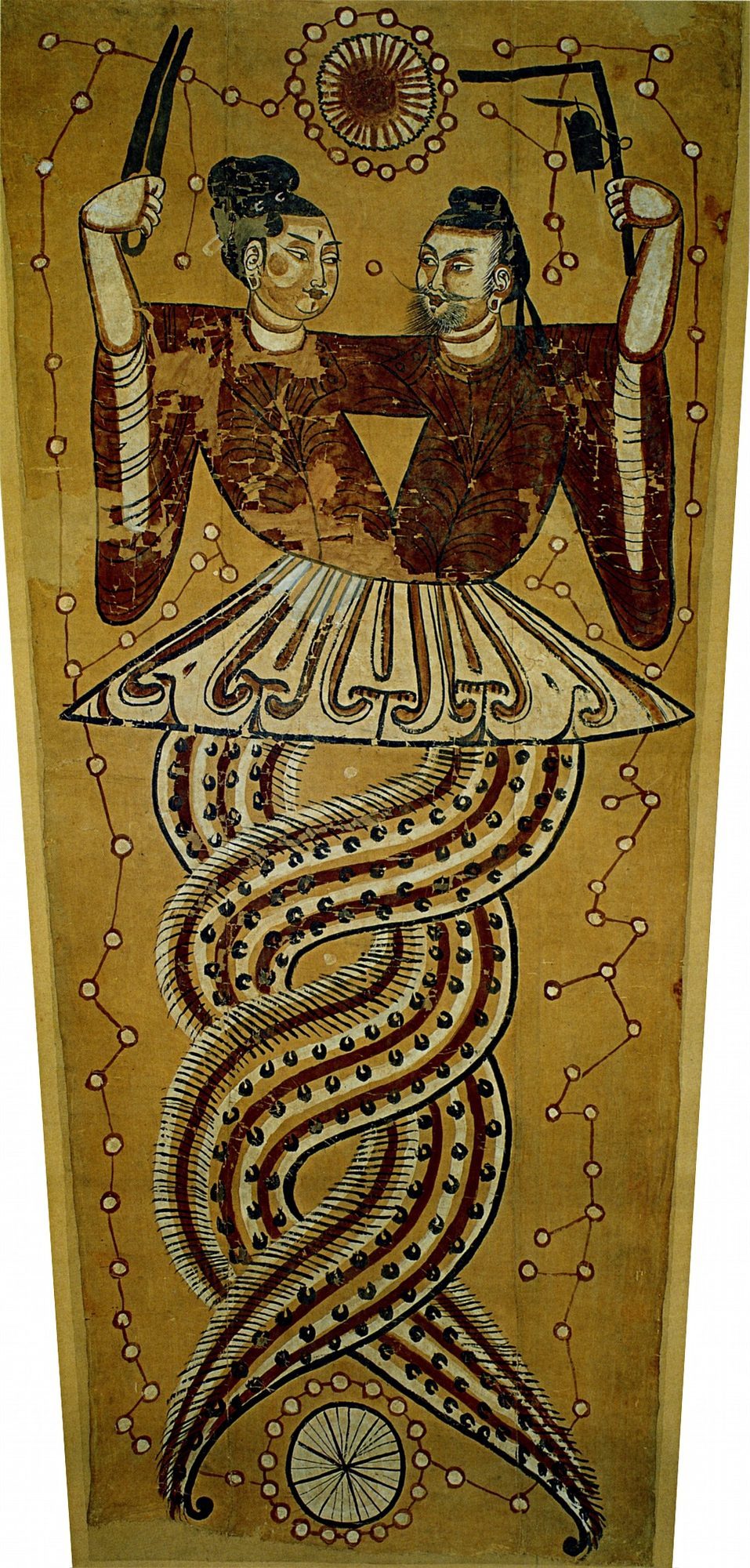
One thing the early record withholds is a family. Nüwa arrives without parents, without a genealogy, so unmoored that the Chuci stops to ask the obvious question of a maker who is herself made: Nüwa had a body, so who fashioned it? The later, beloved version in which she and Fuxi are brother and sister who marry to repeople the world after a catastrophe is a Tang-dynasty tale, arriving a thousand years after the Huainanzi, however ancient the entwined-serpent couples carved on Han tomb-tiles may make it feel. In the oldest layer she is singular. She kneads the first people, mends the only sky, and answers to no ancestor.
Nüwa had a body: who fashioned it? (Chuci, “Tianwen”; author’s rendering from the Chinese)
- Huainanzi (淮南子), Lanming xun (覽冥訓), c. 139 BCE: the sky-mending in four acts — smelting five-coloured stones to patch the azure sky (煉五色石以補蒼天), cutting the turtle’s legs to raise the four poles (斷鼇足以立四極), slaying the black dragon to rescue Jizhou (殺黑龍以濟冀州), and damming the flood with reed-ash (積蘆灰以止淫水); the restored cosmos and the beasts that hide their fangs; and the line pairing Fuxi and Nüwa as sage-rulers. Chinese read verbatim (ctext.org). Standard EnglishMajor, Queen, Meyer & Roth, The Huainanzi (Columbia UP, 2010), ch. 6, §6.7. The catastrophe’s cause (Gonggong and Mount Buzhou) comes from a separate passage (Tianwen xun), not from this text.
- Fengsu Tongyi (風俗通義), lost fragment (Ying Shao, c. 140–206 CE), preserved in Taiping Yulan (太平御覽) juan 78: the two-tier human-creation myth — yellow earth patted by hand (the noble) and the cord dragged through mud (the common) — and Nüwa as institutor of marriage / divine matchmaker (神媒). Survives only as a quoted fragment, not in the received text.
- Shanhaijing (山海經), Dahuang xi jing (大荒西經): the ten spirits
Nüwa’s Intestines
(女媧之腸) in the wilderness of Liguang — the sole Shanhaijing mention, and no sky-mending or human-making in it. EnglishAnne Birrell, The Classic of Mountains and Seas (Penguin, 1999). - Chuci (楚辭),
Tianwen
(天問): 女媧有體,孰制匠之? — the earliest text to puzzle over her own made body. - Shuowen Jiezi (說文解字) (Xu Shen, c. 100 CE): the gloss of 媧 as 古神聖女,化萬物者也,
an ancient divine woman who transformed the myriad things.
- Liji (禮記), Mingtang wei (明堂位): the sheng reed mouth-organ (笙簧) attributed to Nüwa (女媧之笙簧).
- Liezi (列子), Huangdi (黃帝篇): Fuxi, Nüwa, Shennong and Yu as serpent-bodied, human-faced beings of non-human form yet the virtue of great sages; the commentary tradition adds the
seventy transformations a day.
- Shiji (史記), as quoted in the Kangxi Zidian: 女媧煉五色石補天, showing the sky-mending was canonical in the Han historiographical tradition.
- Duyi Zhi (獨異志) (Li Rong, Tang dynasty): the late Nüwa–Fuxi sibling-marriage tale at Kunlun — later tradition, not ancient myth.