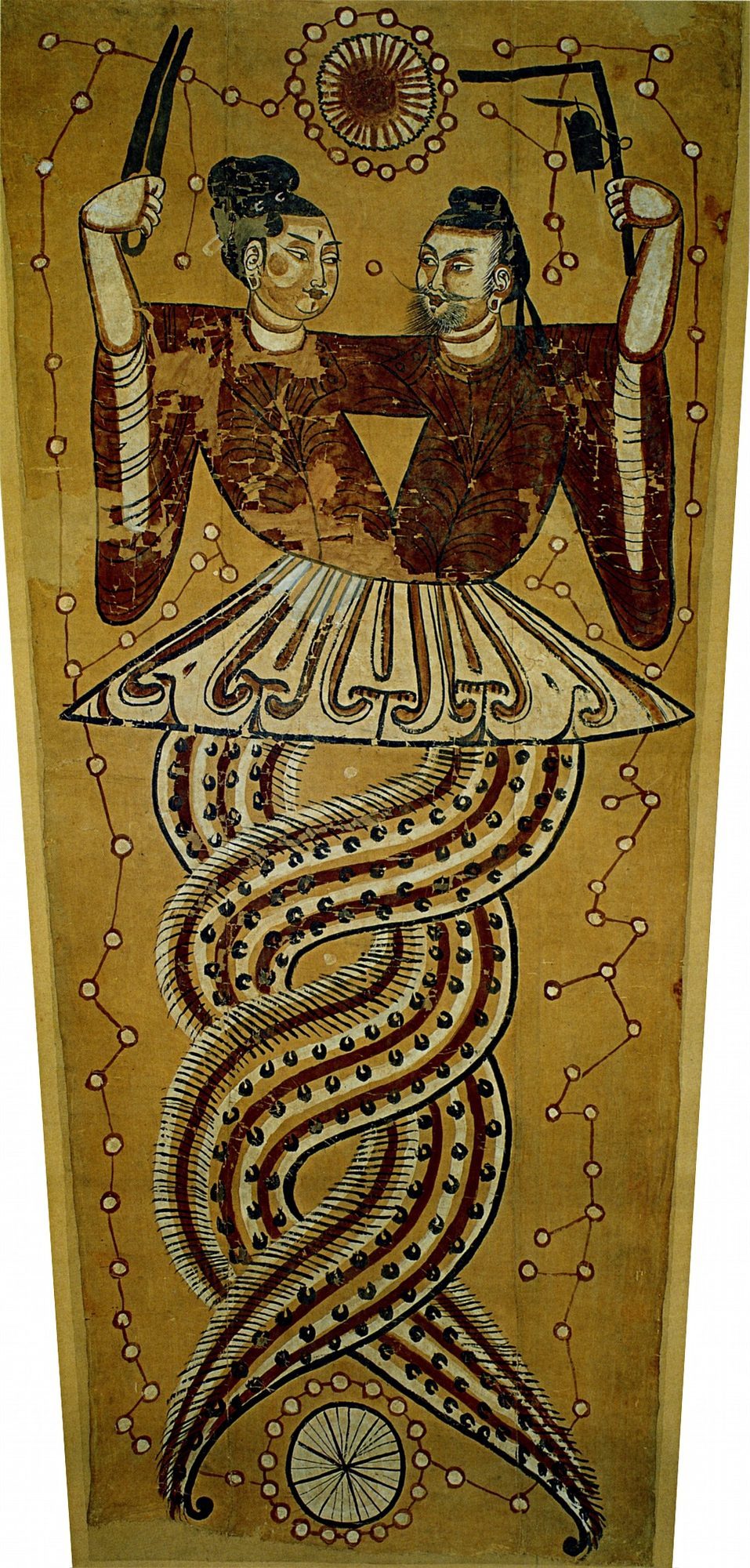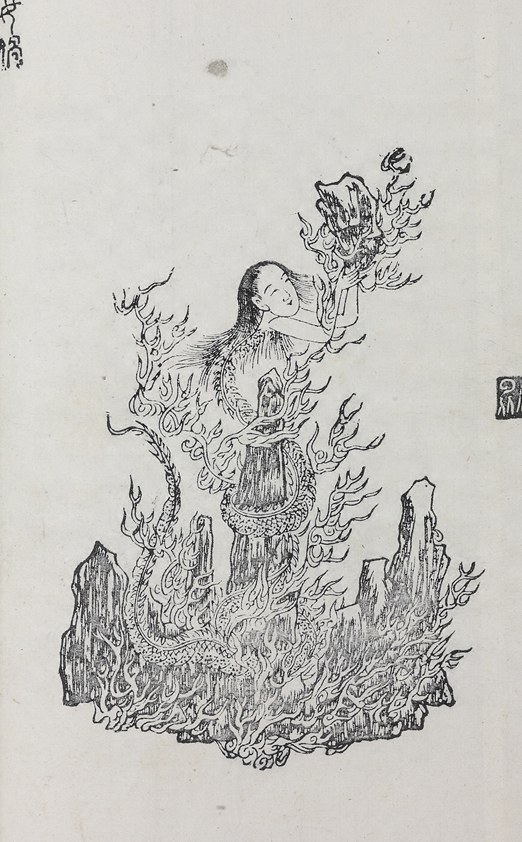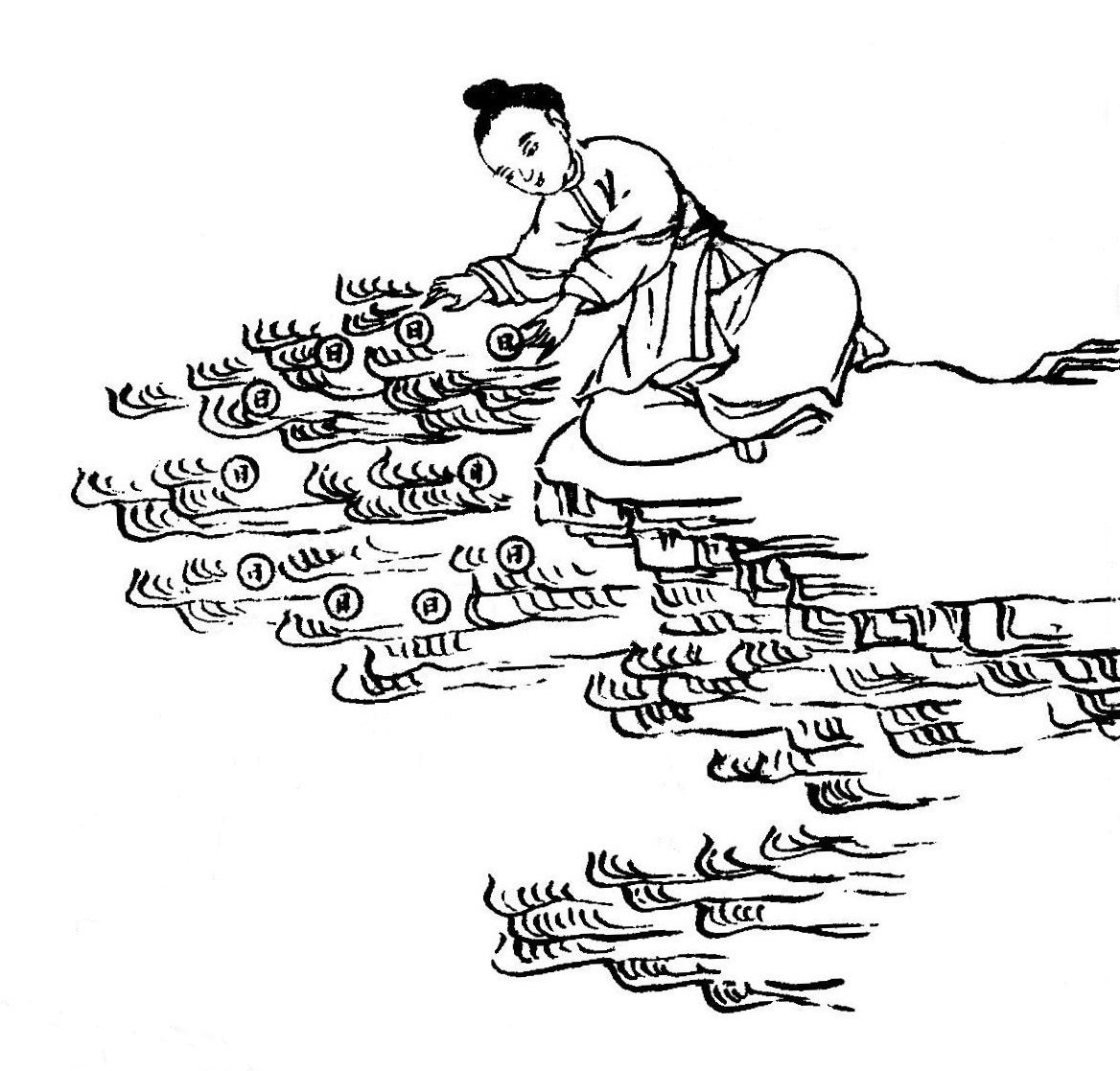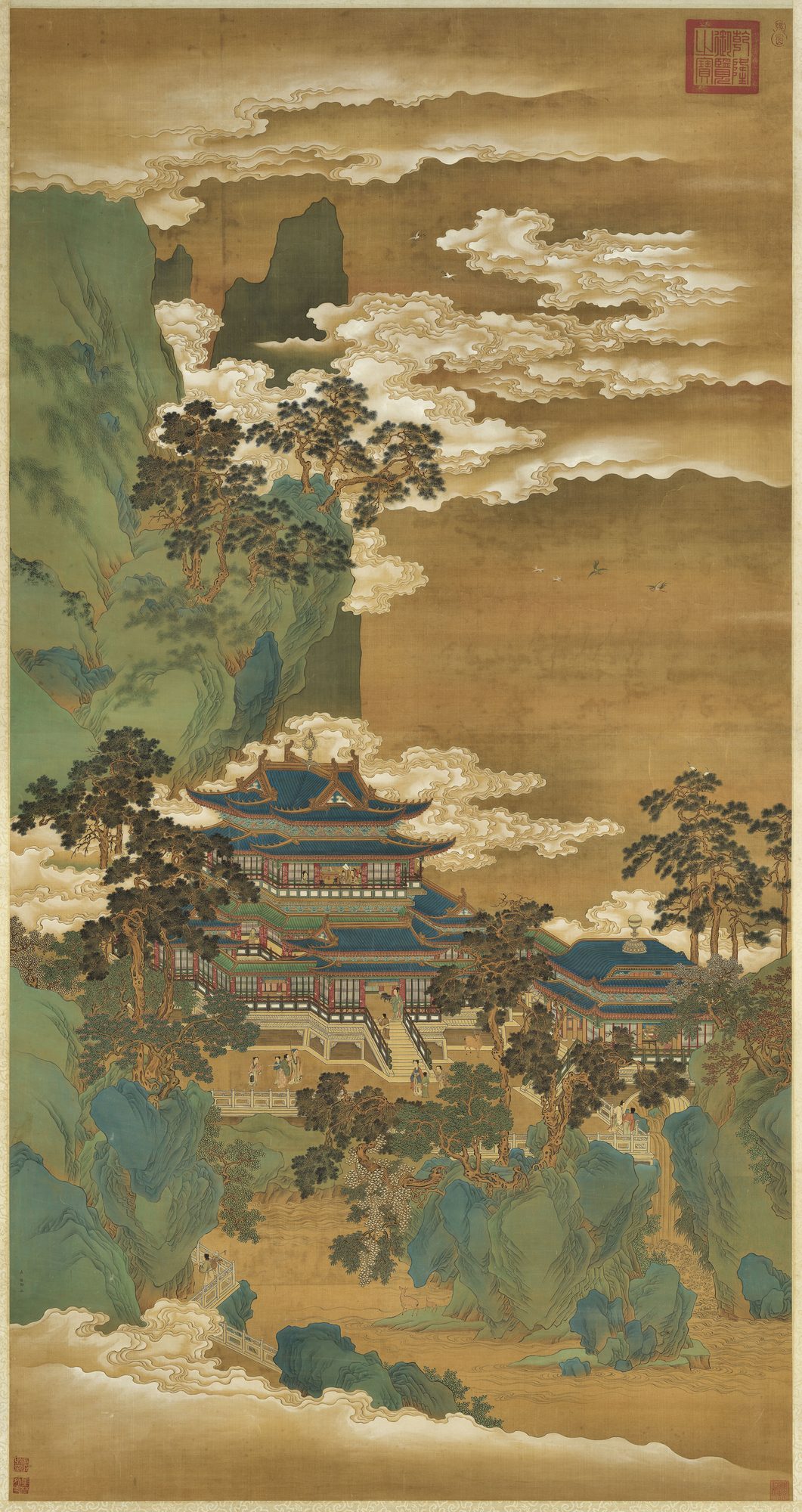
Before there was an up or a down there was an egg. Not a figure of speech and not a shining orb of light, but something the oldest surviving fragment describes with almost domestic plainness: the whole of Heaven and Earth lay mingled and murky together like a chicken’s egg,
a single lump of undivided chaos, and inside that shell a giant was born. His name was Pangu, and for the first stretch of his life he did nothing at all that we are told of. He simply grew, curled inside the dark, while eighteen thousand years went by around him.
Then the egg opened. What had been one thing came apart into two, along a line that Chinese cosmology would keep for the rest of its history: the clear and the bright rose upward and became Heaven, and the turbid and the heavy sank downward and became Earth. This is the whole physics of the thing in a single stroke. There is no maker standing outside the shell to crack it, no word of command. The light simply floats and the murk simply settles, and the giant who had been sleeping between them wakes into the gap.
One zhang taller every day
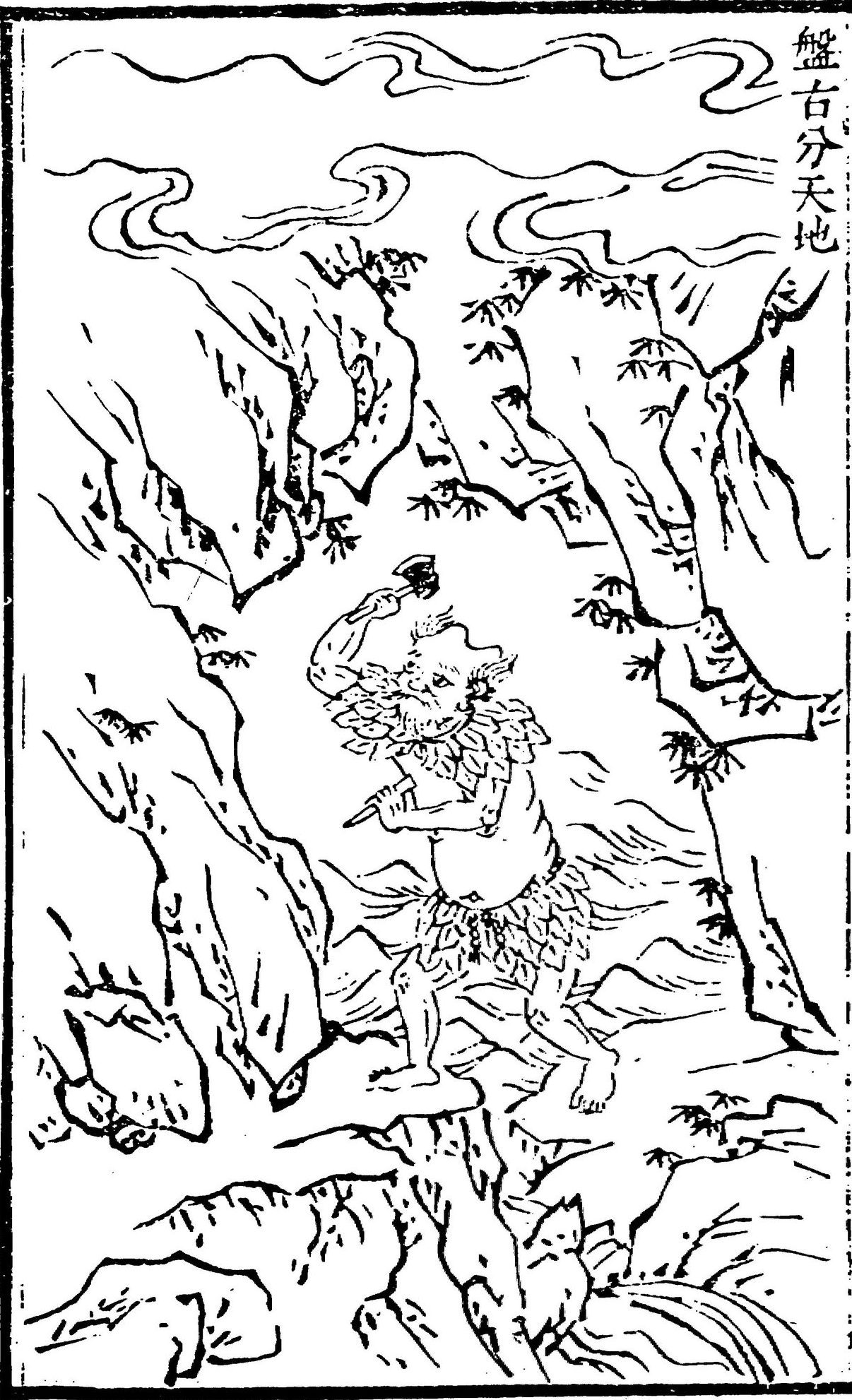
He does not rest in it. Pangu stands up in the narrow space between the new sky and the new ground, and he begins to change. Nine times transformed in a single day,
the fragment says, his body in ceaseless flux as he holds the two halves apart, divine in relation to Heaven, sagely in relation to Earth.
He is not quite a god and not quite a man but the living hinge between them, and the effort of him has a measurable rhythm.
Each day Heaven rose one zhang higher, a zhang being a real measure of roughly ten Chinese feet; each day Earth grew one zhang thicker; and each day Pangu himself grew one zhang taller to fill the widening distance. There is something almost mechanical in the image, an inch-by-inch inflation of the cosmos, sky and soil and giant all lengthening in lockstep at the same steady rate.
That went on for another eighteen thousand years. When it was finished, Heaven was as high as it could be, Earth as deep as it could be, and Pangu as tall as he could be. The fragment even gives the figure that resulted: Heaven stands ninety thousand li from Earth.
Only after all of this, the oldest text is careful to add, did the first rulers appear, the Three Sovereigns; the ordering of the human world comes late, long after the ordering of the physical one. This much is the story as Xu Zheng told it in his Sanwu Liji in the third century, and it stops there, with the sky lifted, the earth laid down, and the giant standing exhausted in a fully separated world.
Two fragments welded into one
What happens next comes from a different book, and the distinction is worth keeping rather than smoothing away. The account of Pangu’s death and its consequences is traditionally drawn from another of Xu Zheng’s works, the Wuyun Linian Ji, and many popular retellings quietly weld the two fragments into one seamless tale. They are two fragments, and the second is the stranger of them. In it, Pangu is the first-born,
and at the dawn of things, near death, his body is transformed. The word the text uses is the word for a metamorphosis, and what it describes is a giant dissolving into the furniture of the world.
His left eye became the Sun
The catalogue is precise, and it can be laid out almost one line to a piece. His breath became the wind and the clouds. His voice became the thunder. His left eye became the Sun and his right eye the Moon. His four limbs and the five points of his body became the four poles that hold up the sky and the Five Sacred Peaks. His blood ran out as the rivers; his sinews and veins settled into the contours of the land; his flesh became the fields and the soil.
His hair rose and scattered as the stars, and the fine hair of his skin sprouted as the grasses and the trees. His teeth and bones hardened into metal and stone, his marrow into pearls and jade, and his running sweat fell as the rain. There is no corner of the visible world, in this telling, that is not a piece of the dead giant’s anatomy. To look at a river is to look at his blood; to look up at night is to see where his hair came down.
Vermin off a corpse
And then the last item on the list, which is the most unsettling image in the whole of Chinese myth and is genuinely there in the fragment. The parasites that lived on Pangu’s body, the small creatures crawling on his skin, were stirred by the wind, and they became the common people. Humankind is not moulded from earth here and not breathed into being by a loving hand.
We are the vermin off a corpse, animated by a passing breeze, a by-product of the giant’s decay rather than its purpose. It is worth pausing on how little this flatters us, because the flattering alternative existed alongside it: the separate and much-loved tradition in which the goddess Nüwa shapes human beings out of yellow mud. The Pangu fragment offers no such tenderness. The world is his body and we are the lice that were living on it.
Accounts that never settled
Because the myth survives only in scraps quoted by later anthologists, its details never settled into a single official version, and the honest thing is to say so. By the sixth century, Ren Fang’s Shuyiji was recording several competing folk accounts of Pangu’s death in the same breath, one after another, without choosing between them. A Qin-Han popular saying
mapped his head and belly and arms and feet onto the five sacred mountains.
The earlier Confucian scholars
said his weeping became the rivers, his breath the wind, his voice the thunder, and the pupils of his eyes the lightning. An old saying
held that his moods still move the weather, his joy clearing the sky and his anger clouding it over. And a regional Wu-Chu saying
quietly rewrites the whole premise: there Pangu is not a lone giant at all but half of a married couple, Pangu and his wife together the beginning of yin and yang.
The single primordial body splits into two primordial partners, and the loneliest creation myth suddenly has company in it.
A tomb in the Southern Sea
The giant did not vanish once his body was spent, either, at least not in the eyes of the people who told his story. The Shuyiji reports, as a matter of present-day fact for its own sixth-century moment, that there was a tomb of Pangu in the Southern Sea more than three hundred li across, where the common folk said his soul had been buried, and a temple to him at Guilin where people still worshipped.
Those southern ties are part of why modern scholars such as Derk Bodde and Anne Birrell have linked the whole myth to the peoples of southern China, though that is interpretation laid over the fragments rather than anything the fragments say. What the old texts give us plainly is a giant who filled the space he made and then became it, so completely that his worshippers could still point to his grave.
Heaven and Earth were mingled and murky, like a chicken’s egg, and Pangu was born within it. After eighteen thousand years Heaven and Earth split open: the clear and bright became Heaven, the turbid and murky became Earth. (Sanwu Liji, in Yiwen Leiju juan 1; author’s rendering from the Chinese)
- Xu Zheng (徐整), Sanwu Liji (三五曆紀), 3rd c. CE, preserved verbatim in Yiwen Leiju (藝文類聚) juan 1 (comp. Ouyang Xun, 624 CE)the cosmic egg (天地混沌如雞子), Pangu born within it, the egg opening after 18,000 years and the parting of the clear-bright as Heaven and the turbid-murky as Earth (陽清為天,陰濁為地), the nine daily transformations (一日九變) and the
divine to Heaven, sagely to Earth
line (神於天,聖於地), the one-zhang-a-day growth of Heaven, Earth and Pangu alike, the final distance of 90,000 li between Heaven and Earth (天去地九萬里), and the Three Sovereigns appearing only afterward (後乃有三皇). Chinese read verbatim; the Yiwen Leiju fragment is explicitly headed 徐整《三五曆紀》曰 and stops at the 90,000-li line. It does not contain the body-transformation catalogue. - [Xu Zheng], Wuyun Linian Ji (五運曆年紀), 3rd c. CE, surviving only in Tang/Song anthology quotationPangu as
first-born
(首生盤古) and the transformation of his dying body (垂死化身) into the cosmos — breath to wind and cloud, voice to thunder, left eye the Sun and right eye the Moon, limbs and extremities the four poles and the Five Sacred Peaks, blood the rivers, sinews the land’s contours, flesh the soil, hair the stars, body-hair the plants, teeth and bones metal and stone, marrow pearls and jade, sweat the rain, and the parasites on his body becoming humankind (化為黎甿). Chinese read verbatim. Attribution note: the transformation catalogue is conventionally assigned to this work (Bodde, Birrell), not to the Sanwu Liji; a widely-circulated Wikisource page titled 三五曆記 splices both fragments under one heading, which is an editorial merge, not evidence that the catalogue is from the Sanwu Liji. - Ren Fang (任昉), Shuyiji (述異記), Liang dynasty (early 6th c.), juan 1the death of Pangu with four labelled variant traditions set side by side — the Qin-Han popular saying (秦漢間俗説: head, belly and limbs becoming the five Peaks), the earlier Confucian scholars (先儒説: weeping to rivers, breath to wind, voice to thunder, eye-pupils to lightning), an old saying (古説: joy to clear weather, anger to overcast), and the Wu-Chu regional saying (吳楚間説) that Pangu and his wife were
the beginning of yin and yang
(盤古氏夫妻,陰陽之始也); plus the Southern-Sea tomb300-odd li across
(南海有盤古氏墓,亘三百餘里) and the living temple at Guilin (桂林有盤古氏廟). Chinese read verbatim (Siku Quanshu edition). This source’seyes became the Sun and Moon
does not specify left/right; only the Wuyun Linian Ji line assigns left eye/Sun, right eye/Moon. - Taiping Yulan (太平御覽, 983 CE), juan 2 (天部)the Song imperial encyclopedia that also re-quotes the Xu Zheng Pangu fragments, the conventional second witness to the Sanwu Liji text. Cited as a cross-reference; not read word-for-word for this piece, since the identical facts are covered by the Yiwen Leiju text that was read verbatim.
- Derk Bodde,
Myths of Ancient China
(1961), and Anne Birrell, Chinese Mythology (1993)the standard modern treatments; the source of the Wuyun Linian Ji attribution and of the hypothesis linking the Pangu cult to the southern Miao, Yao and Zhuang peoples. Modern scholarship and interpretation, cited as such and not as primary text.