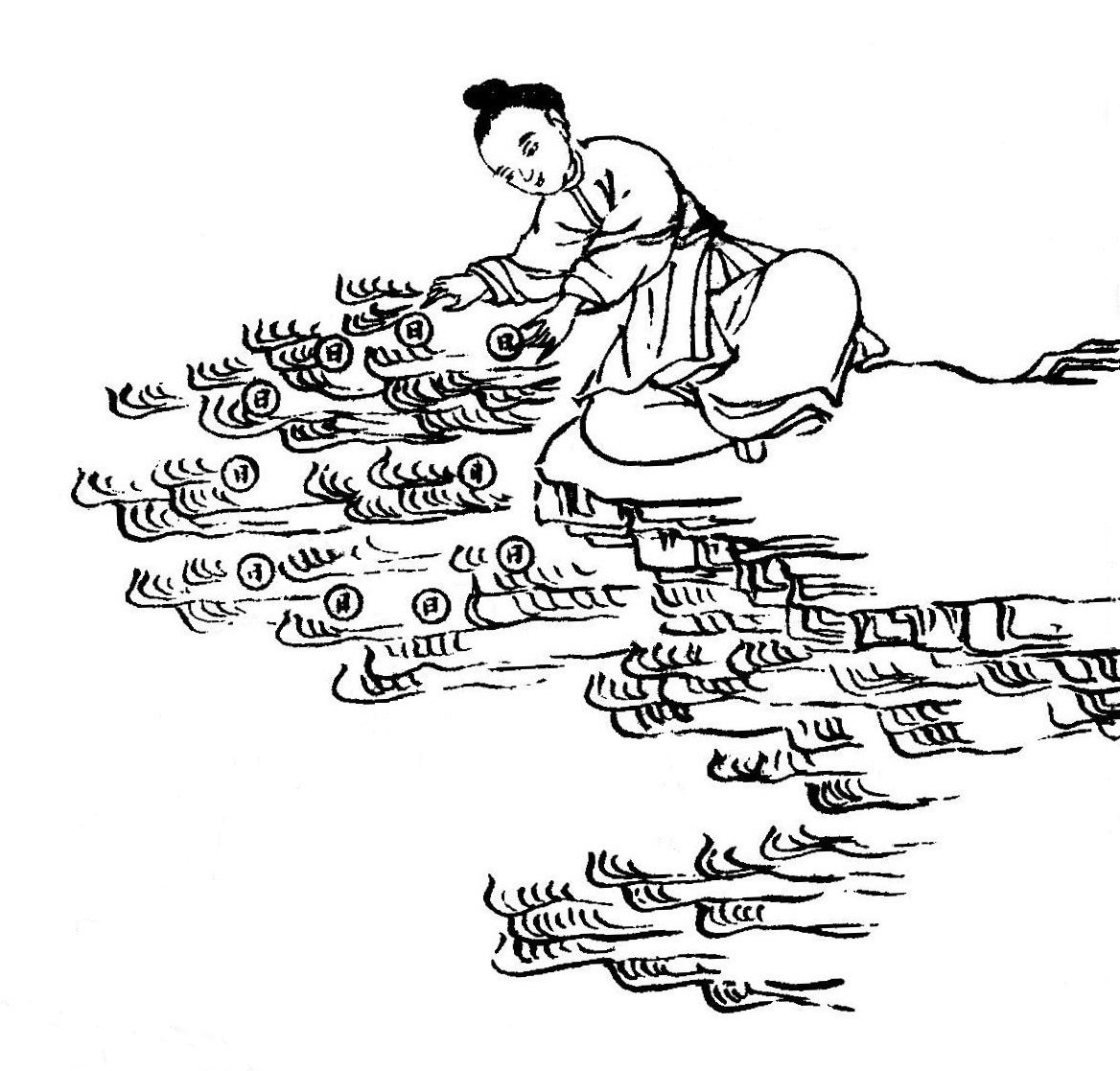
At the edge of the world, beyond the southeastern sea and among sweet waters, a woman knelt in a gulf and bathed her children. There were ten of them, and each one was a sun. She lifted them from the Sweet Gulf one at a time. When a sun was clean and burning, she sent it across the sky from east to west. It came home at dusk, and the next morning she sent another in its place. Her name was Xihe. The oldest account gives us only this: at the rim of the earth lived a woman who washed the suns.
The book that records this says little more about her. Xihe was the wife of the high god Di Jun and the mother of the ten suns. That is nearly the whole of her genealogy in the Classic of Mountains and Seas. The passage surfaces twice, once placed beyond the southeast sea and once beyond the East Sea, and the old editor Yuan Ke, reading the two against each other, judged that the eastern placement was the right one, since the Sweet Gulf and the Boiling Valley of the sunrise both belong in the east. It is a small textual disagreement, but it points the reader the right way: toward the sunrise, where the ten suns lived.
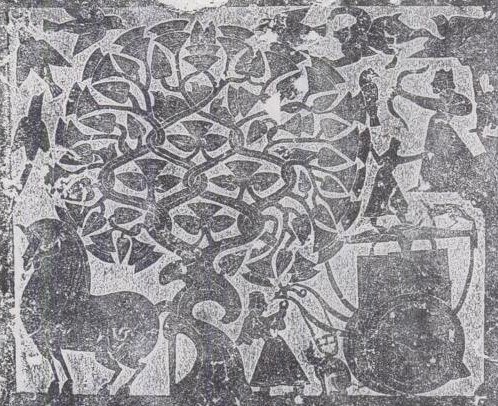
They lived in a tree. Far in the east, in the hot water of the Boiling Valley, stood a colossal mulberry called the Fusang, and the ten suns roosted in its branches: nine of them on the lower boughs and one, whose turn had come, waiting on the topmost branch. Each sun was carried across the heavens by a crow, and they went in strict rotation, so that as one arrived at the day’s end another was already setting out, borne on black wings out of the tree. That is the mechanism of the world in these texts. Ten suns, one tree, one crow apiece, and a mother who kept the order of them.
She was not only their nurse. In the Songs of the South, the great southern poems gathered under the name Qu Yuan, Xihe becomes the driver of the sun itself, and the poet, riding his own visionary flight across the sky, gives her an order. He commands her to slow down. Let Xihe slacken the pace, he says, gazing toward the western mountain of Yanzi but not pressing on toward it, so that the long day of the journey will not end too soon.
In the same breath the landmarks of the solar road appear: the horses watered at the Xianchi pool, the reins made fast at the Fusang. Elsewhere in the same poems her name is tied to the dawn, in a question flung at heaven: before Xihe rises, whence comes the light of the Ruo-flower? She is the one who lifts the sun, and the sky is dark until she does.
Then there is the day the order broke. The Huainanzi, compiled in the second century BCE, tells how in the reign of the sage-emperor Yao the ten suns all rose at once. The crops charred where they stood, the plants and trees died, and the people had nothing left to eat, so Yao sent for the archer Yi, who shot at the suns overhead.
The text does not name Xihe in this catastrophe, and it does not say how many suns fell; it says only that Yi shot at the ten. But the suns are hers by the older genealogy, and the disaster is what happens when ten children who should go out one at a time all take wing together. The mother who bathed them and sent them up in turn is, by implication, the keeper of the very order that failed.
Here the honest telling has to slow down, because two familiar pictures of Xihe are not as old as they look. The first is the rationalists’ Xihe. In the Book of Documents, in the Canon of Yao, the same name is read not as a goddess at all but as calendar officials: Yao commands Xi-He
to observe the heavens and regulate the seasons, and the name splits into two clans, the Xi and the He, sent to the four directions to mark the solstices and the equinoxes. This is euhemerism, myth combed into administration, and it runs alongside the solar goddess rather than beneath her. Where one tradition sees a woman washing suns, another sees a bureau of astronomers.
The second picture is the one most retellings reach for first: Xihe reining a chariot drawn by six dragons across the sky. It is a magnificent image, and it is late. No pre-Han or Han text names her with six dragons. The six dragons come from the Yijing, from the Qian hexagram, where they are a cosmological figure and nothing to do with the sun or with Xihe. The idea of Xihe as the sun’s driver comes from a different place again, the Eastern Han commentator Wang Yi, who glossed her in the Songs of the South as the sun’s charioteer
: a driver, but with no dragons.
And the actual sun-chariot, horse-drawn, belongs to the anonymous attendant of the Huainanzi, who is never called Xihe. Only much later, in the commentaries and above all in Tang poetry, were these three strands braided into the single dazzling figure of the dragon-charioteer. The mother of the suns and the driver of the sun are ancient. The six dragons are a poet’s flourish laid over her centuries afterward.
What remains, stripped back, is stranger and quieter than the dragon-chariot: a woman at the eastern edge of the world with ten burning children and a tree to keep them in, bathing each in turn and sending it up to cross the sky. She has a lunar twin, too, in the same book.
Where Xihe is wife of Di Jun and mother of ten suns, Changxi is wife of Di Jun and mother of twelve moons, and between them they hold the two halves of the sky. That is the shape of her at the beginning, before the astronomers and the poets had their turn: not a charioteer trailing dragons, but the mother of the daylight, kneeling in sweet water with a sun in her hands.
I ordered Xihe to slacken the pace, gazing toward Mount Yanzi but pressing on no further. (Chuci, “Li Sao”; author’s rendering from the Chinese)
- **Shanhaijing (山海經), Dahuang nan jing (大荒南經), Great WildsSouth:** Xihe as a woman of the Land of Xihe
beyond the southeast sea, between the Gan waters,
bathing the suns in the Sweet Gulf (Ganyuan, 甘淵); wife of the high god Di Jun (帝俊) and mother of the ten suns (羲和者,帝俊之妻,生十日). The same passage appears a second time in the Dahuang dong jing (see below). Chinese read verbatim (zh.wikisource). English: Anne Birrell, The Classic of Mountains and Seas (Penguin, 1999). - **Shanhaijing (山海經), Dahuang dong jing (大荒東經), Great WildsEast:** the duplicate Xihe passage sited beyond the East Sea (東海之外) and reading 是生十日 (
she it is who bore the ten suns
); the crow-borne rotation above the Fu-tree,when one sun arrives, another sets out, each borne by a crow
(一日方至,一日方出,皆載于烏); and Yuan Ke’s (袁珂) collation note arguing the Xihe passage properly belongs in the East, after the Sweet Gulf entry. Chinese read verbatim (zh.wikisource). English: Birrell 1999. - **Shanhaijing (山海經), Haiwai dong jing (海外東經), Beyond the SeasEast:** the Boiling Valley (Tanggu, 湯谷) and, standing in its water, the Fusang (扶桑) mulberry where the ten suns bathe, with nine roosting on the lower branches and one on the upper (九日居下枝,一日居上枝). The verified nine-below/one-above image of the roosting suns. Chinese read verbatim (zh.wikisource). English: Birrell 1999.
- Chuci (楚辭), Li Sao (離騷), c. 3rd c. BCE: Xihe as the sun’s driver, commanded to slacken the pace so the day will not end,
gazing toward Mount Yanzi (崦嵫) but not to press on
(吾令羲和弭節兮,望崦嵫而勿迫); the adjacent couplet of the solar road, the horses watered at the Xianchi pool (咸池) and the reins tied at the Fusang (飲余馬於咸池兮,總余轡乎扶桑); and the Ruo tree brushing the sun (折若木以拂日). Chinese read verbatim (zh.wikisource). EnglishDavid Hawkes, The Songs of the South (Penguin, 1985). - Chuci (楚辭), Tian Wen (天問, Heavenly Questions): Xihe tied to the sun’s rising, posed as a question rather than a tale,
before Xihe rises, whence the light of the Ruo-flower?
(羲和之未揚,若華何光?). Chinese read verbatim (zh.wikisource). EnglishHawkes 1985. - Huainanzi (淮南子), Tianwen xun (天文訓, Treatise on the Patterns of Heaven), c. 139 BCE: the daily solar itinerary — the sun rises from the Bright Valley, bathes in the Pool of Xian, brushes the Fusang, then ascends it to begin its journey (日出于暘谷,浴于咸池,拂于扶桑…登于扶桑,爰始將行). This canonical Han sun-journey passage does not name Xihe; the sun’s attendant here is an anonymous female. Chinese read verbatim (zh.wikisource). EnglishMajor, Queen, Meyer & Roth, The Huainanzi (Columbia UP, 2010), ch. 3.
- Huainanzi (淮南子), Benjing xun (本經訓): in the time of Yao the ten suns rise together, scorching the crops and killing the plants and trees, so that the people have nothing to eat, and Yao sends the archer Yi (羿) to shoot at them (十日並出,焦禾稼,殺草木…堯乃使羿…上射十日). Xihe is not named; the ten suns are hers by the Shanhaijing genealogy. The received text says only that Yi shot at the ten suns and gives no number felled. Chinese read verbatim (zh.wikisource). EnglishMajor et al. 2010, ch. 8.
- Shangshu (尚書), Yao Dian (堯典, Canon of Yao): the euhemerised, rationalised tradition — Yao commands
Xi-He
to observe the heavens and regulate the calendar (乃命羲和,欽若昊天,曆象日月星辰,敬授民時), and the name splits into two clans of astronomer-officials, the Xi clan (羲氏) and the He clan (和氏), dispatched to the four directions. Not a solar mother but a bureau of astronomers. Chinese read verbatim (zh.wikisource). - Yijing / Zhouyi (周易), Qian hexagram (乾卦): the source of the
six dragons
figure (時乘六龍以御天), a cosmological image and neither a sun-chariot nor originally Xihe’s; cited here only to show that the popular six-dragon chariot is a later composite. Chinese read verbatim (zh.wikisource). - Wang Yi (王逸), Chuci Zhangju (楚辭章句) commentary, Eastern Han: the gloss identifying Xihe as
the sun’s driver
(羲和,日御也), the origin of the Xihe-as-charioteer image — a driver, but with no dragons. Reported via the secondary literature on the six-dragon question; the exact wording was not read verbatim in Wang Yi’s commentary and should be re-verified against a print edition before quoting.