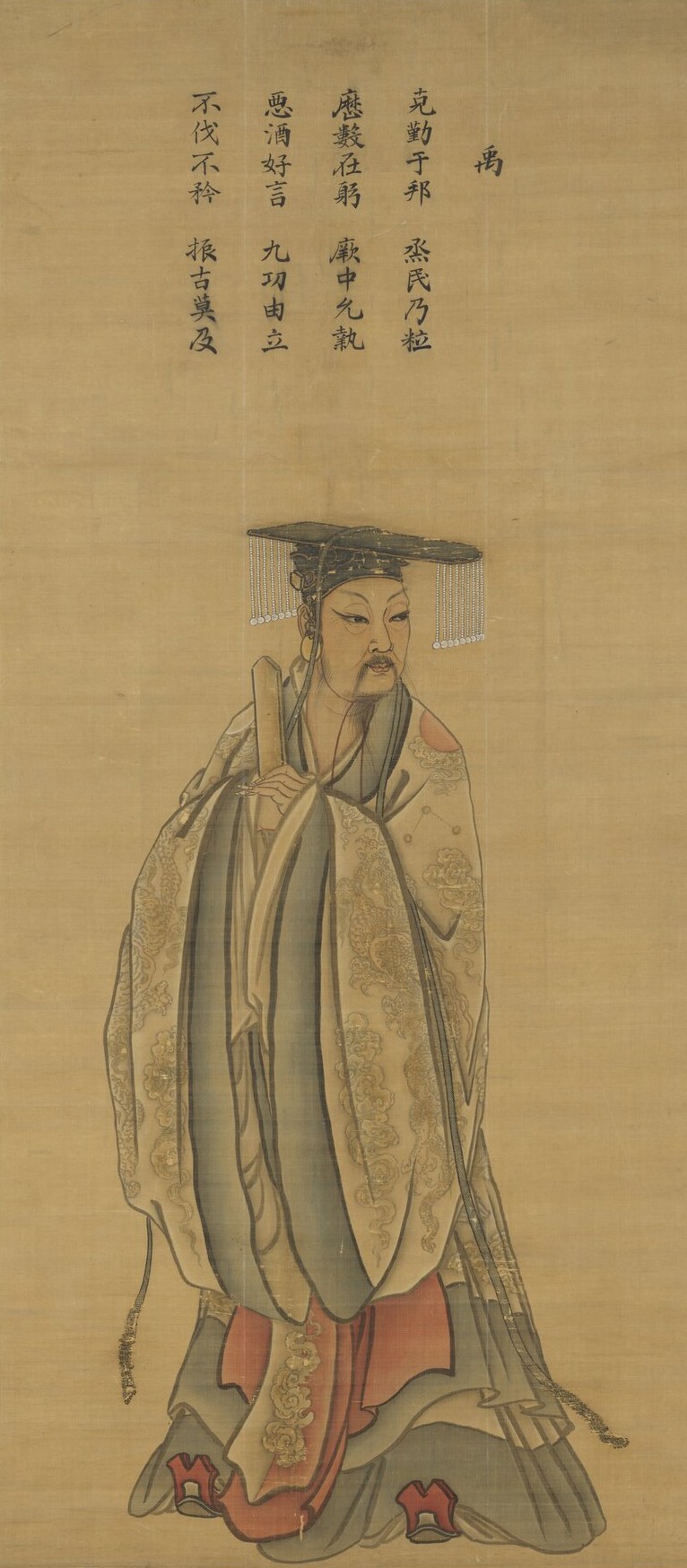
The oldest object that says his name is a bronze bowl. It was cast in the Western Zhou, somewhere around the ninth century BCE, to hold offerings, and its inscription names Yu and credits him with spreading out the land and setting the rivers in their courses. The bowl treats this as common knowledge, a settled piece of the deep past. Yet it stands more than a thousand years after the flood Yu is supposed to have tamed, and every fuller account of him, the histories that give him a father, a wife and a route through the drowned provinces, was written later still. He is a figure the record reaches for long after the fact and never once catches in the act.
A king with no contemporary to speak for him
Set the dates side by side. Tradition places Yu and his flood around 2200 BCE, at the founding of the XiaThe dynasty the tradition dates to roughly 2070 to 1600 BCE and says Yu founded, known only from texts written long after it and still without secure contemporary attestation.. The next witness comes far later. Its earliest name-bearing trace, the Bin Gong xuA Western Zhou bronze ritual vessel of about the 9th century BCE, whose inscription is the earliest datable text to name Yu and credit him with ordering the flooded land., is that ninth-century bowl, well over a millennium after the man. The classic describing his survey of the land was likely composed in the Warring States or later; Sima Qian’s Records, which fixed his image for good, around 100 BCE. No oracle bone from his supposed age carries his name. He is a king remembered only by descendants who lived closer to us than to him.
Their confidence is not evidence. When these texts agree, they agree as one late tradition drawing on itself, not as independent witnesses standing across the centuries from the man. A modern school of Chinese scholars, the doubters of antiquity, pressed this to its edge in the early twentieth century: Yu, they argued, began not as an engineer but as a water-spirit or river-beast of the old myths, slowly given a face, a lineage and a throne.
They had a philological hook. The oldest Chinese dictionary, compiled around AD 121, glosses the very graph of his name as the picture of a reptile or a creeping thing. It is a hypothesis, not a fact, but the reader deserves it before the sage-king is allowed to look like a man in a portrait.
The tools of a man who measured the world
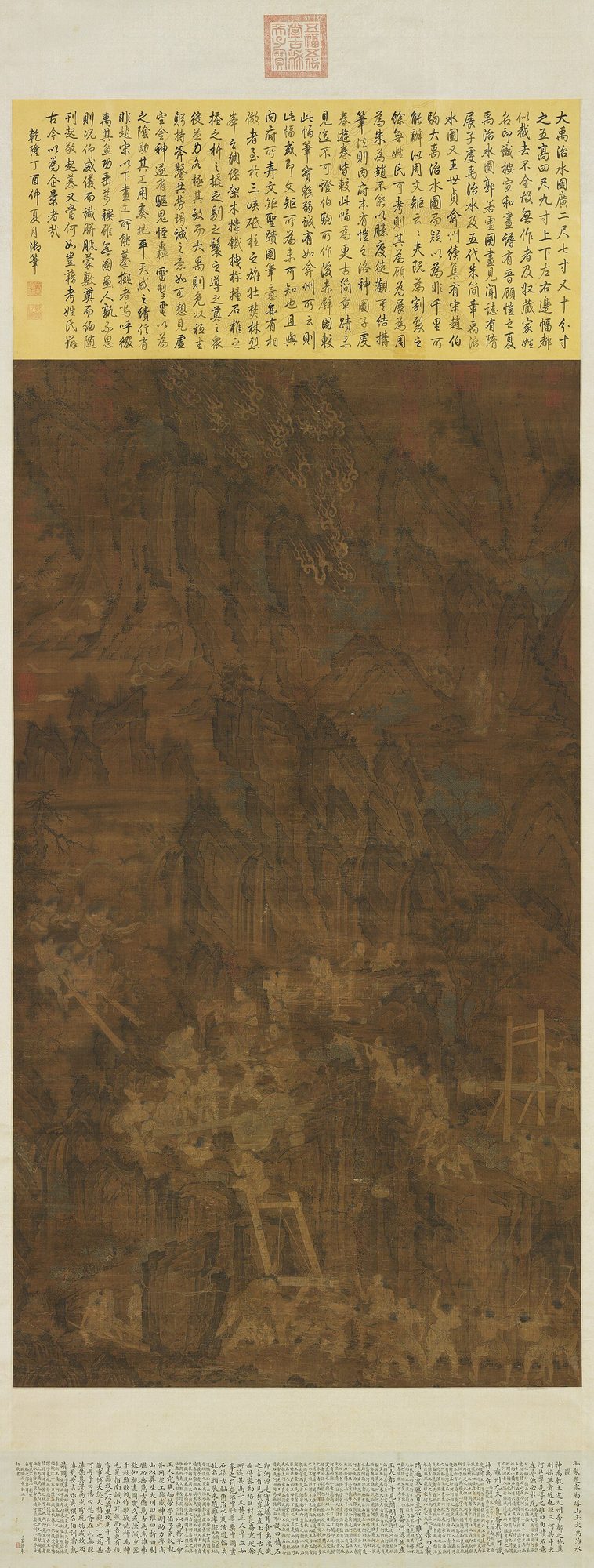
The tradition’s picture of how Yu worked is unusually concrete, which is part of why it persuades. He is not shown wrestling the waters like a storm-god; he is shown as a surveyor. The Records lists the vehicles he used to reach the flooded ground: a carriage on dry land, a boat on the water, a sledge across the mud, spiked shoes for the hills.
In one hand he carried the marking-line, in the other the compass and the square. These are the instruments of a man laying out canals and taking the measure of mountains, and the tradition puts them in his hands on purpose. The Yu who survives is an engineer of the land, and the myth remembers his kit as precisely as his deeds.
The same texts insist he paid for the work with his body. He went about in ragged clothes and on poor food, the Records says, giving to the spirits what should have gone to his own comfort, until his own house fell into ruin. His voice in the Book of Documents makes the sacrifice domestic and sharp: when his little son Qi was crying and wailing, he did not turn to look at him, but kept his whole mind on the labour of the land.
The famous version, that he passed the door of his own home three times across the years of the work and never once went in, is kept by both Mencius and the Records. It is the detail everyone remembers even when they remember nothing else.
How long that ordeal lasted the tradition cannot settle, and the two texts that carry the figures stand three centuries apart. Mencius, compiled around 300 BCE, says eight years away from home. Sima Qian’s Records, set down around 100 BCE, says thirteen. Both have him pass his door three times without entering; they simply differ on how long the passing went on. No source decides between them, so both witnesses stay on the page.
The land carved into nine
The work Yu is best remembered for outside the flood is the division of the drained world into the Nine ProvincesThe jiu zhou (九州), the nine regions into which the Yu Gong divides the drained land, each surveyed for its soil and its tribute: a scheme of empire, not a map anyone had walked.. The Tribute of Yu has him spread out the land, follow the line of the hills, fell the trees, and fix the great mountains and rivers in their places. Then it walks region by region, beginning with Jizhou in the north, recording the colour of each area’s soil and the tribute it owed. This reads least like a rescue and most like the founding of a state: a survey of the whole known world, sorted, graded and set in order for the paying of taxes.
Read for what it is, the passage is less a memory of the second millennium BCE than a charter for the age that wrote it. A unified realm neatly parcelled into nine tributary regions is the ideal of a much later empire, projected back onto the mist at the beginning of things and given the authority of the founder’s own hand. That does not make it worthless. It makes it a window onto how a later China imagined order should look, with Yu as the figure who first imposed it, less the man who drained the water than the man who drew the lines.
The throne that turned into an inheritance
Yu’s last and most consequential act has nothing to do with rivers. It concerns how power passed after him, and it is the hinge on which the whole shape of early Chinese kingship is said to turn. Before Yu, the tradition tells of rule handed on by merit: Yao chose Shun, a commoner raised for his worth, and Shun in turn chose Yu. Yu, it is said, meant to continue the pattern and named his able minister Yi as heir. But when Yu died, on tour in the south, the lords of the land did not go to Yi. They went to Yu’s son Qi, saying, he is the son of our sovereign, and Qi took the throne.
That is the moment merit-succession becomes hereditary rule. The Records marks the founding of the Xia dynasty here, Yu’s line settling into the seat of power and the surname Si carried down through it. On taking the throne Yu had faced south, the orientation of a ruler giving audience to the realm; his son’s accession made that house a lineage. Whatever the truth of the flood, this is the piece later ages needed most, because it explains the origin of the thing they lived under. The first dynasty begins not with a conquest but with a body of lords quietly deciding the last king’s son should be the next one.
The couplet that arrived two thousand years late
One warning belongs at the foot of any honest account of Yu, because it is the trap the tradition sets for its admirers. The most quoted line of wisdom attributed to him, that the human heart is precarious and the heart of the Way is subtle, does not come from the old strata at all.
It sits in the Counsels of the Great Yu, a chapter of the Book of Documents presented to the throne in the early fourth century AD and now widely judged a reconstruction of that late date, some two and a half thousand years after the Yu it ventriloquises. That couplet became a cornerstone of later moral philosophy, which is exactly why it must not be handed back to a Bronze Age sage-king as if he had said it.
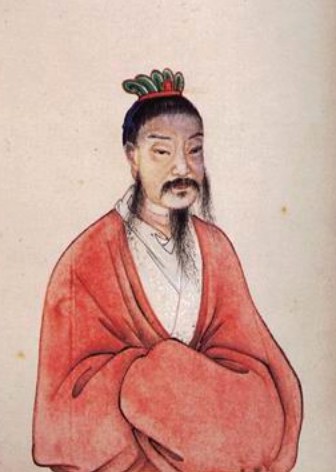
What remains, when the late accretions and the unprovable history are set aside, is a clearer figure rather than a diminished one. Yu is the tradition’s image of the ruler who serves: who measures the land rather than commands it, wears his body out on the public work, draws the boundaries of a realm and then, almost against his own intention, founds the line that inherits it. Whether such a man ever lived is a question the sources cannot answer. What they preserve is a portrait a civilisation kept polishing for three thousand years because it showed them the kind of king they wished to have had.
When travelling on dry land he used a carriage, on the water a boat, in miry places a sledge, and over the hills spiked shoes. On the one hand he used the marking-line, and on the other the compass and the square. (Shiji, “Xia benji”; H. J. Allen’s rendering)
- Bin Gong xu (豳公盨) bronze inscription, Western Zhou, c. 9th c. BCE: the earliest datable text to name Yu and credit him with spreading out the land and ordering the rivers after the flood, over a millennium after Yu’s traditional date, and the reason he can be spoken of as attested at all. Ed. Constance A. Cook,
Sage King Yu 禹 and the Bin Gong xu 豳公盨
, Early China 35/36 (2013). Secondary edition; the bronze itself not read verbatim for this piece. - Shujing (書經 / 尚書, Book of Documents), Yu Gong (禹貢, Tribute of Yu): Yu divides the land, follows the hills and cuts the trees, fixes the high hills and great rivers, and surveys the Nine Provinces beginning with Jizhou (禹敷土,隨山刊木,奠高山大川; 冀州). New Text stratum; core redaction Warring States to Early Han. EnglishJames Legge, The Chinese Classics vol. III (The Shoo King, 1865).
- Shujing, Yi Ji (益稷, Yih and Tseih): Yu’s first-person accounthe opened passages for the streams throughout the nine provinces and led them to the sea, mounted his four conveyances, and did not regard his wailing infant son Qi at the door. English: Legge, Shoo King (1865).
- Mengzi (孟子, Mencius), Teng Wen Gong I.4 (滕文公上): Yu eight years away from home, thrice passing his own door without entering (禹八年於外,三過其門而不入). Compiled c. 300 BCE. EnglishLegge, The Chinese Classics vol. II (Mencius, 1893 ed.).
- Shiji (史記, Records of the Grand Historian), Xia benji (夏本紀), Sima Qian c. 100–90 BCE: Yu’s genealogy back to the Yellow Emperor through Zhuanxu; the four conveyances and the marking-line, compass and square; the ragged clothes and poor diet; thirteen years away; accession facing south with the surname Si and the house of Xia; and the succession that passed to his son Qi over the appointed minister Yi. EnglishH. J. Allen, Journal of the Royal Asiatic Society (1895).
- Shujing, Da Yu mo (大禹謨, Counsels of the Great Yu): the couplet on the precarious human heart and the subtle heart of the Way (人心惟危,道心惟微). ⚠ Ancient Text stratum, presented to the throne c. AD 317–322 and now widely regarded as a 3rd–4th c. CE reconstruction; cited here only to place it correctly in time, not as ancient Yu-material.
- Shuowen Jiezi (說文解字), c. AD 121: glosses the graph 禹 as a reptile or insect pictograph, the philological hook for the modern argument (the doubters-of-antiquity school, Gu Jiegang) that Yu was originally a water-creature later humanised. Cited via secondary summary; not read verbatim.