
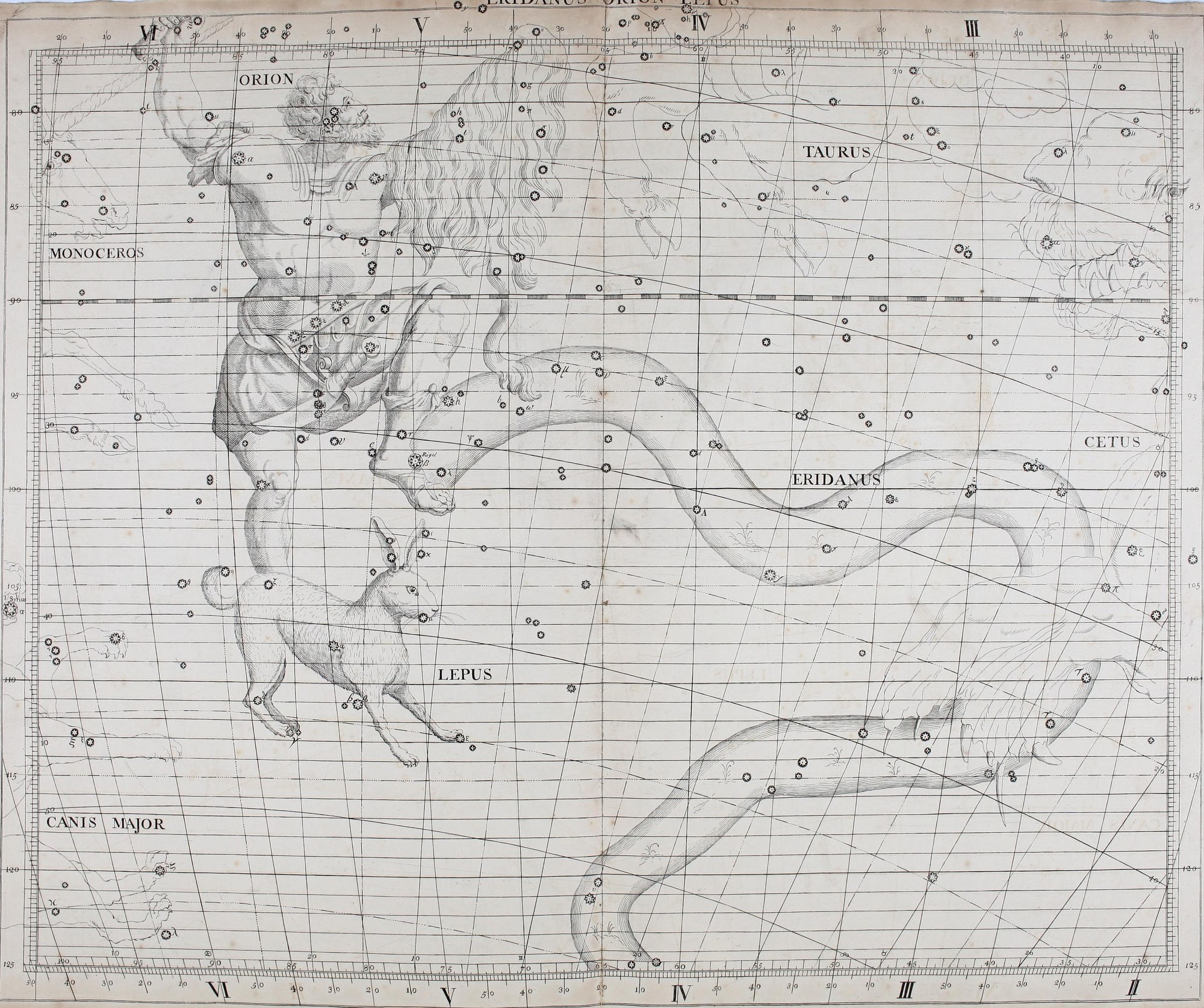
Orion is the hourglass pattern set by three belt stars between Betelgeuse at the shoulder and Rigel at the foot, with the Orion Nebula marking the sword. It stands highest on northern winter evenings, the belt rising due east and setting due west. The six traditions on this page each gave it a different name.
Orion strides across winter with three stars for a belt and a red star for a shoulder. Six traditions named him, and no two agreed what he was.
How six traditions read these stars
Greek — the Hunter
Greek. The hunter who boasted against wild earth, stung by Gaia’s scorpion and set among the stars by Artemis, fleeing Scorpius forever. Apollodorus, Library
Mesopotamian — the True Shepherd of Anu
Mesopotamian. Not a hunter but the True Shepherd of Anu (SIPA.ZI.AN.NAThe Mesopotamian name for these stars, meaning True Shepherd of Anu; a shepherd figure, not a hunter (MUL.APIN I ii 2).), a shepherd figure standing where the Greek hunter walks. MUL.APIN I ii 2; Hunger & Steele 2019
Egyptian — the Consort of Sopdet
Egyptian. SahThe Egyptian personification of these stars, consort of Sopdet, ascending with the pyramid dead (Pyramid Texts)., consort of Sopdet, ascending with the pyramid dead: the same stars as a funerary escort rather than a hero. Pyramid Texts
Chinese — the Two Mansions
Chinese. ShenOne of two Chinese mansions at these stars, paired with Zi; determinative stars used as stations for tracking the Moon (Tianguan shu). 參 (ζ Ori) and Zi 觜 (λ Ori), determinative stars of two mansions: stations for tracking the Moon, not a figure at all. Tianguan shu
Hindu — Ardra and the Deer’s Head
Hindu. MrigashiraA lunar station received in the living tradition at these stars, paired with Ardra; described here as received, without adjudication (nakshatra list). (λ, φ Ori) and Ardra (Betelgeuse): lunar stations received here as the living tradition gives them, without adjudication. Nakshatra list
Norse — the Fishermen
Norse. Fiskikarlar, the fishermen: a late folk name for the belt, held lightly, since no myth survives with it; Frigg’s distaff is late folklore with no Eddic attestation. ISOF Friggarock
Figure and story retellings link here as they publish.
Sources
- MUL.APIN I ii 2 (Hunger & Steele 2019)
- Apollodorus, Library (myth narrative)
- Pyramid Texts (Sah, consort of Sopdet)
- Tianguan shu (Shen/Zi determinatives)
- Nakshatra list (Mrigashira/Ardra; living tradition)
- ISOF Friggarock (late folklore, never Eddic)
Sky — when and where to look
Sky — when and where to look
Key stars. Betelgeuse shoulder, Rigel foot, three belt stars, Orion Nebula sword
Visibility. Northern winter evenings; belt rises due east, sets due west
Traditions on this page (6)
Traditions on this page (6)
- Greek
- Mesopotamian
- Egyptian
- Chinese
- Hindu
- Norse
Full narratives live in the linked retellings below — this hub keeps the comparison on the page and never retells them.
- MUL.APIN I ii 2 (Hunger & Steele 2019)
- Apollodorus, Library (myth narrative)
- Pyramid Texts (Sah, consort of Sopdet)
- Tianguan shu (Shen/Zi determinatives)
- Nakshatra list (Mrigashira/Ardra; living tradition)
- ISOF Friggarock (late folklore, never Eddic)