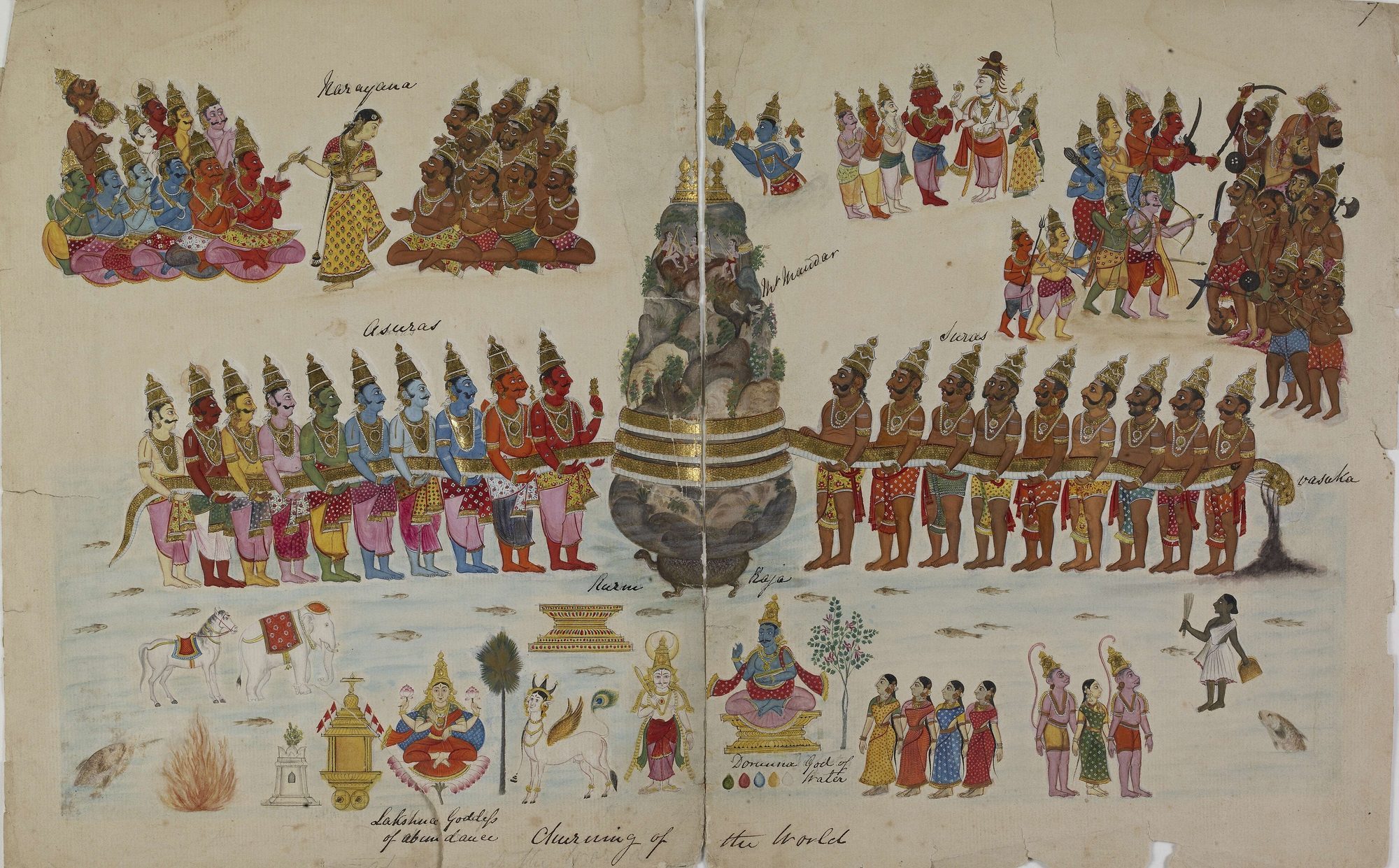
The gods were losing. Their strength had drained out of them, and the nectar that would make them deathless lay dissolved in the sea of milk, out of reach of any single hand. So Nārāyaṇa gave them a strange instruction: churn the ocean, and churn it not alone but shoulder to shoulder with your enemies. Only the gods and the demons pulling together could turn a mountain fast enough to wring immortality from the deep, and so the two hosts that had been at each other’s throats since the beginning laid down their quarrel, walked to the shore of the milk-sea, and agreed to spin it as one. The prize would be split afterwards. Everyone at the water’s edge already knew there would be no splitting it.
A slighted flower-garland
Why they were weak depends on who is telling the story, and the oldest and the later tellings do not agree. In the Mahābhārata, the eldest and fullest version, there is no curse at all: the gods simply desire the amrita, the drink of the deathless, and Nārāyaṇa tells them how to get it. The Purāṇas supply a reason. In both the Vishnu Purāṇa and the Bhāgavata, the whole disaster begins with a slighted flower-garland.
The short-tempered sage Durvāsas gives Indra a divine wreath; Indra, careless on his elephant, lets it fall and be trampled, and the furious sage curses him, so that vigour drains from the three worlds and Śrī, the goddess of fortune herself, abandons the universe. In that frame the churning is not a raid on immortality so much as a rescue of everything that has been lost. Whichever way the story opens, the two hosts end up at the same shore, hands on the same serpent.
Mandara upright in open sea
The machine they build is enormous. For a churning-staff they take Mandara, a mountain that rises eleven thousand yojanas into the sky and plunges as far below, and the great serpent Ananta tears it up by the roots. Set upright in open sea, such a staff would simply sink, so they need a pivot, and the king of tortoises consents to bear the whole mountain on his back.
(In the Purāṇic tellings the tortoise is no anonymous beast but Vishnu himself, taking the form that later tradition would name the Kūrma avatar, the second of his ten descents; the Mahābhārata passage read here calls it only the king of tortoises and does not identify it as the god.) The Ocean agrees to be churned on one condition, that he receive a share of whatever rises. For the churning-rope they take the serpent-king Vāsuki and wind him round the mountain, and here the two armies take up their stations: the demons seize the serpent by his hood and head, the gods take hold of his tail. Then they haul, back and forth, and Mandara begins to spin.
It is a violent, punishing labour, and the serpent suffers worst of all. From Vāsuki’s straining mouth pour black vapours shot with flame, which gather overhead into thunderclouds and break in cool rain on the exhausted workers, while blossoms shaken loose from the trees on the whirling mountain drift down on them. The friction of the spinning peak sets its own forests alight until Indra puts the fire out with more rain; sea-creatures are ground to nothing in the turning depths.
There is a quiet reason, in the Purāṇic version, why the gods will come out ahead: the demons at the serpent’s head are scorched by the fire from his hood, while the gods at the tail are refreshed by the rain driven their way. And still, at first, the sea yields nothing. The workers churn until their strength fails again, and again Nārāyaṇa pours fresh vigour into them so the labour can go on. Slowly the milk-water changes. It thickens through stages, mingling with liquid gold and gummy exudations, until the agitated deep turns to clarified butter and the ocean is ready at last to give up what it holds.
Which treasures, and in what order
Then the treasures rise. Exactly which treasures, and in what order, is one of the places where the traditions part company, and it is worth resisting the neat modern list of fourteen jewels
that flattens them all into one. The Mahābhārata brings up the Moon, then Lakṣmī robed in white, then Soma the moon-god, the dazzling white horse Uccaiḥśravas, the jewel Kaustubha, and the physician-god Dhanvantari cradling the vessel of nectar, before the poison comes last of all.
The Vishnu Purāṇa raises quite different things: the wish-cow Surabhi, Vāruṇī the goddess of wine, the celestial Pārijāta tree, the dancing Apsarasas, the Moon, then poison, then Dhanvantari, and finally Śrī on her lotus. The Bhāgavata reverses the drama entirely and lets the poison surface first, before any of the good things. The later fourteen ratnas
enumeration is a harmonisation stitched across many Purāṇas; no single passage read here lays out that tidy fourteen. What all three agree on is a core: Lakṣmī, the white horse, the Kaustubha gem, Dhanvantari with his pot, and a world-ending poison all come out of that sea.
Swallowing the world’s death
The poison is the crisis of the story. It boils up out of the ocean and blazes like a smoking fire, its very scent stupefying the three worlds, a venom called Kālakūṭa (or Hālāhala) that threatens to undo creation before the nectar can even be shared. It is Śiva who saves them. He gathers the whole burning mass and swallows it, and it lodges in his throat and stains it blue, so that ever after he bears the name Nīlakaṇṭha, the blue-throated, the poison sitting in him not as a wound but as an ornament.
In the Bhāgavata’s telling he takes it with his consort Pārvatī’s consent, and the few drops that escape his palms are lapped up by scorpions and snakes, which is why they carry venom to this day. Only the Vishnu Purāṇa tells it otherwise, giving the poison not to Śiva but to the Nāgas, the snake-gods, so that in that version the blue-throat name has no place. The god who swallows the world’s death is the reason the world survives to be made immortal.
A woman of impossible beauty
At last Dhanvantari rises from the sea, robed in white, bearing the jar of amrita itself, and the fragile truce shatters in an instant. The demons snatch the pot and flee with it, and the whole labour threatens to end with the wrong side holding the prize. So Vishnu changes shape. He becomes a woman of impossible beauty, an enchantress the Bhāgavata names Mohinī and counts as his own incarnation, and the demons, undone by desire, hand her the nectar and let her promise to portion it out fairly between the two camps. She seats the gods on one side and the demons on the other, and begins to serve the gods.
Beheaded a fraction too late
One demon sees the trick. Rāhu slips into the gods’ line in disguise and takes the nectar into his mouth, but the Sun and the Moon, seated nearby, recognise him and cry out, and Vishnu’s discus takes off his head in the same instant. It is a fraction too late. The nectar has already reached his throat, so the severed head cannot die: it rises immortal into the sky and shrieks while the headless trunk crashes to earth and makes it tremble.
Ever since, that deathless head chases the two who betrayed him across the heavens, and when it catches and swallows the Sun or the Moon, we on the earth below look up and call it an eclipse. The rest is quickly told. The gods drink, their strength and their immortality restored, and the old war breaks out again on the seashore in earnest, until Vishnu’s discus, blazing like the fire at the end of an age, routs the demons and drives them down into the earth and the salt sea. Mandara is carried back to its place, and the vessel of nectar is given to Nārāyaṇa to keep.
Do thou churn the Ocean with the gods and the Asuras. By doing so, amrita will be obtained as also all drugs and gems. (Mahābhārata, Ādi Parva, Āstīka Parva, Section XVII, tr. Kisari Mohan Ganguli)
- Mahābhārata, Ādi Parva, Āstīka Parva, Sections XVII–XX (trans. Kisari Mohan Ganguli, ed. Pratap Chandra Roy)the oldest and most detailed narrative read here. Nārāyaṇa’s command to churn the sea of milk with the Asuras so that
amrita will be obtained as also all drugs and gems
; Mandara thatrises eleven thousand yojanas, and descends downwards as much,
torn up by the serpent Ananta; the Ocean’s consent in exchange fora share of it
; the king of tortoises bearing the mountain; Vāsuki as the cord, with the Asuras at the hood and the gods at the tail; theblack vapours with flames
from Vāsuki’s mouth turning to rain-clouds; the milk-water thatturned into clarified butter
; the products (Moon, Lakṣmīdressed in white,
Soma, the White Steed, the gem Kaustubha, Dhanvantari with the vessel of nectar, Airāvata, and the poison Kālakūṭa); Śiva swallowing the poison to become Nīlakaṇṭha; the enchantress (bewitching Māyā… the form of an enticing female
); Rāhu beheaded, the nectarhaving reached Rāhu’s throat only,
and the eclipse-cause; the Sudarśana-discus battle; Mandara restored and the amrita entrusted to Nārāyaṇa. - Vishnu Purāṇa, Book I, Chapter IX (trans. H. H. Wilson, 1840)the Durvāsas-curse frame (the slighted garland, Airāvata’s trampling, the loss of Śrī and of the gods’ vigour); Vishnu’s command to churn; Vishnu himself as the tortoise pivot (
Hari himself, in the form of a tortoise, served as a pivot
); the godsstationed… at the tail of the serpent, the Daityas and Dānavas at its head,
with the burning-hood detail that scorches the demons while the tail-driven clouds refresh the gods; a distinctive product-list (Surabhi, Vāruṇī, the Pārijāta tree, the Apsarasas, the Moon seized by Mahādeva, the poison taken by the Nāgas, Dhanvantari, and Śrī/Lakṣmī); Lakṣmī’s epiphanyseated on a full-blown lotus,
bathed by the sky-elephants fromvases of gold,
casting herselfupon the breast of Hari
; Vishnu’s female form recovering the amrita; the demons routed into Pātāla. - Bhāgavata Purāṇa (Śrīmad Bhāgavata), Skandha VIII, Chapters 5–9, and I.3 (trans. G. V. Tagare, Motilal Banarsidass)Mohinī named and counted Vishnu’s thirteenth incarnation, Dhanvantari the twelfth (I.3); the
fourteen valuable things
summary (I.3); the Durvāsas-curse frame (VIII.5); Vishnu as the Divine Tortoise (VIII.5.10); the Hālāhala/Kālakūṭa poison emerging first, swallowed by Śiva with Pārvatī’s consent, the blue throat thatbecame an ornament of that benevolent Deity,
and the leaked drops taken up byscorpions, serpents… cobras
(VIII.7); the ordered products Surabhi, Uccaiḥśravas (taken by Bali), Airāvata, Kaustubha (taken by Vishnu), Pārijāta, the Apsarasas, Lakṣmī, Vāruṇī (taken by the Asuras), and Dhanvantari with the nectar-jar (VIII.8); Dhanvantari’s portrait,complexion bluish (like a cloud)… bearing a jar full of nectar
(VIII.8.32–34); Mohinī deluding the Asuras; Rāhu drinking in disguise, exposed by the Sun and Moon, beheaded by the discus, his head made immortal as the eclipse-cause (VIII.9.24–26). - Note on the
fourteen ratnas
: the fixed list of exactly fourteen treasures (commonly Lakṣmī, Kaustubha, Pārijāta, the Apsaras/Rambhā, the Moon, Uccaiḥśravas, Airāvata, Surabhi, Vāruṇī, the Hālāhala poison, Dhanvantari, the amrita, and sometimes the conch and the bow) is a cross-Purāṇic harmonisation, not a single-passage quotation. The Bhāgavata asserts the number fourteen (I.3), but the three texts read here differ in both membership and order, and the fixed enumeration draws also on the Padma, Agni and Vāyu Purāṇas, which were not read verbatim for this piece. Treat anythe fourteen treasures were…
list as later Purāṇic synthesis, not the wording of one cited verse.