The order that upholds the world once had a body. The lawgiver Manu describes it as a creature standing four-footed and entire, when the world was young and righteousness complete. Then time began to work on it. In the age that followed, the beast lost a foot. In the age after that, another, and another again, so that the thing which upholds the world hobbles now on a single leg while unrighteousness walks abroad on the missing three. This is the oldest and strangest thing to understand about dharma: it is not a rule the world obeys but a living order the world can maim, and has been maiming, for a very long time.
No single English word fits it. The Victorian scholars who first turned these texts into English could not agree on one, and their disagreement is instructive. The same translator, Georg Bühler, renders the one Sanskrit term as sacred law
in one chapter of Manu and as justice
in another; a modern translator of the Gita leaves it untranslated and glosses it as prescribed duty
or righteousness.
Sacred law, justice, duty: the reader meets the same idea under three different names, and none is wrong. Dharma is the order that holds at three levels at once, the structure of the cosmos, the ordering of society, and the conduct of a single life, and the interesting thing about the texts is that they refuse to let any one level swallow the others.
The bull whose legs are the ages
At the widest level dharma is the frame of the cosmos itself, and Manu gives it a second animal body to make the point. Divine justice, he says, is a bull, and the four feet of that bull are the four ages of the world, one foot for each yugaOne of the four world-ages of the Hindu cycle, running from a first golden age to a final degenerate one, across which righteousness is imagined steadily failing. across which righteousness slowly fails. To cheat or injure it is to lame the animal that carries everything. Out of this comes the load-bearing sentence of the whole tradition, and it reads less like a promise than a warning: Justice, being violated, destroys; justice, being preserved, preserves: therefore justice must not be violated, lest violated justice destroy us.
That sentence is the buried source of a line half the modern world can quote, dharmo rakṣati rakṣitaḥ, usually given in English as dharma protects those who protect it.
The snappy aphorism is a genuine descendant of Manu, but it is a modern compression, not the scripture’s own wording; Bühler’s Victorian sentence is longer, colder, and more exact about the danger.
The order does not reward the good out of affection. It keeps standing only as long as it is kept, and when it falls it takes its keepers down with it. Note too that Bühler here calls the word justice
and not law,
and the choice matters: at the cosmic level, dharma is less a code to be looked up than a balance that can be tipped.
Duties cut from a body
At the next level down, dharma becomes society, and here the texts turn concrete and troubling. Manu derives the whole social order from the dismembered body of the creator. The duties of the four varṇasThe four broad social orders of the classical law-books, each assigned its own duties; the Sanskrit word means 'colour' or 'class'., he writes, were assigned to those who sprang from his mouth, his arms, his thighs and his feet.
From the mouth came the priests, given teaching, study and sacrifice; from the arms the warriors, commanded to protect the people and to abstain from sensual indulgence; from the thighs the herders and traders; and from the feet, in the text’s own blunt words, one occupation only the lord prescribed
for the lowest order, to serve meekly
the other three. It is an image of hierarchy so total that even the parts of the god’s body are ranked.
And how does one know what the law actually requires? Manu answers this like a jurist listing his authorities. The sources of the sacred law are fourfold: the Veda first, then the tradition and the conduct of those who know the Veda, then the customs of holy men, and finally, startlingly, one’s own satisfaction,
the assent of a good person’s own heart.
Revelation stands as the supreme authority, but it does not stand alone; custom and conscience are named beside it. The definition that opens the whole discussion says as much. Learn, Manu writes, that sacred law which is followed by men learned in the Veda and assented to in their hearts by the virtuous, who are ever exempt from hatred and inordinate affection.
The law is what the wise do and what the good, unclouded by anger or craving, recognise as right.
Say what is true, do thy duty
The gentlest voice on this whole subject is also the oldest, and it comes from a graduation. In the Taittiriya Upanishad, roughly the sixth or fifth century before the common era, a teacher sends his pupil out into the world with a charge, and the charge has become one of the most repeated sentences in Indian life. Having taught the boy the Veda, the teacher says: Say what is true! Do thy duty!
In Sanskrit it is four words, satyaṁ vada, dharmaṁ chara, truth and dharma set side by side as the two things a life must not swerve from. Do not neglect your study, the teacher goes on; treat your mother as a god, your father as a god, your teacher and your guest as gods; and when you give, give with faith, with joy, with modesty, and with kindness. This is dharma at the level of a single person’s daily conduct, and it is small, warm and entirely unlike a caste-chart. It is not the ordering of anyone else. It is how to be decent.
The distance between this voice and Manu’s is worth stating plainly, because the three great texts on dharma do not speak from one moment. The Taittiriya’s convocation is older than the Bhagavad Gita and older than Manu’s law-book by something like three hundred to eight hundred years; the Gita and Manu, roughly contemporary with each other, both stand about half a millennium later than the Upanishad.
So when a modern summary lays do thy duty
beside die in your duty
beside the caste-law and calls the result the Hindu view of dharma,
it is flattening the better part of a thousand years of development into a single flat statement the tradition never made at its own pace. The same flattening is the Kali-age error the old image warns against: to take the one leg still standing for the whole beast, and mistake the ruin for the rule.
Better your own duty done badly
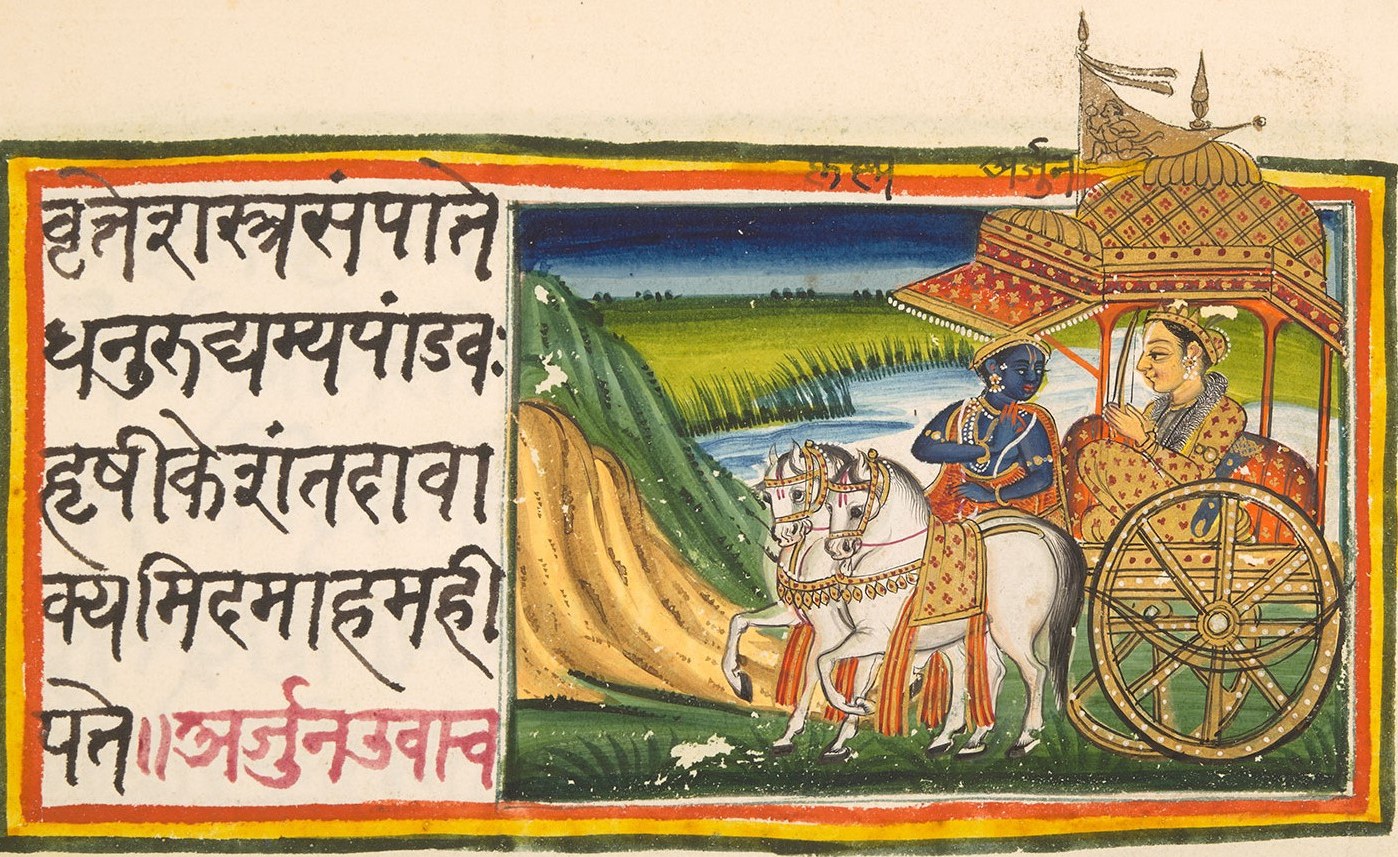
The most demanding thing the tradition ever said about dharma is a single verse of the Bhagavad Gita, and it is the reason the word carries such weight. Krishna, charioteer and god, tells the warrior Arjuna, who has faltered at the thought of killing his own kin, a principle that reaches far past that one battlefield. It is far better,
he says, “to perform one’s own prescribed duty, though tinged with faults, than to perform another’s duty, though perfectly.
It is preferable to die in the discharge of one’s own duty; another’s is fraught with danger.” Here dharma turns personal and severe. Your own duty, your svadharmaA person's own prescribed duty, fixed by birth and station, which these texts rank above another's duty even when one's own is done badly., is not a matter of taste or fit. It is yours by birth and station, and to do it imperfectly is a nobler thing than to do someone else’s flawlessly, even at the cost of your life. The Gita means this literally enough that it says a good death in one’s own work beats a safe life in another’s.
The teaching mattered enough to the text that it says it twice. Fifteen chapters after the first statement, near the poem’s end, the same opening line returns word for word, and closes on a different guarantee: by doing the duties that are innate to you, a person does not incur sin.
Two versions of one teaching, a deliberate echo across the length of the book, which is worth knowing before anyone quotes the Gita says
as if the Gita said it once. The verse is a stark either-or, and it is easy to read it as the tradition hardening into caste-duty and nothing else. But the same book will not let that reading stand.
Abandon all your dharmas
For the last word the Gita gives to dharma is its abandonment. In the poem’s closing chapter, the same god who commanded Arjuna to hold his own duty absolutely turns and says the opposite: Abandon all varieties of dharmas and simply surrender unto Me alone. I shall liberate you from all sinful reactions; do not fear.
Within a single book the personal duty upheld above life itself is, at the end, told to let go. This is not a contradiction some later editor failed to catch.
It is the tradition’s own last move, staged deliberately, and the two verses are meant to be held together and not resolved. Dharma is the order that holds the cosmos, orders society, and directs a life; and then, for the one who surrenders, it is the thing that can finally be set down. The texts hold cosmic law, social station, personal truth and their own transcendence in the same hand, and the honest reader is left holding all four.
Justice, being violated, destroys; justice, being preserved, preserves: therefore justice must not be violated, lest violated justice destroy us. (Manusmriti 8.15, tr. Georg Bühler)
- Manusmriti (Mānava-Dharmaśāstra) 1.81–82 (trans. Georg Bühler, The Laws of Manu, Sacred Books of the East vol. 25, Oxford, 1886)dharma as a creature
four-footed and entire
in the first age, losing a foot in each age after, the concrete image of cosmic order decaying across the yugas. The text as we have it dates c. 2nd century BCE–3rd century CE; this translation is Victorian, some two millennia later. - Manusmriti 8.15–16 (Bühler, SBE 25)
Justice, being violated, destroys; justice, being preserved, preserves
; and divine justice personified as a bull (vṛṣa) whose legs are the ages. Bühler renders dharma here asjustice.
This is the source behind the popular maxim dharmo rakṣati rakṣitaḥ,dharma protects those who protect it,
which is a modern compression of the fuller sentence, not scripture’s own wording. - Manusmriti 1.87–91 (Bühler, SBE 25)the duties of the four varṇas assigned to those who sprang from the creator’s mouth, arms, thighs and feet, and the single duty prescribed to the lowest order.
- Manusmriti 2.1, 2.6, 2.12–13 (Bühler, SBE 25)the definition of the sacred law as that which the learned follow and the virtuous, free of hatred and craving, assent to in their hearts; and its fourfold source, the Veda, the sacred tradition, the customs of the virtuous, and one’s own satisfaction, with revelation named the supreme authority.
- Taittiriya Upanishad 1.11.1–4 (Śikṣāvallī, Eleventh Anuvāka; Yajur Veda; trans. F. Max Müller, The Upanishads Part II, SBE vol. 15, Oxford, 1884)the teacher’s charge to the graduating pupil,
Say what is true! Do thy duty!
(satyaṁ vada, dharmaṁ chara), with mother, father, teacher and guest each heldlike unto a god,
and gifts givenwith joy, with modesty, with fear, with kindness.
The oldest source here, c. 6th–5th century BCE. - Bhagavad Gita 3.35 and its doublet 18.47 (trans. Swami Mukundananda, holy-bhagavad-gita.org, IAST confirmed)
far better to perform one’s own duty (swa-dharma), though faulty, than another’s done perfectly … better to die in one’s own duty; another’s is fraught with danger,
restated near the poem’s end asby one’s innate duties one incurs no sin.
The Gita layer dates c. 2nd century BCE–2nd century CE. - Bhagavad Gita 18.66 (Mukundananda, IAST confirmed)
Abandon all varieties of dharmas (sarva-dharmān parityajya) and simply surrender unto Me alone,
the tradition’s own subordination of svadharma to devotion, within the same book that commanded it.