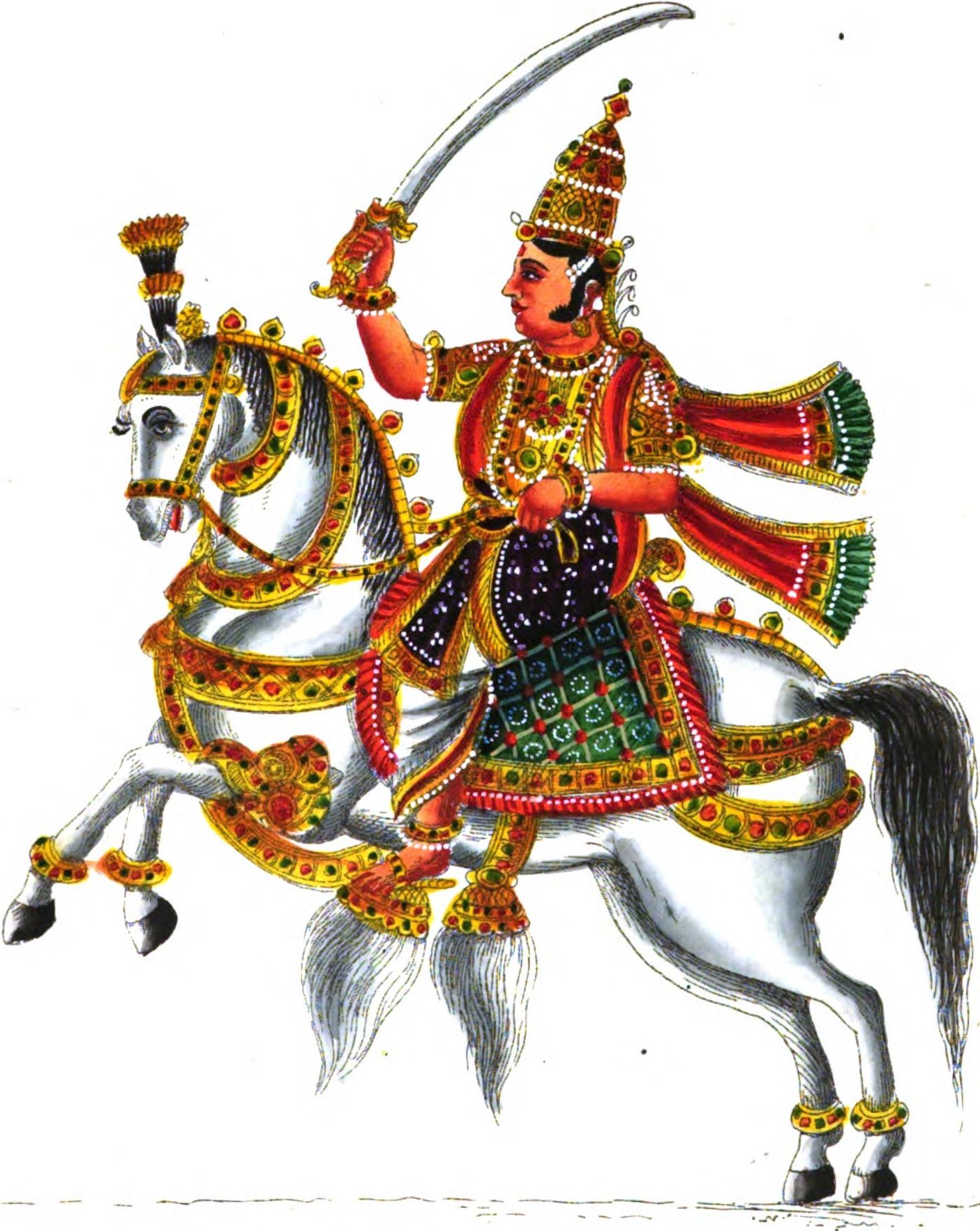
For a thousand years he took nothing. First he drank only water, then he fed on the air alone, and at last he lived on nothing whatever, holding himself so still and so long that the heat of his penance troubled the worlds. When Brahma came to reward him, he did not offer riches to a man who had spent a millennium refusing them. He offered an office. The god of wealth was made by a fast, and that paradox sits at the centre of everything the epics say about Kubera: the keeper of every buried hoard is the one figure who wanted none of it for himself.
The reward, when it came, was rule rather than gold. Brahma announced that he meant to set four guardians over the world, one to each concern: Yama over the dead, Indra over the gods, Varuna over the waters, and now a fourth over the dominion of wealth. With Shakra, Varuna and Yama,
the Creator told him, you shall be the fourth.
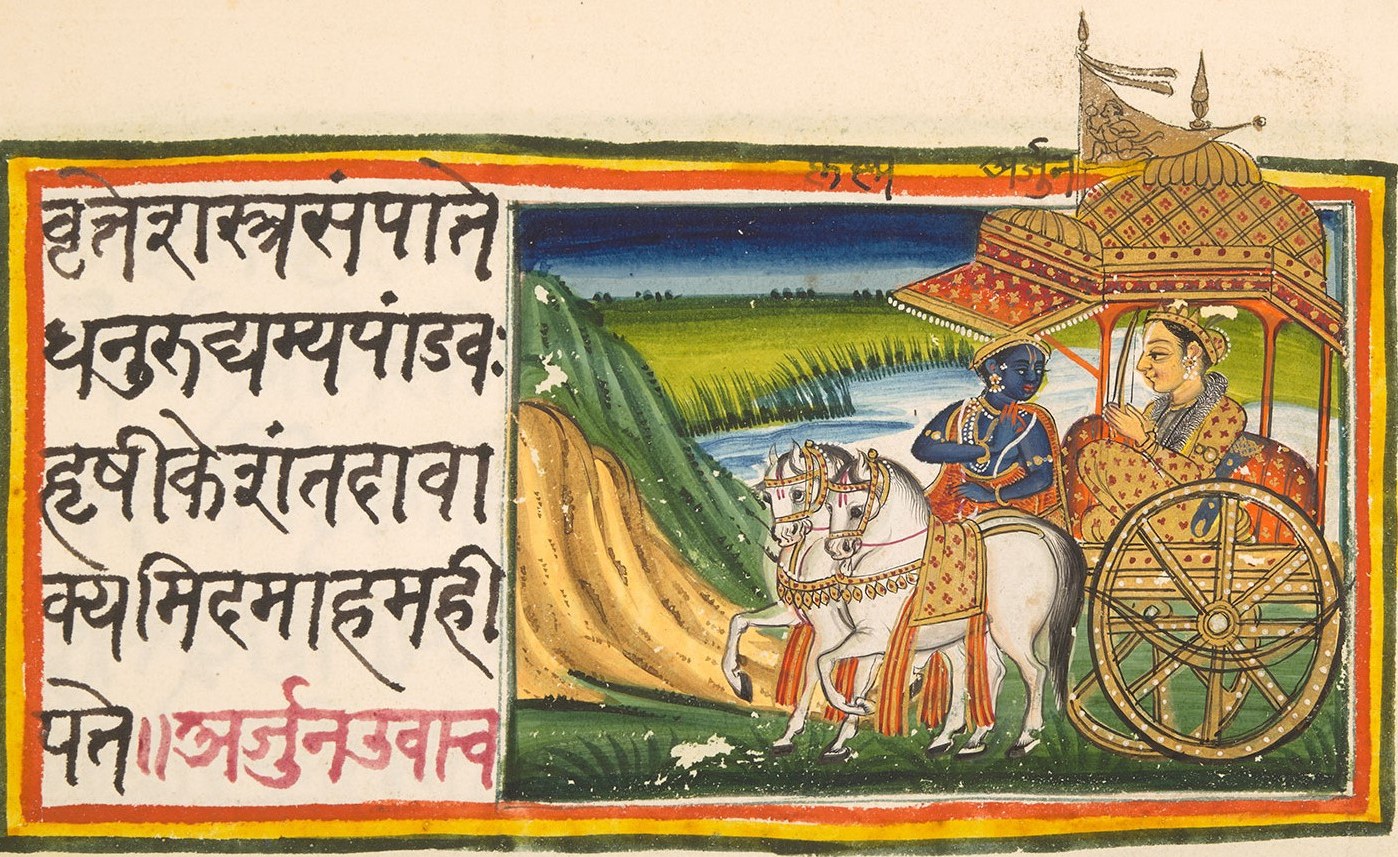
In the same breath he gave the new lord a vehicle to match his rank, a chariot called the PushpakaThe self-moving aerial chariot, bright as the sun, that Brahma gives Kubera and that will fly for no owner but him., as bright as the sun,
and bade him be equal to the gods. So Kubera enters the tradition as a constitutional power rather than a hoarder, one quarter of the machinery that holds the world in order.
The names he was given
He is almost never called only Kubera. To his own people he is the yakshaA class of nature-spirits linked to the earth, its buried wealth and its wild places; usually benign, ruled by Kubera and ranged from graceful attendants to grim, peg-eared guards. king, lord of the earth-spirits who guard its buried hoards, but the epics prefer Vaishravana, son of Vishravas,
and the patronymic carries his whole descent: from Brahma through the mind-born sage Pulastya, to the brahmin Vishravas, and so to Kubera by Vishravas’s wife, the daughter of Bharadvaja. His grandfather named him at birth, declaring that the child would become the Guardian of Wealth and, since he took after his father, should be known as Vaishravana. The wealth-titles pile up around him after that, Dhanada the wealth-giver, Dhaneshvara the lord of wealth, Dhanapati the master of treasure, each a variation on a single idea.
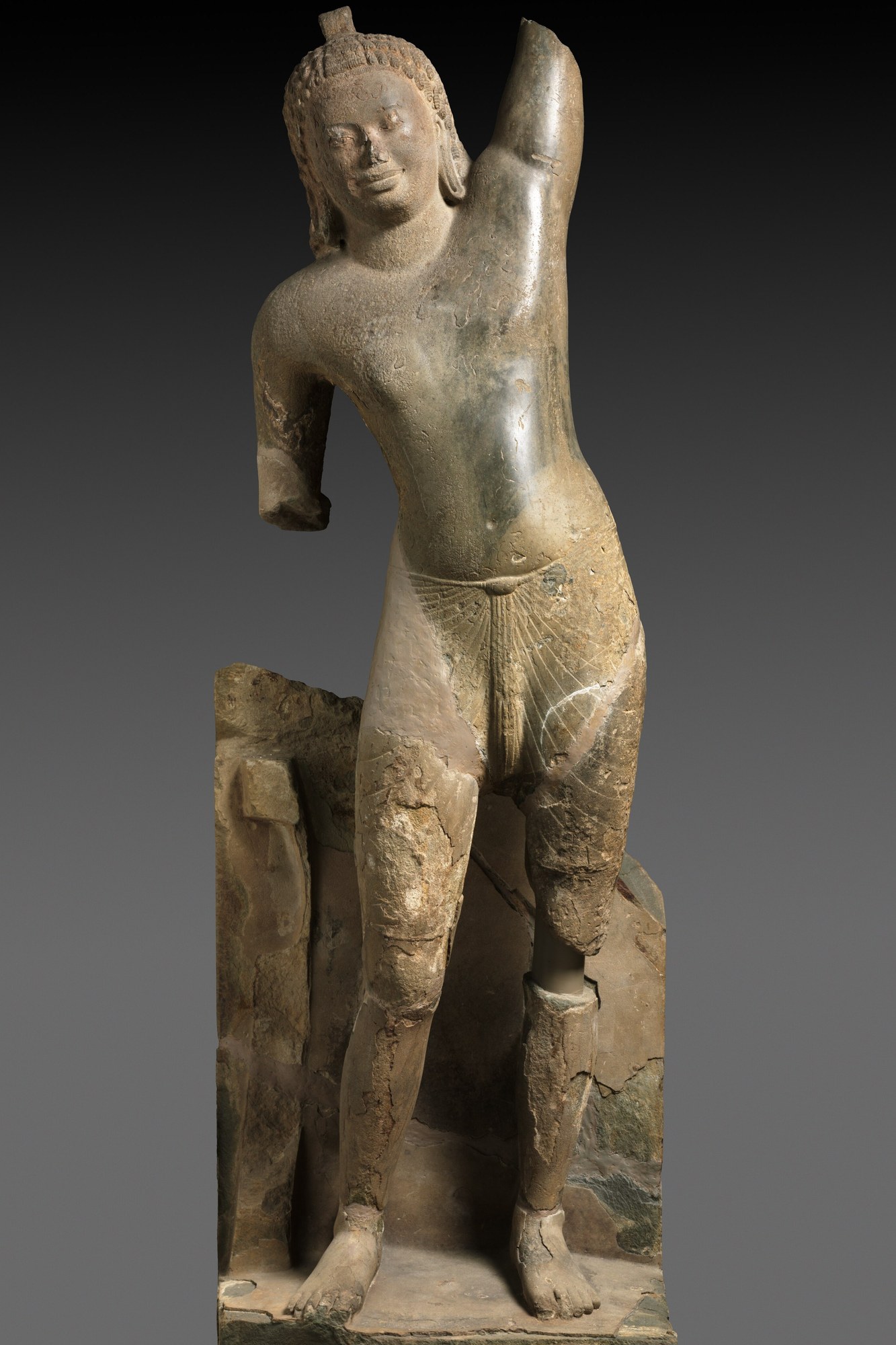
Two of the labels most people attach to him, though, come from outside these texts, and honesty about that is the point of reading them. Kubera’s grotesque body, the pot-belly and the three legs and the eight teeth and the jewel-spilling mongoose clutched in one hand, is the work of later Puranic description and temple sculpture, not of the epics.
The Mahabharata gives him nothing of the kind: it seats him crowned in a golden garland, holding a noose, a sword and a bow, and has him carried on the shoulders of men. Nor do the epics ever place his capital at Alaka, the shimmering Himalayan city every reader associates with him. That name belongs to the court-poetry of Kalidasa, some centuries after the epic core. The texts examined here give him first Lanka, and later a seat on Mount Kailasa.
The city he was given and lost
Lanka came to him as a gift, and left him as a theft. Built by the divine architect Vishvakarma on the summit of Mount Trikuta above the southern sea, with golden walls and archways of emerald, it had been abandoned by the rakshasas in their fear of Vishnu, and Vishravas handed the deserted city to his son: Dwell in Lanka and be happy.
Kubera peopled it and ruled it, flying home to visit his parents in the Pushpaka.
The Ramayana is careful to hold two truths at once here. By Kubera’s own account Lanka is his lawful inheritance, given by his father when the night-rangers had fled it. By his enemies’ account it is the rakshasas’ ancestral seat, which the crafty Lord of Wealth
merely took possession of. The epic never decides between them, and neither should we.
The enemy was family. Kubera and the demon-king Ravana were half-brothers, both sons of Vishravas, one by a brahmin’s daughter and one by a rakshasi. Goaded by his mother’s kin to reclaim the city, Ravana sent an envoy demanding it back. Kubera’s answer was not to fight but to share: the city and the kingdom, he offered, were his brother’s too, to hold without division.
The offer was refused. When Kubera later sent a fraternal warning, urging Ravana to stop ravaging the gods’ gardens and persecuting the sages, Ravana killed the messenger and swore to send all four World-GuardiansThe powers set over the regions of the cosmos to hold it in order; four in the older reckoning, later expanded to eight guardians of the directions. to the house of death.
What a thief cannot carry
The war came to Mount Kailasa. Kubera’s yaksha general Manibhadra led four thousand of his people against Ravana’s ministers, and in the fighting struck the demon’s diadem askew. Then the two brothers met in single combat with maces. Kubera loosed the fire-weapon; Ravana parried it with the weapon of Varuna, turned himself by rakshasa magic into a tiger, a boar, a cloud, a mountain, an ocean, a tree, and at last brought his mace down on his brother’s head.
Kubera fell senseless, covered with blood, like unto an Ashoka Tree whose roots have been severed,
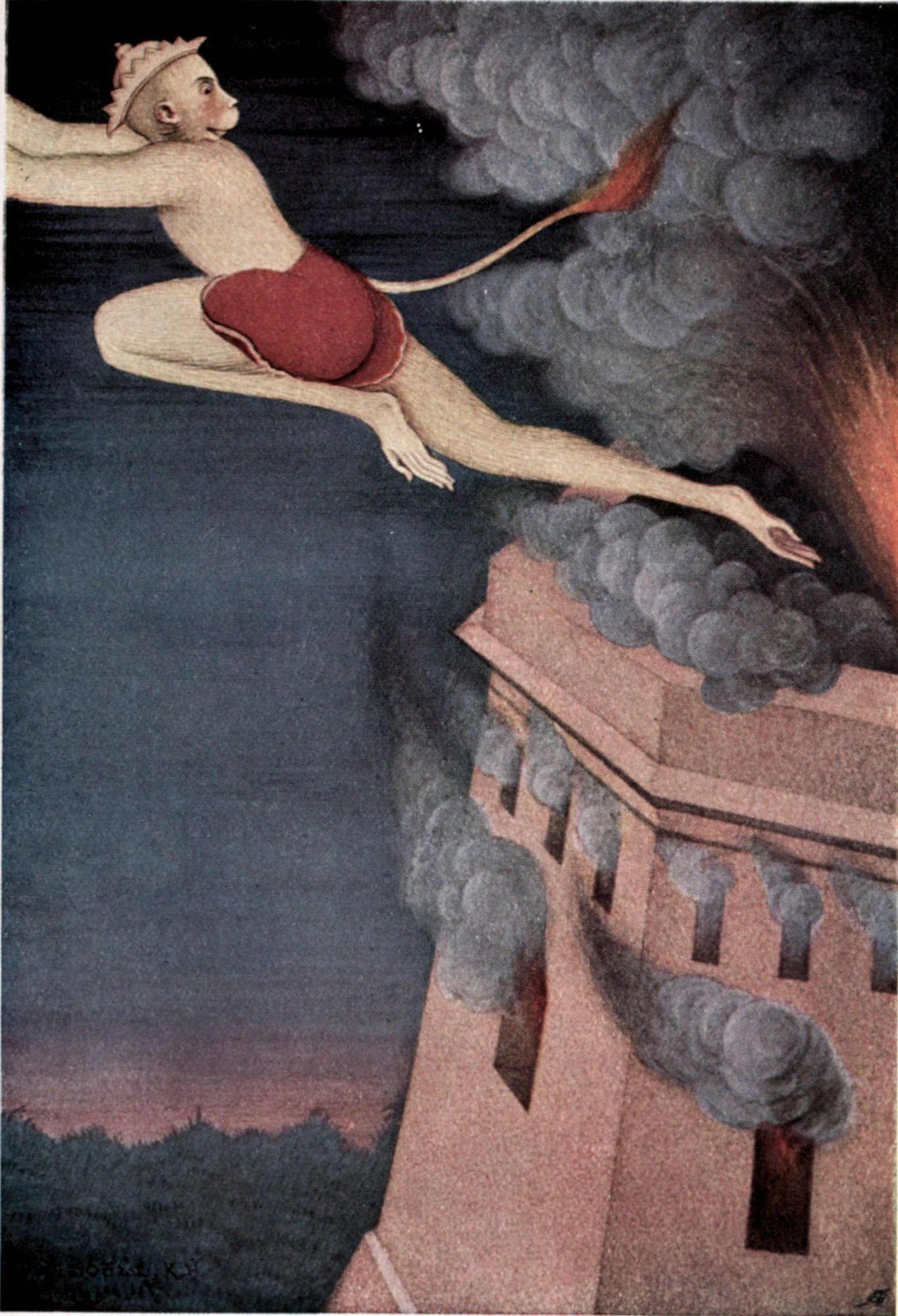
and the sages bore him through the sky to safety. Ravana seized the Pushpaka, with its golden pillars and doors of emerald and its fruit-bearing trees, and flew off with his prize.
Except that it would not fly. The moment the chariot was parted from its true lord it fell still, and Ravana’s own minister had to explain why: the Pushpaka is only able to serve Dhanada,
and cut off from the Lord of Wealth it has become motionless.
It is the sharpest image the tradition gives us of the god’s real nature. Wealth taken by force stops working in the thief’s hands. The treasure-god’s signature possession is one that refuses, on principle, to reward a theft.
The lord on the mountain
The Mahabharata catches Kubera later, settled and serene on the Himalayan heights, king of the yakshas amid Mandara and Kailasa, his peaks made inaccessible by eighty thousand gandharvas and hosts of his own people. When Bhima forces his way into Kubera’s pleasure-lake, a sheet of water filled with golden lotuses and fragrant saugandhika flowers on stalks of lapis lazuli, and cuts down the rakshasa guards who bar him, the god does not punish him. He calls the slain guards already slain by Destiny,
blesses the wandering Pandavas, and reveals that the mortal’s violence has freed him from an old curse of the sage Agastya. The wealth-lord of this book is generous, unruffled, past the reach of loss.
And past his kin, too. The Vishnu Purana, later again, sets him among the sovereignties of the whole creation, where Vaishravana was made king over kings.
It is worth marking how far apart these witnesses stand. The Uttara Kanda that tells of Lanka is itself a late addition to the Ramayana, and the Vishnu Purana is later still, perhaps four or five centuries into the common era, while the English translations through which readers meet them date to the nineteenth and twentieth centuries, close to two thousand years after the Sanskrit originals.
The Purana declines even to make him regent of the north, an office the mature system takes for granted; that primal list gives the north to another. Kubera’s familiar shape, guardian of the northern quarter, master of Alaka, cradling his mongoose, was assembled over centuries out of texts that each knew only a part of him.
Without doubt it is only able to serve Dhanada, and, since it is separated from that Lord of Wealth, it has become motionless.
- Vālmīki, Rāmāyaṇa, Uttara Kāṇḍa (Book 7), chapters 2–3, 11, 13–16 (Hari Prasad Shastri tr., Shanti Sadan, London, 1952; via wisdomlib docs 424763–424764, 424772, 424774–424777)the load-bearing life. Chapters 2–3, Kubera’s descent from Pulastya through Vishravas, the thousand-year austerity of water then air then nothing, Brahma’s appointment of him as the fourth World-Guardian and Lord of Wealth, the gift of the Puṣpaka
as bright as the sun,
and the grant of the Vishvakarma-built Laṅkā on Mount Trikuta. Chapters 11, 13, the quarrel with Rāvaṇa: the demand for Laṅkā, Kubera’s offer to share itwithout division,
his fraternal warning and Rāvaṇa’s murder of the envoy. Chapters 14–16, the war at Kailāsa, Manibhadra’s yakṣa host, the mace-duel and Rāvaṇa’s shape-shifting, Kubera felledlike unto an Ashoka Tree,
the seizure of the Puṣpaka and its refusal to fly for anyone but its owner. The Uttara Kāṇḍa is by scholarly consensus a later layer than the epic’s older core (Books 2–6); the Sanskrit is conventionally placed around the turn of the era and the translation read is from 1952. - Vyāsa (trad.), Mahābhārata, Vana Parva (Book 3), Sections ~CXL and CLII–CLXI (Kisari Mohan Ganguli tr., P. C. Roy ed.; archive.org DjVu
mahabharataofkri03roypuoft)Kubera king of the Yakṣas on Mandara and Kailāsa, guarded by eighty thousand Gandharvas; the Saugandhika-lotus lake of golden flowers on lapis-lazuli stalks; Bhīma’s defiance of the Krodhavaśa guards; and Kubera’s darśan, borne on men’s shoulders in a golden garland with noose, sword and bow, blessing the Pāṇḍavas and declaring himself freed from Agastya’s curse. Compiled roughly between the 4th century BCE and the 4th century CE; the translation read dates 1883–1896. - Viṣṇu Purāṇa, Book I chapter XXII, with Book II (H. H. Wilson tr., London, 1840; archive.org DjVu
dli.csl.3715)Vaiśravaṇamade king over kings
among the sovereignties Brahmā establishes, the four quarter-regents (where the north is given to Hiraṇyaroman, not Kubera), Wilson’s note listingKubera, of riches and of the Yakṣas,
and Kubera’s city on Kailāsa among the eight Lokapālas. The Purāṇa is commonly dated to about the 4th–5th century CE; the translation is from 1840. The brief’sVishnu Purana 3
is imprecise: the Kubera material sits in Books I–II, and there is no substantive Kubera episode in Book III. - Later tradition (named here so it is not mistaken for the above). The proper name Alaka for Kubera’s golden city is the classical kāvya tradition, above all Kālidāsa’s Meghadūta (c. 4th–5th century CE), not the epics, which give Laṅkā and then Kailāsa. The grotesque iconography, the pot-belly, three legs, eight teeth, tawny eye and jewel-spilling mongoose, is Purāṇic and Śilpa-śāstra temple tradition; the epics read here give no such body.
Regent of the north
is true of the mature Dikpāla system but is not the appointment made in Viṣṇu Purāṇa I.22. These strands were not read verbatim this pass and are flagged rather than sourced.