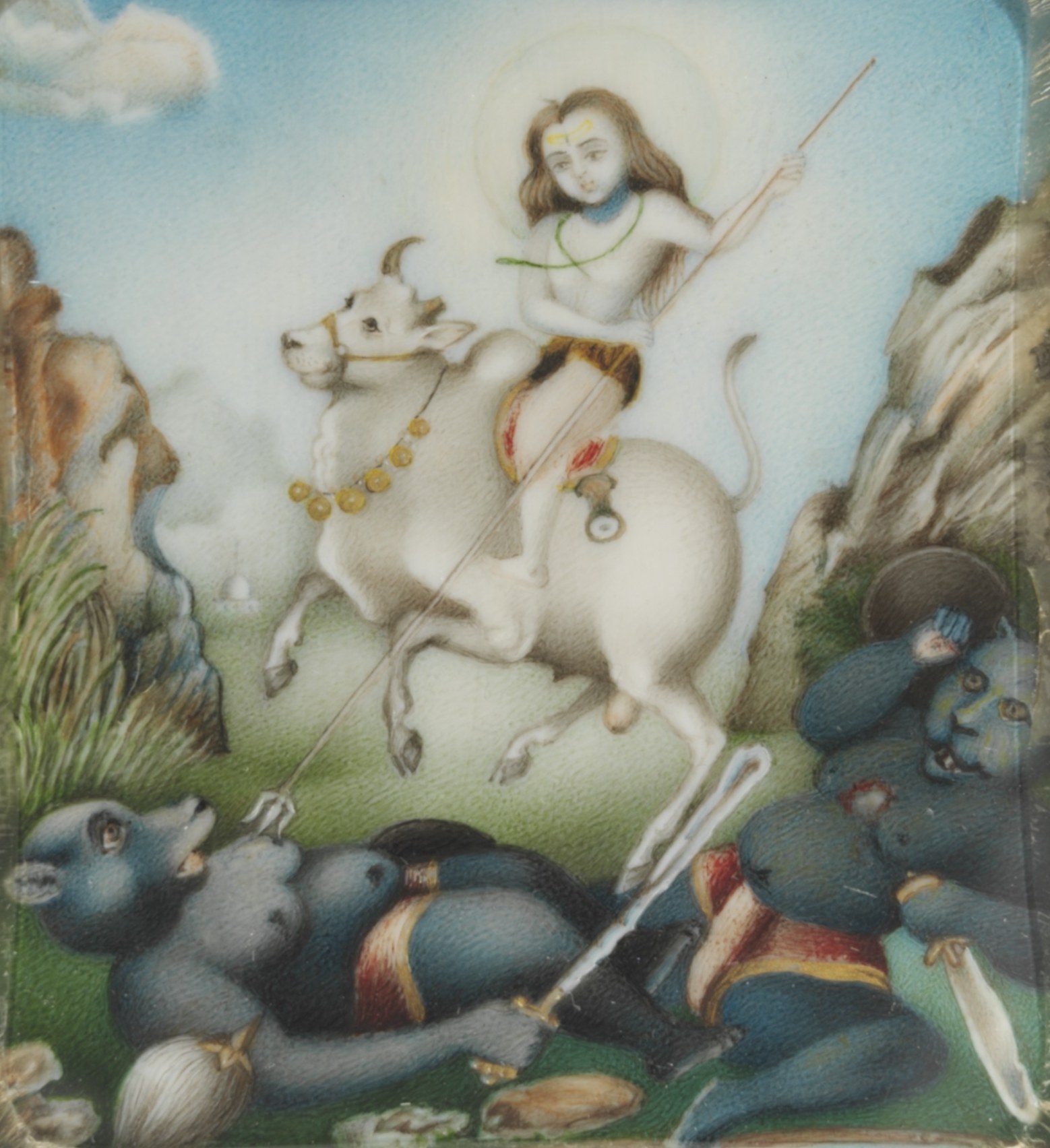
A traveller who climbs the steps of any Shiva temple meets the same guardian before he reaches the god. A bull of white stone lies on the central axis, hump high, dewlap heavy, garlanded and hung with bells, and he has turned his great head to face the dark doorway of the shrine. He is not going anywhere. He has been lying there, gazing at his lord, for as long as the temple has stood. This is Nandi, and the popular imagination knows him as exactly this: the bull who is Shiva’s mount, the doorkeeper of the god, and the first and most faithful of his devotees, forever seated where the worshipper must pass him to pray.
The oldest Sanskrit sources tell a stranger story, and it is worth being honest at the outset that the calm bull on the platform is a late arrival. In the older texts the name Nandin belongs not to an animal at all but to a man, and the bull that carries Shiva is a separate creature with its own name. The seated white bull called Nandi, familiar from every shrine, is a fusion of the two that scholarship traces to a later, largely southern development. To meet Nandi properly is to meet him twice.
The sage drained to a skeleton
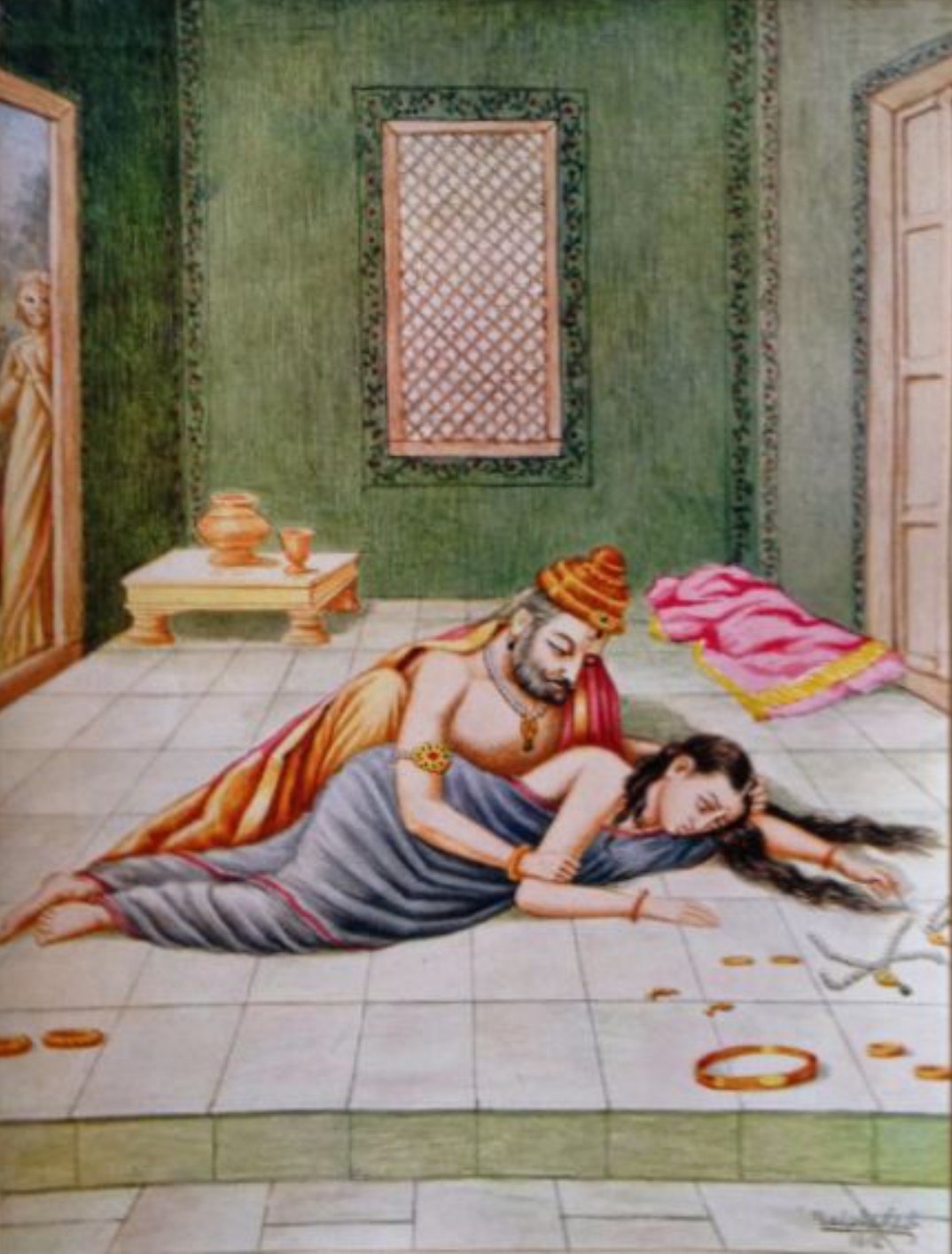
The fullest life is a birth narrative, and it begins with a father who wanted a son who would never die. The sage Shilada, pressed by his ancestors to continue the line, went to Indra and asked for a child who would be free of death and not born of any womb.
Indra told him plainly that this was beyond his gift; he could grant only a mortal, womb-born son, and sent Shilada to propitiate Shiva instead. So the sage sat down to a penance so long and so fierce that the earth built an anthill over his motionless body, and worms with beaks as hard as adamant
bored into him and drank him dry until nothing was left but a bare skeleton.
Shiva, appearing at last, granted the impossible request in his own person. I shall become your son by the name of Nandin,
the god declared. I shall not be born of a womb.
When the child came, as Shilada began a sacrifice, he arrived with the lustre of the fire that ends an age; flowers rained from the sky and the celestial musicians walked through the air. He was born three-eyed and four-armed, matted-haired and crowned, in the form of Rudra
himself. Only on reaching his father’s hut did he shed the divine shape and take a human one, his memory of his own godhead wiped clean, and Shilada raised him and taught him the Vedas.
How a boy conquered death
The gift of a son who could not die was tested almost at once. In Nandin’s seventh year two sages, Mitra and Varuna, looked at the boy and foretold that he would be dead within the year. Nandin was unafraid. I shall deceive death by means of my penance,
he answered, and set himself to worship the great god rather than to learn or to grieve. It was, of course, a trial; Shiva had sent the two sages himself to see what the child would do.
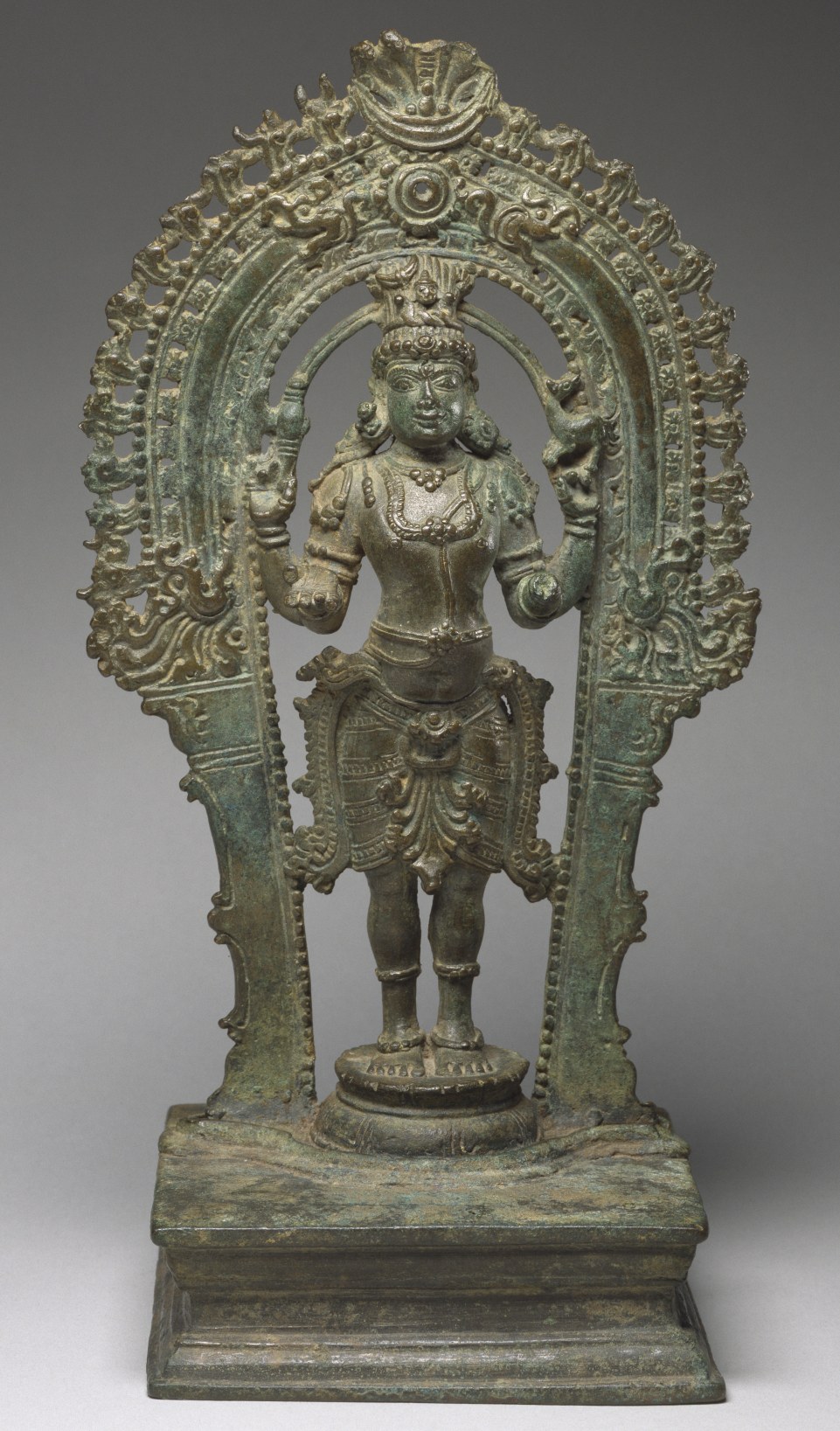
The reward was extravagant. Shiva took the lotus garland from his own head and tied it around Nandin’s neck, and at its touch the boy became three-eyed and ten-armed, a second Shiva.
The god decreed him deathless, ageless and eternal, and made him lord of the GaṇasThe rowdy host of dwarfish, animal-featured attendants who follow Shiva; Nandi is made their eternal chief., chief of the rowdy host of attendants who follow Shiva. Brahma himself performed the coronation while Vishnu and Indra sang his praises.
There were nuptials too: Nandin was married to Suyasha, a daughter of the Maruts, who was given three eyes of her own and freedom from ever being reborn. Among the wedding gifts, the Liṅga Purāṇa notes a golden crown wrought by the divine architect Vishvakarman and earrings of diamond and lapis lazuli. Among them too, tellingly, was a fine bull.
The man being crowned, in other words, is given a bull; he is not yet the bull.
The guard with the monkey face
An older and quite different Nandin appears in the epics. In a late appendix to the Rāmāyaṇa, Nandikeshvara is the dwarfish, dark-and-tawny gatekeeper of Shiva’s mountain, KailasaThe Himalayan mountain that is Shiva's abode, guarded at its gate in the older epic tradition., a gaṇa and not a beast. When the demon-king Rāvaṇa halted his flying chariot at the sacred slopes and was refused passage, he mocked the guard for his monkey-like face. The insulted Nandin cursed him: creatures of that very shape and power would one day destroy his race. Centuries of readers have understood the curse fulfilled when the monkey armies of Rama, and Hanuman with his torch, brought Lanka down in flames.
This gatekeeper and the crowned son of Shilada are separated by many centuries, the epic episode dated roughly to the first three centuries of the common era and the birth-and-coronation narrative to a compilation redacted anywhere from the fifth to the fourteenth centuries. They are not one biography but successive strata of a name.
When the man became the mount
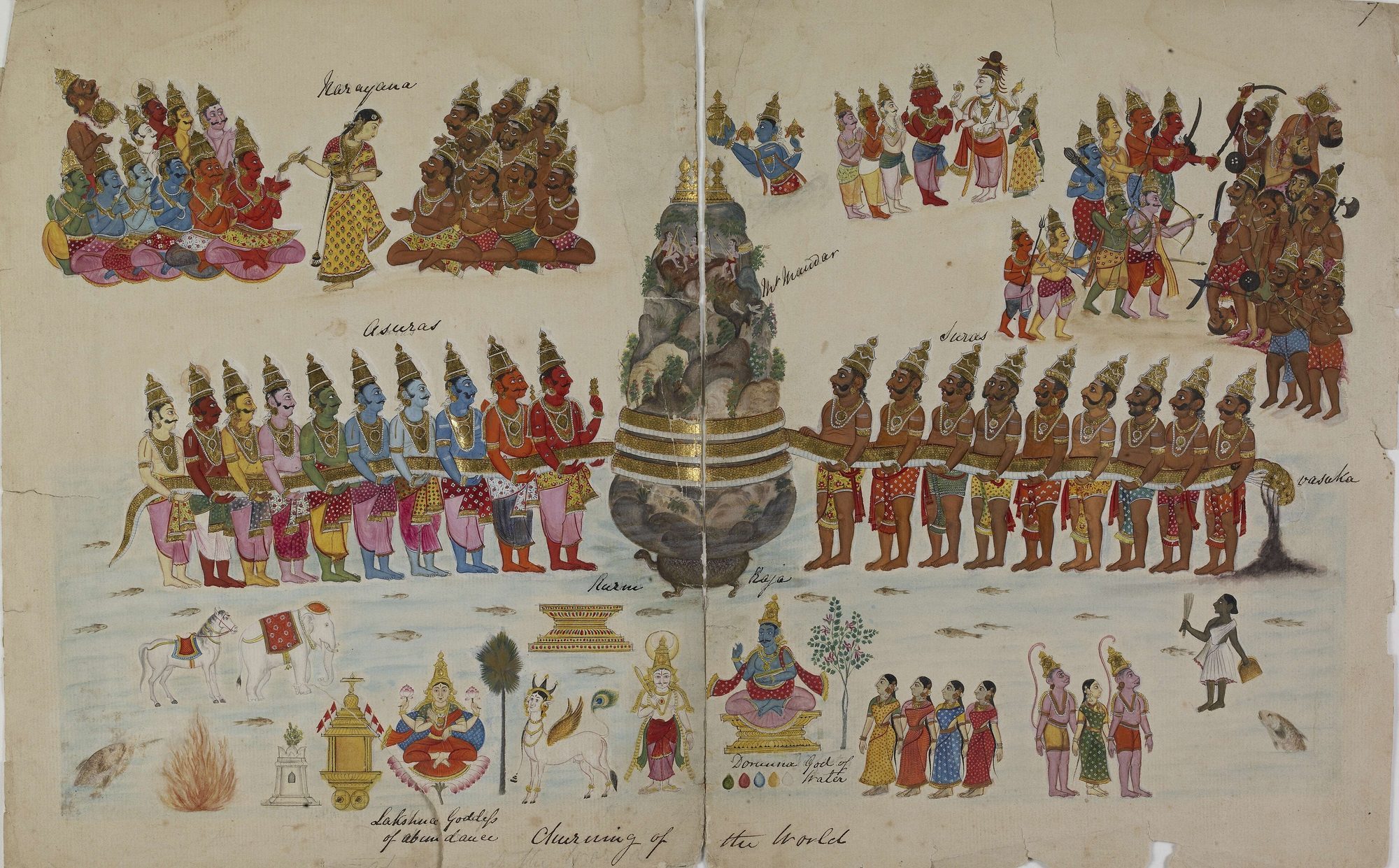
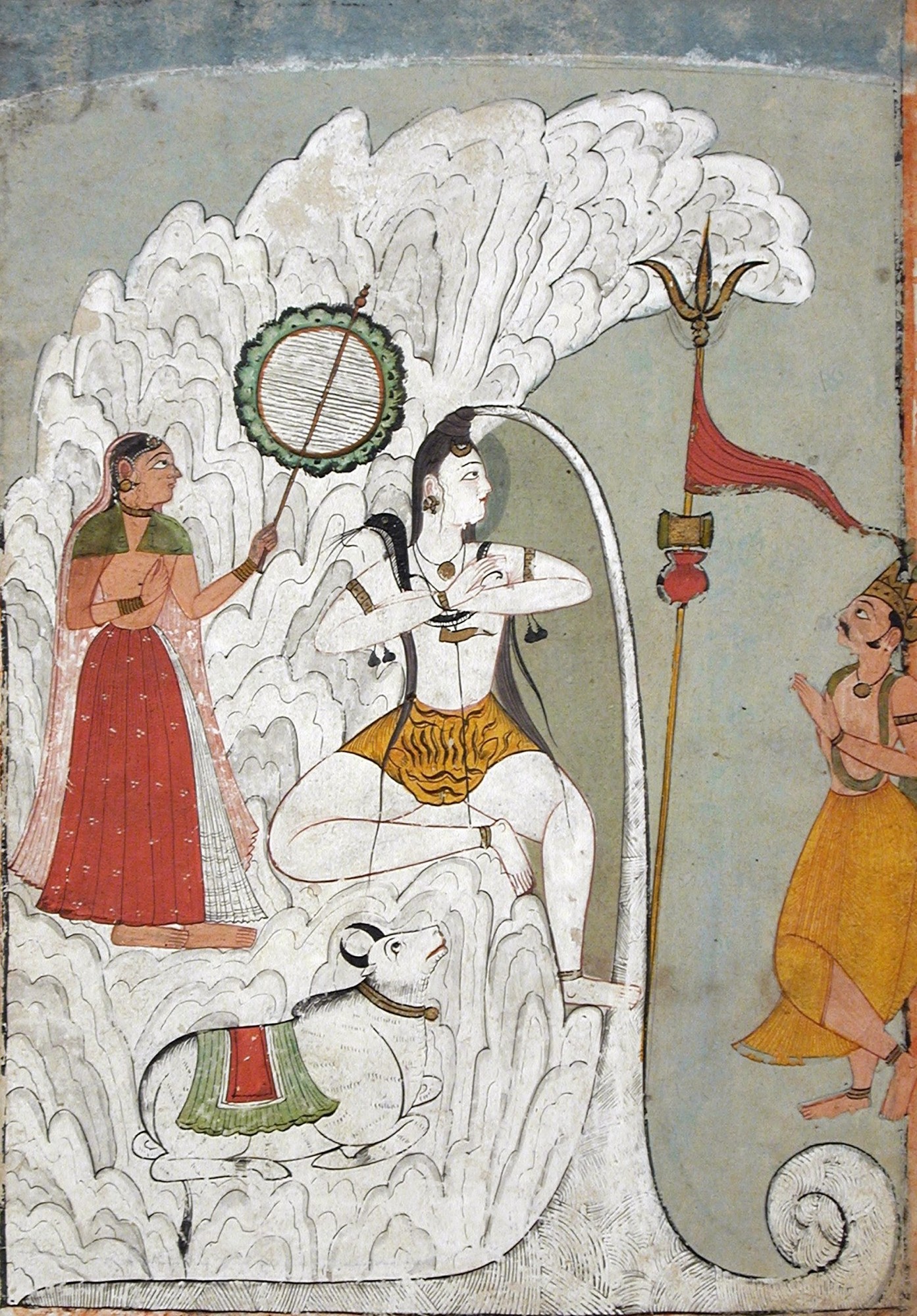
Where, then, is the bull? He is present throughout, but as a distinct figure. When Shiva flings water from his matted hair to make five holy rivers, it is the bull’s own bellow, in the Liṅga Purāṇa, that gives birth to the river Vṛṣadhvani, bull-sound.
When Shiva rides home after the coronation, he mounts his bull while the human-formed Nandin walks at his side. The vāhanaThe animal mount that carries a Hindu deity and serves as that god's emblem; Shiva's is the white bull., the animal that carries the god and stands as his emblem, is named again and again in the older Purāṇas simply as the mount of Shiva.
The modern scholar Gouriswar Bhattacharya argued that fusing the two, so that the bull itself is called Nandi, is a comparatively recent regional syncretism, and the Shaiva ritual texts keep them apart. Yet the fused image is the one that endured, and it is not hard to see why. Everything the man Nandin was — the deathless chief of the host, the guard who let no unworthy one pass, the devotee who wanted only to sit at the god’s side — is carried perfectly by the patient white bull who lies before the shrine and will not take his eyes off the door.
“I shall become your son by the name of Nandin. I shall not be born of a womb.”
- Śiva Purāṇa, Śatarudra-saṃhitā, chapter 6 (
The incarnation of Nandīśvara
), trans. J. L. Shastri (Motilal Banarsidass, 1950; via wisdomlib doc 226402)the sage Shilada of the Shalankayana line urged by his ancestors to raise progeny; Indra’s refusal and his direction to propitiate Shiva; the thousand-divine-year penance under an anthill, the body drained by wormsas hard as adamant
to a bare skeleton; Shiva’s boon,I shall become your son by the name of Nandin
; the non-womb birth with the lustre of the age-ending fire, three eyes and four armsin the form of Rudra
; the shedding of the divine form; and the death-prophecy of the sages Mitra and Varuna in the boy’s seventh year. The extant Śiva Purāṇa is a late compilation, c. 10th–14th century CE. - Śiva Purāṇa, Śatarudra-saṃhitā, chapter 7 (
The coronation and the nuptials of Nandīśvara
), trans. J. L. Shastri (via wisdomlib doc 226403)Shiva’s own lotus garland tied round Nandin’s neck, whereupon he becomes three-eyed and ten-armed,a second Shiva
; the boon of deathlessness and the office of lord of the Gaṇas; Brahma’s coronation with Vishnu and Indra in praise; the marriage to Suyasha, daughter of the Maruts, granted three eyes and freedom from rebirth; the wedding gifts, among thema fine bull, a white elephant, a lion
; and the making of the five rivers. - Liṅga Purāṇa, chapter 43 (
Coronation of Nandiśvara
), trans. J. L. Shastri (Motilal Banarsidass, 1951)the parallel Shilada birth and coronation; the obliteration of Nandin’s divine memory; the golden crown made by Vishvakarman and the earrings of diamond and lapis lazuli; and the bull whose bellow gives rise to the river Vṛṣadhvani (bull-sound
). c. 5th–10th century CE. - Vāyu Purāṇa 54.76, 54.108, 101.265 (via Purāṇic Index)Nandi named as the vāhana, the mount, of Shiva, distinct in these older texts from the human gaṇa-chief. Core Purāṇa c. 3rd–5th century CE; the verses are cited from the index and were not read verbatim.
- Vālmīki, Rāmāyaṇa, Uttarakāṇḍa, sarga 16 (via T. A. Gopinatha Rao, Elements of Hindu Iconography, vol. 2)Nandikeshvara the dwarfish, dark-and-tawny gaṇa guarding Kailasa; Rāvaṇa’s mockery of his monkey-face; and the curse that monkey-shaped beings would destroy Rāvaṇa’s race. The Uttarakāṇḍa is a later appendix to the epic and the episode is conventionally placed c. 1st–3rd century CE; the epic’s own verses were not read verbatim this pass, the content being taken from Gopinatha Rao’s summary.
- Gouriswar Bhattacharya,
Nandin and Vṛṣabha
(1977), ZDMG Supplement III,2, pp. 1543–1567modern scholarship arguing that the identification of Shiva’s bull with the name Nandi is a late regional syncretism, the older Sanskrit, Tamil and other texts keeping the anthropomorphic doorkeeper Nandin distinct from the bull Vṛṣabha. Cited from the reference apparatus; the article itself was not read.