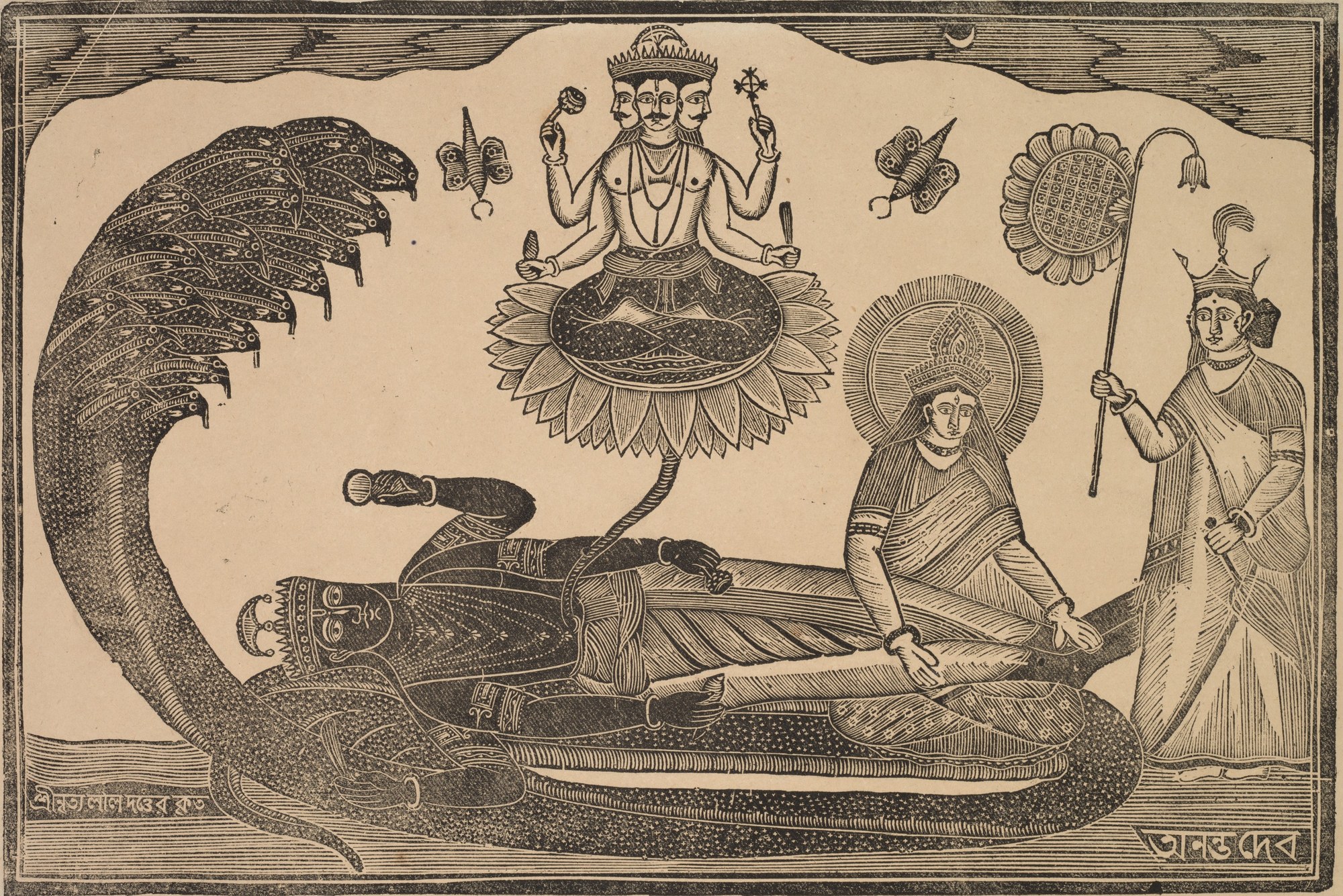
He yawns, and the earth trembles. Somewhere far below the seven underworlds a serpent shifts in his sleep, his jaws open, and across the whole surface of the world the mountains shake, the seas slop against their shores, the rivers jump their banks. This is how the Vishnu Purana accounts for the quaking of the ground: it is the stirring of the thing the ground is resting on. His name in that text is Shesha, and he is a snake with a thousand heads, and the entire earth with all her woods and mountains and seas sits on a single one of them, so small against him that a later text will call it a mustard seed, an atom lying on one hood among a thousand. He is the floor beneath the floor of the world.
The eldest of the serpent brood
Before he is a cosmic pillar he is a son, and the oldest son at that. The Mahabharata places his birth at the head of a whole brood of serpents: Shesha was born first, it says, and then Vasuki, and after them the rest of the great Nagas. That order matters, because it keeps two serpents apart who are forever being confused. Vasuki is the younger brother, the one who will later be lashed round a mountain and used as a churning-rope to beat the ocean into nectar. Shesha is the elder, and his work is heavier and stiller. He is the one who holds things up.
The picture of how he came to that work is, in this oldest telling, not grand at all but grim. Revolted by his brothers’ cruelty and their scheming against their own mother, Shesha simply left them. He went off to Gandhamadana and Badari and the foot of the Himalaya and practised austerities so severe that, in the epic’s flat phrase, his flesh and skin and sinews dried up. He lived on air. It is a portrait of a serpent-ascetic, and it is worth holding onto, because everything the later tradition piles on top of him grows out of this starved, self-denying figure and steadily buries it.
Who set the weight on his head
There is a real disagreement between the sources here, and it is not a small one. In the Mahabharata it is Brahma, the Grandsire, who is so pleased with the serpent’s penance that he gives him the earth to carry. Bear this earth, he commands, so unsteady with her mountains and forests and seas, so that she may be steady; and Shesha agrees, enters a crevice, passes to the underside of the world, and holds the goddess up with his head. For this the epic honours him with a startling title. It calls him the god Dharma, the god of right order itself. Vishnu is nowhere in the scene.
That is the earliest layer, and roughly nine hundred years separate it from the version most people picture. By the time of the Bhagavata Purana, a text of the ninth or tenth century, the serpent is no longer Brahma’s appointee but Vishnu’s own. The gap is not a detail of phrasing; it is the whole Vaishnava reframing of a figure who began outside it.
The Vishnu Purana, standing between the two in time, goes furthest of all and makes the serpent not the god’s servant but the god’s substance, calling Shesha the very form of Vishnu proceeding from the quality of darkness. Read in order, the texts do not describe one fixed being. They show a figure being slowly drawn into the orbit of a rising god, from Brahma’s honoured labourer to Vishnu’s dark emanation, across the better part of a millennium.
The couch on the flood
The image the world remembers belongs to that latest layer. Between one creation and the next, when the universe has been withdrawn and there is nothing but water, Vishnu lies down to sleep, and the bed he sleeps on is the serpent. The Bhagavata describes it with care: the god asleep on the coils of the king of snakes upon the waters of the deluge, his arms wound about by the body of the great snake he calls his dear friend, and the darkness of the flood dispelled by the light of the gems on the serpent’s countless hoods, which spread over the sleeper like a jewelled umbrella.
He sleeps, the text says, for a thousand aggregates of four ages, and from a lotus growing out of his navel the creator Brahma is born to begin the next world. The serpent is the one steady thing across the emptiness between two universes.
This is a different ocean from the one his brother works in, and the two are easily run together. Vasuki’s churning happens in the sea of milk, a specific place, to win a specific prize. Shesha’s couch floats on the shoreless waters of dissolution, the pralayaThe dissolution that ends each cosmic age, when the worlds are withdrawn or burnt away before the next creation; between two of them Vishnu sleeps on the serpent., where there is no place and nothing to win, only the long sleep between ages.
Jewelled, ploughing, perfumed
The longer the tradition looks at him the more it dresses him, and the accreted figure of the Puranas is sumptuous where the epic’s was starved. He wears a single earring, a diadem and a white necklace, and garments coloured purple in one text and blue in another; he shines, says the Vishnu Purana, like the white mountains crowned with flame.
In his hands he holds a plough and a pestle, and beside him stands Varuni, the goddess of wine, for by now the serpent has been identified with Balarama, the wine-loving, plough-bearing elder brother of Krishna, and wears that hero’s attributes as his own. Unmarried NagaA divine serpent of Indian tradition, half snake and half deity; the great Nagas are the many-hooded sons of Kadrū, of whom Shesha is the eldest. princesses anoint his long silver arms with sandal and saffron; his very breath, scattering the sandal-paste they grind, perfumes the skies.
One of the strangest gifts in his portfolio is knowledge. The Vishnu Purana records that the ancient sage Garga won from Shesha, by propitiating him, the whole science of the stars, the courses of the planets and the reading of good and ill in the heavens. The serpent who holds up the earth is also the first astronomer’s teacher.
And the same mouths that teach are the mouths that end the world: at the close of each cosmic age, the text says, a venomed fire issues from them, and that fire, taking form as Rudra, devours the three worlds. The Bhagavata gives the same office a fiercer image, a destroyer manifesting from between the serpent’s angry brows in eleven three-eyed shapes, each with a trident, to draw the world back in. He is at once the bed on which the cosmos sleeps and the fire in which it burns.
What “a thousand” counts
His thousand heads are not a census. Every witness says a thousand, and every witness in the same breath treats the number as a stand-in for the uncountable: the thousand jewels in his crests give light to all the regions, and even a speaker with a thousand tongues, the Bhagavata says, could not tell over his acts. This is the sense the Vishnu Purana draws his other name from.
Because neither the gods nor the Gandharvas nor the sages can comprehend his form or hymn his praise to the end, it says, he is called AnantaThe serpent's other name, which the Vishnu Purana glosses as "the infinite, the imperishable", because neither gods nor sages can measure or hymn him fully., the endless, the imperishable. The name is the confession that the counting stops before he does. It is also why the painted serpent, with his tidy five or seven visible hoods arching over the sleeping god, is a courtesy of art and not a portrait of the text; the pictures give the eye a number it can hold, where the words insist there is none.
Below the seven Pátálas is the form of Vishńu, proceeding from the quality of darkness, which is called Śesha… He bears the entire world, like a diadem, upon his head, and he is the foundation on which the seven Pátálas rest. (Viṣṇu Purāṇa 2.5, tr. H. H. Wilson)
- Mahābhārata, Ādi Parva, Āstīka Parva, Sections XV & XXXVI (Ganguli trans., Pratap Chandra Roy ed., c. 1883–96)the earliest witness here for Śeṣa as a named actor. His birth first among Kadrū’s serpents (
Sesha was born first, and then Vasuki
); his revulsion at his brothers’ cruelty and his withdrawal into austerities at Gandhamādana, Badarī and the foot of Himavat untilhis flesh, skin, and sinews dried up
; Brahmāthe Grandsire
commanding him tohold the Earth steady
and honouring him asthe god Dharma
; Garuḍa givenfor Ananta’s help
; and, in Section XV,the powerful Ananta
tearing up Mount Mandara so the gods could churn the sea, with Vāsuki (not Śeṣa) serving as the rope. Note that in this oldest layer the earth-bearing is Brahmā’s command, with no Viṣṇu connection and no Balarāma identity. The Āstīka Parva is a relatively late stratum of an epic whose core is conventionally dated c. 400 BCE – 400 CE (a scholarly convention, not a claim of the text), so roughly turn of the era. - Viṣṇu Purāṇa 2.5 (Wilson trans., The Vishnu Purana, 1840)Śeṣa below the seven Pātālas as
the form of Viṣṇu, proceeding from the quality of darkness (tamas),
bearing the worldlike a diadem
and forming the foundation on which the Pātālas rest; the thousand crest-jewels thatgive light to all the regions
; the yawn at whichearth, with all her woods, and mountains, and seas, and rivers, trembles
; the breath that scatters the serpent-women’s sandal-paste andsheds perfume around the skies
; the iconography of earring, diadem, purple raiment, plough and pestle and the attendant wine-goddess Vāruṇī, marking the identity withBalarāma or Saṅkarshana
; the sage Garga winninga knowledge of the principles of astronomical science, of the planets
by propitiating him; the kalpa-endvenomed fire
from his mouthsimpersonated as Rudra, who is one with Balarāma
; and the text’s own etymology of the name: because his mightcannot be comprehended by the gods themselves,
therefore he is called the infinite (Ananta), the imperishable.
A comparatively early Purāṇa, conventionally c. 1st–5th c. CE. Wilson’s own footnote records that the Mahābhārata and the Purāṇas assign the Nāgas different Pātāla-divisions, a nineteenth-century comparison of texts rather than a single primary statement. - Bhāgavata Purāṇa 5.25 (Tagare trans., Motilal Banarsidass, c. 1976)the serpent named Saṅkarṣaṇa, on one of whose thousand heads
the terrestrial globe with all its mountains, rivers, seas and the living beings
lieslike an atom
andappears like a mustard seed
; the destroyer Rudra manifested from his knitted browsin eleven forms, each three-eyed and holding a trident
; the unmarried Nāga princesses anointing hissilver-pillar
arms with aguru, sandalwood and saffron; and his Balarāma aspect in blue garments, bearing the plough, wearing the humming Vaijayantī wreath. A comparatively late Mahāpurāṇa, scholarly consensus c. 9th–10th c. CE, roughly 700–900 years after the epic’s Śeṣa, and the measure of how far the figure grew from a penance-hardened Nāga into a jewelled cosmic deity. - Bhāgavata Purāṇa 3.8 (Tagare trans.)the classic reclining scene. Viṣṇu asleep
on the bed of the king of Snakes (Śeṣa)
upon the waters of the deluge whilethis whole universe was immersed in water,
his armscoiled round by the body of great snake,
whom he calls hisdear friend
; the deluge-darknessdispelled by the lustre of gems on the myriad heads of the umbrella-like hoods
; the sleep lastingone thousand aggregates of four yugas
; and Brahmā, born on the navel-lotus, diving down the stalk to find the Man lying on the serpent’s coils. A late Purāṇic witness, and the source of the popular Ananta-śayana image.