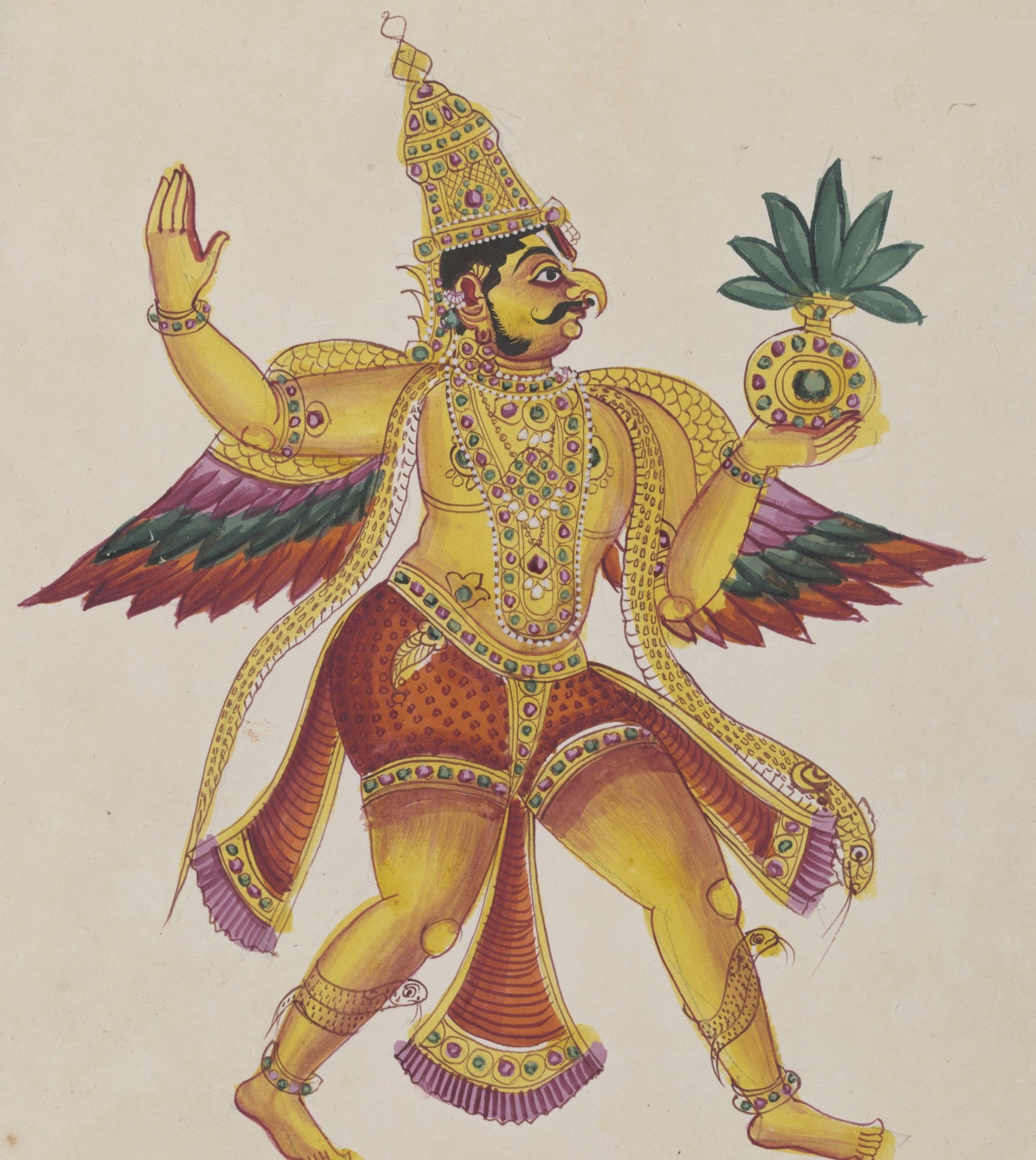
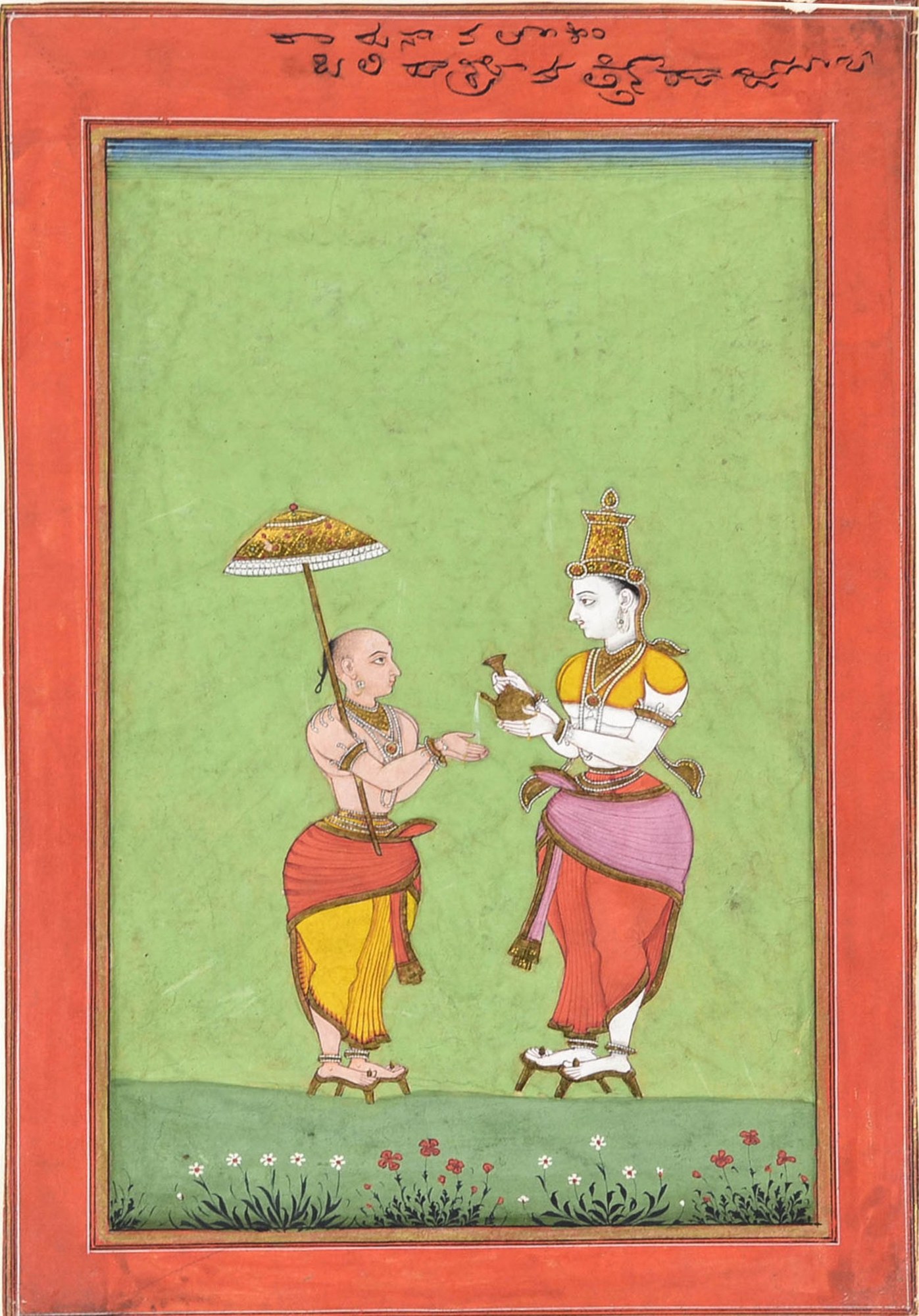
The god who reclaims the universe does it by making himself small. When the gods come to Vishnu stripped of heaven, dispossessed by a demon-king who has out-prayed and out-sacrificed them all, the answer heaven sends is not a warrior. It is a boy: a dwarf-brahmin, freshly invested with the sacred thread, carrying an umbrella, a wooden water-pot and a beggar’s staff, radiant as the sun risen close by. He is the fifth of Vishnu’s ten descents, and he asks for less than any of them. Three paces of ground. He walks it off with his own short feet.
Older than the dwarf who begs
The strange thing about Vamana is that the smallest part of him is the oldest. Long before there was any dwarf, or any king to trick, the Rigveda already sang of Vishnu measuring the cosmos in three enormous steps: Through all this world strode Vishnu; thrice his foot he planted.
In those hymns, roughly thirty-two to thirty-five centuries old, the three strides are a solar act, a god pacing out the earthly regions, with no beggar and no bargain anywhere in sight.
The begging-dwarf who tricks a pious asuraA member of the class of powerful anti-gods who contend with the deva-gods for the three worlds; not simply "demons", and often, as with Bali, pious. is a much later graft onto that ancient stride. The Vishnu Purana, perhaps four or five centuries into the common era, already knows the frame but tells it in a single breath, disposing of the whole affair in one sentence. The fully-dramatised story, the ragged boy and the contentment sermon and the cosmic vision, belongs to the Bhagavata Purana, commonly placed around the ninth or tenth century.
Between the Vedic stride and the Bhagavata’s dwarf lie something on the order of twenty-three to twenty-seven hundred years. The pace is genuinely archaic; the plot around it is medieval. Anyone who calls the trickster-Vamana timelessly ancient has collapsed a gap wider than the one between Homer and the printing press.
Three paces, measured by his feet
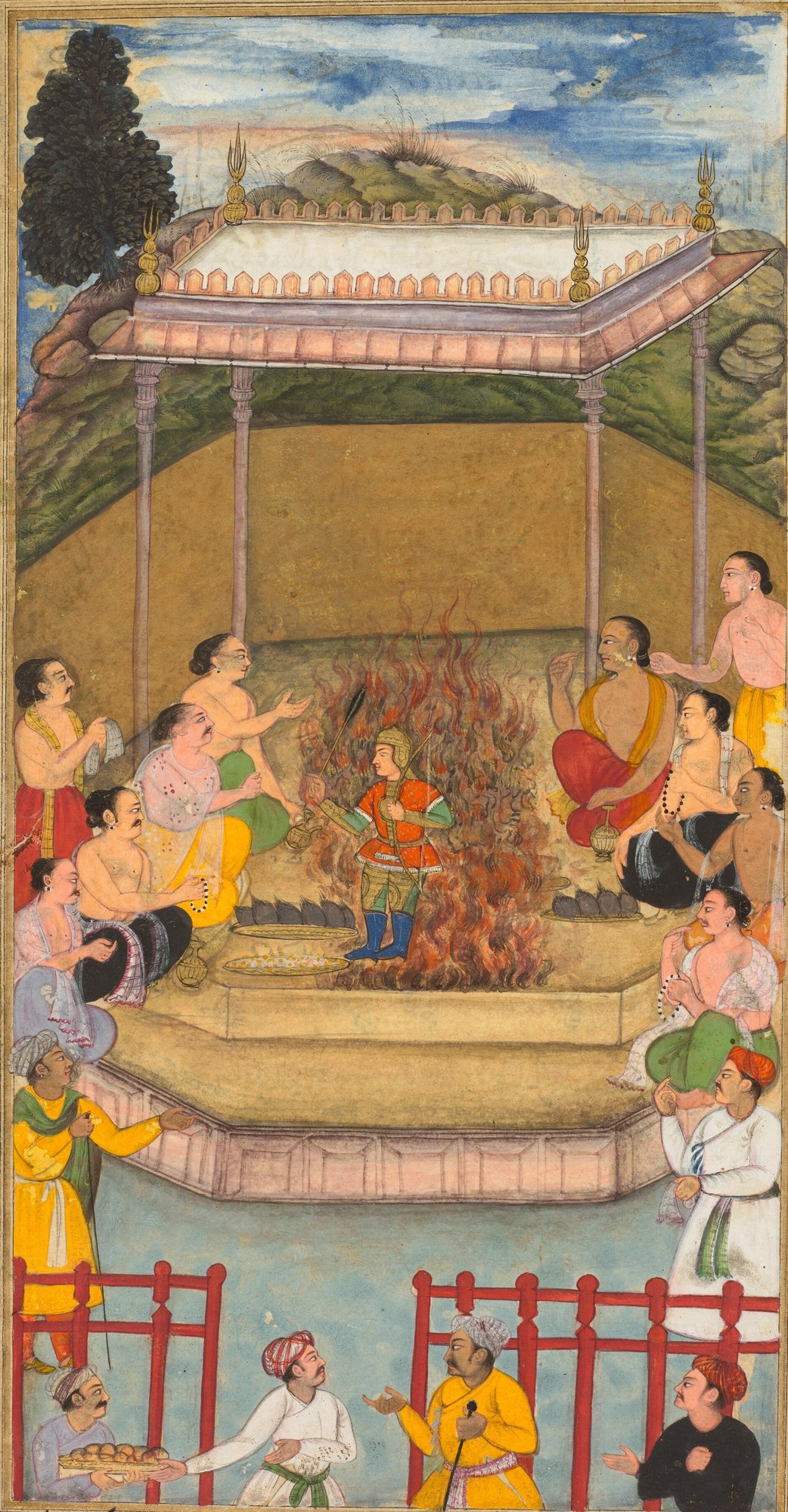
The Bhagavata’s Vamana is a study in disproportion. Born of Aditi, mother of the gods, he receives his upanayanaA boy's initiation with the sacred thread, the rite that opens Vedic study; performed here for the dwarf-brahmin before he sets out., the boy’s investiture with the sacred thread, and is equipped by the whole pantheon: the sun-god teaches him the Gayatri, Brihaspati gives the thread, Brahma the water-pot, Kubera a begging-bowl, and Uma herself serves his first alms. So outfitted, this small figure walks to a horse-sacrifice on the north bank of the Narmada, and though he is a dwarf he treads heavily, bending down the earth at every step, on account of his weight.
It is a plant, and a good one.
The king at the sacrifice is Bali, and Bali is the reason the story refuses to be a simple tale of divine cunning. He is an asura, great-grandson of the god-tormentor Hiranyakashipu, but he is also a man of scrupulous honour who has won the three worlds by devotion and rite. When the dwarf refuses lands, gold, villages and elephants and asks only for three paces of earth measured by his own feet, Bali all but laughs and urges him to ask for a continent.
His own guru, Shukra, sees through the disguise at once and forbids the gift, naming the trap before it springs: how, he asks, can three steps of this creature be small, when one of his feet will cover the earth and another the sky? Where is the space left for the third foot?
Bali gives anyway. That is the hinge of his character, and of the whole piece. Cursed by his own preceptor for the disobedience, warned in plain words that he is being robbed, he keeps his promise to a brahmin rather than break it like a gambler,
and pours the water that seals the gift.
A body that becomes the universe
Then the dwarf grows. The Bhagavata gives him a body that becomes the universe, netherworlds at the soles and the two twilights on his garment and the rivers running in his veins, and he strides. One step takes the earth; a second climbs past every heaven to the seat of Brahma at the summit of the cosmos, where the creator washes the raised foot and the wash-water falls to earth as the celestial Ganga. Two paces have swallowed everything. There is, exactly as Shukra warned, nowhere to put the third.
Here the famous popular image, of the god stamping his last step onto Bali’s head to crush him down into hell, is not what this oldest full telling actually says. In the Bhagavata, Bali, bound by Garuda with the noose-cords of Varuna, fears only disgrace and not damnation, and he volunteers: place the third step on my head. He is not stamped down; he offers himself. And Vishnu’s answer is grace, not punishment.
The god explains that he strips the wealth of those he loves, and hands Bali not a prison but a jewelled netherworld free of sickness and fear, guarded by Vishnu in person, together with the promise that Bali will one day hold the office of Indra himself. Heaven is returned to the gods; the dwarf is crowned Upendra, the younger brother of Indra and guardian of the worlds.
Even the ending refuses to agree with itself across the tradition. Wilson’s Vishnu Purana sends the demon and his line to Patala, a different named underworld from the Bhagavata’s SutalaA jewelled subterranean realm, one of the seven netherworlds, given here as a reward rather than a prison., and says nothing of the offered head at all. The site of Bali’s descent is not one fixed fact but two witnesses, five or more centuries apart, each naming a different room in the house of the dead.
What survives all of it is the shape of the paradox. The avatar who recovers the universe is the one who came asking for almost nothing, and the demon he defeats is the story’s model of a kept word. Vamana wins by understatement, and Bali loses without disgrace: a conquest dressed as a gift, and a defeat that reads, in the end, like a reward.
With three paces he subdued the worlds, and gave them, freed from all embarrassment, to Purandara. (Vishnu Purana 3.1, tr. H. H. Wilson)
- Bhāgavata Purāṇa 8.18–23 (G. V. Tagare tr., Motilal Banarsidass; via wisdomlib docs 1128832–1128837)the load-bearing narrative. Chapter 18, the incarnation through Aditi, the dwarf’s thread-ceremony and the gods’ gifts, his arrival at Bali’s horse-sacrifice on the north bank of the Narmadā at Bhṛgu-Kacchaka, and Bali’s offer of lands, gold and cattle. Chapter 19, the request for
a small piece of land three paces in length measured with my feet,
the discourse on contentment, Bali’s assent and Śukra’s loophole-riddle,Where is the space left for the third foot?
(with the footnote citing the Vedic root). Chapter 20, Śukra’s curse, the sealed gift, the expansion into the cosmic body and the first two strides. Chapter 21, the Gaṅgā from Brahmā’s wash-water, the Asuras’ rout, Garuḍa’s binding of Bali withthe noose-cords of Varuṇa,
and the demand for the third pace. Chapter 22, Bali offering his own head, the grace-doctrine and the grant of Sutala with future Indra-hood. Chapter 23, heaven restored to Indra and Vāmana crowned Upendra. Text commonly dated c. 9th–10th c. CE (contested). - Viṣṇu Purāṇa 3.1 (H. H. Wilson tr., 1840; via wisdomlib doc115978)the entire episode in one sentence,
With three paces he subdued the worlds, and gave them, freed from all embarrassment, to Purandara,
with Wilson’s footnote [22] naming the fuller sources (Bhāgavata, Kūrma, Matsya, Vāmana Purāṇas) and giving the Pātāla variant, a different named netherworld from the Bhāgavata’s Sutala. VP often dated c. 4th–5th c. CE (contested). - Ṛgveda 1.22.17–20 and 1.154.1–4 (R. T. H. Griffith tr., The Hymns of the Rigveda Vol. I, 1889/1920; archive.org in.ernet.dli.2015.284070)Viṣṇu’s three cosmic strides,
Through all this world strode Vishnu; thrice his foot he planted,
the ancient Trivikrama motif with no dwarf, no Bali and no begging. Ṛgvedic core c. 1500–1200 BCE. - Variant traditions. The popular image of the third step planted on Bali’s head to press him down into the netherworld is NOT the Bhāgavata’s wording, where Bali offers his own head and is honoured with a kingdom, not crushed; it is best treated as later, composite tradition. The donor-deity roster at the thread-ceremony differs across Purāṇas (the Bhāgavata’s own footnote records a different assignment in the Matsya Purāṇa, chapter 245, not read directly here). The birth of the Gaṅgā from Brahmā’s wash-water is one Purāṇic aetiology of the river among several. The Vāmana Purāṇa, named in the tradition as a fuller source, was not accessible in translation and no detail is attributed to it.