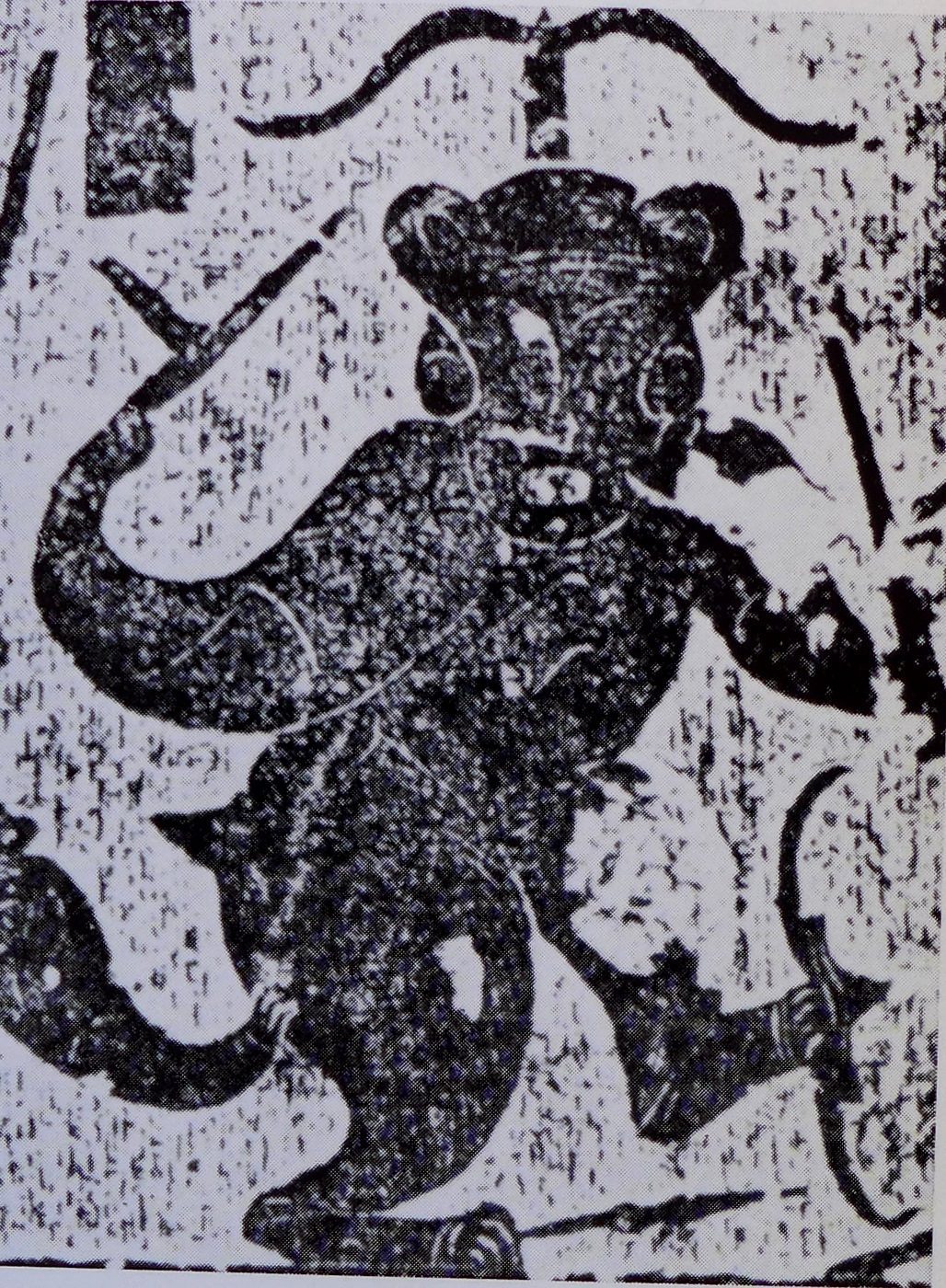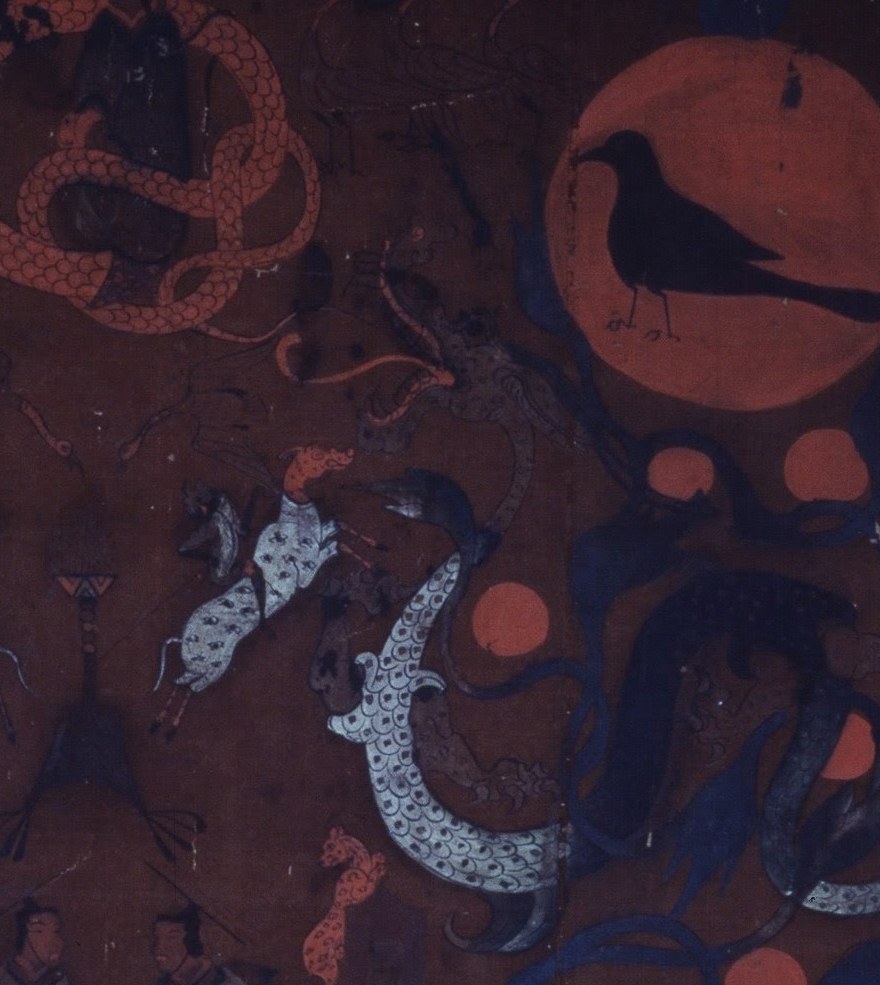
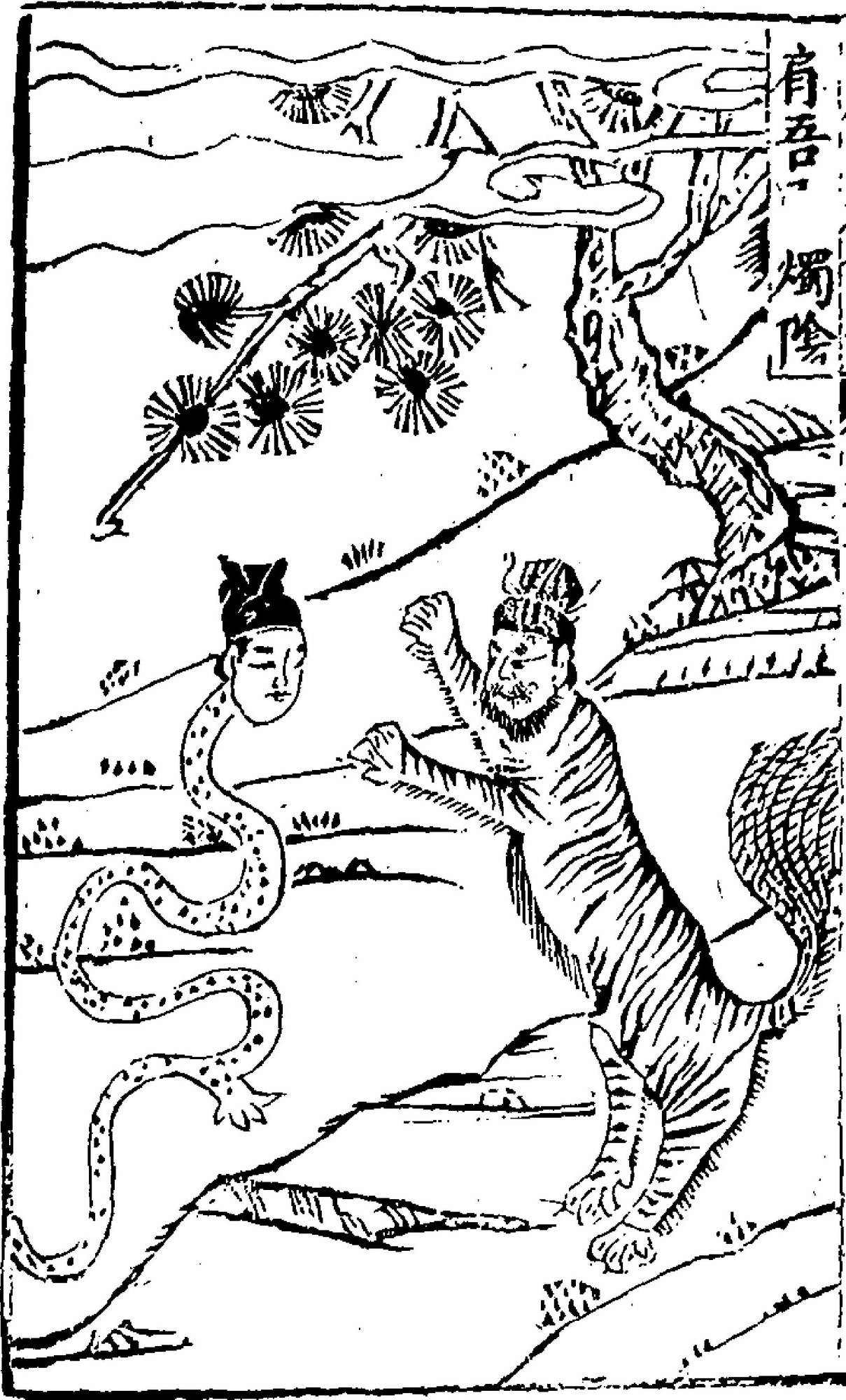
Somewhere past the last inhabited ground, north of a river the old books call the Scarlet, a creature a thousand liA Chinese unit of distance of a few hundred metres, varying by era; a thousand li is not a measured figure but a way of saying vast, horizon-spanning. long lies still in the dark. It does not eat. It does not drink. It does not sleep, and it does not breathe. Its body is a serpent’s, its face a man’s, and the whole of it is the red of blood against country the sun never reaches. When it opens its eyes, day begins. When it closes them, night comes down. This is the whole of the creature as the oldest sources leave it: not a story with a beginning and an end, but a description held very still, a cosmic engine in the shape of a scarlet snake.
The being goes by two names, and the two names carry two slightly different pictures. In one passage of the Shanhaijing he is Zhuyin, the Torch Shade, the god of Bell Mountain; in another he is Zhulong, the Torch Dragon, coiled on a different mountain in the same far north. Modern scholars read them as one figure, and the parallels are close enough to make that reading natural. But the ancient texts never say so outright, and where they differ, they differ in ways worth keeping.
A body that makes the weather
Everything the Torch Shade does, he does by holding still. The Bell Mountain passage of the Shanhaijing is blunt about it: he takes no food, no water, no breath. The one exception is the exception that runs the world. When he does breathe out, that exhalation is the wind. One long blow is the whole of winter; one call is the whole of summer. The seasons are not something that happens around him. They are his respiration, slowed to the pace of a year.
The same economy governs the light. His eyes are the switch between day and night, and there is nothing else to the machine: no chariot, no lamp carried across the sky, only a lidded stare that opens and shuts over the ninefold darknessThe far northern dark the Torch Dragon is said to light (九陰, the nine yin); a later commentary read it as the nine dark points of the compass. of the north. He is a thousand li long, a measure meant less as a number than as a way of saying that the body runs past the horizon. He is scarlet, and that redness against the northern dark is the single image every source agrees on. He lies at the foot of his mountain, self-sufficient and unmoving, an animal in shape but nothing that lives as an animal lives.
Bell Mountain, the Great Wilderness, the Huainanzi
Set the two passages side by side and the seams show. The Bell Mountain description in the Shanhaijing and the parallel account in its Great Wilderness
chapter are not quite the same witness: the two layers of that composite book stand as much as a century or two apart, the Great Wilderness material reckoned among its later strata.
The second passage keeps the human face, the serpent body and the scarlet, but it adds a detail the first does not have, eyes set vertically in a straight seam, and it moves the god to Mount Zhangwei, north of the Scarlet River. It also hands him command over wind and rain outright, where the earlier passage had made the weather from his breath alone.
The sharper disagreement waits in another book. The Huainanzi, compiled around 139 BCE, places him north of Wild Goose Gate, hidden by a mountain called Weiyu, and there it changes his anatomy. He is no longer a snake. His body is a dragon’s, and the text is careful to add that it has no feet.
That is more than a century and a half between the snake of the Shanhaijing and the footless dragon of the Huainanzi, the same creature carrying two different zoologies. He is a snake in the older telling and a footless dragon in the younger, and the honest thing is to name which text one is following rather than quietly splicing the two into a dragon with a snake’s body.
Where the sun does not reach
The oldest voice to invoke him is not describing him at all, but asking about him. The Chuci, the songs of the south, contains a long poem of unanswered cosmological questions, and one of them turns to the far dark: where the sun does not reach, what is it that the Torch Dragon lights? The poem, from perhaps the third century BCE, expects no answer. It simply holds the creature up as the light of the one place the sun cannot go, and moves on to the next riddle. It is the earliest surviving trace of the figure, and it already treats him as a known thing, a fixture at the edge of the world.
The torch he does not hold
The English name, Torch Dragon, and the picture that comes with it, a great serpent gripping a flame in its jaws to light the northern sky, are not in any of these old passages. They come from a commentary. Guo Pu, writing between roughly 276 and 324 CE, glossed the line about the ninefold darkness and reported an older, now-lost explanation: that the sky in the northwest is insufficient, and so a dragon holds a torch in its mouth to light the heavens.
This is the image that fixed the creature’s name in English, and it is worth being exact about its age. Guo Pu was writing some three centuries after the Shanhaijing passages he was explaining, roughly the distance from Shakespeare to now. In the texts he glossed, the light comes from the god’s eyes and the weather from his breath. The torch in the mouth is the later tradition’s way of finishing a picture the base texts left open, and it should be read as commentary, not as the oldest layer.
What remains underneath the commentary is stranger and sparer than the name suggests. Later readers have wanted him to be a memory of the aurora over the northern horizon, or the personified sun, or a figure in some larger cosmological scheme. Those are modern guesses, and the texts endorse none of them.
The texts give only the description, held still: a scarlet, thousand-li body in the sunless north, eyes that make the day by opening, breath that makes the winter by blowing out. He does nothing, goes nowhere, fights no one and is born of no one. He simply lies at the edge of the world and, by the rhythm of his stare and his breathing, keeps the light and the seasons turning.
Where the sun does not reach, what does the Torch Dragon light? (Chuci, “Tian Wen”; author’s rendering from the Chinese)
- Shanhaijing (山海經), Haiwai Beijing (海外北經), c. 3rd c. BCE–1st c. CE: the Zhuyin (燭陰) passage — the god of Bell Mountain (Zhongshan) whose looking makes day and shutting makes night, whose blowing is winter and calling is summer, who neither eats, drinks nor breathes (his breath is the wind), a scarlet, human-faced, snake-bodied being a thousand li long (「鍾山之神名曰燭陰,視為晝,瞑為夜,吹為冬,呼為夏,不飲,不食,不息,息為風,身長千里…人面,蛇身,赤色,居鍾山下。」). Chinese read verbatim; English is the author’s literal gloss. Published translationAnne Birrell, The Classic of Mountains and Seas (Penguin, 2000).
- Shanhaijing (山海經), Da Huang Beijing (大荒北經), later stratum, c. 1st c. BCE–early CE: the Zhulong (燭龍) passage — a human-faced, snake-bodied, scarlet god on Mount Zhangwei north of the Scarlet River, with vertical eyes set in a straight seam; his closing is dark, his looking is light; he neither eats, sleeps nor breathes; wind and rain are at his command; he shines over the ninefold darkness (「有神,人面蛇身而赤,直目正乘,其暝乃晦,其視乃明,不食不寢不息,風雨是謁。是燭九陰,是謂燭龍。」). Chinese read verbatim.
- Chuci (楚辭), Tian Wen (天問), Heavenly Questions, attrib. Qu Yuan, c. 3rd c. BCE: the couplet posing the Torch Dragon as a riddle of the far dark — where the sun does not reach, what does the Torch Dragon light? (「日安不到,燭龍何照?」). The Da Zhao (大招) section uses the variant name Chuolong/Zhuolong (逴龍/趠龍). Chinese read verbatim. EnglishDavid Hawkes, The Songs of the South (Penguin, 1985).
- Huainanzi (淮南子), Duixingxun (墬形訓), comp. under Liu An, c. 139 BCE: Zhulong north of Yanmen (Wild Goose Gate), hidden by Mount Weiyu, never seeing the sun, with a human face and a footless dragon body (「燭龍在雁門北,蔽於委羽之山,不見日,其神人面龍身而無足。」). Chinese read verbatim.
- Guo Pu (郭璞) commentary on the Shanhaijing, 276–324 CE (later — interpretation, not base text): glosses the ninefold darkness as the nine dark compass points and reports a lost Shijing commentary that, the northwest sky being insufficient, a dragon holds a torch in its mouth to light the heavens. The handheld-torch image and the English name derive from this gloss, roughly three centuries after the passages it explains, not from the oldest layer.