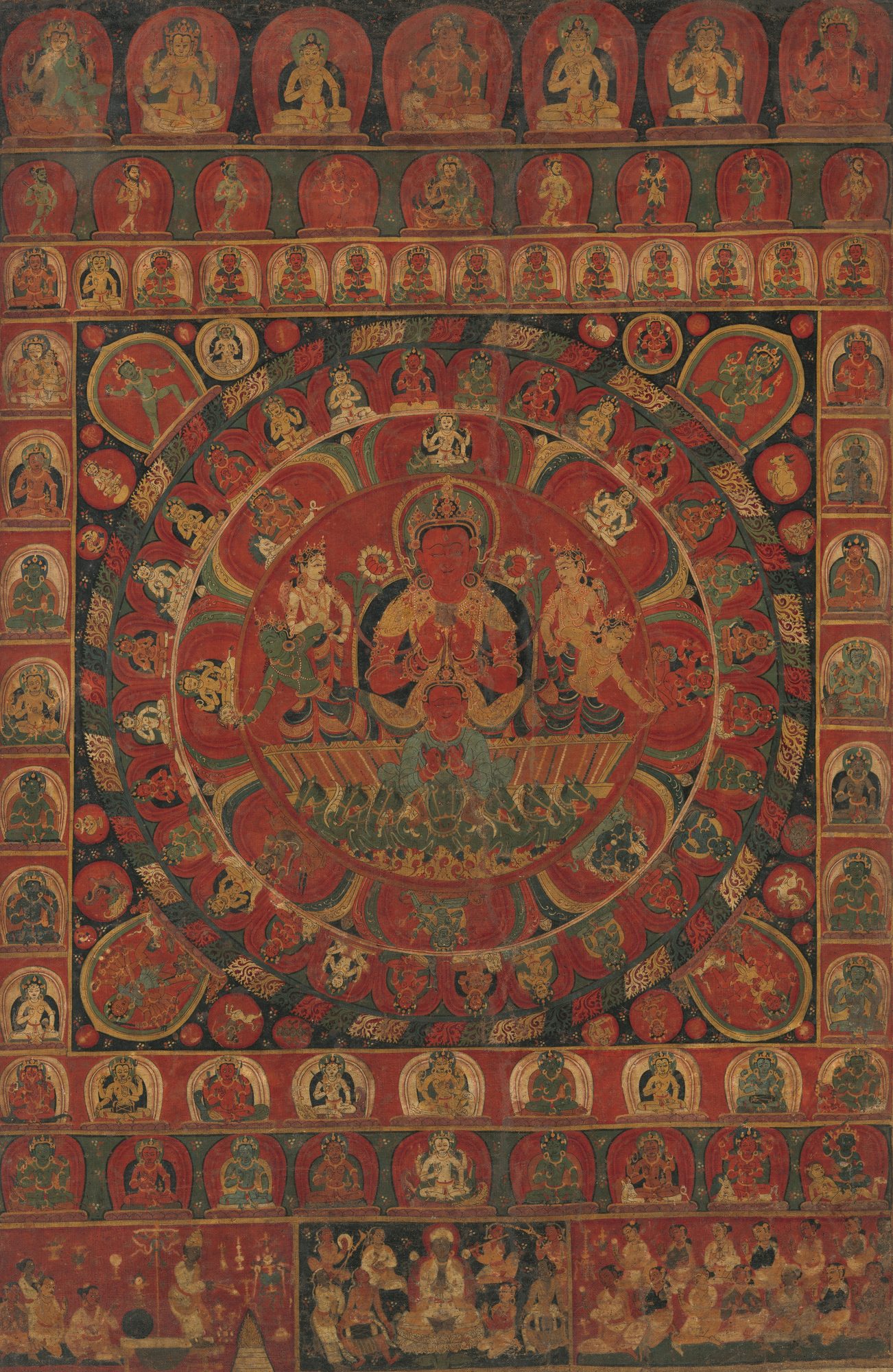
Her name begins with a refusal. Strip away the a- that opens it and what remains is diti, a bond, a tie, a limitation; put the negating syllable back and you have a-diti, the un-bound, the one who cannot be fenced in. She is, quite literally, Boundlessness with a face turned toward you. The oldest Indian scripture does not give her a life, a birth she grows out of, a quarrel she wins, a death she suffers. It gives her something stranger and larger. In a single famous verse the poet simply widens the word until it holds everything there is, and calls that Aditi.
That verse is worth hearing whole, because nothing else in the Veda is quite so total. Aditi is the heaven, the singer says, and Aditi is mid-air; Aditi is the Mother and the Sire and Son; Aditi is all the Gods and the five classes of men, Aditi is all that has been born and all that shall be born.
There is no edge to her anywhere in that list. She is above and between, parent and offspring at once, the gods and the peoples and the whole of time in both directions. To name her is not to point at a goddess standing somewhere. It is to gesture at the sheer fact of there being anything at all, and then to say: that. Her.
The name and the reading of it
Because she is a principle before she is a person, the tradition has never fully agreed on what her name means, and it is honest to say so. The commentators Griffith gathers in his notes pull in different directions across two and a half thousand years. Sāyaṇa, writing in the fourteenth century of our era, reads Aditi flatly as the Earth.
The nineteenth-century philologist Roth heard in the word freedom or security; Benfey heard sinlessness; and Max Müller, reaching for the largest sense, called it the earliest name any people ever invented to express the Infinite, the endless expanse beyond the earth and the clouds and the sky. These are guesses at a word already ancient when the hymns were sung, and they do not resolve. What they share is a direction: whether you land on Earth or freedom or the Infinite, you land on something without a hard boundary, which is the whole of what the name insists on.
Daughter of her own son
Nowhere is her strangeness sharper than in the hymn the Veda simply titles The Gods,
and here the dating matters, because a reader should know how old the voice is. This hymn belongs to Maṇḍala 10, the youngest layer of the Rigveda, composed perhaps around 1200 to 1000 BCE, several centuries later than the oldest family books. Its cosmogony is correspondingly abstract, the speculation of a late and philosophical hand: Existence, it says, sprang in an earlier age of the gods from Non-existence, and only afterward were the regions of the world born.
Into that abstraction the poet drops a deliberate knot. DakṣaA Vedic creative power, Skill or Force personified; in the youngest Rigvedic cosmogony he and Aditi generate each other, and he is later merged with Prajāpati., a personified creative power, was born of Aditi; and Aditi, the same verses say in the same breath, was born of Dakṣa, brought forth as his daughter. Mother of her father, daughter of her son: the cosmos giving birth to its own precondition. Even the ancient Indian tradition found this hard.
The etymologist Yāska, wrestling with it centuries later, could only offer that perhaps the two had one origin, or that gods, being gods, may simply be born from each other and derive their substance one from the other. It was never a poet’s slip. It was a riddle set on purpose, an image of a beginning that has no first thing in it, and after these two the blessed gods themselves were born, sharers of immortal life.
Eight sons, and one thrown away
From that boundless mother came the Ādityas, the sovereign gods who hold the cosmic order and rule by it, Varuna and Mitra chief among them. The same late hymn counts them, and the count is one of the tradition’s genuine unsettled questions, which a retelling must keep unsettled rather than tidy. Eight sons, this hymn says, sprang from Aditi’s body. With seven of them she went forth to meet the gods. The eighth she cast far away.
That eighth is MārtāṇḍaThe 'dead egg' or sun-of-the-dead-shell, Aditi's eighth and cast-away son, glossed by Griffith's commentator as the mortal, dying solar aspect., a name the commentators gloss as the dead egg, the shell of the sun-of-the-dead, the mortal solar aspect. His mother brings him back toward life only, the verse says, to spring to life and die again, so that birth and death are built into him from the start, the way the sun is born every dawn and dies every dusk. A mother who keeps seven children and hurls the eighth away, and the discarded child is the sun that must perish daily to rise: it is one of the bleakest small pictures in the Veda, and it sits inside a hymn about the making of the deathless gods.
The number does not stay at eight. Elsewhere the older layers speak of seven Ādityas, or six; and far later, in the classical Hinduism of the Brāhmaṇas and epics and Purāṇas, the count hardens into a fixed twelve, one for each solar month. That neat dozen is not Rigvedic. It arrives more than a thousand years after these hymns, and to read it back into the Veda is to skip a millennium of change. In the Rigveda the sons of Aditi are the gods of sovereignty and law, not a calendar.
The cow that must not be struck
The last of her great images brings all this cosmic breadth down onto a single standing animal. At the sacrifice, the priest who has just received a cow as his fee proclaims her something more than an animal, and he does it by naming Aditi. The Rudras’ Mother, he sings, the Daughter of the Vasus, the Sister of the Ādityas: mother and daughter and sister to the three great families of the gods, all in one breath, all in one cow.
Then the warning, plain as a fence-rail: injure not Aditi, the cow, the sinless. The word he uses of her is aghnyāThe Vedic epithet of the cow, 'she who must not be slain'; the sacred inviolable beast the poet identifies with Aditi and universal Nature., she-who-must-not-be-slain, and Griffith’s own note reads the beast as the earthly type of Aditi, of universal Nature herself. Boundlessness, for one verse, wears hide and horn and stands in front of the fire, and the whole force of the line is that you may not raise your hand against her.
It is the same logic that runs under her gentler epithets. Because her name is the Unbound, the bound man calls on her. In the Śunaḥśepa hymns a doomed son cries out, who shall to mighty Aditi restore us, that I may see my Father and my Mother, and begs that the bonds above him and between and below be loosened so that he may live.
To be restored to Aditi is simply to be set free, home, unfettered; and in the horse-sacrifice hymn the plea narrows to the soul itself, that freedom from sin may Aditi vouchsafe us. She is not a mother in a house. She is the open ground a captive longs for, the release the guilty ask, the sheer un-boundedness that a bound and finite creature can only pray toward.
Aditi is the heaven, Aditi is mid-air, Aditi is the Mother and the Sire and Son. Aditi is all Gods, Aditi five-classed men, Aditi all that hath been born and shall be born. (Ṛgveda 1.89.10, tr. Griffith)
- Ṛgveda 1.89.10 (trans. Ralph T. H. Griffith, The Hymns of the Rigveda, Vol. I, BenaresLazarus, 1896): the master identification verse, in which Aditi is named as heaven, mid-air, Mother, Sire and Son, all the gods, the five classes of men, and everything born or yet to be born. This Maṇḍala 1 book is a relatively late stratum of the Rigveda; the hymn is dated c. 1500–1200 BCE, the Griffith rendering roughly three millennia later.
- Ṛgveda 10.72.2–5, 8–9 (
The Gods
; Griffith, Vol. II, 1897)Existence sprung from Non-existence; the mutual generation of Dakṣa and Aditi (Daksha was born of Aditi… For Aditi, O Daksha, she who is thy Daughter, was brought forth
); and the eight sons of Aditi, of whom she keeps seven and casts Mārtāṇḍafar away,
bringing himto spring to life and die again.
Maṇḍala 10 is the youngest layer of the Rigveda, c. 1200–1000 BCE; its abstract cosmogony reflects that later, speculative phase and must not be read as the oldest Indian creation account. - Ṛgveda 8.101.15 (Griffith’s
HYMN XC,
Vol. II, 1897)Aditi as the inviolable sacred cow —The Rudras’ Mother, Daughter of the Vasus, the Adityas’ Sister… injure not Aditi, the Cow, the sinless
— with Griffith’s note glossing the cow (aghnyā,not-to-be-slain
) asthe earthly cow, as the type of Aditi or universal Nature.
Modern standard numbering RV 8.101 corresponds to Griffith’s8.90/HYMN XC
because his edition prints the eleven Vālakhilya hymns as a separate appendix. - Ṛgveda 1.24.1 and 1.24.15 (Śunaḥśepa cluster; Griffith, Vol. I, 1896)
Who shall to mighty Aditi restore us, that I may see my Father and my Mother?
and the release-prayer to loosenthe bonds above, between, and under.
Griffith’s footnotes here gather the competing etymologies — Sāyaṇa’sEarth,
Roth’sfreedom or security,
Benfey’ssinlessness,
and Müller’sthe earliest name invented to express the Infinite
(Trans. of the Rigveda I.230). - Ṛgveda 1.162.22 (the horse-sacrifice hymn; Griffith, Vol. I, 1896)
Freedom from sin may Aditi vouchsafe us
— the goddess as absolver, not merely protector. - Enumeration (later, non-Rigvedic)the fixed count of twelve Ādityas, one per solar month, is a post-Rigvedic development recorded in the Brāhmaṇa, epic and Purāṇic tradition (Griffith’s note on the
thirty-three gods
count, citing Wilson), roughly a millennium or more after the hymns above, which give eight or seven. It should not be attributed to the Rigveda.