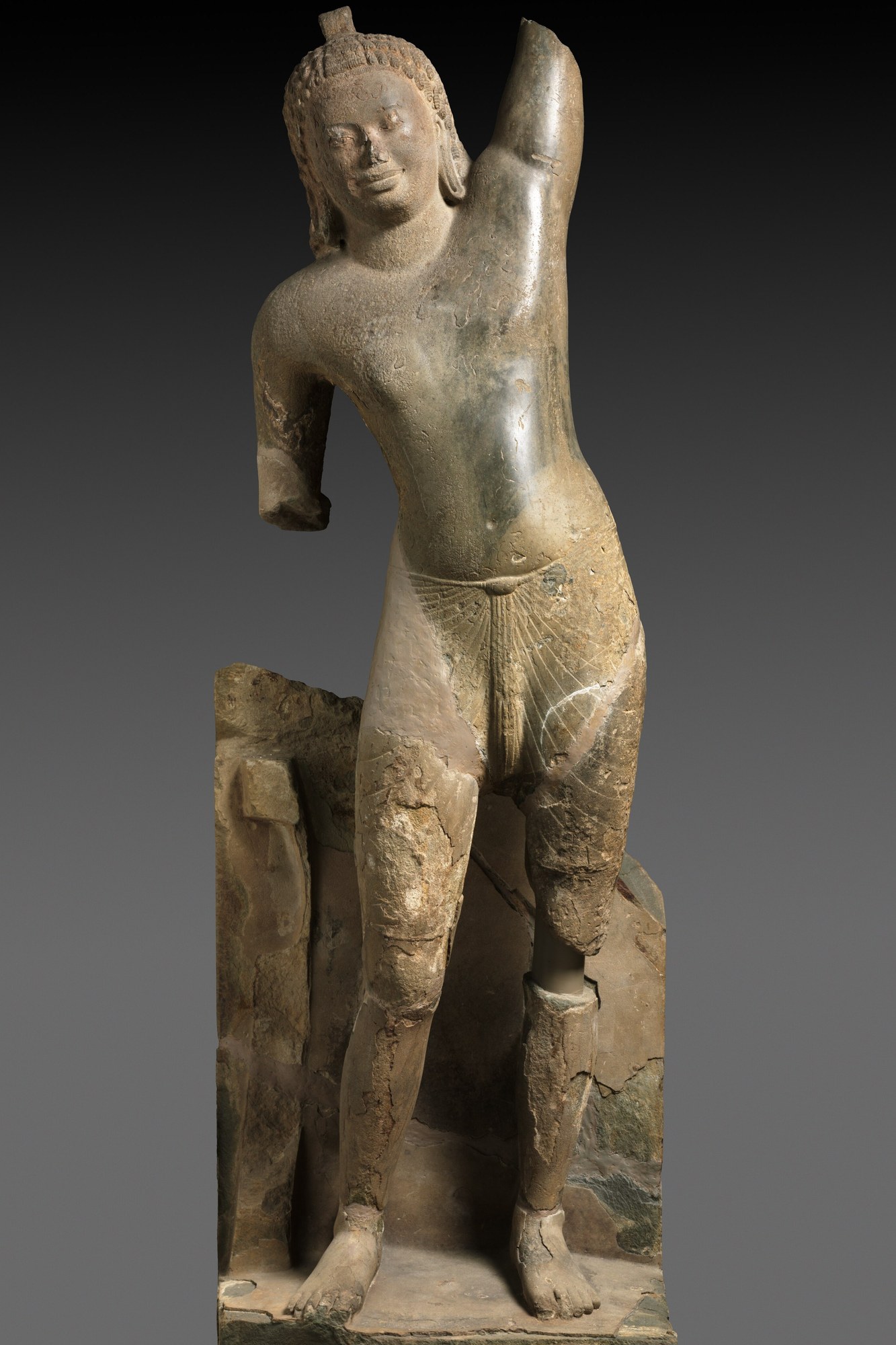
The materials for the sacrifice were already gathered, and the boy wanted to know what they were for. This was the Indra-yāgaThe cowherds' annual sacrifice to Indra, god of rain and storm, which Krishna argues the herders of Vraja should redirect to the mountain and the cows., the yearly worship of Indra, lord of rain and storm, and the whole cowherd country of VrajaThe pastoral country around Vṛndāvana where Krishna is raised among the cowherds and their cattle. kept it: curds and rice, sweet cakes and boiled pulses, the milk of every cow, all of it laid up for the rite. Krishna, a herdsman’s child of seven, went to the elders as if he had never seen the offering before and asked Nanda, his foster-father, to explain it. Nanda gave the plain answer any of them would have given. Indra is the rainfall itself, he said, and the clouds are his loving forms; they pour down the water that is the delight and the life of every creature, and men like themselves worship him with sacrifice. To abandon the inherited rite out of passion or greed or fear, he warned, is to forfeit one’s real good.
What the herdsmen owe
The boy answered with an argument, not a miracle. A creature lives and dies by its own past deeds, he said, by its own karma; what power can Indra exercise over beings who only follow the course of their actions? Then he turned the elders’ own lives against the case for Indra. We are not farmers, he reminded them. We have no towns and no countries; we are forest-dwellers, living in the jungles and on the mountains, and our whole wealth is the cattle and the hill that feeds them.
Let the sacrifice go, then, to the things that actually sustain us: to the cows, to the Brāhmaṇas, and to Mount Govardhana. And let it be done, he added, with the very materials already collected for the worship of Indra. Nanda and the cowherds heard him out and approved. Correct, very nice,
they said, and they carried the whole offering up the slope.
What follows in the Bhāgavata Purāṇa is stranger than the argument that produced it. To show the herdsmen that the mountain would receive their gift, Krishna announced that he was the mountain. In a gigantic form set on the summit of Govardhana he consumed the enormous heap of food, the sweet dishes and the puddings and the milk of all the cows, while the ordinary Krishna stood on the slope and bowed to his own other self. The people walked the circuit of the hill and the cattle, keeping the mountain always on their right, and went home satisfied.
The god deprived of his portion
Indra was not satisfied. Cheated of a sacrifice that had been his by long custom, the storm-god loosed the SaṃvartakaIn the Purāṇas, the clouds of universal dissolution; the storm Indra unleashes on Vraja is said to be of their host. clouds, the host the Purāṇas name for the drowning of the whole universe at the end of an age, and told them to destroy the cowherds’ cattle with wind and water. He would come behind them himself, he said, riding his white elephant Airāvata with the storm-gods at his back.
What the two Sanskrit tellings then describe is a flood. In G. V. Tagare’s modern English of the Bhāgavata the rain falls until the raised ground and the low ground can no longer be told apart, the whole earth one drowned sheet. Horace Hayman Wilson, translating the older Viṣṇu Purāṇa more than a century earlier, in 1840, rendered the same scene as sky and horizon and earth blurred into one by an incessant shower, so that above and below and on every side the world was water.
The two witnesses are not close in time: the Viṣṇu Purāṇa is commonly placed around the fourth or fifth century of our era, and the Bhāgavata perhaps half a millennium later, both of them drawing on an older lost telling. It is Wilson’s Viṣṇu Purāṇa that lingers on the animals. The cattle, pelted by the storm, shrank cowering or gave up their breath; some cows covered their calves with their own flanks, and some watched the flood carry their young away while the calves, shivering in the wind, looked back piteously at their mothers. Soaked and freezing, the herders and their beasts ran to the boy for shelter.
A mountain held in sport
He lifted the hill. The wording of both texts is careful to make it look effortless, even playful. Tagare’s Bhāgavata says Krishna, though a child, uprooted Govardhana with ease using one of his hands and held it up sportively, as if it were a mushroom; Wilson’s Viṣṇu Purāṇa has him pluck up the mountain and hold it aloft with one hand in sport, raised over the cow-pens like a large umbrella.
Neither text says a finger. The famous image of the whole mountain balanced on the tip of Krishna’s little finger, which nearly all the paintings show, is a later devotional and iconographic tradition; the oldest specification in the commentaries points the other way, to a left hand rather than a fingertip. What the Purāṇas describe is a hand.
Under it went everyone. Enter the cavity beneath the mountain, Krishna told them, you and your cattle and your wealth, and have no fear that it will slip from my hand. The cowherds and their women and children crowded in with the wagons and the grain and the priests, the cattle packed around them, and the boy stood holding the roof of stone steadily over all their heads.
He did not move from the spot for seven days. Tagare’s Bhāgavata says seven days; Wilson’s Viṣṇu Purāṇa says seven days and nights of unbroken rain; an old Vedic gloss quoted in the same chapter says seven nights. They agree on the number, and on the fact that the storm broke against the underside of the hill and never reached the people beneath it.
Indra of the cows
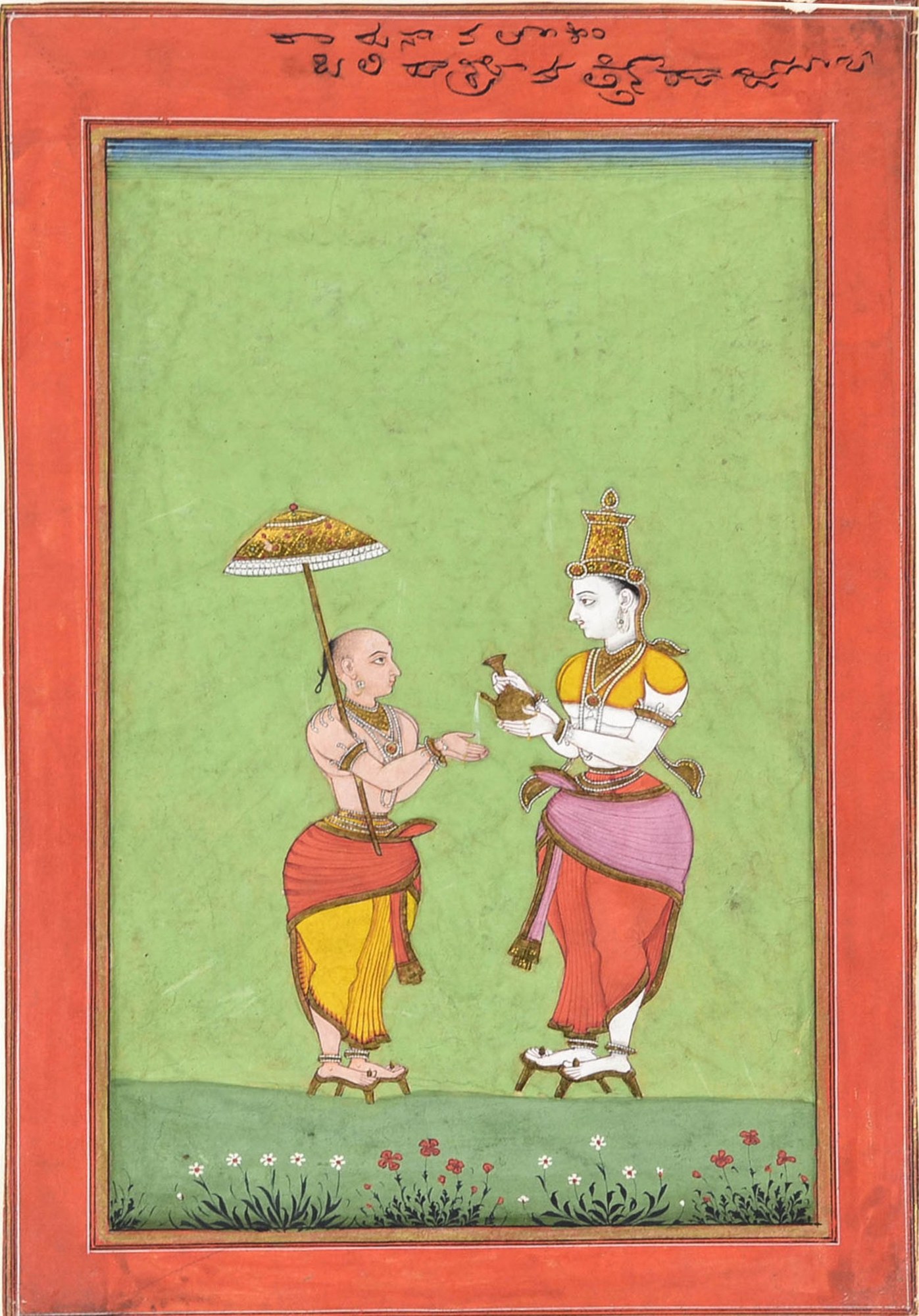
On the seventh day Indra gave up. His clouds were spent, his flood had drowned nothing, and he called them off; the sky cleared, and Krishna set the mountain back sportively on its old foundation while everyone stood staring. The storm-god came afterwards to make his peace. In the Bhāgavata he arrives secretly, ashamed, and touches Krishna’s feet with his crown, begging pardon for the pride of his own power. The wish-granting cow Surabhi comes down from her heaven of cattle to stand with him, and together they consecrate the boy, Indra pouring over him the water of the heavenly Gaṅgā carried in Airāvata’s trunk and proclaiming him GovindaA name granted to Krishna at the close of this episode, read as 'Indra of the cows' or 'finder of cows'., Indra of the cows.
The older Viṣṇu Purāṇa keeps the coronation leaner and adds a scene the Bhāgavata places elsewhere: Indra confides that a portion of himself has been born as the warrior Arjuna, and asks Krishna to protect him in the war to come, while Garuḍa the eagle spreads his wings unseen above the boy’s head to shade him. And when, in that same telling, the astonished cowherds ask outright whether the child who held up their mountain is a god, the Viṣṇu Purāṇa has Krishna deny it flatly: I am neither god, nor Yaksha, nor Gandharba, nor Danava; I have been born your relative.
The Bhāgavata answers the same question differently, letting Nanda quiet their wonder by recalling the sage Garga’s old prophecy that the boy was like Lord Nārāyaṇa. One text has him refuse the title to their faces; the other has a prophet supply it. Either way the herdsmen had their answer, and the god of storms had learned to whom the cowherds truly owed worship.
Krishna immediately plucked up the mountain Govarddhana, and held it aloft with one hand in sport… like a large umbrella, over the cow-pens. (Viṣṇu Purāṇa 5.11, tr. Horace Hayman Wilson, 1840)
- Bhāgavata Purāṇa 10.24 (
Prevention of Sacrifice to Indra
), tr. G. V. Tagare (Motilal Banarsidass, AITM series; commonly dated c. 9th–10th c. CE)Krishna’s feigned question and Nanda’s case for the rain-god (The great god Indra is the presiding deity of the rainfall itself and clouds are his loving manifestations
); Krishna’s karma counter-argument (What power can Indra exercise on beings who follow the course of their actions?
) and theforest-dwellers… living in jungles and on mountains
claim; the sacrifice redirected tocows, Brāhmaṇas and the mount (Govardhana)… with the materials collected for the worship to Indra
; and the giganticI am the mountain
form consuming the offering while Krishnaworshipped his own other form.
- Bhāgavata Purāṇa 10.25 (
Lifting up of Mount Govardhana
), tr. G. V. TagareIndra’s world-dissolving Saṃvartaka clouds; the flood in whichthe elevations and the depressions of the ground became invisible
; Krishna uprooting the mountwith one of his hands… as if it were a mushroom
;You need not entertain any fear that the mountain will slip down from my hand
; the seven-day refuge beneath the hill; and Indra relenting, the mountain set backon its previous position while all beings stood a-gazing.
The chapter’s footnote reports a commentator’sleft hand
(savyena pāṇinā, Harivaṃśa 2.18.31). - Bhāgavata Purāṇa 10.26–27, tr. G. V. Tagarethe cowherds’ wonder and Nanda’s recital of the sage Garga’s prophecy that the boy is
similar to Lord Nārāyaṇa
(10.26); Indra’s abashed plea for pardon, the wish-cow Surabhi descending from Goloka, the aspersion with heavenly Gaṅgā water borne by Airāvata’s trunk, and the proclamation of Krishna asGovinda
(10.27). - Viṣṇu Purāṇa, Book V, chapters 10–13, tr. Horace Hayman Wilson (1840; commonly dated c. 4th–5th c. CE)
I am the mountain
(5.10); the Samvarttaka clouds and the flood in whichabove, below, and on every side, the world was water,
with the cattle sheltering their calves; the mountainheld aloft with one hand in sport… as a large umbrella
forseven days and nights
(5.11); Indra installingGovinda,
the ewer of Gaṅgā-water from Airāvata, Garuḍa shading Krishna, and the Arjuna-protection promise (5.12); Krishna’s denial,I am neither god, nor Yaksha, nor Gandharba, nor Danava; I have been born your relative
(5.13); and the sceptic Śiśupāla’s jibe that Govardhana wasnothing more than an ant hill
(5.11 footnote). - Harivaṃśa 2.15–18 [cited but not read verbatim for this piece]named in the Bhāgavata and Viṣṇu Purāṇa apparatus as the earliest and
enlarged
telling of the episode, sharing a common older bardic source, and the origin of theleft hand
(savyena pāṇinā, 2.18.31) reading.