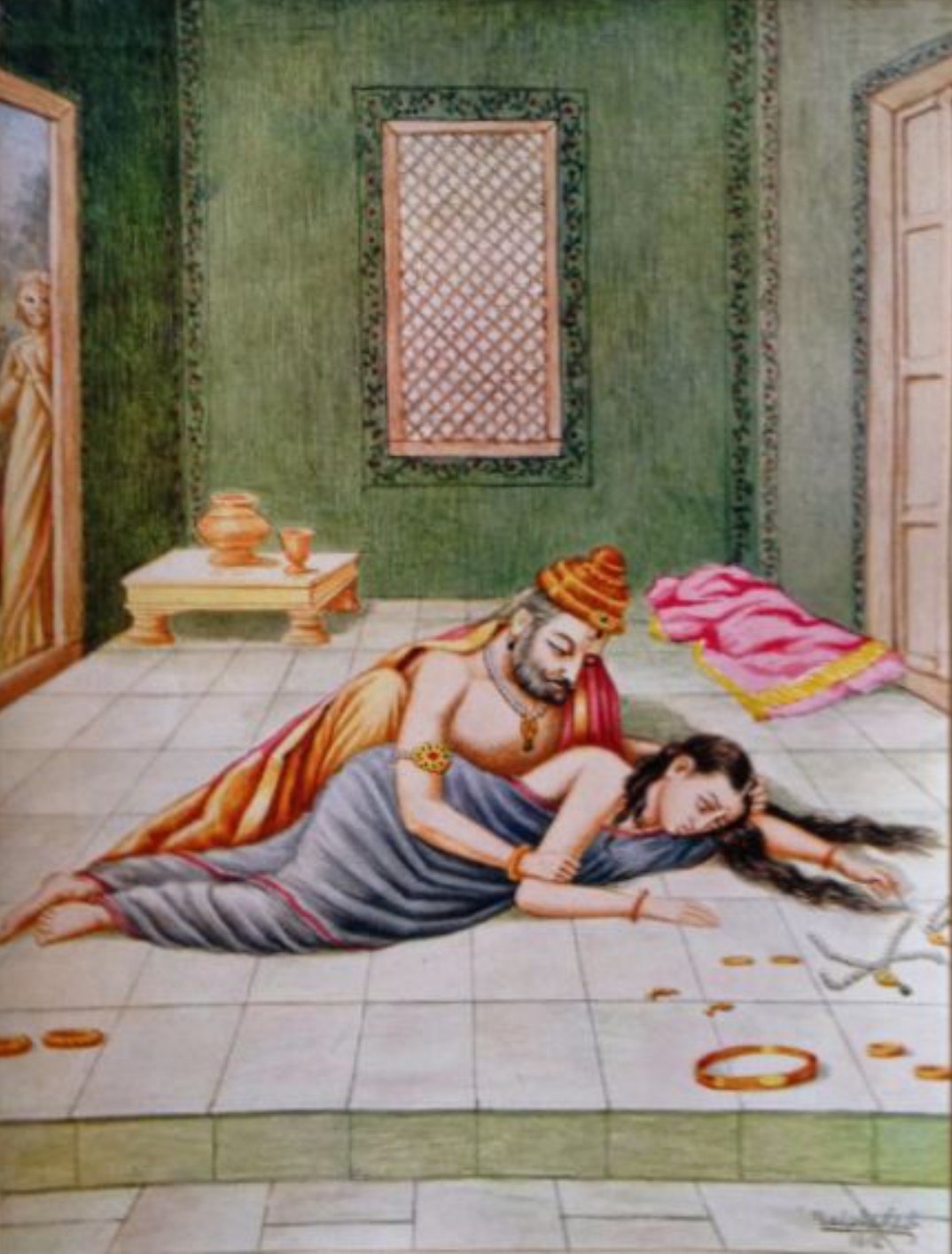
The bargain was struck on a battlefield, years before anyone thought to be afraid of it. Dasharatha, king of Ayodhya, had gone to fight for Indra against the demon host of Timidhvaja, master of the sorcery called Shambara, and the fighting had gone badly. The demons carried off the wounded by night. Pierced again and again, the king fell senseless in his chariot, and it was his junior queen Kaikeyi who bore him out of the ruin and kept him alive. In his gratitude he offered her two boons, anything she wished, whenever she wished it. She did not spend them. She said only that she would claim them when the need arose, and let the years close over the promise like water.
The seed a servant planted
The need was arranged for her. On the eve of Rama’s installation as heir, with the whole city hung with garlands, Kaikeyi was content, even glad; her stepson Rama she loved and praised. It was her hunchbacked serving-woman, Manthara, who could not bear the sight of the festival. She turned the coronation inside out. Once Rama is crowned, she argued, your own son Bharata is finished. A new king does not suffer a rival brother to live near the throne. He will drive Bharata into exile, or have him quietly killed.
Kaikeyi resisted, at first. She had no quarrel with Rama. But Manthara pressed, and the plan she pressed was complete down to the last gesture. Go to the chamber of wrathThe krodhagara, a room set aside in the palace where a slighted queen could lie on the bare ground in soiled clothes until the king came to appease her., she said; lie on the bare ground in soiled clothes; do not look at the king, do not speak to him. Make him swear his oath before you name what you want. Ask first that Bharata be made regent, and only second that Rama be sent away. Ask for both together, and let the first hide the teeth of the second.
A garden, and then the bare floor
Dasharatha came to Kaikeyi’s apartment expecting to share his joy. The approach was a paradise: parrots and peacocks and cranes, soft music from the bowers, painted walls, champaka and asoka trees, altars of ivory and silver and gold. He passed through all of it toward the woman he loved as dearly as his own life, and found her stretched on the floor of the wrath-chamber, her jewels flung down around her like stars scattered across the ground, her hair loose, her clothes fouled.
The sight unmanned him. He knelt and caressed her and begged to know what grief could have reached her here, in his own house, and swore before she would answer that he would grant her anything, at any cost, even at the cost of his life. Then, to seal it past all recall, he swore the oath by the one name that could never be broken. He swore by Rama himself, by his invincible son, dearer to him than the queen at his feet, the son without the sight of whom he could not live a single hour. He did not know he was pledging the boy’s own name against the boy’s own ruin.
Two wishes, named at last
Only now, with the king bound by a sworn and witnessed oath, did Kaikeyi call up the old battlefield promise. She summoned its witnesses out of the sky: the thirty-three gods, the moon and the sun, the day and the night, the cardinal points, the gandharvas and the demons, all called to remember what Dasharatha had promised her when she carried him bleeding out of the war. Then she named her price, and it came in two parts, not one.
The first boon: that the very preparations laid out for Rama’s crowning be turned instead to Bharata’s, and her son proclaimed regent in his place. The second boon, spoken into the silence after the first: that Rama be sent into the forest for fourteen years, dressed in bark, his hair matted like a hermit’s, while Bharata ruled unhindered. Take the second away and the first is only a mother’s ambition. Together they are a coup.
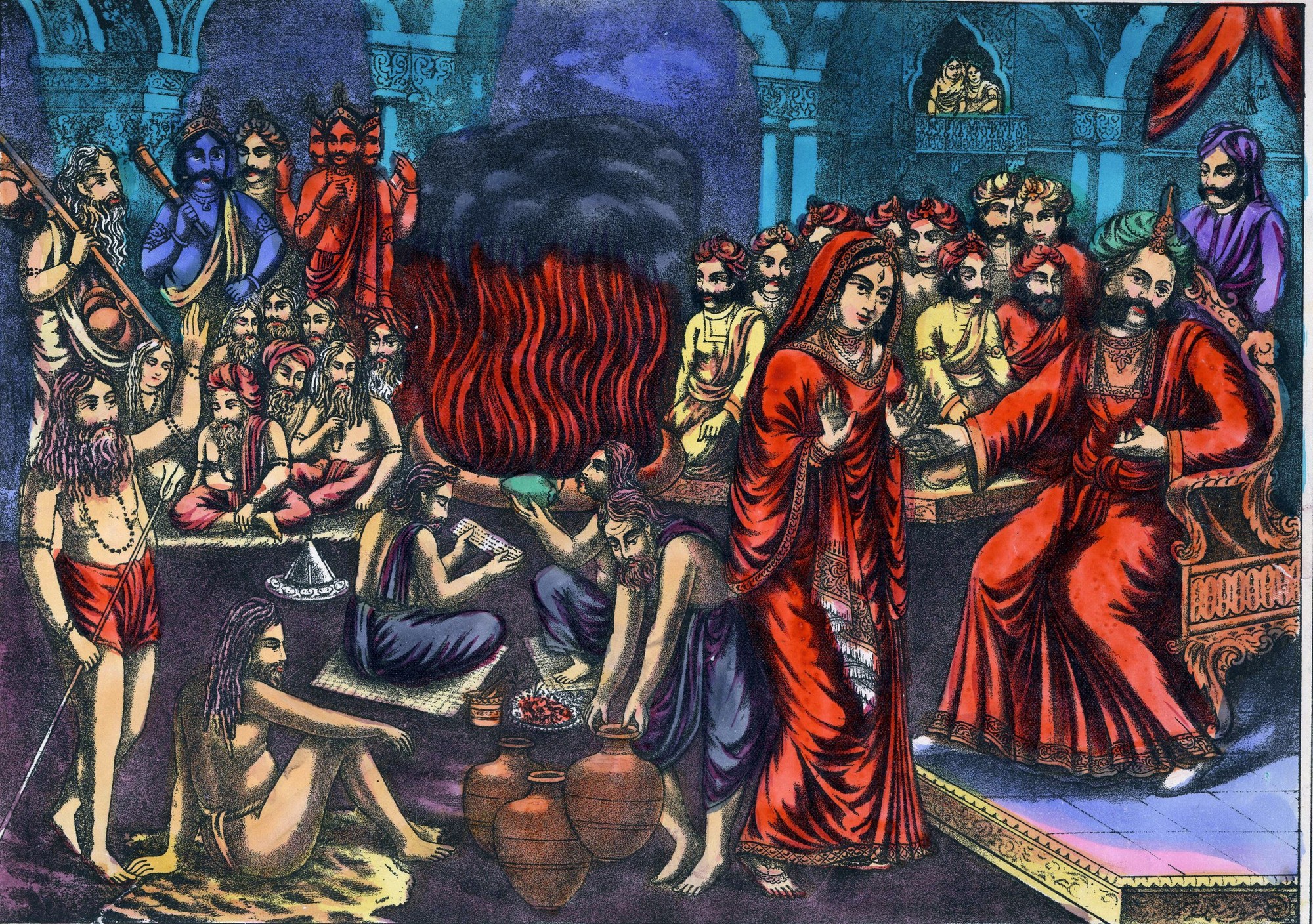
The king broke. He fainted, and revived, and raged at her, calling her the destroyer of his line. He fell at her feet. She could take his other queens, he told her, his kingdom, his own life, anything but this one son. The world might go on without the sun, and crops might grow without rain, but he could not live even a little while without Rama. He heaped up the pictures of what she had done: a man who carefully keeps the very rope he will hang by, a child playing with a black snake and not knowing it will kill him. She was a viper, he said, that he had warmed at his own breast.
The trap that had no floor
What he did not do was take the boons back. He could not. He was the king of the IkshvakuThe solar dynasty of Ayodhya, also called the House of Raghu, into which Rama is born and whose kings the epic holds up as keepers of their word. line, the solar house whose whole glory was that its word held, and Kaikeyi knew exactly where that pride became a cage.
She answered his grief with law. A king who breaks a promise, she reminded him, is no king; he forfeits the righteousness that is the ground he stands on. She named ancestors who had kept terrible pledges, King Shivya and King Alarka, men who had given away flesh and eyes rather than break faith. This was satyaTruth, and the keeping of a given word; the dharma that binds a king to a promise even when honouring it destroys him., the truth-keeping that made a king a king, and she held it to his throat. If he refused, she said, she would drink poison in front of him.
There was no floor to the trap because the king had built it himself, first on the battlefield and then again in the wrath-chamber with an oath sworn on his son’s head. He could keep his word and lose Rama, or break his word and lose the one thing that made him more than any other man in Ayodhya. He sank down at Kaikeyi’s feet, the text says, like an orphan, fawning and abject, a man about to die. Rama would go. The only question left was how long the father would outlast the parting, and the answer had been written into him decades before, on another riverbank, in the dark.
What he had done at the ford
On the sixth night after Rama walked into the forest, Dasharatha lay dying by inches beside his chief queen Kaushalya, and he told her at last why. When he was young, before he ever married, he had prided himself on an archer’s trick: he could shoot at a sound alone, in the dark, and hit what he could not see. One night he was hunting at a ford on the river Sarayu, where buffaloes and elephants and tigers came down to drink, and he heard what he took for an elephant filling its trunk with water. He loosed an arrow dipped in snake-venom at the sound.
It was not an elephant. It was a young ascetic, come to the ford to draw water for his aged parents, and both of them were blind. Later tradition would give the youth a name, Shravana, and paint him carrying his parents in baskets on a shoulder-pole; Valmiki’s verses know none of that.
Here he is only the son of a hermit, and when the king came running to the cry, the dying youth was careful to name the one thing that mattered for the reckoning: he was born of a vaishya father and a shudra mother, so the king had not, at least, killed a brahmin. At the boy’s own asking Dasharatha drew the poisoned arrow out, and the boy died.
The curse comes home
The king carried the water the rest of the way, to a hermitage where two blind old people sat waiting, seated together like a pair of birds robbed of their wings, listening for a son whose footstep would not come. He confessed. Because he confessed of his own accord, the sage-father did not strike him dead. But over the ashes of his cremated son the old man pronounced the sentence that had been waiting the whole span of the king’s life to fall due: that Dasharatha too should die of grief for a lost son, exactly as he had parted these two from theirs. Then the bereaved parents built a pyre and walked into it.
A lifetime is the distance between the sin and the sentence, and the whole poem bends around that gap. The boon in the wrath-chamber did not kill Dasharatha; it only supplied the shape the old curse had reserved for itself. Separation from a son, ending in death: the curse names the mechanism, and Kaikeyi, from an ambush she could not have known she was serving, springs it.
On the sixth night, his senses guttering out one by one like a lamp when the oil is spent, the king could no longer even see Kaushalya at his side. At midnight, worn down by grief for the son he had exiled, he named his queens, named Kaikeyi last as his cruel enemy, called out for Rama, and died.
Mayest thou suffer the same grief that thou hast caused to me, through separation from thy son, ending in thy death. (Ramayana, Ayodhya Kanda 64, tr. Shastri)
- Valmiki, Ramayana, Ayodhya Kanda, sargas 8–9 (Hari Prasad Shastri, The Ramayana of Valmiki, 1952; via wisdomlib.org)the battlefield origin of the two boons in the war against Timidhvaja, master of the Shambara sorcery, and Kaikeyi bearing the wounded king from the field; his open-ended offer of
two boons
deferred untilthe need arises
; and Manthara’s reframing of the coronation as a mortal threat to Bharata, with her step-by-step script (thechamber of wrath,
the soiled clothes, the withheld speech, the oath before the demands, regency first and exile second). Book II is widely held by scholars to belong to the epic’s older core. - Valmiki, Ramayana, Ayodhya Kanda, sarga 10 (Shastri)the paradisal approach to Kaikeyi’s apartment (
parrots, peacocks, swans and cranes,
altars of ivory, silver and gold
) set against the wrath-chamber where the queen lies on the bare ground, her jewels scatteredas stars illumine the firmament
; the king, loving heras dearly as his own life,
swearing to grant whatever she wisheseven at the cost of my life.
- Valmiki, Ramayana, Ayodhya Kanda, sarga 11 (Shastri)the oath sworn
by the invincible Rama, who is even dearer to me than you… without seeing whom I cannot live one hour
; the summoning of the cosmic witnesses (the thirty-three gods… moon, sun… the gandharvas, the asuras
); and the two boons stated verbatim, Bharata’s regency first and then Rama’s exileto the forest for fourteen years, wearing a dress of bark, with matted locks like a hermit.
- Valmiki, Ramayana, Ayodhya Kanda, sarga 12 (Shastri)the king’s collapse, his rage (
O Destroyer of my Dynasty
), his plea thatthe world may continue to exist without the sun… but I cannot live even for a little while without Shri Ramacandra
; the self-condemning similes (the preserved hanging-rope, the child and the black snake, the queen asa venomous snake
); and Kaikeyi’s dharmic rebuttal, citing Kings Shivya and Alarka and threatening poison, until the king fallslike an orphan, fawning and abject… at the feet of Kaikeyi as one about to die.
- Valmiki, Ramayana, Ayodhya Kanda, sargas 63–64 (Shastri)the youthful sin at the Sarayu ford, the night hunt
by sound alone
and the poisoned arrow loosed atthe sound as of a pitcher being filled with water
; the youth revealed to beborn of a shudra mother and a vaishya father
(so the guilt is explicitly not brahmin-murder); the blind parentslike two birds bereft of their wings
; the father’s curse (the same grief… through separation from your son, ending in your death
) and the parents’ self-immolation; and the king’s deathat midnight,
senses failingas the flame of a lamp subsides when the oil is consumed,
calling Rama’s name. The name Shravana and the shoulder-pole baskets are later folk tradition, not in these verses. Scholars date the Sanskrit epic’s growth to roughly the fifth or fourth century BCE onward, with Book II among its earliest strata; all English wording here is Shastri’s 1952 prose, some 2,400 years younger than the material it renders.