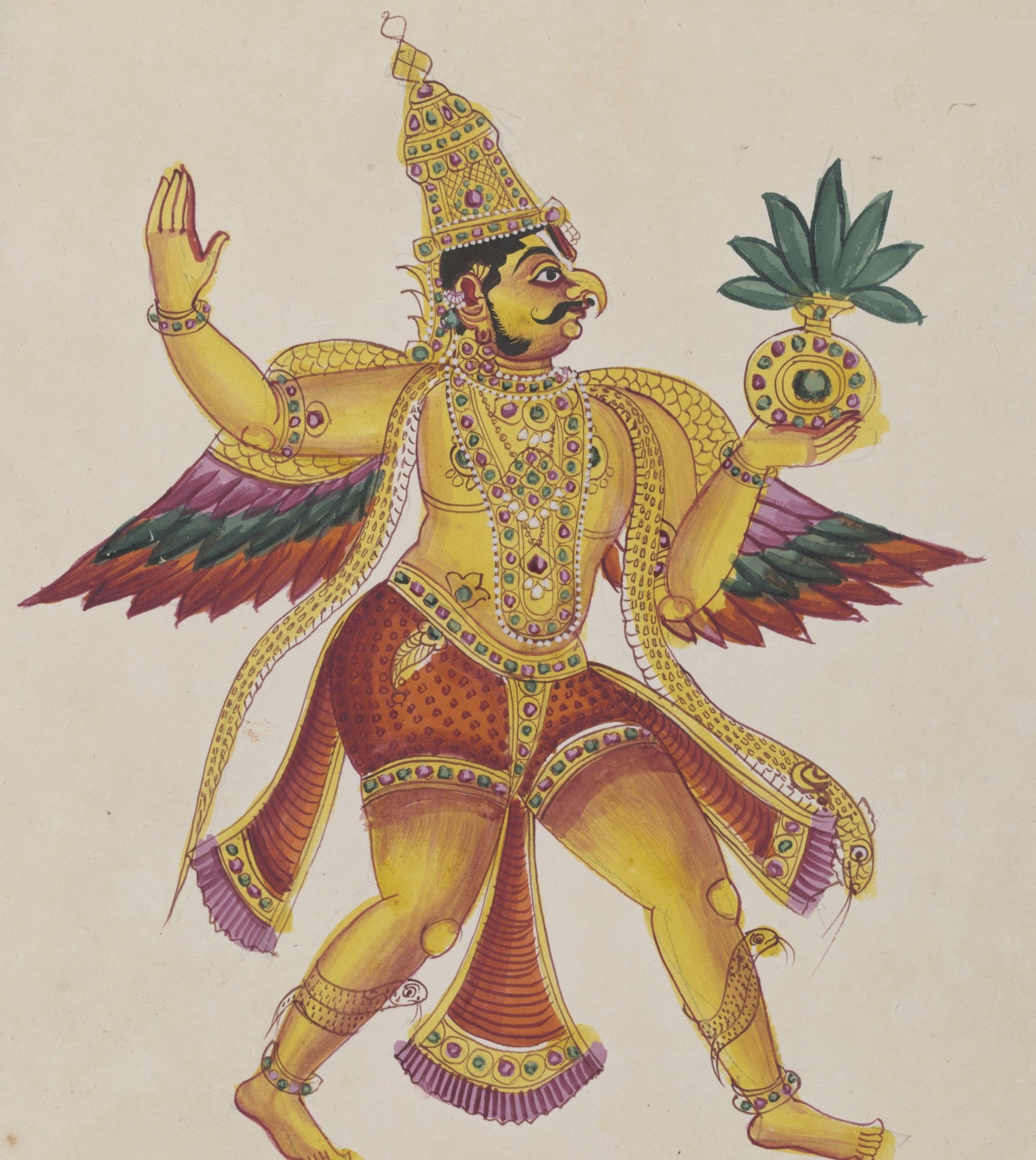
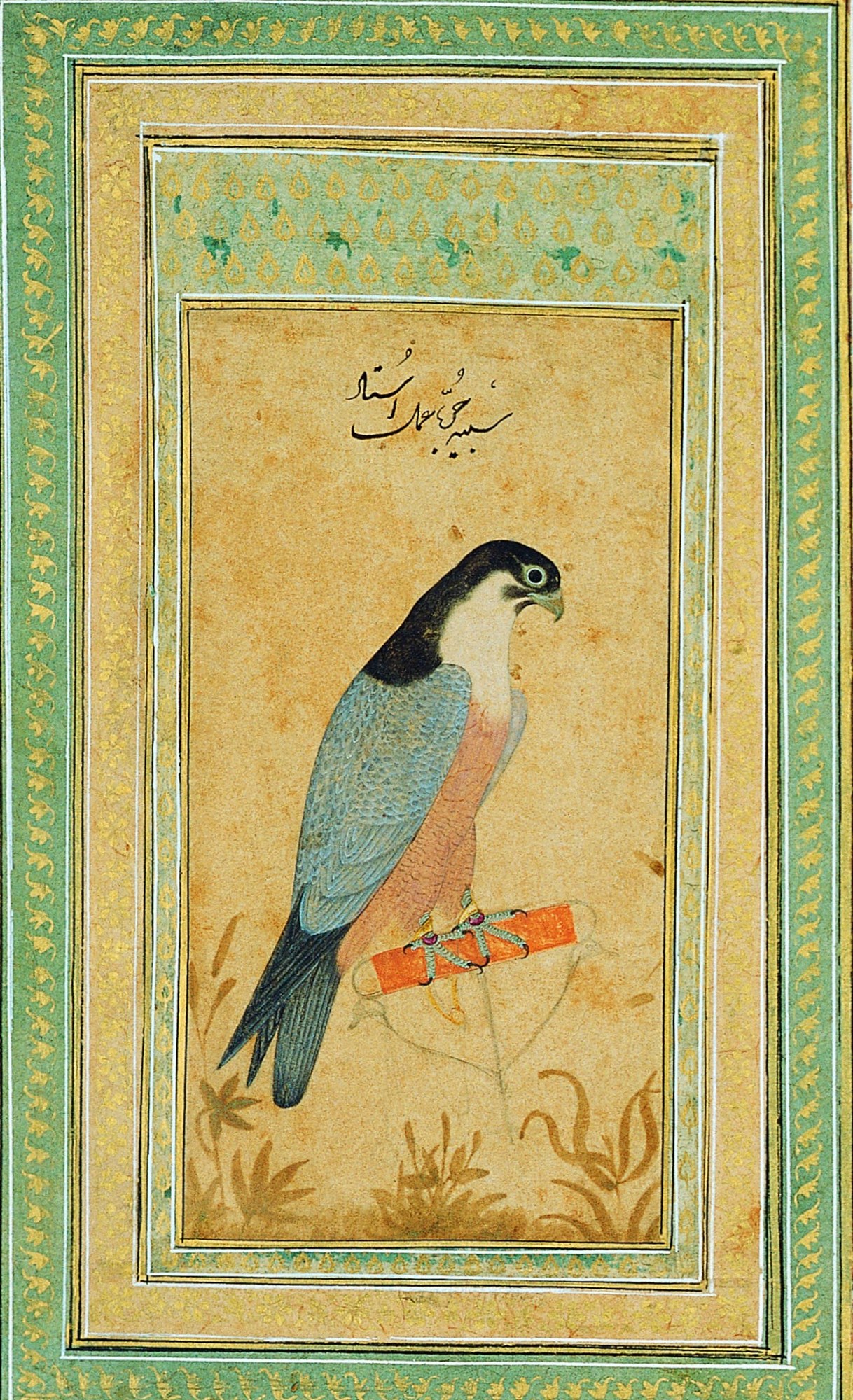
Above all the birds of heaven the poet ranks a single falcon. Before all birds be ranked this Bird, sings the seer Vāmadeva, supreme of falcons this fleet-winged Falcon, and the reason is one flight he made. The most precious thing in the cosmos, the exhilarating draught the gods themselves desired, lay locked away in the loftiest heaven, and the falcon went up and took it. He flew with no chariot to bear him, by his own wheel-less nature, which Griffith glosses as flight by pure natural impulse, no wheels, no team, only the bird and his own will. He crossed to the highest heaven and brought back to ManuMankind, or the archetypal first sacrificer, to whom the falcon is said to bring the god-loved draught down from heaven., to mankind, the god-loved oblation, and in that single carrying he acquired his glory.
With no car to bear him
The flight itself the hymn measures against thought. When the Bird brought it, the poet says, hence in rapid motion sent on the wide path fleet as thought he hurried, and swift he returned with the sweetness of the Soma. This is not a journey of days. It is instantaneous, faster than any chariot, a thing that happens in the space of an intention.
And the falcon did not come back with a sip. He bore an impossible cargo, a thousand libations with him, yea, ten thousand, the whole wealth of the pressed draught carried in one stoop, and behind him he left his enemies in the dust. The Bold One left Malignities behind him, wise, in wild joy of Soma, left the foolish. The seizing was clean and total.
The next hymn tells the same flight from the inside, in the voice of the one being carried. I, as I lay within the womb, the speaker says, considered all generations of these Gods in order; a hundred iron fortresses confined me, but forth I flew with rapid speed a Falcon. A hundred iron fortresses, and out of all of them at once, borne on the wing of a bird. Who exactly speaks here the tradition never fixes.
The verse itself names no one. The old commentator Sāyaṇa reads the I
now as the Soma, now as Indra; Griffith, following Bloomfield and Weber, hears instead Agni, the lightning that rends the cloud and brings down the sweet rain, so that the whole theft becomes an allegory of the storm. The hymn leaves the door open, and it is worth leaving open, because the falcon’s passenger may be the draught, or the god, or the fire in the sky.
He conquered with his strength
One thing the carried one is certain of: this was no gift. Not at his own free pleasure did he bear me, the voice insists; he conquered with his strength and manly courage. The Soma was guarded, and the falcon had to fight his way to it and fight his way out.
Straightway the Bold One left the fiends behind him and passed the winds as he grew yet more mighty, and then came the descent, which is the most vivid image in the whole account. When with loud cry from heaven down sped the Falcon, thence hasting like the wind he bore the Bold One. A screaming stoop out of the height, the bird plummeting with his prize and crying as he fell.
He did not fall unopposed. As he ran the sky an archer took aim. Then, wildly raging in his mind, the archer KṛśānuThe celestial archer who guards the Soma in heaven and shoots at the falcon as it carries the draught away. aimed and loosed the string to strike him, and the arrow found its mark in flight. Here the Rigveda gives the wound a strange and beautiful consequence. Downward hither fell a flying feather of the Bird, one single plume spiralling loose as the falcon drove on, and where it touched the earth, the commentators say, it grew into the sacred palāśaThe sacred Parṇa tree (Butea frondosa), which the Rigveda's commentators say grew from a feather the falcon shed in flight. tree, the Butea frondosa with its flame-coloured flowers.
The bird was hit, shed a feather, and kept flying, and the wound left a tree standing on the ground below. Wounded, and still bearing the Soma, he came down, and the draught was poured out at last for Indra to drink to his rapture, the beaker white, filled with milk, filled with the shining liquid.
When the metres became birds
Centuries later a very different text retells the flight, and the distance between the two is worth stating plainly. The Rigveda hymns belong to one of the older family books, conventionally placed around 1500 to 1200 BCE. The Aitareya Brāhmaṇa is later exegetical prose, roughly 800 to 600 BCE, half a millennium to a millennium downstream. It does not preserve the same falcon.
It rewrites him. Under the heading The Abstraction of Soma. Origin of the Three Libations,
it explains that King Soma lived once in heaven, and the gods and seers, wanting him among them, commissioned not a bird but the poetic metres to fetch him. The metres transformed themselves into birds and flew up, and because of this the whole story is called sauparṇam, the eagle-tale.
The first two failed. Jagatī flew first, tired at the halfway point, lost three of her syllables, and came back with only consecration and austerity. Triṣṭubh went next, tired past the middle, shed one syllable, and returned bearing the sacrificial reward. Only GāyatrīThe eight-syllable Vedic metre, who in the later ritual retelling takes the form of a bird and alone succeeds in fetching the Soma down from heaven. succeeded.
Before setting out she made the gods chant a charm of safe passage over her the whole way, go, and come back, and come back, and with that protection she frightened the guardians and seized the Soma with her feet and her bill, snatching up along the way the syllables the other two had dropped. The archer of the earlier hymn returns here too, and does more damage: Kṛśānu, one of the guardians, discharged an arrow after her, which cut off the nail of her left leg. This became a porcupine.
The cascade from the wound
That severed nail is the seed of a small creation. From the marrow dripping out of the cut sprang a goat; the arrow-shaft became a serpent that does not bite; the force of the shot made a second snake; the feathers became the hanging aerial roots of the fig; the sinews became worms. One wound spilled a whole menagerie onto the earth, and the porcupine came first. Note that this is a different injury from the Rigveda’s. There a feather falls and becomes a tree; here a claw is shot away and becomes a porcupine. The two witnesses stand far apart in time and neither loss should be folded into the other.
Gāyatrī’s three grips became the pattern of the daily rite. What she seized with her right foot became the morning pressing, the most auspicious. What she held in her left foot became the midday pressing, weaker, so that the gods had to strengthen it with the Triṣṭubh metre and with Indra himself. What she carried in her bill became the evening pressing, weakest of all because she had sucked its juice as she flew, and this is why, the Brāhmaṇa says, sour milk is poured into the evening Soma to this day, to give back the sweetness the falcon drank on the way down.
What began in the Rigveda as one bird’s heroic theft has become, in the later text, the charter for why the sacrificial day has three offerings and why they are not equal. The falcon has turned into a metre, and the flight into a ritual almanac, but the arrow of Kṛśānu still finds him, and the Soma still comes down.
Not at his own free pleasure did he bear me: he conquered with his strength and manly courage. Straightway the Bold One left the fiends behind him and passed the winds as he grew yet more mighty. (Rigveda 4.27.2, tr. Ralph T. H. Griffith, The Hymns of the Rigveda)
- Rigveda 4.26 (Vāmadeva, tr. Griffith, The Hymns of the Rigveda, Vol. I, 1896)the falcon ranked
supreme of falcons
; the flightwith no car to bear him
byhis own wheel-less nature
(Griffith’s note: flightby his own natural impulse
); the god-loved oblation brought to Manu; the returnfleet as thought
; the Soma takenfrom yon loftiest heaven
; the load ofthousand libations… yea, ten thousand
; andThe Bold One left Malignities behind him… left the foolish.
Rigvedic Saṃhitā, Mandala IV (a family book), conventionally c. 1500–1200 BCE. - Rigveda 4.27 (Vāmadeva, tr. Griffith, same edition)the first-person account of the one carried past
a hundred iron fortresses
;Not at his own free pleasure did he bear me: he conquered with his strength and manly courage
; the descentwith loud cry from heaven
;the archer Kṛśānu aimed and loosed the string to strike him
;downward hither fell a flying feather of the Bird,
which Griffith’s note reports becamethe sacred Parṇa or palāśa tree, the beautiful Butea Frondosa
; and the delivered Soma,the beaker, white, filled with milk, filled with the shining liquid,
poured for Indra. Griffith records the speaker-identity as disputed among the commentators (Sāyaṇa reading Soma or Indra; Griffith, following Bloomfield 1893 and Weber, reading Agni-as-lightning); the verse names no one. - Aitareya Brāhmaṇa 3.25–3.28 (ed./tr. Martin Haug, The Aitareya Brahmanam of the Rig Veda, Bombay 1863)
The Abstraction of Soma. Origin of the Three Libations
— the metres transformedinto birds (suparṇa),
the tale calledsauparṇam
; Jagatī and Triṣṭubh failing and shedding syllables; Gāyatrī’s safe-passage charm and her seizing of Somawith her feet and bill
; Kṛśānu’s arrow thatcut off the nail of her left leg. This became a porcupine,
with the goat, serpents, fig-roots and worms born of the wound; and the three grips (right foot, left foot, bill) that became the morning, midday and evening libations, the evening reinforced with sour milk because Gāyatrīsucked the juice
in flight. Brāhmaṇa prose, conventionally c. 800–600 BCE — half a millennium to a millennium later than the Rigveda hymns, and a ritual reinterpretation, not an independent parallel. - Vājasaneyi Saṃhitā 4.27 with Mahīdhara’s commentarynamed by Sāyaṇa (via Haug’s note to Aitareya Brāhmaṇa 3.27) as listing the guardians of the celestial Soma, including Kṛśānu. Cited within the sources above; not read independently for this piece.