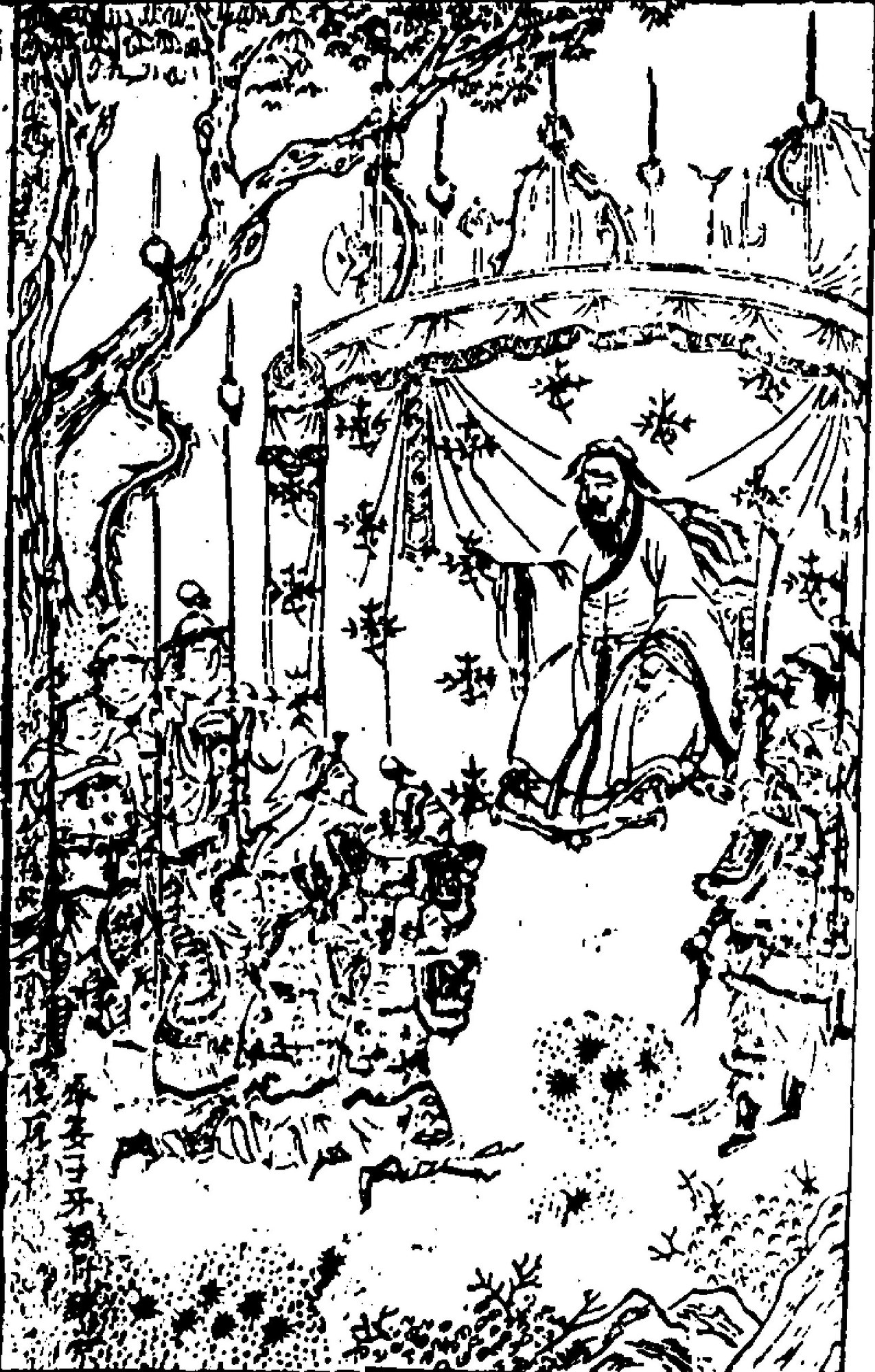
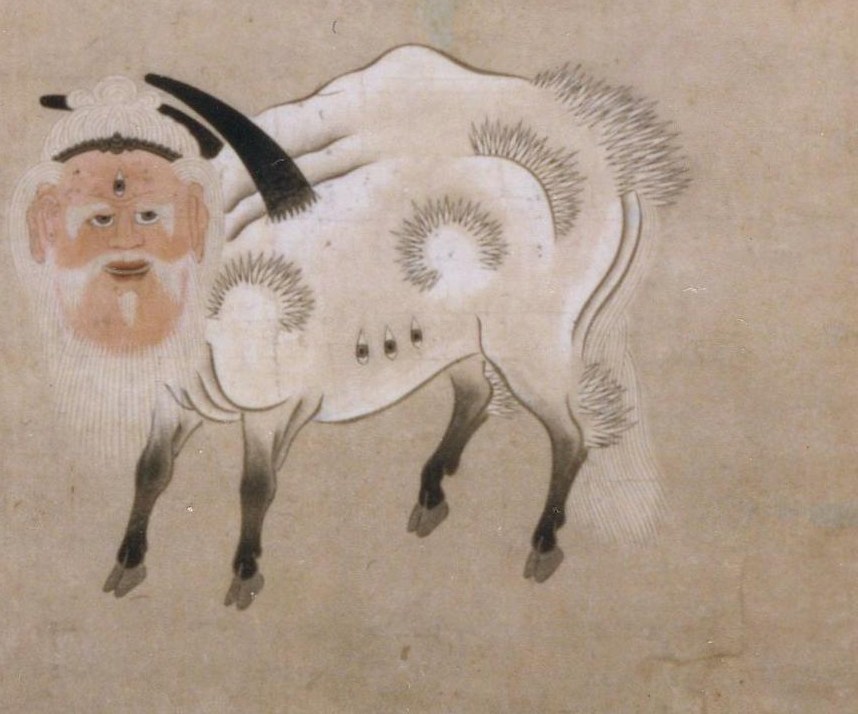
On his tour of the east the Yellow Emperor came down to the sea, climbed a mountain called Huan, and at the water’s edge met a beast that could talk. It was a divine creature, the account says, one that penetrated the dispositions of every thing in the world, and the sovereign did what any ruler faced with a talking oracle would do: he asked it about the ghosts and spirits of the earth. The beast answered by counting them. Every kind of spirit, prodigy and haunt that had ever formed out of the world’s breath or been left behind by a wandering soul, it enumerated to a total of eleven thousand five hundred and twenty. This is the Baize, the White Marsh, and the strange thing about its famous conversation is how young it is.
A beast a thousand years too late
The Yellow Emperor belongs to the legendary dawn of the Chinese world, a sovereign of a supposed antiquity so deep no text touches it. The Baize does not. The whole seashore encounter, the speaking beast, the count of the spirits, survives in one place only: the Yunji Qiqian, a Daoist anthology compiled around 1028 CE in the Northern Song, quoting an older Daoist annals of Xuanyuan.
This is fangshiA master of esoteric arts and recipes for power over spirits; it is a fangshi tradition, not the classical annals, that preserves the Baize legend. lore, the material of the masters of esoteric arts, not the sober court annals, and its date is the medieval period, some two millennia after the age the story is set in.
Even the beast’s bare name reaches back only a little further. The earliest datable mention of Baize is a single clause in Ge Hong’s Baopuzi, written around 317 to 320 CE, which says merely that the Yellow Emperor, to exhaust the knowledge of spirits and monsters, recorded the words of Baize.
That is roughly seven hundred years before the anthology that tells the actual story, and Ge Hong tells no story at all: no shore, no mountain, no dialogue, no tally.
He names the beast and moves on. Everything vivid about Baize, everything a reader pictures when the name is spoken, was written down centuries after the first bare reference to it, and both of those moments sit far downstream of the sovereign they describe. This is a piece of medieval Daoist lore wearing the costume of the archaic. It is worth knowing which is which before the beast opens its mouth.
What the White Marsh knew
The marvel of the Baize is not its shape but its speech. The encounter text gives it no body to speak of, only two powers: it is able to speak, and it penetrates the dispositions of the myriad things. It is, in other words, the beast that knows. What it knows is the entire population of the unseen world, and the account frames that population in the oldest cosmological language available.
The spirits are the things that essence-qiThe vital breath or energy of Chinese cosmology; here, the essence-qi from whose condensing the myriad creatures Baize enumerates were held to arise. condenses into and the transformations that a wandering soul leaves behind. That formula is itself far older than the story around it, a line lifted from the ancient appendices to the Yijing and set inside a medieval frame, so that the beast counts the world’s spirits in words that predate its own legend.
And the count is exact. Where a lesser marvel would offer a vague multitude, the text gives a specific figure: eleven thousand five hundred and twenty kinds. The precision is the point. A specific enormous figure is a census, and it turns the Baize from a wonder into a bureaucrat of the supernatural, an official register of everything that could ever trouble a person in the dark. The number carries the weight of a symbolic totality, the sum of all spirit-kinds, and the tradition never wavered from it. Every later witness gives the same figure.
The picture that outlived the beast
What the sovereign did with this catalogue matters more than the meeting itself. He had the beings drawn, the text says, and made into pictures to instruct the world, and this act is offered as the origin of the Baize TuThe lost White Marsh Diagram, the picture-catalogue of spirits the Yellow Emperor is said to have made from Baize's words; used as a demon-naming manual., the White Marsh Diagram. Then he composed an incantation against evil to drive the beings off. The knowledge became an instrument of government and protection: a bestiary you could hang on a wall.
The logic of that instrument is spelled out in the older, drier witness. In Ge Hong’s manual for travellers into the wild, the Baize Tu appears not as a story but as a piece of equipment, paired with another lost chart, the Jiuding Ji. Consult the register of the hundred demons, he advises, know the names of the world’s demons, keep these diagrams, and the host of demons withdraws of itself.
The power here is purely a power of naming. To know a spirit’s name and form is to strip it of its terror, and the diagram was the reference book that let you do it. The beast that knew every name had, in effect, written the field guide to fear.
That diagram is lost. No complete copy of the Baize Tu survives, and it is known now only from scattered quotations and from a damaged Dunhuang manuscript of the ninth or tenth century, itself a descendant of the tradition rather than the thing itself, and one that carries no picture of Baize at all. The catalogue outlived its source and then was itself worn away, so that the most famous work of the all-knowing beast comes down to us as a rumour of a book.
The face nobody agrees on
For a creature defined by knowledge, the Baize is oddly hard to see. The encounter that made it famous describes no body beyond divine beast,
and every image of it comes from later hands that could not agree. A Ming encyclopedia, the Sancai Tuhui of 1609, gives it a dragon’s head, green hair and a single horn, and lets it fly. The History of Yuan, from 1370, makes it tiger-headed with a red mane and a dragon’s body.
The oldest depiction of all, preserved in a Japanese bibliographic tradition, gives it the body of an ox and a bearded human head. The familiar modern image, a green-haired, single-horned, lion-like beast, is a fusion of these and belongs to none of them. None of these faces has any right to be projected back onto the sovereign at the shore, who met only a voice.
The afterlife of that voice was long and practical. The image of Baize, like its lost diagram, was hung in the home as a charm against sickness and evil, a later East Asian custom rather than part of the Yellow Emperor’s legend. When cholera came to Edo in 1858, people are said to have placed the beast’s image on their pillows. The all-knowing creature had become an amulet, its total census of the world’s terrors compressed into a single picture you slept beneath, trusting that a thing which knew every spirit by name could keep them from your bed.
The Yellow Emperor toured the east, came to the sea and climbed Mount Huan, and at the shore obtained the divine beast Baize, which was able to speak and penetrated the dispositions of the myriad things. (Yunji Qiqian j.100, quoting the Xuanyuan Benji; author’s rendering from the Chinese)
- Ge Hong (葛洪), Baopuzi Neipian (抱朴子·內篇), ch. 13
Jiyan
(極言), c. 317–320 CE (Eastern Jin): the earliest datable link of the Yellow Emperor to Baize by name, 「窮神奸則記白澤之辭」 (to exhaust [the knowledge of] spirits and monsters, he recorded the words of Baize
). An allusion onlyno beast described, no seashore, no dialogue, no tally. Chinese read verbatim via zh.wikisource 抱朴子/卷13; English is the author’s literal gloss. - Ge Hong (葛洪), Baopuzi Neipian (抱朴子·內篇), ch. 17
Dengshe
(登涉), c. 317–320 CE: the earliest datable reference to the diagram, 「及白澤圖九鼎記,則眾鬼自卻」 — one should know the names of the world’s demons and possess the Baize Tu (白澤圖) with the Jiuding Ji (九鼎記), whereuponthe host of demons withdraws of itself.
The Baize Tu here is a functional demon-identification manual; the beast is not mentioned. Chinese read verbatim via zh.wikisource 抱朴子/卷17; English is the author’s literal gloss. - Yunji Qiqian (雲笈七籤), j.100, quoting the Xuanyuan Benji (軒轅本紀); anthology compiled by Zhang Junfang (張君房), c. 1028–1029 CE (Northern Song): the ONLY source carrying the full narrated encounter — the eastern tour to the sea and Mount Huan (帝巡狩,東至海,登桓山), the divine beast obtained at the shore (於海濱得白澤神獸), its speech and total knowledge (能言,達於萬物之情), the question on the ghosts and spirits of the world (因問天下鬼神之事), the enumeration framed by 「自古精氣為物,游魂為變者」 to a total of 11,520 kinds (凡萬一千五百二十種), the drawing of them to instruct the world (帝以圖寫之,以示天下) and the exorcistic text (帝乃作…之文以祝之). The base witness carries the copyist slips 巡獰 (for 巡狩) and 中邪 (for 祝邪); the corrected readings are followed. Chinese read verbatim via zh.wikisource 軒轅黃帝傳; English is the author’s literal gloss.
- (LOST) Baize Tu (白澤圖), the White Marsh Diagram of spirits: a demon-identification manual attributed to the Baize/Huangdi legend. No complete text survives; known only from allusions, later quotations, and a Dunhuang fragment.
- (FRAGMENT) Dunhuang manuscript Pelliot chinois 2682, Baize jinggui tu (白澤精恠圖): copied c. 9th–10th c.; Bibliothèque nationale de France. A damaged descendant of the Baize Tu tradition, carrying no drawing of Baize itself. Provenance via Harper (2018) and Sasaki (2012); the manuscript was not consulted for this piece.