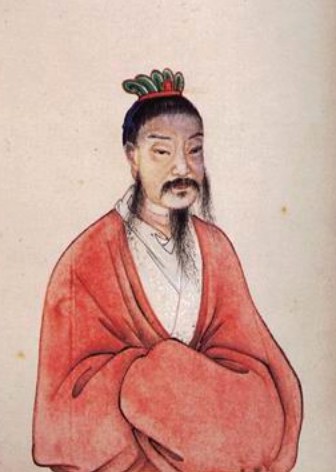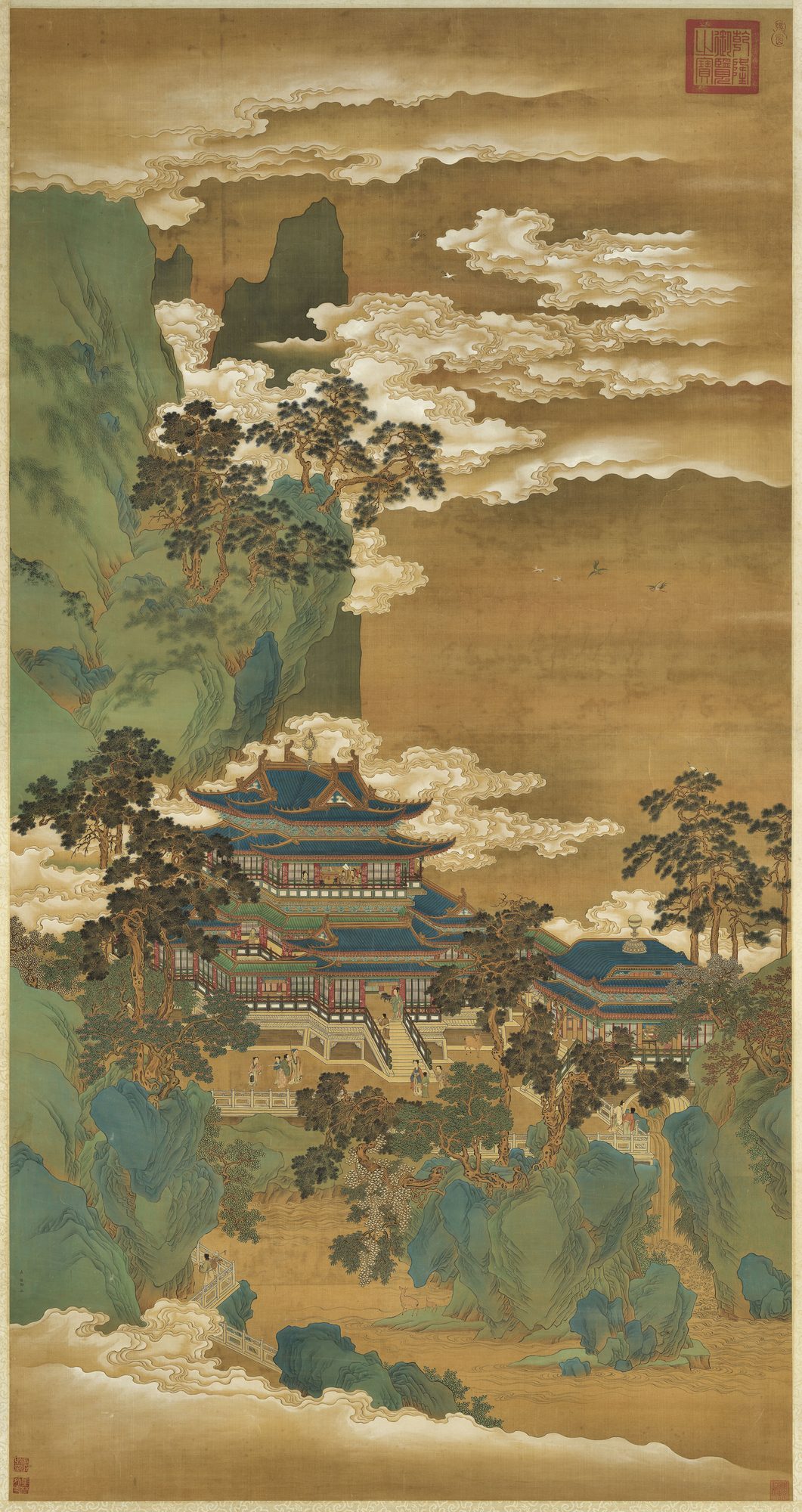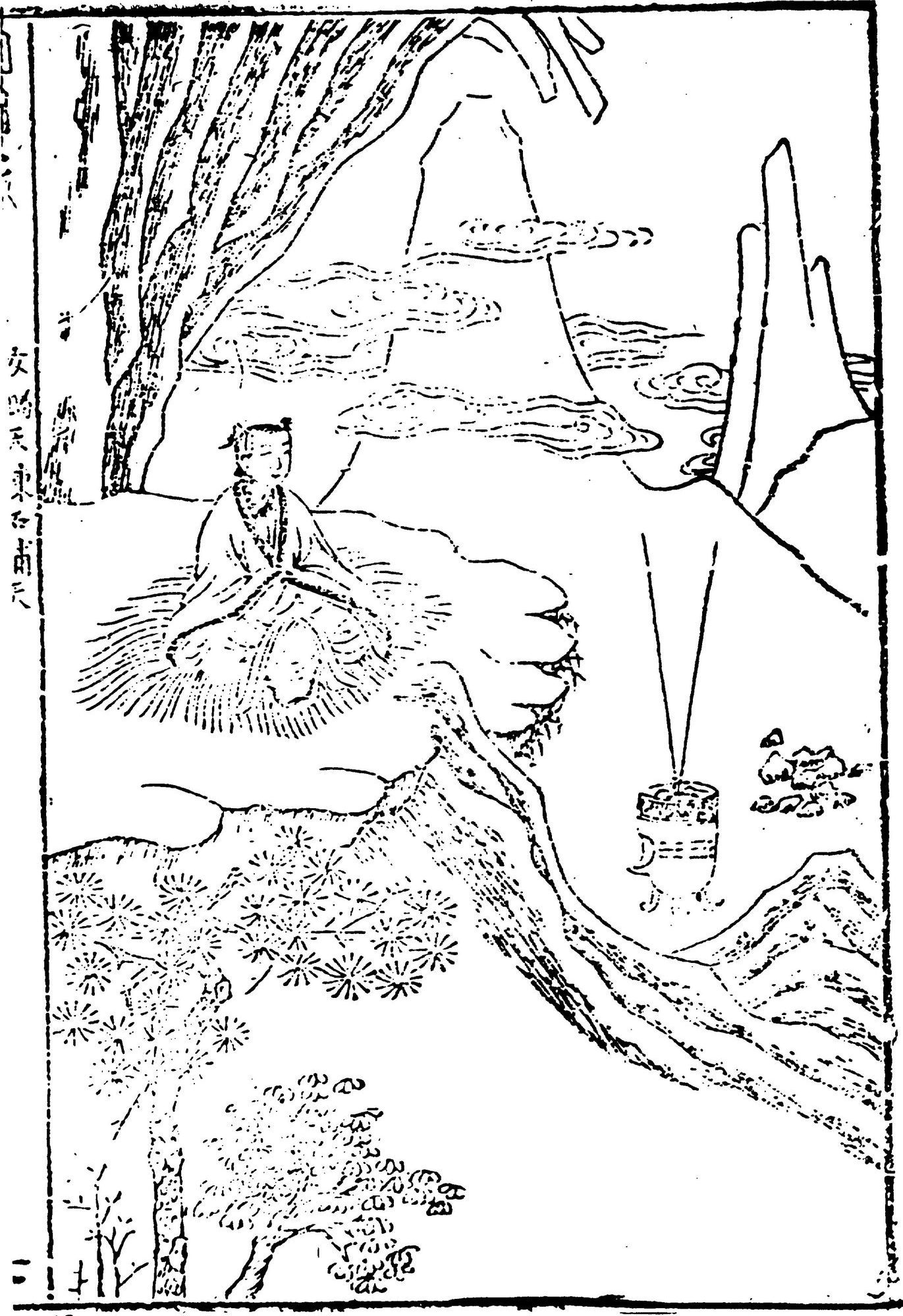
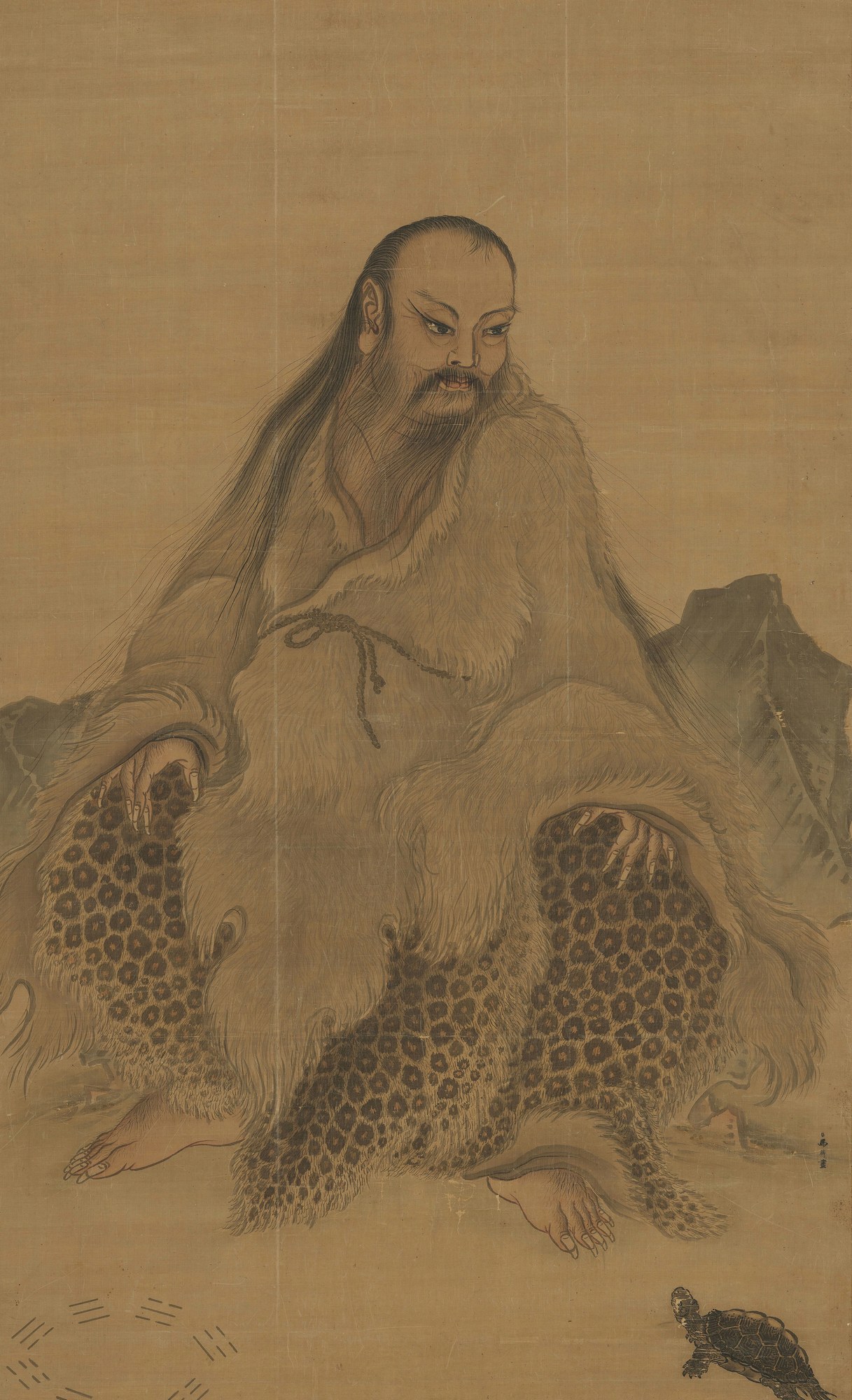
Reckon the reigns backward far enough and you arrive at a throne with no throne before it. The man who sat on it, one account says, ruled the world for a hundred and eleven years. He kept his capital at a place called Chen, ordered the officers of his court under the names of dragons and called them the Dragon Master, made a zither strung with twenty-five silk strings, and climbed the eastern peak of Mount Tai to offer sacrifice to Heaven. Then he died and was buried, and the reign of the second sovereign began. This is Fuxi drawn as the first emperor of China: dated, capitalled, and buried, the founder of a dynastic line running down to Shennong the ploughman and beyond.
It is a precise and vivid picture, and it is also the youngest layer of the whole tradition by the better part of a thousand years. The reign-length, the capital, the dragon-offices and the feng riteThe feng (封), a sovereign's offering to Heaven made on the summit of a great mountain, in Fuxi's case the eastern peak Mount Tai. all come from a single short text, the Sanhuang benji, which Sima Zhen wrote in the eighth century of our era and prefixed to the ancient Shiji to give the histories a proper opening at the head of the Three SovereignsThe sanhuang (三皇), the earliest legendary rulers headed by Fuxi; the sources disagree over the second and third names..
Sima Zhen was an honest compiler and said as much himself: the records of these first kings, he wrote in his preface, are scanty, and the material is shallow and near at hand. He meant near in time. The oldest strand of Fuxi is a Warring-States figure who read the sky; the emperor with the eleven-decade reign is a Tang scholar’s reconstruction, and the reader who wants the real Fuxi has to hold the two apart.
A hundred and eleven years, in the eighth century
Set the dates side by side and the gap is the point. The Baihu Tong, which first fixes Fuxi at the head of the sovereigns, is an Eastern Han text of the first century. The commentaries on the Book of Changes that make him the master of the eight small figures are older still, from the Warring States and early Han.
Against those, the Sanhuang benji is roughly nine hundred to a thousand years late, further from them in time than we stand from the Norman Conquest. When it tells you the capital was Chen and the reign ran a hundred and eleven years, it is not reporting an ancient record. It is furnishing a very old and rather bare figure with the props of imperial history, the way a later age imagines its own beginnings.
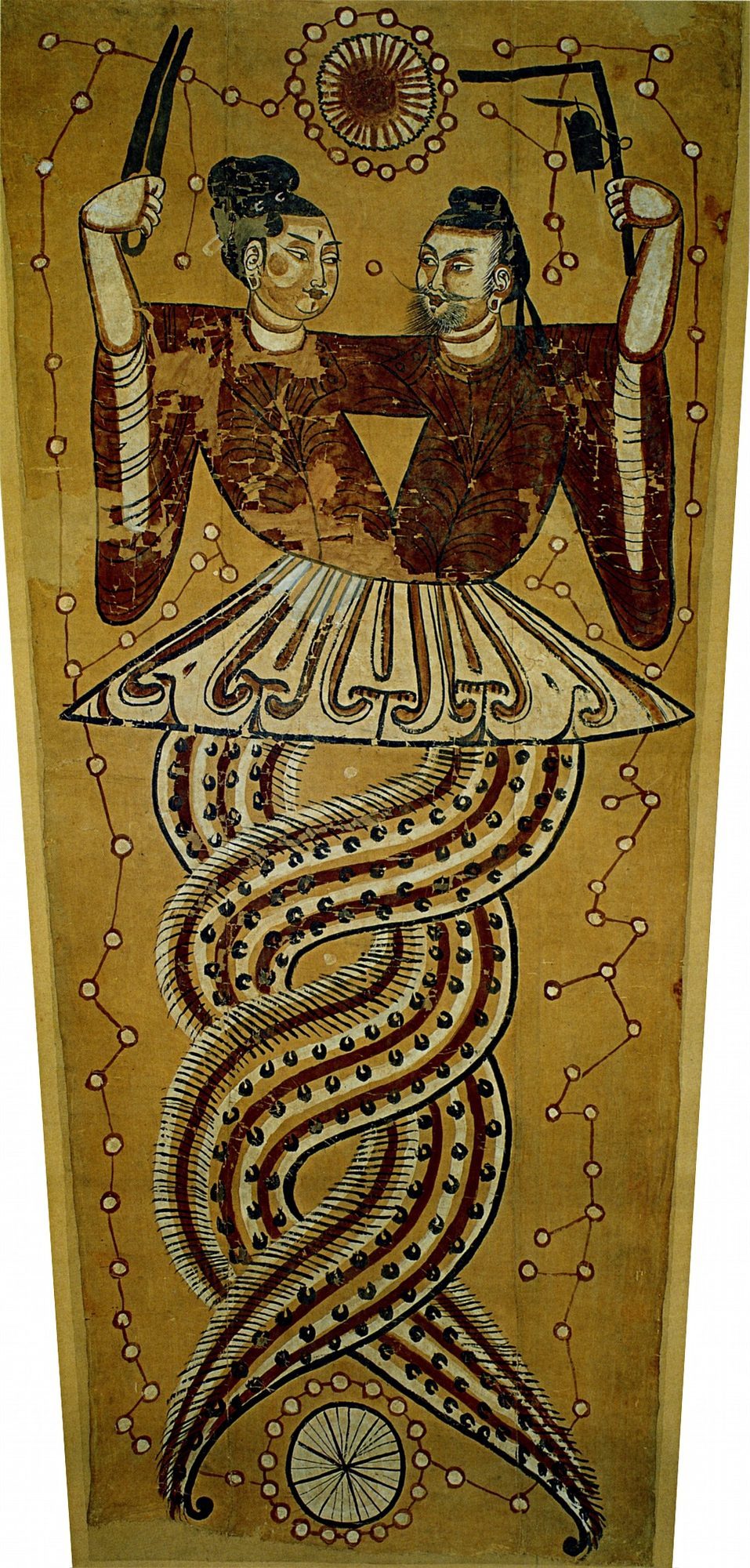
The sovereign’s own body carries the older strangeness through. Fuxi, the Sanhuang benji says flatly, had the body of a serpent and the head of a man, and possessed the virtue of a sage. His mother was named Huaxu; she trod on the footprint of a giant at the Thunder Marsh and so conceived him, at a place called Chengji.
Sima Zhen, careful again, notes in his own hand that this birth-legend is not his: he takes it from Huangfu Mi’s third-century Diwang shiji, a source itself centuries younger than the Han. The footprint at the marsh is a real and haunting image of how a first king comes into the world, but it is legend gathered around the throne long after, not bedrock beneath it.
Heaven, earth, and the ladder of doublings
What is genuinely oldest, and genuinely his, is the reading. Looking up he observed the images in heaven, the Sanhuang benji has him do, and looking down the patterns on earth; he watched the markings of birds and beasts and the fitness of the ground, took what was near from his own body and what was far from the things around him, and so first drew the eight trigrams. Each trigram is three lines, broken or whole, and the eight together were meant to comprehend the powers of the spirits and sort the dispositions of the myriad things. That sentence is Sima Zhen quoting, almost word for word, the far older Book of Changes he is prefacing.
Where the Changes goes past the sibling accounts is in saying what the trigrams are, not merely that a sage once drew them. In the Changes, its Great Commentary declares, there is a Supreme UltimateThe taiji (太極), the single undivided origin from which the Great Commentary derives everything by successive doubling..
This gives birth to the Two Modes; the Two Modes give birth to the Four Images; the Four Images give birth to the Eight Trigrams; and the eight trigrams determine fortune and misfortune, and out of fortune and misfortune comes the great enterprise of the world. It is a ladder built entirely of doublings, one undivided origin splitting into two, two into four, four into eight, each rung a set of small line-figures twice as full as the last. Fuxi’s eight signs are not a bundle of lucky diagrams. They are the fourth rung of a staircase that begins in unity and ends in everything, and that structure, not the act of invention, is what the oldest commentary cared about.
The Chart out of the river
The same commentary supplies the machinery by which a sage reads such a pattern, and it is careful about the credit. Heaven gives birth to numinous things, it says, and the sage takes them as his rule; the River gave forth the Chart, the Luo gave forth the Writing, and the sage took them as his model. Note the word: the sage, not Fuxi by name.
The famous picture of a dragon-horse rising from the Yellow River with the River-Chart on its back, from which Fuxi is supposed to have copied the trigrams whole, is a later embroidery of the weft-texts and the commentators; the line the Great Commentary actually gives has no dragon-horse in it and names no one. What the earliest layer allows is only this: a sage read something the cosmos offered, and the eight figures came of the reading.
Later synthesis fixed the reader in a quarter of the sky. The Changes places its trigrams around the compass and opens the circuit in the east: the Thearch comes forth in Zhen, it says, and Zhen is the east, the place where the myriad things come out. On that peg Sima Zhen hangs the whole seasonal identity of the first king.
Fuxi reigned by the virtue of Wood and presided over the ordinances of spring; he is Taihao, the Great Brightness, the green sovereign of the eastern morning. The equation of that eastern brightness-god with the culture-hero of the trigrams is itself a Han-era fusion, as the scholarship notes, another seam stitched shut long after the figures on either side of it were made.
First of the sovereigns
Head of all this, in the text that first says so, Fuxi stands first. The Three Sovereigns, the Baihu Tong asks, who are they? Fuxi, Shennong and Suiren, it answers, and then, honestly, records the quarrel: some say Fuxi, Shennong and Zhurong instead. The lists cannot agree who else belongs in the first age of the world, and Sima Zhen, listing still more candidates, finally seated Nüwa in the third place himself.
Through every version one name holds its position. Whoever comes second and third, Fuxi comes first, and the same book says why in a single line that fuses ruler and cosmologist: he fixed the way of humanity, and drew the eight trigrams to govern the world below. To draw the trigrams, in the oldest understanding of him, was not to invent a curiosity. It was an act of sovereign rule, the first reading of the cosmos by the first man to sit above it.
There is in the Changes the Supreme Ultimate, which gives birth to the Two Modes; the Two Modes give birth to the Four Images; the Four Images give birth to the Eight Trigrams; and the eight trigrams determine fortune and misfortune, and fortune and misfortune give birth to the great enterprise. (Yijing, Xici shang §11; author’s rendering from the Chinese)
- Sima Zhen (司馬貞), Sanhuang benji (三皇本紀), Tang, c. 720–730 CE: a supplement prefixed to the Shiji. Fuxi (太皞 庖犧氏), of the Feng surname (風姓), succeeds the Suiren clan and continues Heaven as king (繼天而王); his mother Huaxu treads a giant’s footprint at Thunder Marsh (履大人跡於雷澤) and bears him at Chengji; he has a serpent’s body and a human head (虵身人首); he draws the eight trigrams by observing heaven and earth (始畫八卦); he orders the offices by dragons as the Dragon Master (以龍紀官,號曰龍師), makes the twenty-five-string zither (作二十五絃之瑟), keeps his capital at Chen (都於陳), performs the feng rite on Mount Tai (東封太山), and reigns one hundred and eleven years (立一百一十一年崩), by the virtue of Wood, presiding over spring (木德王,注春令). Sima Zhen’s own preface flags the records as scanty (罕備) and the material as shallow and near in date (淺近), and his interlinear notes source the Feng surname to the Guoyu and the Huaxu birth-legend to Huangfu Mi’s Diwang shiji (3rd c. CE). Chinese read verbatim (zh.wikisource.org/wiki/三皇本紀). English renderings above are the author’s own literal gloss.
- Yijing (易經), Xici shang / Great Commentary Part 1 (繫辭上) §11: the generative cosmology, the Supreme Ultimate (太極) giving birth to the Two Modes (兩儀), the Four Images (四象) and the Eight Trigrams (八卦), which determine fortune and misfortune and issue in the great enterprise; and the sage-model line, the River yielding the Chart and the Luo the Writing, which the sage (聖人), not Fuxi by name, takes as his model (河出圖,洛出書,聖人則之). Warring-States / early Han. Chinese read verbatim (zh.wikisource.org/wiki/易傳/繫辭上).
- Yijing (易經), Shuogua (說卦) §5: the trigrams arranged around the compass, the Thearch coming forth in Zhen (帝出乎震), Zhen being the east where the myriad things come out (萬物出乎震,震,東方也); the basis for Fuxi/Taihao’s eastern, spring placement. Chinese read verbatim (zh.wikisource.org/wiki/易傳/說卦).
- Baihu Tong (白虎通義), ch. 1 (號), attrib. Ban Gu, Eastern Han, 1st c. CE: the Three Sovereigns (三皇) with Fuxi at their head, and the source’s own recorded variant of the third name (Fuxi, Shennong, Suiren; or Fuxi, Shennong, Zhurong); and the gloss that Fuxi fixed the way of humanity and drew the eight trigrams to govern the world below (始定人道,畫八卦以治下). Chinese read verbatim (zh.wikisource.org/wiki/白虎通/卷01).
- Baihu Tong (白虎通義), ch. 5 (封禪): the rationale for the feng and shan sacrifices on Mount Tai and the auspicious-omen catalogue, including the River yielding the Dragon-Chart and the Luo the Turtle-Writing (河出龍圖,洛出龜書); context for Fuxi’s Mount Tai rite and the He-tu / Luo-shu motif. Chinese read verbatim (zh.wikisource.org/wiki/白虎通/卷05).
- **Anne Birrell, Chinese MythologyAn Introduction** (Johns Hopkins UP, 1993) p. 44: on the later merger of the eastern divinity Taihao with the culture-hero Fuxi. Scholarship, not a primary source.