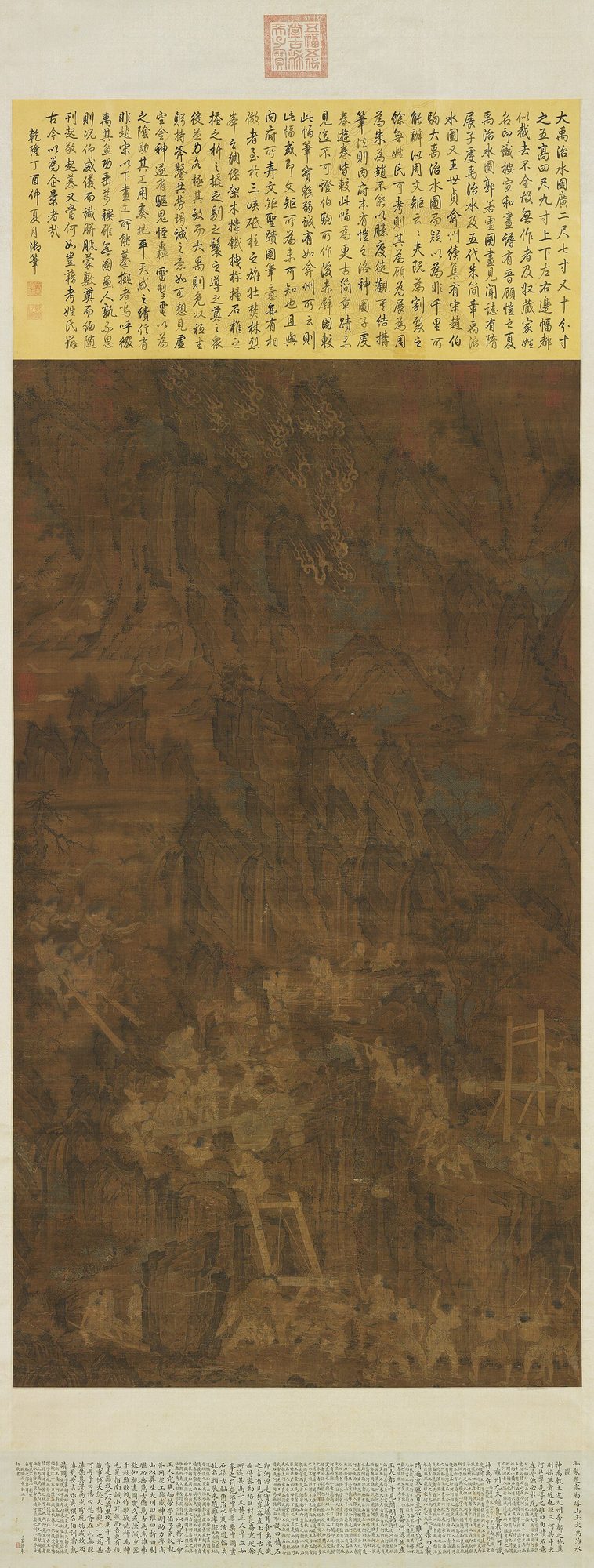
The water was winning. It had come up over the low fields and then over the high ones, and then it had climbed the hills until the hills went under, and now the old poets reach for the only image big enough to hold it: surging, it spreads destruction; vast, it embraces the mountains and overtops the ridges; immense, it swells to heaven. A whole world going down under a rising tide, and beneath that tide the people, crying out for someone, anyone, who could master the flood. The emperor Yao put the question to his court. Who can bring this under control?
His advisers, the Four Peaks, answered with one name, and it was not a name Yao liked. Gun. The emperor demurred, doubting the man’s temper, but his counsellors pressed and he gave way, and so the task of saving a drowning world fell to Gun. He laboured at it for nine years, and at the end of nine years the water was no lower than when he began.
Divine earth heaped against the flood
The oldest and strangest telling of how he tried does not send him to the flood empty-handed. In it there exists a marvellous substance called xirang, the swelling soil, self-renewing earth that grows of its own accord: pile it against the water and it rises as the water rises, a dam that builds itself higher the more it is asked to hold. But the xirang did not belong to Gun.
It belonged to the High God, and Gun stole it. Without waiting for the god’s command, he took the divine earth down to the human world and heaped it against the flood, a mortal thief hauling forbidden material out of heaven to save the people below. It is the same shape as the Greek theft of fire, the same defiant generosity, and it ends the same way: badly, for the thief.
Zhurong at Feather Mountain
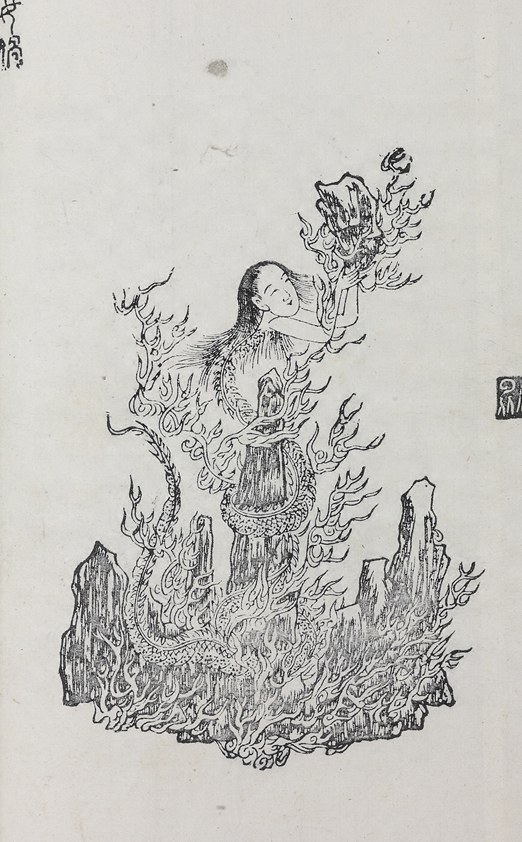
For the god was enraged, and his anger fell on Gun in a form with a cruel logic to it. He sent Zhurong, the god of fire, and at the wild outskirts of Feather Mountain the fire god killed the man who had tried to tame the water. Fire against the failed master of water, a clean elemental irony. In the sterner court chronicles the death is folded into the machinery of state: Gun is one of four great criminals executed at the edges of the world, punished at Feather Mountain by imperial decree.
But even the word for that punishment refuses to settle. It can mean put to death, and it can mean banished for life, so that whether Gun was killed at Feather Mountain or merely exiled there to die is a genuine fork in the ancient record, not a modern quibble. Either way, the flood outlived him.
Gun then gave birth to Yu
And here the myth does something no tidy tragedy would allow. Gun’s body did not rot. It lay at Feather Mountain, and out of it came his son. The line in the oldest text is bald and astonishing, four characters that leap across the grave: Gun then gave birth to Yu. A father who fails, dies, and becomes the son who will succeed, the corpse of the old method carrying inside it the seed of the new one.
The poets of Chu, brooding over this centuries later, could only turn it into questions: why did his body not decay for three years? What owl, what turtle, dragged and carried at the dead man on the mountain? They did not pretend to know. They asked, and left the asking on the page.
There is another thing the Chu poets would not let go of, and it is the reason Gun is more than a cautionary failure. In the plain chronicles he is a botched official who threw the very order of the cosmos into confusion, dammed the flood and so disordered the Five Phases until the god withheld from him the great plan of governance and gave it to his son instead.
But in the songs of the south the same man is grieved over. Gun, in his stubborn uprightness, destroyed himself: not a bungler but a hard, upright soul broken by an impossible task, and worth mourning. Both valences are old. The failure and the dignity sit in the record together, and the honest telling keeps them both.
Digging the flood off to the sea
What the son did differently is the whole moral of the story, and unlike the moralising that later ages would pile on top, this part is genuinely ancient. The High God, having killed the father, now commissioned the son: go, spread the soil, settle the Nine Provinces. And Yu did not build. He dug. Where Gun had answered the water with a wall, Yu answered it with a way out. He opened passages for the nine streams and led them to the four seas; he deepened the channels and the ditches and led them down to the rivers.
In the sharpest ancient telling of the contrast, Yu dug into the ground and drained the flood off to the sea, drove the snakes and dragons out of the marshes where the standing water had bred them, and let the waters run through the land in their proper courses, and those courses have names we still use: the Jiang, the Huai, the He, the Han. He did not wrestle the flood. He gave it somewhere to go.
Thirteen years, the tradition says, he spent at it, and out of those years grew the tale everyone remembers even when they remember nothing else: that three times in that long labour Yu passed the door of his own house and did not go in, once while his wife was in childbed, once while his infant son called out to him, and did not stop.
That story is a later, didactic bloom, grafted on by ages that wanted a lesson in devotion; it is not in the ancient core. What the ancient core gives instead is starker and better. When the digging was done the waters had drained and the land lay open, laid out in its Nine Provinces, and the son who had come out of the drowned father’s body had finished the work the father died attempting.
A yellow bear in the Feather Abyss
Gun was not simply forgotten as the man who failed. In the oldest strange coda his spirit does not vanish; it changes. Punished at Feather Mountain, his ghost turned into a yellow bear, or, as many old readers insisted, a three-legged turtle, and slipped down into the Feather Abyss, and there he became the object of the Xia dynasty’s suburban sacrifice, honoured by three dynasties after. The failed father was worshipped, not merely condemned. The flood-tamer who chose the wall over the channel, who stole from heaven and died for it, went down into the deep water he could never hold back and was remembered there as a god.
Of old, Gun dammed the flood waters and thereby threw the Five Phases into disorder. The High God was enraged and withheld from him the Nine Categories of the Great Plan. Gun was executed, and Yu then rose to succeed him. (Shujing, “Hong fan”; author’s rendering from the Chinese)
- Shanhaijing (山海經), Hainei jing (海內經), comp. c. 4th–1st c. BCE: the mythic core — Gun steals the High God’s swelling-soil (xirang, 息壤) to dam the flood without waiting for the god’s command (鯀竊帝之息壤以堙洪水,不待帝命), the God has the fire-god Zhurong kill Gun at the outskirts of Feather Mountain (帝令祝融殺鯀于羽郊), Yu is born from Gun’s body (鯀復生禹), and the God then commissions Yu to spread the soil and settle the Nine Provinces (帝乃命禹卒布土以定九州); also Gun’s Yellow-Emperor→Luoming→Bai Ma genealogy (黃帝生駱明,駱明生白馬,白馬是為鯀). Chinese read verbatim. EnglishAnne Birrell, The Classic of Mountains and Seas (Penguin, 1999).
- Chuci (楚辭), Tian wen (天問), Heavenly Questions, attrib. Qu Yuan, c. 3rd c. BCE: the flood posed as unanswered questions — why Gun was punished, why his body was held three years at Feather Mountain, how Yu came from Gun, the owl-and-turtle that drag and carry (鴟龜曳銜), and the yellow-bear metamorphosis (化爲黃熊). Chinese read verbatim. EnglishDavid Hawkes, The Songs of the South (Penguin, 1985).
- Chuci (楚辭), Li sao (離騷), Qu Yuan: the sympathetic gloss — Gun, in his stubborn uprightness, destroyed himself (鯀婞直以亡身). Chinese read verbatim. EnglishHawkes 1985.
- Shujing (書經 / 尚書, Book of Documents), Yao dian (堯典): the cosmic flood description (湯湯洪水方割,蕩蕩懷山襄陵,浩浩滔天), the Four Peaks’ nomination of Gun over Yao’s stated doubt (僉曰:於,鯀哉), the nine fruitless years (九年), and the punishment of Gun at Feather Mountain among the Four Punishments (殛鯀于羽山). Chinese read verbatim. Published EnglishK. C. Wu, The Chinese Heritage (1982), p. 69 (
Like endless boiling water, the flood is pouring forth destruction…
). - Shujing (書經 / 尚書), Yi Ji (益稷): Yu’s own first-person channeling account — I opened passages for the nine streams and led them to the four seas; I deepened the channels and ditches and led them to the streams (予決九川,距四海,濬畎澮距川). Chinese read verbatim. Published EnglishJames Legge (public domain).
- Shujing (書經 / 尚書), Hong fan (洪範, The Great Plan): Gun’s failure framed cosmologically — he dammed the flood and threw the Five Phases into disorder, so the enraged High God withheld the Nine Categories of the Great Plan; Gun was executed and Yu rose to succeed him (鯀陻洪水,汩陳其五行;帝乃震怒,不畀洪範九疇,彝倫攸斁。鯀則殛死,禹乃嗣興). Chinese read verbatim.
- Mengzi (孟子, Mencius), Teng Wen Gong II (滕文公下): the clearest damming-versus-channeling contrast — Yu dug the ground and drained it to the sea, drove out the snakes and dragons, and the waters ran through the land-channelsthe Jiang, the Huai, the He and the Han (禹掘地而注之海,驅蛇龍而放之菹,水由地中行,江、淮、河、漢是也). Chinese read verbatim.
- Zuozhuan (左傳, Zuo Commentary), Duke Zhao year 7 (昭公七年): the earliest attestation of Gun’s metamorphosis — his spirit became a yellow bear (黃熊) and entered the Feather Abyss (羽淵), and he became the Xia suburban sacrifice, honoured by three dynasties (實為夏郊,三代祀之). Chinese read verbatim. Note熊 is widely read by commentators as 能 (nai), a three-legged turtle rather than a bear; both readings circulate.
- Liji (禮記, Book of Rites), Ji fa (祭法): the Xia offered jiao (郊) sacrifice to Gun as the recipient of the Mandate who passed it to Yu. Cited via secondary quotation of the primary text; not read verbatim this pass.
- Shiji (史記, Records of the Grand Historian), Xia benji (夏本紀), Sima Qian c. 100 BCE: the historicised genealogy (Zhuanxu→Gun→Yu) and Shun’s execution of Gun; source of the received imperial
Great Yu controls the waters
narrative and of the laterthree times he passed his own door
tradition. Cited via secondary quotation; not read verbatim this pass.