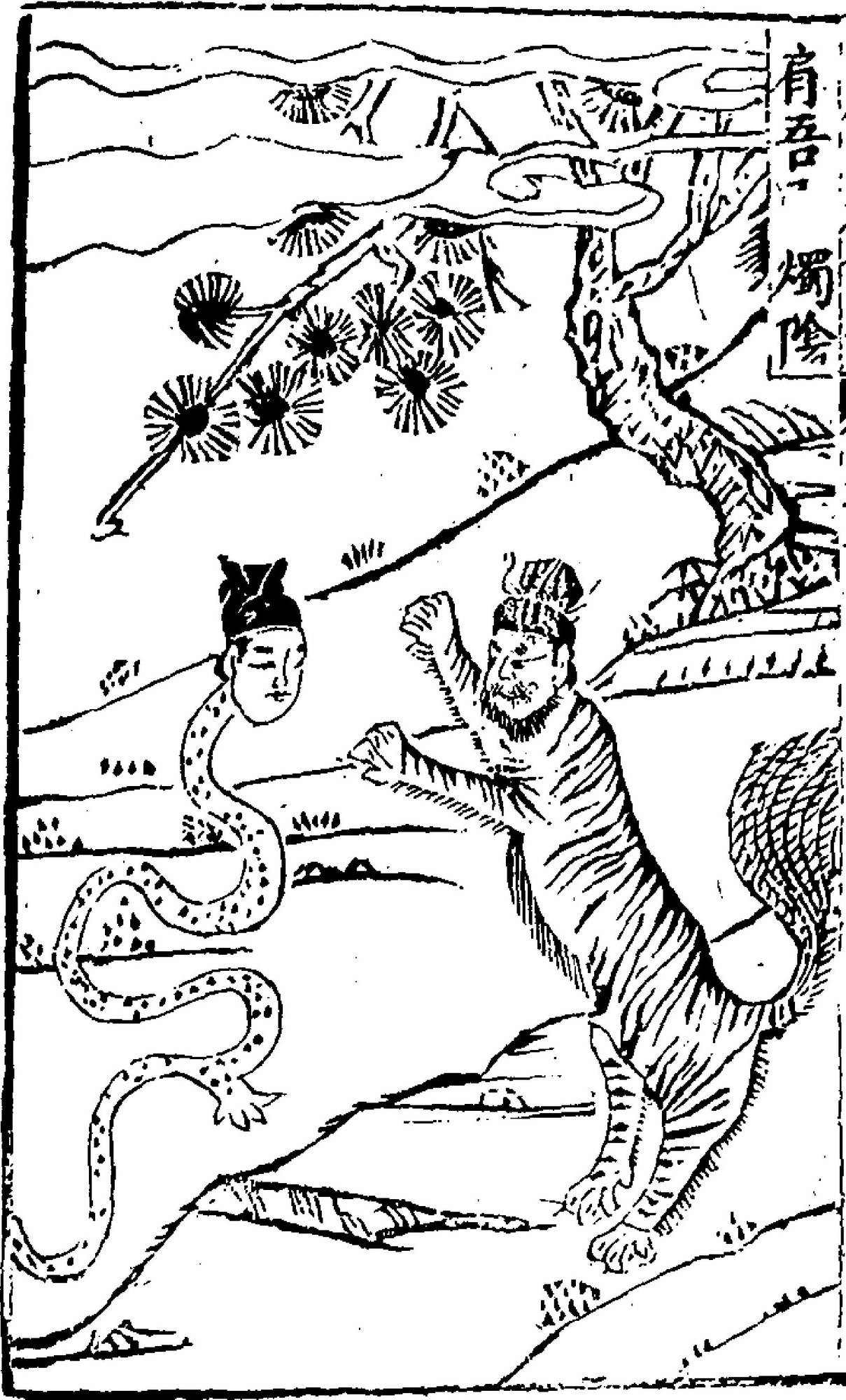
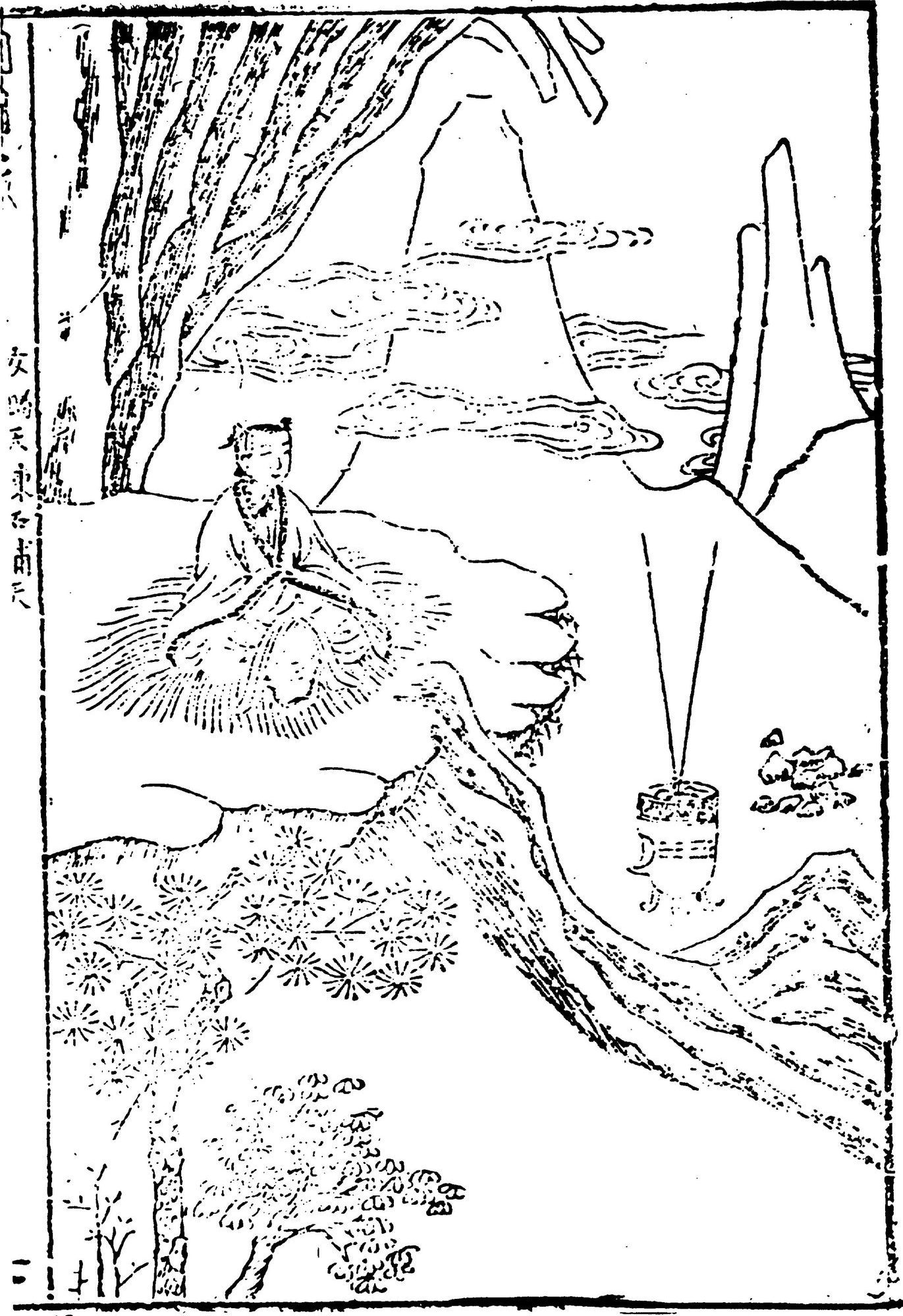
The sky had a hole in it. Not a metaphor and not a storm, but an actual wound in the blue vault overhead, the four great pillars that held Heaven up snapped off at the base so that the roof of the world sagged and gaped. The nine provinces had cracked apart. Heaven no longer covered everything; Earth no longer bore everything up. Through the tear came fire that blazed and would not be put out and water that spread in great sheets and would not drain away, and into a world with no order left to protect them came the beasts: ferocious animals eating the blameless people, birds of prey stooping to snatch the old and the weak out of the ruin. This is where the oldest telling drops us, in the middle of a cosmos coming undone, with no explanation offered for how it broke.
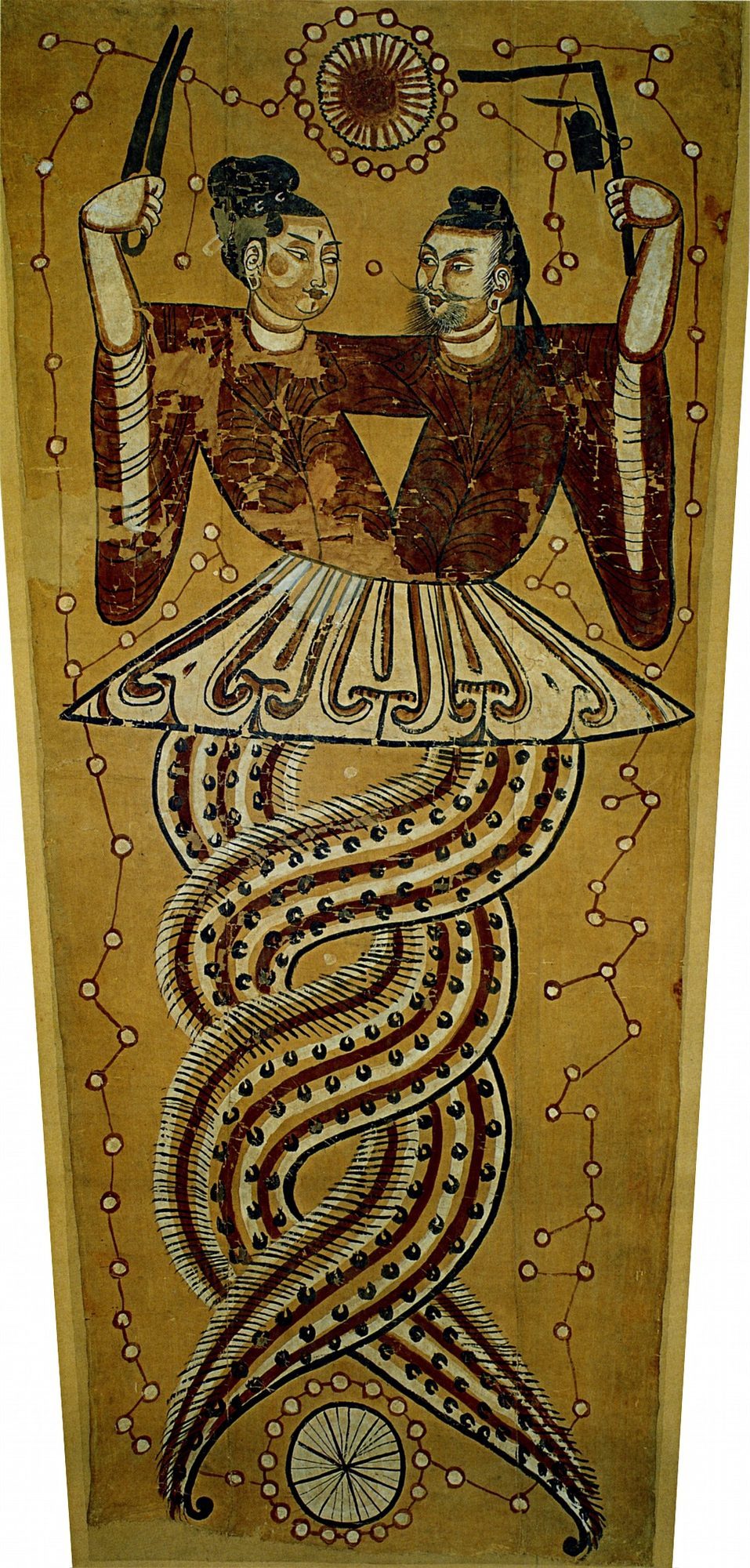
Into that wreckage walks a goddess with a human face and the lower body of a serpent, and what she does about it is the most famous repair in Chinese myth. She does not pray it away or command it whole. She goes to work with her hands.
Smelting the stones of five colours
Her first act is a forge. She gathers stones of five colours and smelts them, fuses them in fire, and with the molten result she patches the azure sky. The verb the text chooses is metallurgical, the word for working ore, so this is not a mason troweling over a gap; it is a smith pouring new material into a broken casting. The hole is in a deep blue-green vault, and she fills it with fired stone.
The early sources are careful, and worth being careful with in turn: they say only five-coloured stones.
They do not name the five colours, and they do not gloss them as the Five Phases. Later readers would supply a tidy roster of red and yellow and blue and black and white and match each to wood and fire and earth and metal and water, but that is commentary and popularisation laid over a text that simply says the stones were of five colours and leaves it there.
Legs cut for the four poles
Her second act is stranger and more grotesque. Somewhere there is a turtle vast enough that its legs can serve as the columns of the universe, and she kills it and cuts off its four legs and stands them upright as the four poles of the world, new pillars raised where the old ones had failed. In the earliest tellings this creature is not a named individual but simply the great turtle,
a giant of its kind; the habit of treating it as a character with a proper name comes much later. What matters in the old version is the plain, load-bearing horror of the image: the roof of Heaven is propped back into place on four severed limbs.
Reed ash against the flood
Her third act is a killing with a purpose. She slays the black dragon and by its death brings relief to Ji Province, the drowning heartland. Old commentary reads the black dragon as the very essence of water, which is why its death lets the flood recede, and why the province it had ruined can begin to dry.
And her fourth act is the humblest of the four, and the one that lingers longest. Against a cosmic flood, the surging waters,
she does not raise a divine dam. She burns reeds, piles up the ashes, and with that grey heap of cinders she stops the water. A goddess who can smelt the sky and butcher a world-turtle finishes the job with a mound of burnt marsh-grass.
Then the world comes back. The azure sky was patched; the four poles were set right; the surging waters drained away; Ji Province was made tranquil; the crafty vermin died off; and the blameless people kept their lives. Four wounds, four repairs, in exact order: seal the roof, prop the corners, kill the flood at its source, dam the last of the water.
The text that preserves all this, the Huainanzi, then steps back from the drama into a meditation on cosmic order, and closes by pairing Nüwa with Fuxi as sages who set the realm right not by laws and regulations but by the sheer force of their virtue, bequeathing that highest potency to every age that came after. It is the book’s own philosophical spin on her, the repairwoman recast as a model of rule; it is not a separate adventure.
What was she mending
There is a question the story invites and quietly declines to answer, and it is worth not flattening. What was she mending? The popular answer is vivid and satisfying: she was repairing the damage done by Gonggong, the wrathful god who, fighting Zhuanxu for the throne of Heaven, lost and in his rage smashed his head against Mount Buzhou, the Incomplete Mountain,
until Heaven’s pillar broke and the cords of Earth snapped, tilting the sky forever to the north-west so the sun and stars slide that way, and sinking the earth in the south-east so that China’s rivers all run toward the sea.
It is a magnificent aetiology, and it is genuinely ancient. But it lives in a different chapter of the same book, and that book never actually says Nüwa fixed Gonggong’s damage. The link between the broken pillar and the goddess who raised new ones is an inference, drawn by later readers stitching two passages into one story.
Another ancient text refuses the stitch outright. In the Liezi, the order is reversed and the meaning with it. There the lesson comes first: even Heaven and Earth are merely things, and things have deficiencies. So Nüwa smelted her five-coloured stones to mend an inborn flaw in the fabric of the world, a gap that was there from the beginning, and only afterward did Gonggong fight Zhuanxu and butt the mountain down.
In that telling she is not cleaning up after a brawl. She is correcting a defect built into creation itself, patching a sky that was never quite whole. Both readings are old, both are sourced, and they disagree about the deepest thing in the story: whether the broken heavens were an accident of divine violence or a congenital wound in the nature of things. The retelling that flattens them into one loses exactly the tension that makes the myth worth keeping.
The forge and the dam
Either way, the shape of her act is the same, and it is a rare shape for a creation-adjacent myth. Nüwa does not make the world; she fixes it. Her power is not the storm or the flood but the forge and the dam, the craftswoman’s toolkit turned on a cosmos in pieces. And the materials stay stubbornly humble to the end, smelted stone, turtle-bone, a slain dragon, and a heap of ash, as if the point of the story were that even Heaven can break, and that mending it is patient, physical, unglamorous work.
In remote antiquity the four pillars were broken, the nine provinces split apart. Heaven did not cover everything; Earth did not bear everything up. So Nüwa smelted five-coloured stones to patch the azure sky, and cut off the legs of the great turtle to set up the four poles. (Huainanzi, “Lanming xun”; author’s rendering from the Chinese)
- Huainanzi (淮南子), Lanming xun (覽冥訓), c. 139 BCE: the sky-mending scene in four acts — smelting five-coloured stones to patch the azure sky (煉五色石以補蒼天), cutting the great turtle’s legs to raise the four poles (斷鼇足以立四極), slaying the black dragon to relieve Ji Province (殺黑龍以濟冀州), and damming the surging waters with reed-ash (積蘆灰以止淫水); the broken-world catastrophe (fire, flood, and beasts) that precedes it; the restored cosmos (蒼天補,四極正,淫水涸,冀州平); and the closing pairing of Fuxi and Nüwa as sage-rulers who ruled by virtue rather than law (不設法度而以至德遺於後世). Chinese read verbatim. Standard EnglishMajor, Queen, Meyer & Roth, The Huainanzi (Columbia UP, 2010), ch. 6. The five colours are unnamed in the text; the Five-Phases (wuxing) reading is later commentary, not primary.
- Huainanzi (淮南子), Tianwen xun (天文訓), c. 139 BCE: the disaster’s cause, in a separate chapter — Gonggong (共工) and Zhuanxu (顓頊) fight to become the thearch, Gonggong butts Mount Buzhou (不周之山), Heaven’s pillar breaks and Earth’s cords snap (天柱折,地維絕), Heaven tilts to the north-west and Earth sinks in the south-east (天傾西北…地不滿東南), the classic aetiology for the wheeling of the heavens and the south-eastward run of the rivers. The Huainanzi does not itself say Nüwa repaired this damage; the causal link is a later inference. EnglishMajor & al. 2010, ch. 3.
- Liezi (列子), Tangwen pian (湯問篇): the parallel repair, framing Heaven’s flaw as inherent —
things have deficiencies
(物有不足), so Nüwa mended the gap with five-coloured stones (補其闕) and raised the four poles on the ao-turtle’s legs — and placing the repair before the Gonggong episode (其後共工氏與顓頊爭爲帝). So in the Liezi she fixes a built-in defect, and theshe patched what Gonggong broke
sequence is a later harmonisation of the two Huainanzi chapters. Chinese read verbatim. EnglishLionel Giles, Taoist Teachings from the Book of Lieh-Tzü (1912), pp. 78–79 (Giles wording not verbatim-checked). - Shanhaijing (山海經), Dahuang xi jing (大荒西經): the ten spirits
Nüwa’s Intestines
(女媧之腸) in the wilderness of Liguang — the sole Shanhaijing mention of Nüwa, and background on her mythic body, not the sky-mending. EnglishAnne Birrell, The Classic of Mountains and Seas (Penguin, 1999).