In the oldest account of the world’s second age, a man sits with a length of raw wood and two tools in his mind. One piece he hews, cutting it down into a ploughshare; the other he bends, curving it into a handle. Two different actions, two named parts, and out of them the first plough. This is how the Book of Changes introduces Shennong, the Divine Farmer: not descending on a cloud but working wood by hand, and then teaching the benefit of ploughing and weeding to everyone under heaven. When he had fed them, he did one thing more. He set up markets at midday, and the people and goods of all under heaven converged there, exchanged what they had and withdrew again, each of them going home with what he needed. Farming and the marketplace, the field and the fair exchange, are the two gifts the earliest text lays at his feet.
The name it uses is simply Shennong, the Spirit or Divine Farmer, and the title is the whole point of him. A later commentator put it plainly: because he was the first to teach ploughing, he was called the Divine Farmer. He is the second link in a relay of sovereigns. Fuxi came first and read the cosmos into the eight trigrams; when Fuxi passed, the commentary says, Shennong arose and turned that ordered world to the soil. Civilisation is handed down the line like a torch, and Shennong is the one who plants it.
His body was the first field guide
But the plough is only half of him, and the other half is far stranger. For that we leave the Book of Changes for the Huainanzi, the great compendium assembled under Liu An in the second century BCE, and the tone shifts from invention to something close to martyrdom. In antiquity, it says, people ate raw plants and drank raw water, and they sickened and were poisoned, and no one could tell nourishment from harm.
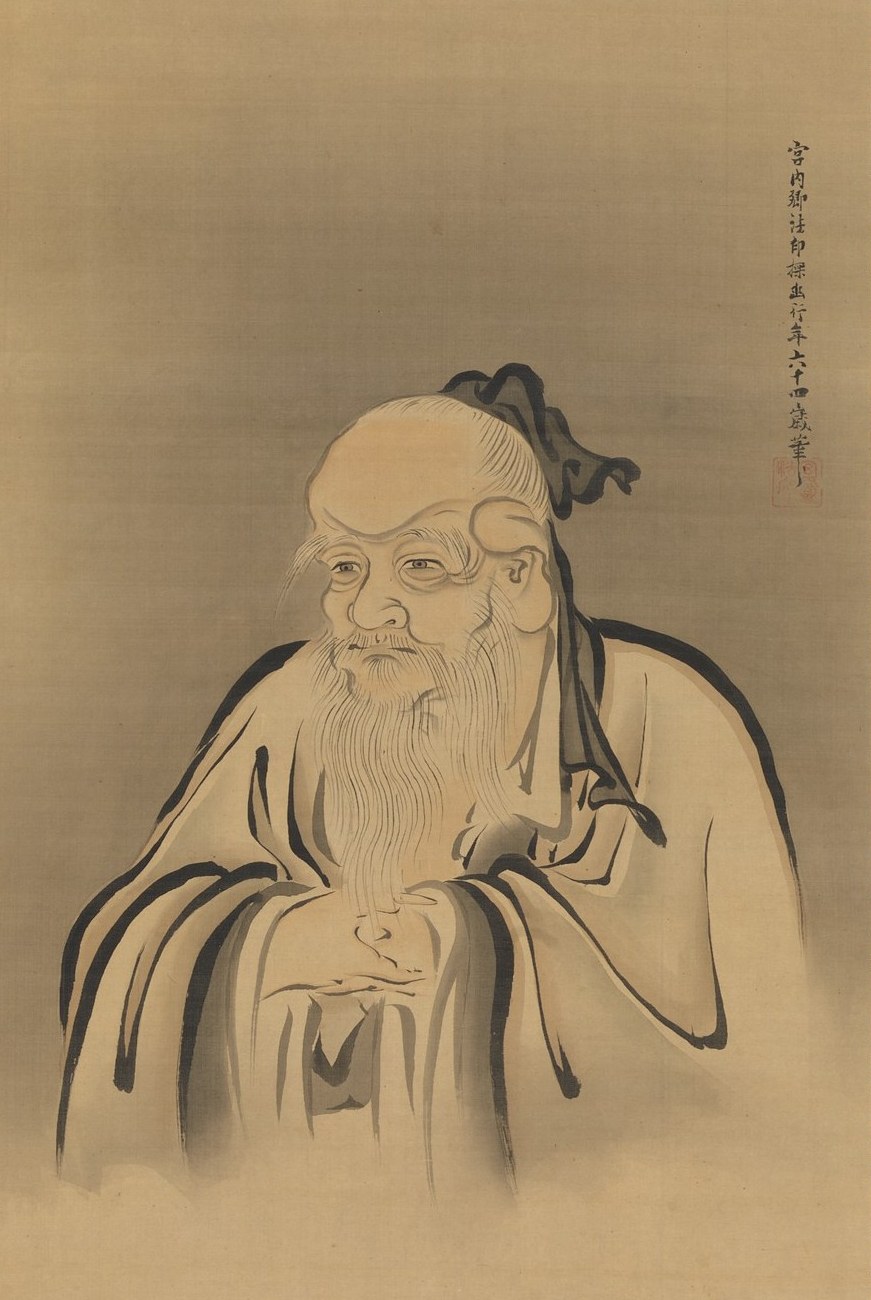
So Shennong taught them first to sow the five grains, and he read the land itself the way a farmer must: which ground was dry and which wet, which rich and which poor, which high and which low. Then he did the thing that would define him forever. He tasted. He put the hundred plants into his own mouth to learn their flavours, drank at the springs to test whether their waters ran sweet or bitter, and by that private catalogue of pleasure and pain he let the people know what to shun and what to seek. His body was the first field guide.
Seventy poisons met in one day
The cost of that knowledge is given in a single, precise, unforgettable line. In one day, the Huainanzi says, he met seventy poisons. The verb matters, and it is worth being exact about it, because the popular version has run far ahead of the text. He met them, encountered them, ran into seventy toxins between one sunrise and the next. The passage does not say he was poisoned seventy times and cured himself seventy times; it does not mention tea, or a jade window in his belly through which he watched the herbs at war with his organs, or a final fatal leaf that killed him.
Those are the gifts of much later ages, of Tang tea-lore and modern retelling, and they are not in the classical line. What the old text gives is stranger and better: a figure who walked, deliberately, into seventy poisons in a day because that was the only way to chart the difference between food and death, and then walked into the next day and did it again.
Yao grew thin, Shennong grew gaunt
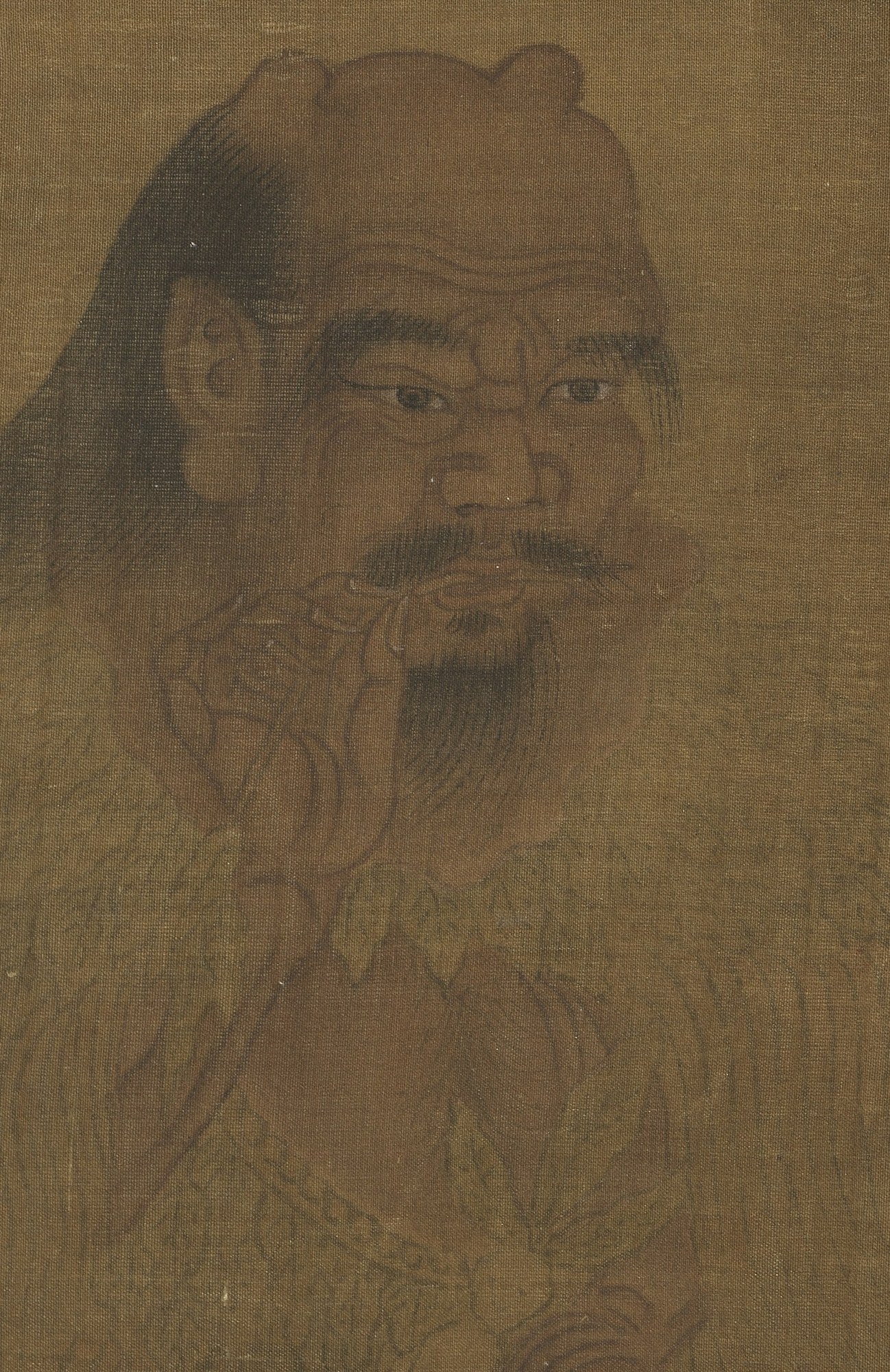
The labour ruined him, and the Huainanzi does not spare us the image. It lists him among the sages worn down by their service to the world. Yao grew thin, it says, Shun grew dark, Yu grew callused, and Shennong grew gaunt. Not a triumphant god crowned with harvest but a haggard one, hollowed out by the work of tasting the world so that others could eat it safely. There is a companion image in the later biography, and it belongs to the other method he is remembered by.
Beside the tasting there was the whip: a russet lash, ochre-red, that he used to strike the plants and trees, and by the striking to read each herb’s nature and force it to give up its secret. The gaunt taster and the man with the reddish whip walking the hills, lashing the grasses to make them speak, are the same figure seen from two angles, and both are answers to the same question. How does a world learn which green thing heals and which one kills? Someone had to find out first, in his own flesh.
A weld made in the Han period
Here the story doubles, and honesty requires saying so. The farmer of the plough and the taster of herbs was, in the oldest layers, not obviously the same being as the Flame Emperor. In the Book of Changes the inventor is named Shennong and never called Yandi. In the Classic of Mountains and Seas, the oldest geography of China, a divine ancestor named Yandi, the Flame Emperor, appears as a patriarch and a god of fire and the south, and the name Shennong never appears beside him at all.
They are two figures with two names attached to two different bodies of story, and they were welded into one only in the Han period and after. The text that most clearly performs the weld is Sima Zhen’s supplement to the Records of the Grand Historian, written in the eighth century, which opens by calling him the Flame Emperor Shennong of the Jiang clan and treats plough and fire and medicine as one man’s work. It is a magnificent synthesis, and it is the version most people mean today when they name him. It is also late, and it should not be read back onto the archaic layer as though the ancients had always meant one god.
Human body, head of an ox
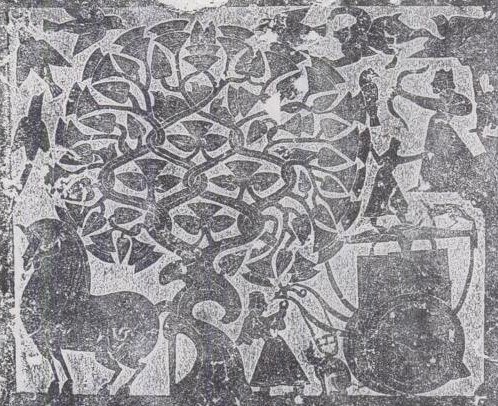
From that merged Yandi strand comes his other, wilder iconography, and it should be kept where it belongs. His mother Nüdeng, the biography says, was moved by a divine dragon and bore a son with a human body and the head of an ox. He ruled by the power of Fire, and so was titled the Flame Emperor, and named his very offices after fire. This is the ox-headed god of the south, not the plain farmer of the plough, and the two images sit uneasily together precisely because they began apart.
The same tradition gives him a reign of a hundred and twenty years, eight generations of successors across five centuries, and a grave at Changsha, and it cannot quite keep its own genealogy straight: Sima Zhen himself pauses to wonder aloud how Yandi and the Yellow Emperor could both be sons of the same mother across so many intervening years. Even the number of the Three Sovereigns he heads is disputed in the very text that lists him; some make the third sovereign Suiren, some Zhurong, some the creator-goddess Nüwa, and the source records the quarrel rather than settling it.
Jingwei will not forgive the sea
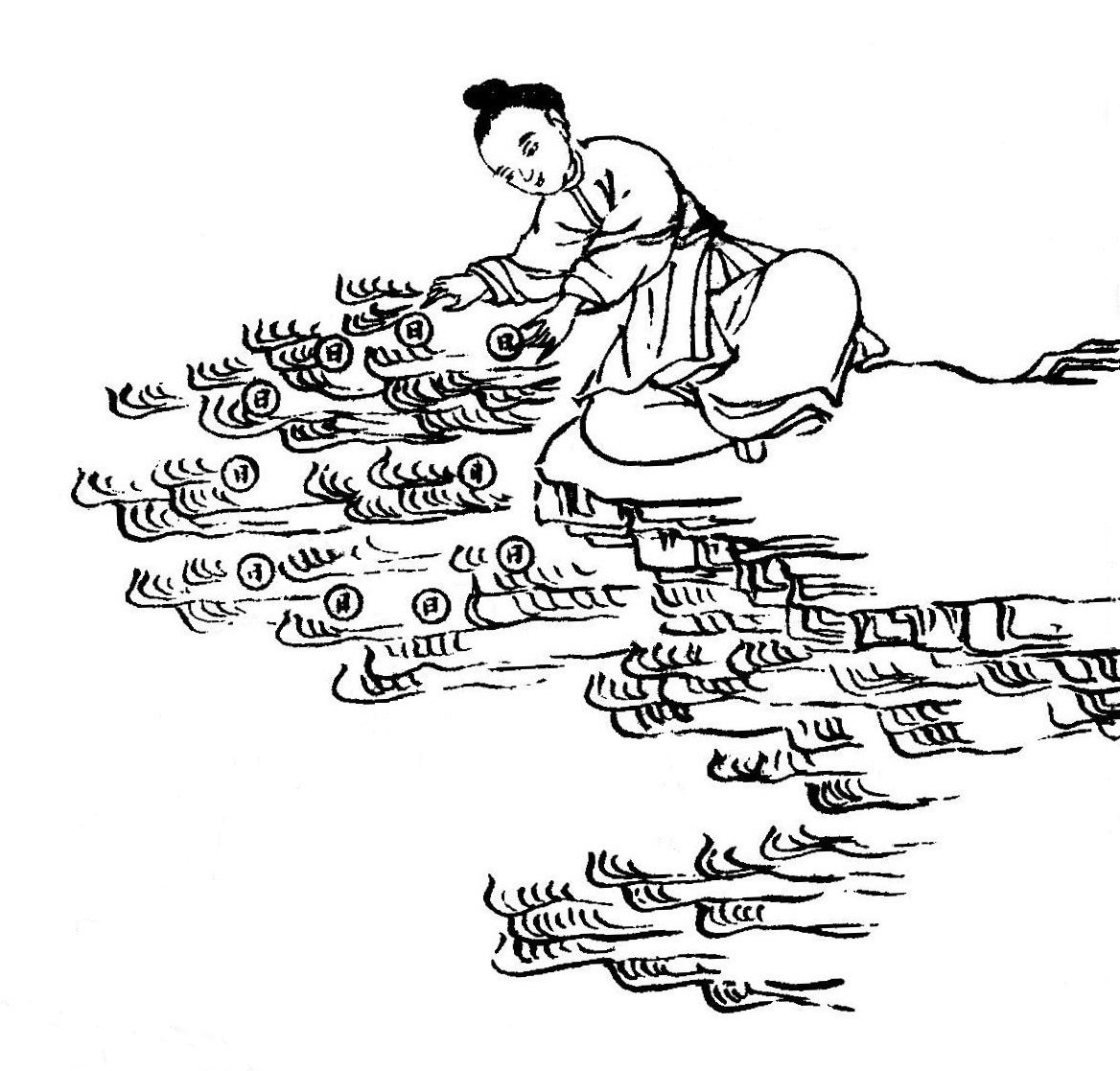
One image from the Flame Emperor’s line is too beautiful to leave out, and it belongs to Yandi’s house, not the plough. Yandi had a youngest daughter, Nüwa, who must not be confused with the creator-goddess of the almost identical name. She went to play in the Eastern Sea and drowned there, and out of that death rose a bird: crow-shaped, with a patterned head, a white beak and red feet, called Jingwei. And Jingwei will not forgive the sea.
She flies to the western mountains and carries back wood and stones in her beak, one small load at a time, and drops them into the Eastern Sea, and she does this without end, meaning to fill the whole ocean that took her. It is a myth of grief turned into stubborn, hopeless, unbreakable labour, and it attaches to the same divine line as the gaunt god who tasted seventy poisons in a day. Father and daughter are bound by the same refusal to stop.
That is the truest thing the old texts leave us about Shennong. Strip away the tea and the jade belly and the death by heartbreak-grass, the accretions of later love, and what remains is harder and finer than any of them. A figure who hewed the first plough and opened the first fair market, and who then made his own body the instrument by which a whole people learned to eat, tasting the hundred plants until he was gaunt with it, meeting seventy poisons in a day, so that after him no one would have to.
In antiquity the people fed on plants and drank raw water, gathered the fruits of trees and ate the flesh of shellfish, and were forever falling ill and taking hurt from poisons. So Shennong first taught the people to sow and reap the five grains, judging the land dry or wet, rich or poor, high or low; he tasted the flavours of the hundred plants and the sweet-or-bitter of the springs, and made the people know what to shun and what to seek. At that time, in a single day he met seventy poisons. (Huainanzi, “Xiuwu xun”; author’s rendering from the Chinese)
- Yijing (易經), Xici II / Great Commentary Part 2 (繫辭下): the earliest witness to Shennong the inventor. After Fuxi (包犧氏) passes, Shennong (神農氏) arises, hews wood into a ploughshare and bends wood into a plough-handle (斲木為耜,揉木為耒), teaches the benefit of ploughing and weeding to all under heaven, and sets up markets at midday where the people exchange and withdraw, each obtaining what he needs (日中為市…交易而退,各得其所). The passage names 神農氏 only; the title 炎帝 (Yandi) is absent. Chinese read verbatim (zh.wikisource.org/wiki/易傳/繫辭下). For a citable English sentence, quote a named translation and re-verify; the wording above is the author’s own literal rendering from the Chinese.
- Huainanzi (淮南子), Xiuwu xun (脩務訓), compiled under Liu An (d. 122 BCE): the herb-tasting culture-hero passage. In antiquity people ate raw plants and drank raw water, gathered the fruits of trees and ate the flesh of shellfish, and fell ill and took hurt from poisons (古者,民茹草飲水,采樹木之實,食蠃蠬之肉。時多疾病毒傷之害); so Shennong first taught the sowing of the five grains, judged the land by dry and wet, rich and poor, high and low, and tasted the flavours of the hundred plants and the sweet-or-bitter of the springs so the people knew what to shun and what to seek (嘗百草之滋味,水泉之甘苦,令民知所辟就); in a single day he met seventy poisons (一日而遇七十毒); and the gaunt god, worn haggard by his labour (神農憔悴), listed beside Yao grown thin, Shun grown dark, Yu grown callused. Note the verb 遇 (
met/encountered
)the text does not say he was cured seventy times, and the tea-origin and jade-belly stories are later accretions absent here. Chinese read verbatim, re-verified against zh.wikisource.org/wiki/淮南子/脩務訓 (the opening clause 采樹木之實,食蠃蠬之肉 confirmed on this pass). - Shanhaijing (山海經), Beishan jing (北山經) and Hainei jing (海內經), Warring States–Han strata: the Yandi (炎帝) strand. His youngest daughter Nüwa (女娃, distinct from the creator-goddess 女媧) drowns in the Eastern Sea and becomes the bird Jingwei, crow-shaped with a patterned head, white beak and red feet (其狀如烏,文首、白喙、赤足), which forever carries western wood and stone to fill the sea (Beishan jing); and Yandi’s descent line down to Zhurong and Gonggong (Hainei jing). The name 神農 does NOT appear in these chapters, which is why they anchor the Flame-Emperor material and not the Divine-Farmer material. Chinese read verbatim (zh.wikisource.org/wiki/山海經/北山經; /海內經).
- Sima Zhen (司馬貞), Bu Shiji Sanhuang Benji (補史記三皇本紀), 8th c. CE supplement to the Shiji: the composite biography that fuses Yandi and Shennong into one god-emperor. The Flame Emperor Shennong (炎帝神農氏) of the Jiang (姜) clan, his mother Nüdeng moved by a divine dragon to bear a son with a human body and an ox’s head (人身牛首); ruling by the power of Fire, hence Flame Emperor (火德王,故曰炎帝); hewing the plough, wielding a russet whip to lash the plants (以赭鞭鞭草木), first tasting the hundred plants so that medicine came into being (始嘗百草,始有醫藥), making the five-stringed zither; titled the Divine Farmer because he first taught ploughing (始教耕,故號神農氏); reigning 120 years, buried at Changsha; and recording the disagreement over which three are the Three Sovereigns. LATE and syntheticauthoritative for the merged tradition, not a witness to the archaic layer. Chinese read verbatim (zh.wikisource.org/wiki/史記, Bu Shiji Sanhuang Benji, pageid 146623).
- Shennong Bencao Jing (神農本草經), the Divine Farmer’s Materia Medica, compiled c. Han, attributed to Shennong (not authored by him): the pharmacopoeia that canonised Shennong as patron of medicine, the institutional afterlife of the
tasted the hundred herbs
myth. Cited as the tradition’s namesake text, not as an ancient eyewitness to the god; no specific herb or remedy is attributed to it here without checking.