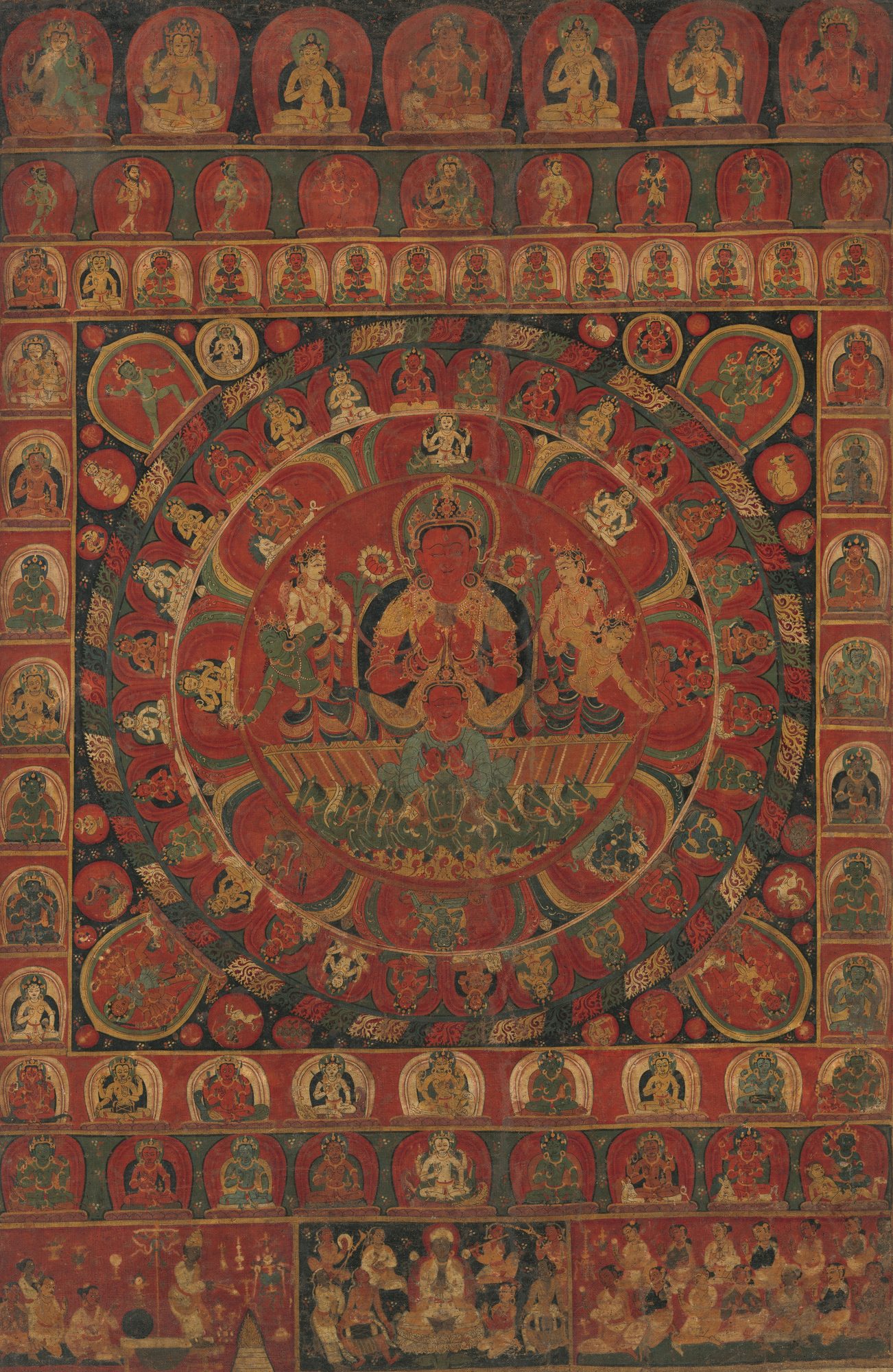
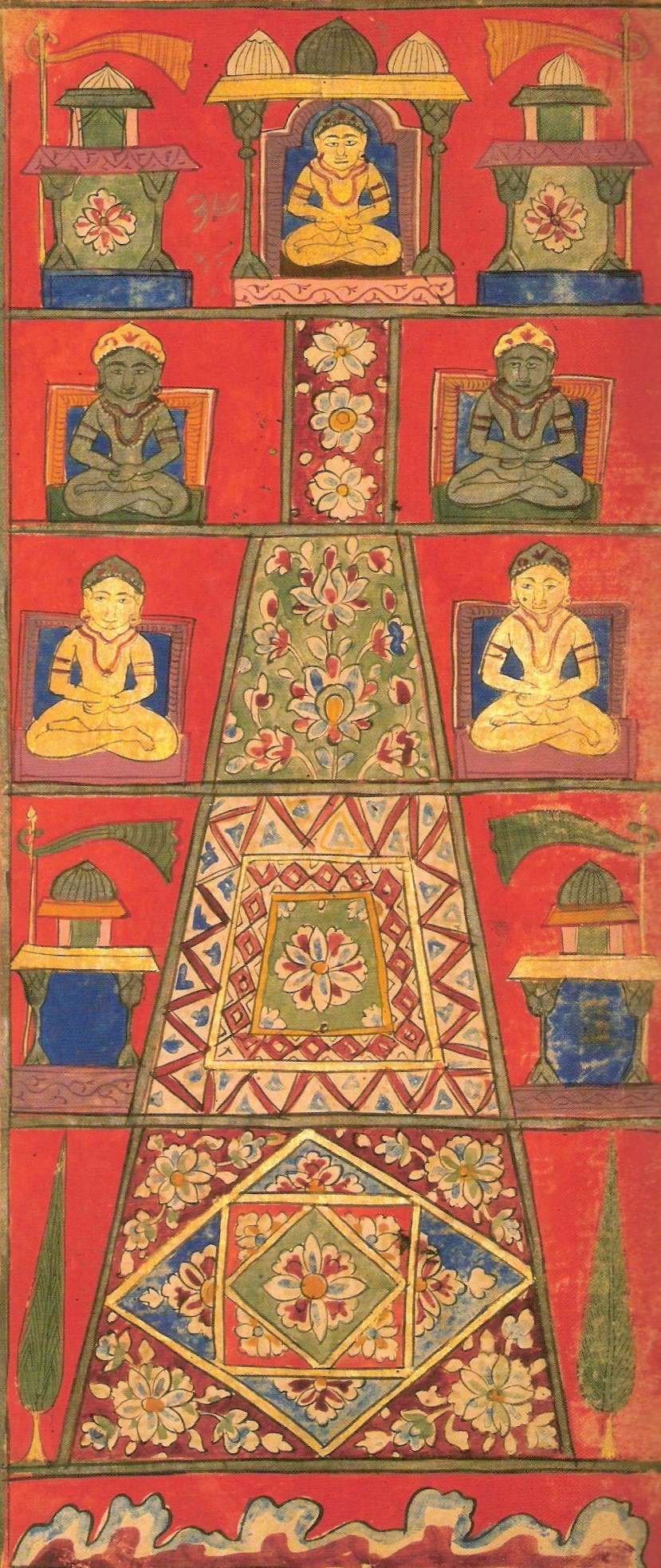
Stand anywhere on the earth the old cosmographers describe and you are standing on a lotus. Not on a ball hanging in space, but on a circular island shaped like a lotus-leaf, ringed by other islands and seas that widen outward like the petals of a bloom. This innermost island is Jambu-dvīpaThe innermost, circular island-continent of the world, shaped like a lotus-leaf, with Mount Meru standing at its navel; named for the giant Jambu (rose-apple) tree., the Isle of the Rose-Apple.
Where the seed-cup of a lotus would sit, a mountain rises out of the ground and does not stop. It is made of solid gold. It outruns any distance a body could walk, and it holds the sky in place. Everything the eye can see wheeling overhead, the sun, the moon, the fixed stars, is turning around its peak.
This is Mount Meru, and the three great texts that describe it do not treat it as a mountain a traveller might reach. They treat it as the still pin at the centre of the turning world. This account draws on three Sanskrit witnesses a millennium apart — the Mahābhārata’s Bhuvana-kośa (Bhīṣma Parva V–VII, oldest), Viṣṇu Purāṇa 2.2 (c. 4th–5th c. CE, Wilson) and Bhāgavata Purāṇa 5.16 (c. 9th–10th c. CE, Tagare).
A mountain of gold with no smoke in its fire
The first thing every source insists on is the gold. The Mahābhārata, reporting the cosmos through the voice of the charioteer Sañjaya, calls Meru a globular mountain made of gold, effulgent as the morning sun and shining like fire without smoke. The Bhāgavata Purāṇa names it flatly the all-gold mountain, the king of all mountains. The Viṣṇu Purāṇa simply calls it the golden mountain and moves on, as though the fact needed no argument.
The gold is not decoration. It is what a thing at the centre of the world is made of, the incorruptible metal that never tarnishes, and the texts pile the image higher until it becomes strange. On Meru even the birds are gold, so uniformly golden, the epic says, that a bird called Sumukha resolves to leave the mountain altogether, for there is no longer any way to tell a good bird from a bad one when every feather is the same precious sheen.
The dimensions match the metal. All three texts agree that Meru is eighty-four thousand yojanas high, and a yojanaAn ancient Indian unit of long distance, glossed by translators at very roughly eight miles, though its exact length is not fixed across the texts. is a long unit, reckoned by translators at very roughly eight miles, which puts the mountain’s height into the hundreds of thousands of miles. This is a cosmic pillar wearing the shape of a peak.
The Viṣṇu Purāṇa gives it the profile of an inverted cone, broader at the summit than at the root, thirty-two thousand yojanas across the top and only sixteen thousand at the base, so that it flares upward like the seed-cup of a lotus opening. That is the governing picture of these two texts: Jambu-dvīpa is the lotus of the earth, and Meru is its pericarp, the swelling central cup that holds the seeds. The Bhāgavata fixes the mountain more precisely still, at the navel of IlāvṛtaThe central region of Jambu-dvīpa, in whose middle Meru rises, extending nine thousand yojanas out from each face of the mountain., the central region of the island, which it says runs nine thousand yojanas out from each of Meru’s four faces.
The one shape the sources will not agree on
It is worth pausing here, because the lotus-cup shape is not the settled truth it looks like. Wilson, translating the Viṣṇu Purāṇa, gathered up what the other Purāṇas say about Meru’s form, and the survey is a small chaos. One text makes it bell-shaped like the flower of the thorn-apple. Others make it four-sided with four coloured faces, or hundred-angled, or thousand-angled, or eight-cornered, or saucer-shaped, or twisted like a coil of braided hair.
Even the colours of its four faces are disputed: white, yellow, black and red in one tradition, ruby and lotus-hue and gold and coral in another. There is no single canonical shape for the mountain at the centre of everything. The elegant inverted cone belongs specifically to the Viṣṇu and Bhāgavata line; it is one reading among many, and the texts themselves know it.
The luminaries that cannot stop circling
The reason Meru matters, beyond its gold, is what happens in the air around its summit. The Mahābhārata states it in a single line that is the direct warrant for the whole idea: the sun always circumambulates Meru, and so does the moon with its train of constellations, and so does the Wind-god. The heavenly bodies do not cross the sky from one horizon to the other and vanish.
They orbit the golden peak like a lamp carried around a pillar, and their circling is what produces the alternation the Bhāgavata Purāṇa frames as the whole point of its geography: this is the account, it says, of the extent of the earth on which the sun shines and where the moon with its hosts of stars is visible. Meru is the axle. The visible heavens are the wheel.
One caution is in order here. The neat machinery by which Meru’s own shadow swings around to make day and night, the sun passing behind the mountain and leaving one quarter of the world in darkness, is developed in later astronomical passages, not in these three chapters. What these texts give is the plain and older claim: the luminaries turn around the mountain. The clockwork that explains exactly how the turning yields night was worked out afterward, and should not be read back into the epic’s single circling line.
The city on the summit and the forests below
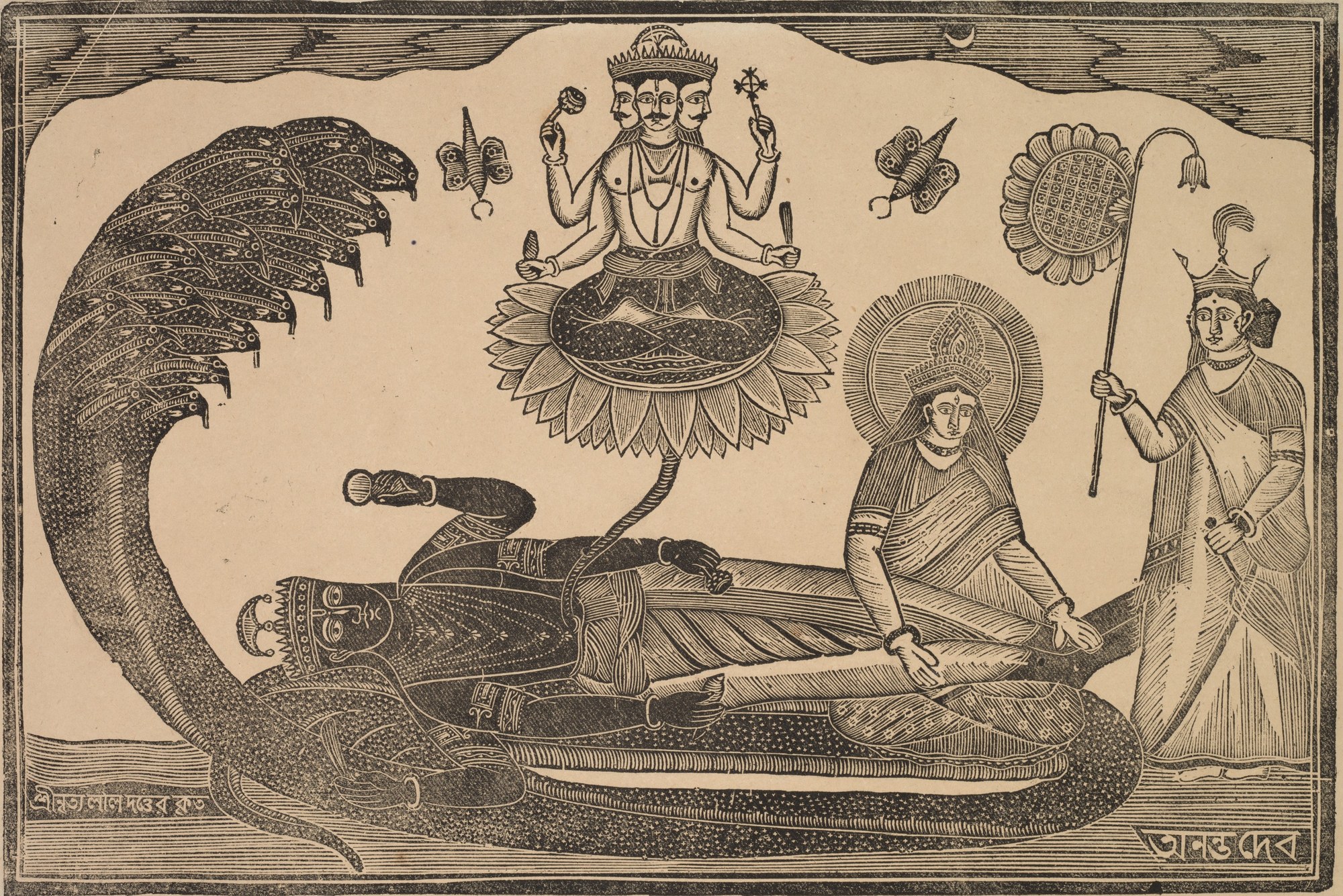
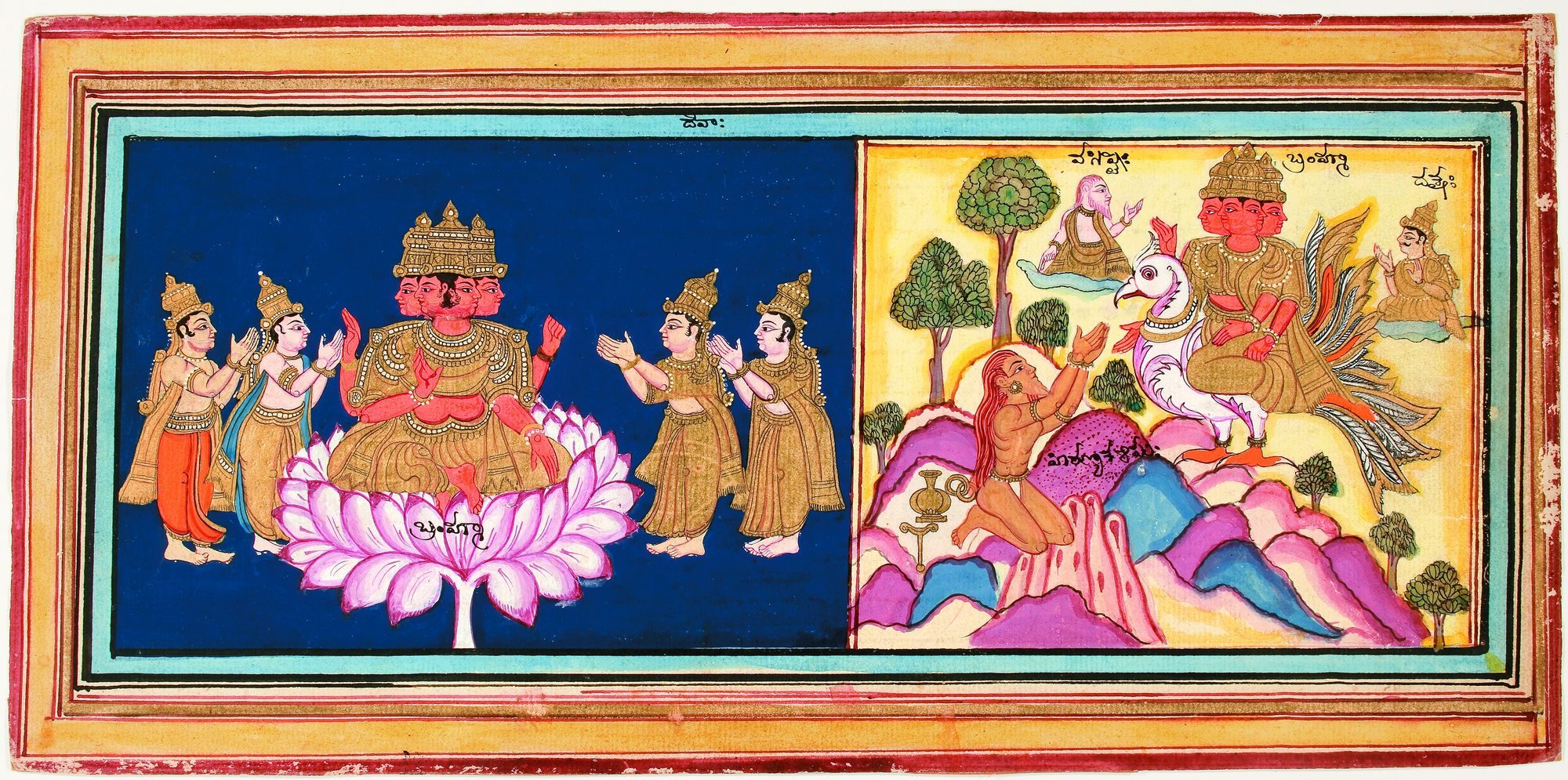
The gold mountain is inhabited. On its flat summit stands the capital of Brahmā, the creator, a golden city that the Bhāgavata names Śāta-kumbhī and lays out foursquare, and around it, in the eight directions of the sky, stand the cities of the world-guardians: Indra’s Amarāvatī to the east, Yama’s hall of restraint to the south, Varuṇa’s city to the west, Kubera’s to the north, each guardian holding his quarter of heaven from his own walled town on the peak.
Here the gods themselves come to worship. Brahmā and Rudra and Indra perform their sacrifices on the summit; the celestial singers Tumburu and Nārada raise their hymns; the seven great seers arrive on every new-moon and full-moon day. Meru is not only the centre of the world’s geometry. It is the centre of its worship, the one place where the gods gather and the guardians of the directions keep their courts.
Below the summit the mountain is buttressed on its four sides by four lesser peaks, each bearing a colossal tree and a lake, and the descriptions turn frankly sensory. The giant Jambu tree that gives the island its name stands eleven hundred yojanas high and touches heaven, and its fruit is enormous: the Viṣṇu Purāṇa makes each apple as large as an elephant, while the epic reckons it two thousand five hundred cubits round. In the epic the ripe fruit falls with a loud noise and pours out a silvery juice that becomes a river circling the mountain; the clay of its banks transmutes into a brilliant gold called JāmbūnadaThe brilliant gold the gods wear, transmuted from the clay of the silvery-juice river banks., the metal the gods wear.
The Bhāgavata multiplies the flavours: a river of deep-red mango juice so fragrant that the maidens who drink it perfume the breeze for ten yojanas around, a five-streamed current of honey, a wish-granting banyan that pours out milk and curds and honey and food and clothing without end. On the northern flank, in a forest of Karṇikāra flowers that bloom in every season, Śiva sports with Umā, three-eyed and blazing like three risen suns, a garland of the golden flowers hanging to his feet.
Sediment, not corroboration, in the golden mountain
It is tempting to read the three texts as one voice describing one mountain, and their agreement on the load-bearing points, the gold, the eighty-four-thousand-yojana height, the luminaries circling, the lotus-cup image, is genuine and striking. But they are not contemporaries, and the reader should hold the gap in mind.
The Mahābhārata’s cosmography belongs to the older epic stratum, whose core reaches back centuries before the common era. The Viṣṇu Purāṇa comes several centuries later, around the fourth or fifth century of the common era. The Bhāgavata Purāṇa is later still, usually placed in the ninth or tenth century, so that its picture stands perhaps five hundred years after the Viṣṇu Purāṇa and possibly a thousand or more after the epic core.
That distance shows exactly where you would expect it. Where the texts agree, they agree because the later ones inherited the image from the earlier; the shared picture is the sediment of a long transmission, not three independent confirmations of one fact. Where they differ, the differences track the chronology. The Viṣṇu Purāṇa names Meru’s four buttress-mountains Mandara, Gandhamādana, Vipula and Supārśva; the later Bhāgavata renames them Mandāra, Merumandāra, Supārśva and Kumuda.
The older text gives the four trees as kadamba, jambu, fig and banyan; the younger one swaps the fig for a mango. The two even disagree, openly, on the size of Brahmā’s city on the summit, and the Bhāgavata’s own commentators note the conflict and cannot resolve it. The golden mountain held still at the centre of the world, but the descriptions of it drifted across a thousand years, and the drift is legible in the names.
And the mountain resists one modern temptation completely. It has been identified, by orientalists and rationalisers, with real ranges, with Kailāsa, with the Pamirs, with the Himalaya. The texts do not permit it. In these very chapters Kailāsa appears as a separate, lesser range standing near Meru, not as Meru itself, and a peak eighty-four thousand yojanas high is not a mountain anyone was ever meant to climb. Meru is the axis of a mythic cosmos, the golden pin at the centre of a lotus-shaped world, and it was built to hold up the sky, not to be found on a map.
That foremost of luminaries, the sun, always circumambulates Meru, as also the moon with his attendant constellation, and the Wind-god too. (Mahābhārata, Bhīṣma Parva, Section VI, tr. Kisari Mohan Ganguli)
- Viṣṇu Purāṇa 2.2 (“Description of the earthJambu-dvīpa; Mount Meru”), trans. H. H. Wilson (1840): the golden mountain
in the centre of this continent,
Jambu-dvīpa; Meru’s dimensions (84,000 high, 16,000 deep below the surface, 32,000 across the summit, 16,000 at the base);so that this mountain is like the seed-cup of the lotus of the earth
; the four buttress-mountains (Mandara, Gandhamādana, Vipula, Supārśva), four trees (kadamba, jambu, fig, banyan) and four lakes (Aruṇoda, Mahābhadra, Śītoda, Māṇasa);the vast city of Brahmā, extending fourteen thousand leagues
; the Ganges descending on the summit and dividing into the four rivers Śītā, Alakanandā, Cakṣu and Bhadrā; the apples of the jambu treeas large as elephants.
Wilson’s footnote 2 supplies the full comparative survey of Meru’s disputed shape (bell, four-sided, hundred- and thousand-angled, saucer, braided-coil) and the coloured faces, gathered from the Vāyu, Matsya, Liṅga, Padma and other Purāṇas — cited here as Wilson reports them, not consulted directly. Generally dated c. 4th–5th century CE. - Bhāgavata Purāṇa 5.16 (“Mythological Geographythe Terrestrial Globe”), trans. G. V. Tagare (Motilal Banarsidass): Jambu-dvīpa
one lakh of yojanas
across;the all-gold mount Meru, the king of all mountains,
84,000 yojanas high, formingthe pericarp of the lotus in the form of the earth,
at the navel of the central region Ilāvṛta; the four buttress-mountains Mandāra, Merumandāra, Supārśva and Kumuda; the four trees (mango, jambu, kadamba, banyan) and the lakes of milk, honey, sugar-cane juice and fresh water; the scented river Aruṇodā whose fragrance carries ten yojanas; Śāta-kumbhī, the square golden capital, ringed by the eight cities of the world-guardians (named in Tagare’s footnote 4); Meru shininglike sacrificial fire surrounded by blades of Kuśa grass.
Usually dated c. 9th–10th century CE, roughly half a millennium later than the Viṣṇu Purāṇa; its divergent nomenclature is treated by Wilson as a later refinement. - Mahābhārata, Bhīṣma Parva, Jambū-khaṇḍa-nirmāṇa Parva, Sections V–VII (the Bhuvana-kośa), trans. Kisari Mohan Ganguli / P. C. Roy (archive.org id
mahabharataofkri05roypuoft)Sañjaya’s cosmographic report to Dhṛtarāṣṭra; Jambu-dvīpa also called Sudarśana, the disc mirrored in the moon as a fig tree and a hare;a globular mountain called Meru made of gold… Effulgent as the morning sun, it is like fire without smoke,
84,000 yojanas high; the sun, moon and Wind-god circumambulating it; the uniformly golden birds and the bird Sumukha who leaves for lack of any way to tell good birds from bad; Kubera’s quarter-share of Meru’s jewels, of which he gives a sixteenth to men; the jambu tree (1,100 yojanas, fruit 2,500 cubits round) and its silvery-juice river; Jāmbūnada gold; the gods’ assembly and sacrifices on the summit; and Śiva with Umā in the ever-flowering Karṇikāra forest on the northern side. Its epic core belongs to the oldest stratum here, older than either Purāṇa by centuries. (The printed text’s anomalous reading of Meru’s depth as 84 yojanas is treated as a corruption against the Purāṇic 16,000, and no depth figure is drawn from the epic above.)