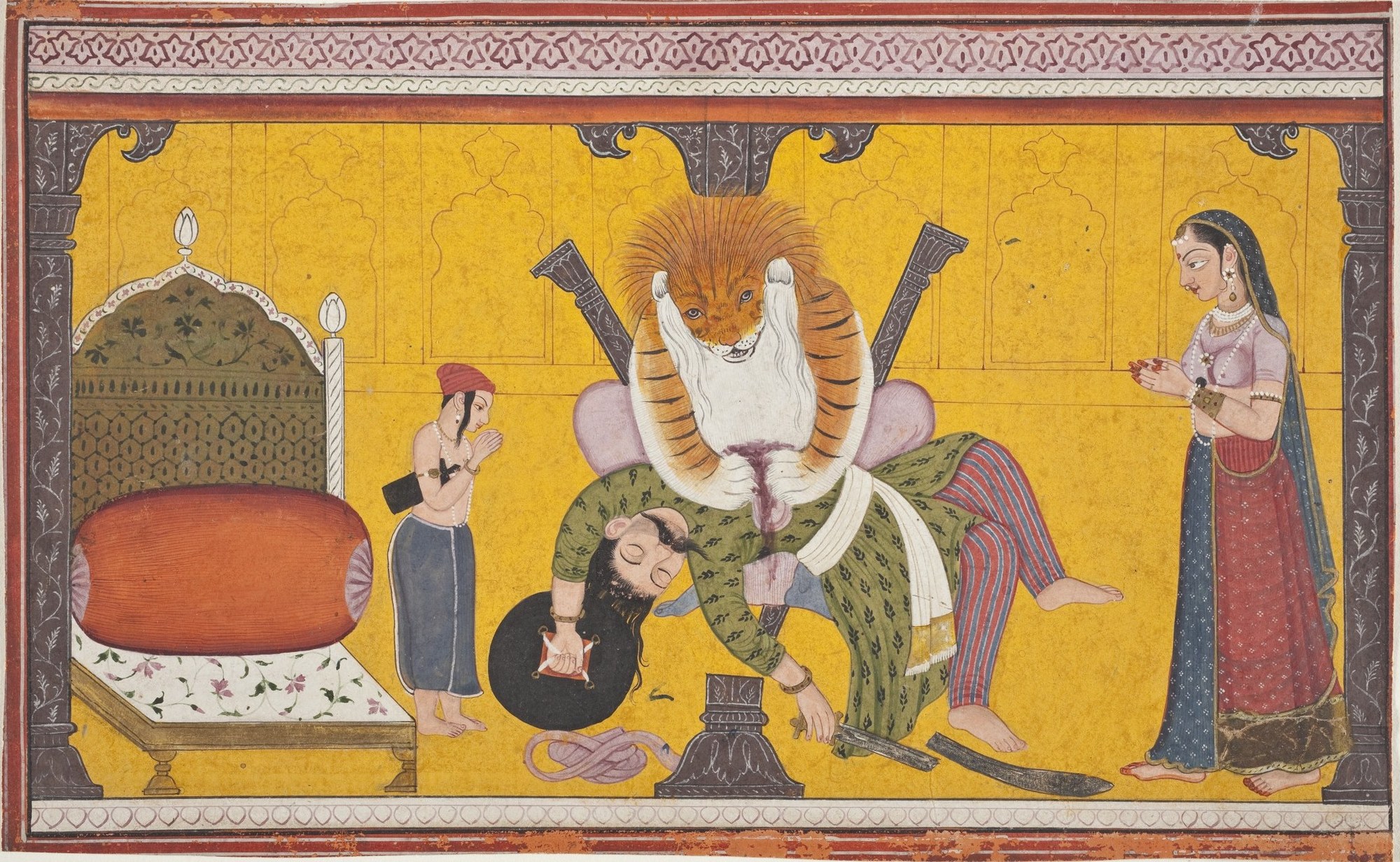
A demon-king had asked for a death with no door left in it, and thought he had one. He would not die by any creature the god Brahmā had made, nor indoors nor out of doors, nor by night nor by day, nor by another being nor by any weapon, nor on the earth nor in the sky, nor by man nor by beast, nor by god nor demon nor great serpent, nor by anything living nor anything dead. It was not, note, a request to be immortal. It was a lattice of paired exclusions, each pair fencing off one avenue and its opposite, and Hiraṇyakaśipu believed the lattice had no gap. The whole point of Narasimha, the man-lion, is that a lattice of opposites always does. He is the fourth avataraA 'descent': a form the god Vishnu takes to enter the world and set it right, of which the man-lion is counted the fourth. of Vishnu, the being the boonA gift or grant won from a deity by austerity, binding on the giver; here a set of conditions under which the demon-king cannot be killed. did not think to name, and he arrives as the shape of everything the demon left out.
A death with no door left in it
Read the boon closely and it is less a wall than a grid. By men or beasts. Indoors or outdoors. By night or by day. On the earth or in the sky. By weapon or by another creature. Each clause names a thing and its contrary, and a mind confident in that construction assumes it has covered the world. But an either/or only closes the world if the world holds nothing between the two.
Set a killer who is neither man nor beast, at a threshold that is neither in nor out, at an hour, in a posture, with a means that each fall between the paired terms, and every clause holds true while the demon dies anyway. The boon is honoured to the letter. That is the elegance of it: nothing is broken, only slipped.
There is a second gap, subtler than the rest, and it decides which god can act. The grant came not from Vishnu but from Brahmā, and its first clause excludes only beings that Brahmā created. Vishnu is not among them; the creator does not make the preserver. So the boon, by its own opening words, leaves standing precisely the one power able to void it. The daityaA race of demons, the descendants of the goddess Diti, set in the myths as the sworn adversaries of the gods. had walled out creation and forgotten the one who stands outside it.
He is seen, even here
The trigger is a taunt. The demon-king, goaded past bearing by his son Prahlāda’s insistence that Hari the lord is present in all things everywhere, gestures at a pillar of the assembly hall. Is he in this? The boy bows to the column and says that he is. As you are vaunting too much,
the father answers, I now sever your head from the trunk. Let Hari whom you trust as a protector, save you.
He springs from his throne, sword in hand, and strikes the pillar with his fist.
What answers is not an argument but a sound. A crash rises inside the pillar so vast that it rent asunder the shell of the cosmic egg,
and Brahmā and the gods, hearing it, take it for Pralaya, the dissolution of the worlds. The theophany is engineered to prove the devotee right on the exact terms of the challenge.
The father asked whether the god was in the pillar; the god comes out of the pillar. And he comes out, the text says, assuming an extremely wonderful form which was neither human nor beastly.
That single clause is the whole ontology of the rescue. The god has manifested as the answer to a riddle, wearing the one category the boon could not exclude, because it is the gap between its two named ones.
The shape the boon forgot
The form is built to be looked at. His eyes are fierce like molten gold; his face is majestic under the blaze of the mane; he has terrible tusks and a tongue that waves like a razor-blade; his brows are knitted and his ears erect; his jaws part like a mountain-cavern; he touches the heavens with his stature and carries hundreds of clawed arms on either side. Even Hiraṇyakaśipu, staring up at it, names the category-failure aloud: He is neither a beast nor a man. How wonderful is this Man-lion form.
The demon has just pronounced his own loophole. He came armed against men and against beasts; standing before him is the thing that is neither.
The god does not hurry. The demon strikes with a mace, then with sword and shield, and twice twists free like a serpent escaping from the clutches of Garuḍa,
and mistakes the escape for the man-lion’s fear. He is being played with. Then the form roared forth a terrific and shrill peal of laughter
and takes him.
All the conditions observed
The kill closes every surviving clause in a single motion, and the text is careful to say so. Narasimha carries the demon to the door of the hall and lays him down there, at the door, on the threshold,
which is neither indoors nor out. He lays him across his own thighs, which is neither on the earth nor in the sky.
And though the demon’s skin has stayed unscratched by the very thunderbolt of Indra, the man-lion tears him open with his claws, as Garuḍa does to the most poisonous serpents,
which is no weapon at all but the body itself. In this way,
the verse concludes, all the conditions of god Brahmā’s boon were observed while killing Hiraṇyakaśipu.
Neither man nor beast, at neither in nor out, on neither earth nor sky, by no weapon, by no creature of the creator. Six clauses, one act. The boon is kept and the demon is dead.
It is worth being exact about two things the retellings add. The most famous clause of all, that the killing came at dusk so that it was neither day nor night, is not in this account; the Bhāgavata Purāṇa, the one classical text that narrates the pillar-scene in full, never reaches for twilight and resolves the whole grant through threshold, lap and claws instead. The tidy checklist itself, the loophole ticked off item by item as though Vishnu recited it, is a modern teaching convenience; the scripture gives the boon and gives the kill and simply states that the conditions were met.
And the pillar-episode is not even universal within the tradition. The older Viṣṇu Purāṇa, perhaps four to six centuries earlier, has no pillar and no boon-loopholing at all; there the demon’s assaults on his son merely fail, the father repents and embraces the boy, and the man-lion survives only as a single backward glance. The scene that defines Narasimha for most who know his name is, as Wilson noted, found in detail only in the Bhāgavata.
The riddle-death is the late tradition’s masterpiece, not the myth’s foundation.
In order to prove true the utterance of his devotee and to vindicate His presence in all creatures and things, He manifested Himself in the pillar of the assembly hall assuming an extremely wonderful form which was neither human nor beastly. (Bhāgavata Purāṇa 7.8.18, trans. G. V. Tagare)
- Bhāgavata Purāṇa 7.3.35–37 (trans. G. V. Tagare, Motilal Banarsidass, 1950)Hiraṇyakaśipu’s boon-request to Brahmā, the paired exclusions that will be loopholed — no death by any being Brahmā created, indoors or out, by night or by day, by another being or by weapons, on earth or in the sky, by men or beasts, by gods, demons or great serpents, by the living or the dead. Note that the request is never for immortality: it is a grid of opposites. Composed text c. 9th–10th c. CE.
- Bhāgavata Purāṇa 7.8 (
Death of Hiraṇyakaśipu and Praise of Nṛsiṃha,
trans. G. V. Tagare, 1950)the load-bearing source. The pillar-blow whose crashrent asunder the shell of the cosmic egg
and is taken for Pralaya (7.8.16); the manifestationwhich was neither human nor beastly
(7.8.18) and the demon’s own cryHe is neither a beast nor a man
(7.8.19); the feature-by-feature form (7.8.20–22); the play, the escapeslike a serpent escaping from the clutches of Garuḍa,
and the seizing (7.8.24–28); the threshold-lap-claws kill in whichall the conditions of god Brahmā’s boon were observed
(7.8.29); and footnote [2], thatgod Brahmā’s boon to Hiraṇyakaśipu was respected by Viṣṇu in Nṛsiṃha form.
- Viṣṇu Purāṇa 1.17–20 (esp. 1.20,
Viṣṇu appears to Prahlāda,
trans. H. H. Wilson, 1840)the variant with no pillar and no boon-loopholing. Hiraṇyakaśipu’s attempts on Prahlāda fail through the boy’s devotion, the father then repents and embraces him, and the man-lion appears only as a back-reference (After his father had been put to death by Viṣṇu in the form of the man-lion
). Wilson’s footnote [2] confirms the divergence: the story is metin detail only in the Bhāgavata.
Text usually placed c. 4th–5th c. CE (disputed), so roughly four to six centuries before the Bhāgavata’s developed scene. - Deborah A. Soifer, The Myths of Narasiṃha and Vāmana (SUNY Press, 1991), pp.37–39, and Roshen Dalal, The Religions of India (Penguin, 2010) p.262 — secondary, not scripturethe
twilight
loophole as the later, popular layer, and the link of theneither X nor Y
boundary-killing pattern to the Vedic myth of Indra and Namuci, slain at the seam of day and night by foam that wasneither dry nor wet.