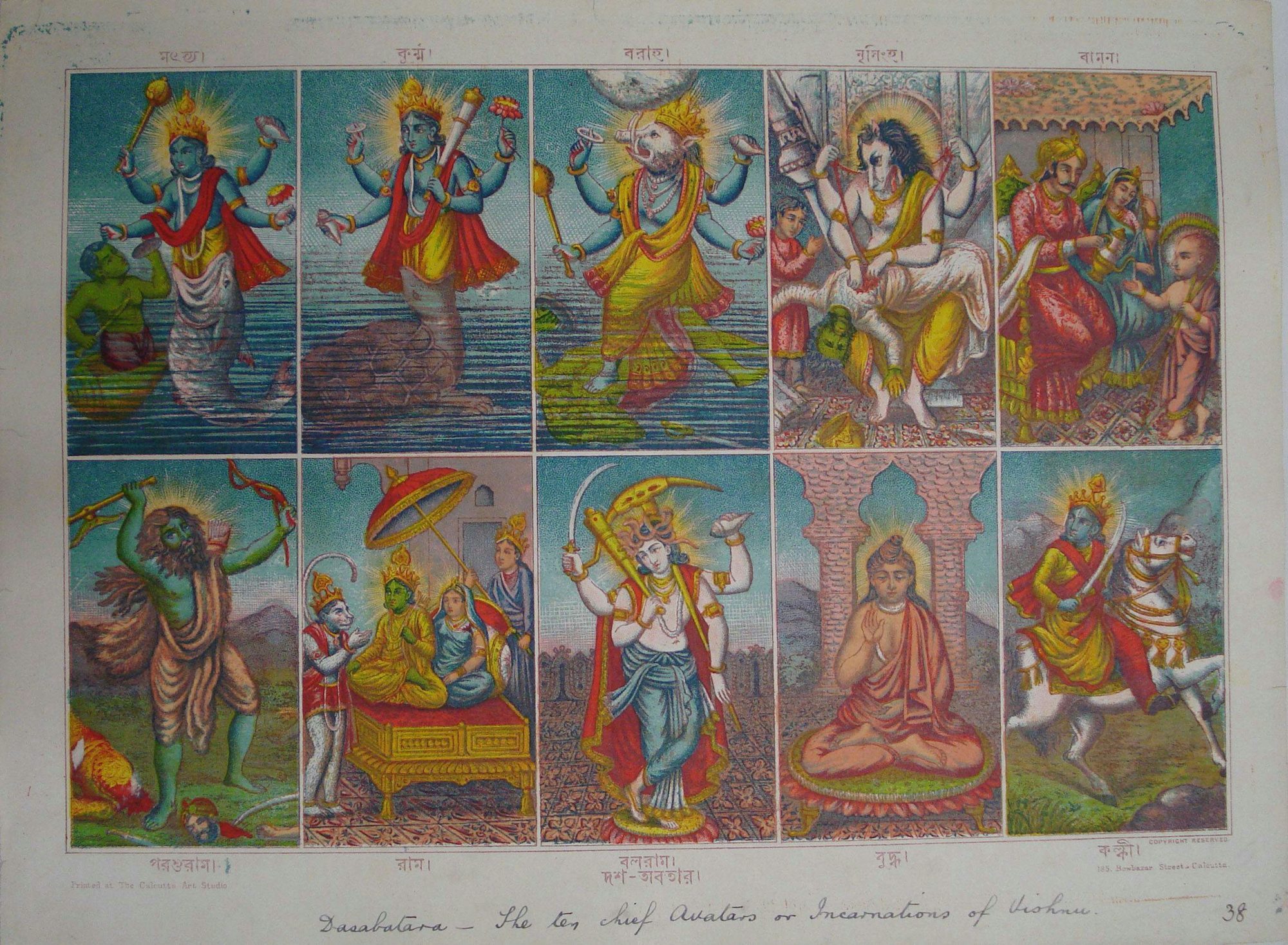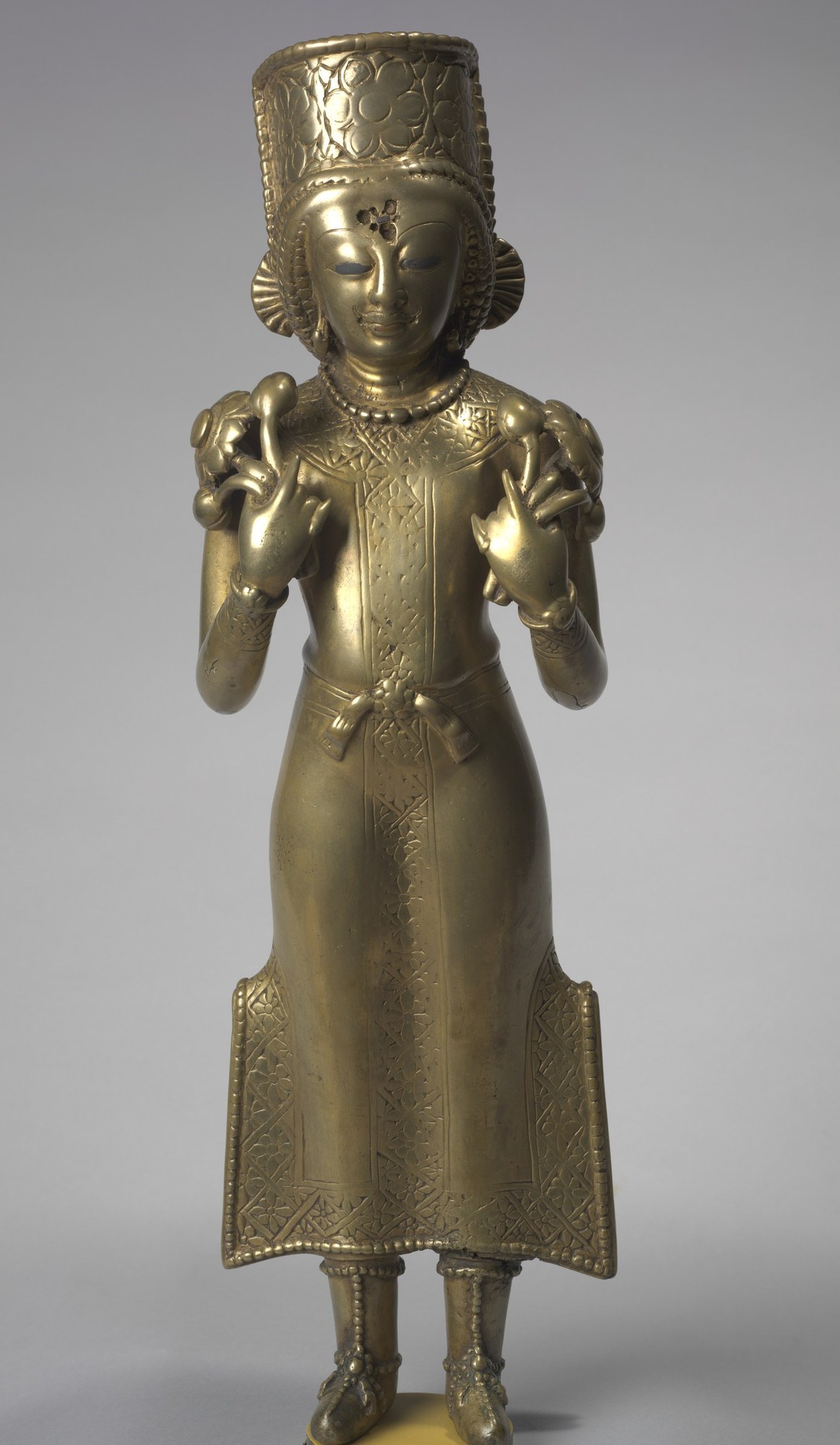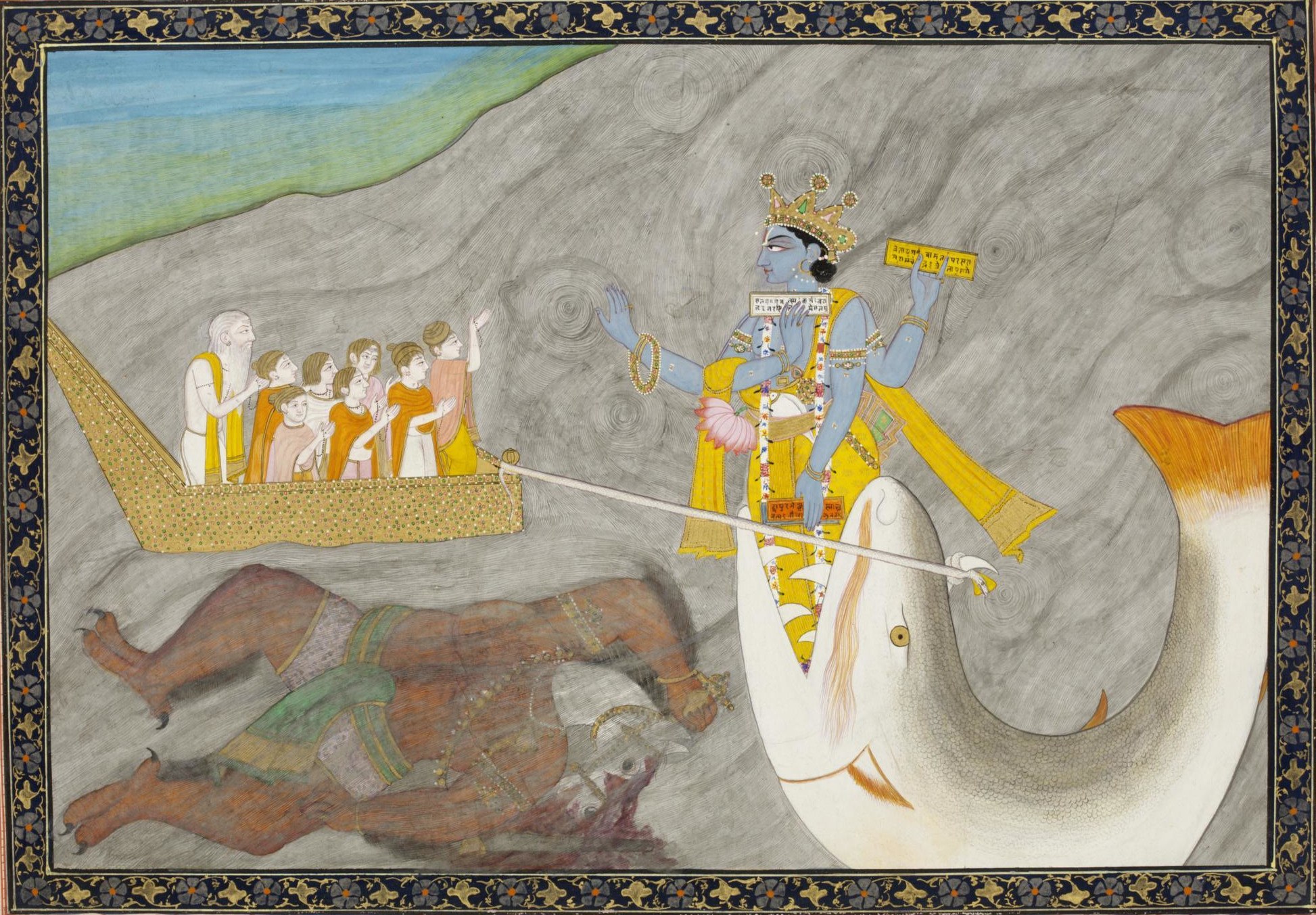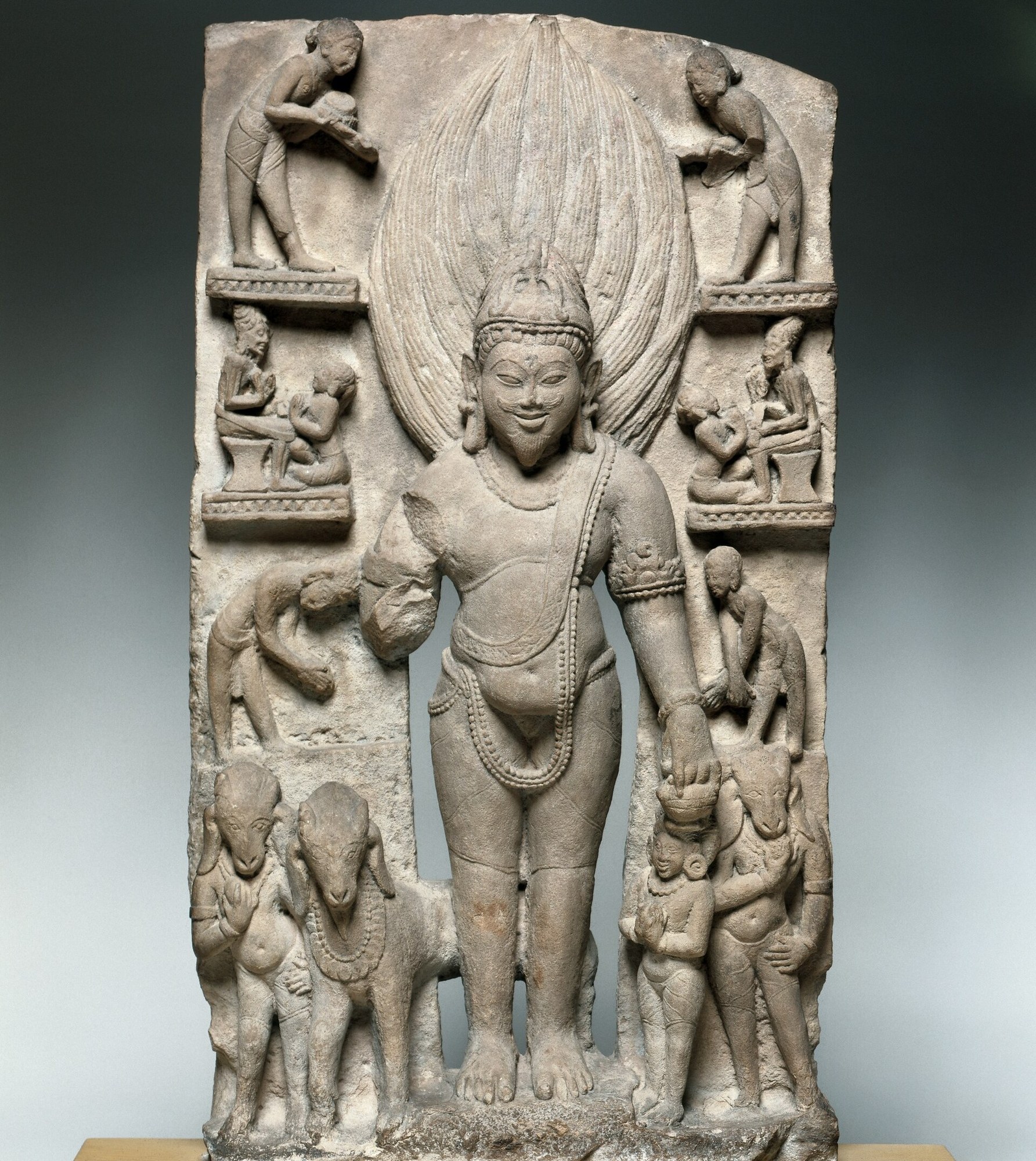
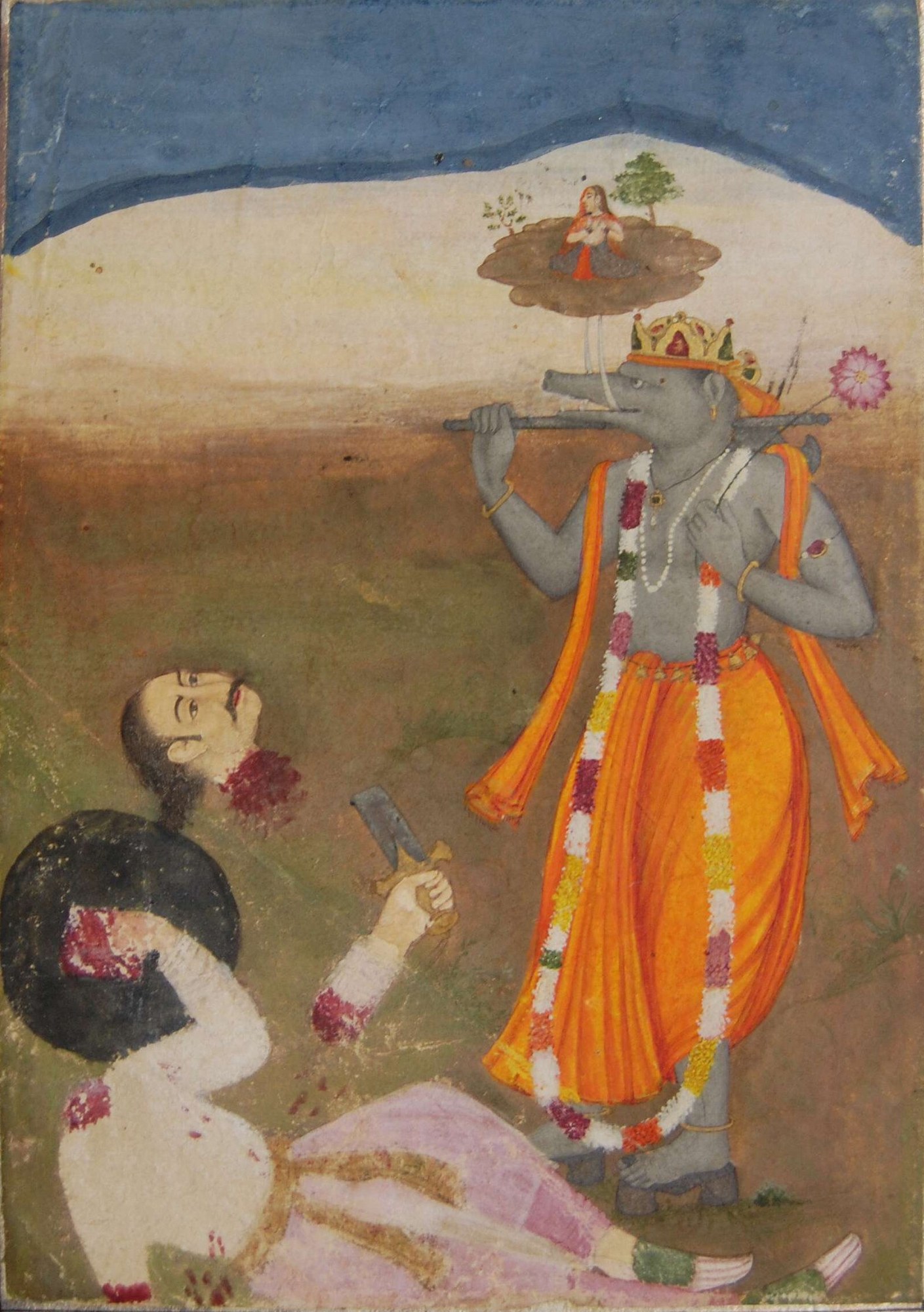
At the end of an age the earth slips loose from its moorings and sinks. It goes down through the one dark ocean into RasātalaThe lowest region of the world in the read sources, beneath the cosmic ocean, where the earth sinks and from which the boar must dive to retrieve it; Puranic cosmology conventionally counts it among seven nether worlds., the lowest cellar of the world, and lies there drowned and out of reach. Then a god puts on the body of a boar and dives after it.
He finds it on the seabed, works his tusks beneath it, and heaves it up streaming into the light. Then he sets it afloat on the water to stay. That is the picture the whole tradition agrees on: a boar with the world balanced on the tip of his tusk. It is usually counted third in the roll of Vishnu’s ten descents. But the boar is older than Vishnu’s claim on him, and for most of his history he belonged to other gods.
A boar the size of a span
The oldest boar in the record does not rescue the earth so much as make her. In the Śatapatha Brāhmaṇa, a late-Vedic ritual text, the earth at the beginning is a scrap of a thing, of the size of a span,
a hand’s breadth of matter on the water. A boar, called Emusha, raised her up,
the text says, and he was her lord PrajāpatiThe Vedic lord of creatures and maker of the world; in the oldest layer it is he, not Vishnu, who takes the boar''s shape and raises the earth..
This is not yet a story with a plot; it is a line spoken to explain a rite, in which the little earth is Prajāpati’s mate, lost and given back to him. The boar here is no incarnation of anyone. He is the creator-god of the Vedas in animal shape, and the earth he lifts is barely bigger than the hand that lifts her. A related Vedic layer paints him stranger still: a black boar, many-armed, dragging the earth up out of the deep, an image with none of the sleek beauty the later god would acquire.
From Prajapati to Brahma to Vishnu
The identity of the boar is the one thing the sources do not agree on, and the disagreement runs along the calendar. In the oldest earth-raising text he is Prajāpati. In the older recension of the Rāmāyaṇa and in the Mahābhārata’s account of creation he has become Brahmā: becoming a boar,
that text says, the self-existent creator raised up the earth, and created the whole world.
Only later still does he become Vishnu, and the moment of the change is caught in the act. The two surviving recensions of the same Rāmāyaṇa passage differ by a single insertion: where the older reads simply Brahmā, the self-existent,
the younger reads Brahmā, the self-existent, the imperishable Vishnu,
and with those three words the creator is demoted to a mere face of Vishnu and the boar changes owners.
The nineteenth-century scholar who first lined these passages up, J. Muir, put the whole development in one sentence: the boar-, tortoise- and fish-forms once ascribed to Prajāpati are in later works transferred to Vishnu.
A gap of well over a thousand years separates the span-sized earth of the Brāhmaṇa, around 650 BCE, from the fully Vaishnava boar of the Puranas in the fourth century CE and after. The reader should hear these as a slow handing-on of the same body from god to god rather than as one seamless faith.
The boar made of sacrifice
When the boar does become Vishnu, the Puranas dress him in an image found nowhere in the older texts: they read his whole body as a sacrifice walking. The Vishnu Purāṇa has the sages hymn him limb by limb. His feet are the Vedas; his tusks are the stake to which the victim is bound; the offerings are in his teeth, his mouth is the altar, his tongue the sacrificial fire, the bristles of his hide the sacred grass, his eyes the day and night. The Bhāgavata makes the mapping finer yet, assigning particular rites to his neck and tongue and nostrils.
This sacrifice-body reading is itself a Puranic invention, formulated nowhere in the older boar and only in these late texts, and it is why the Puranas give him one of his standing titles, Yajña-Varāha, the Sacrifice-Boar: the beast that heaves the earth from the water is also the rite that keeps the cosmos turning, and to picture him diving is to picture the whole machinery of Vedic worship going down into the sea and coming back up with the world on its point.
The demon who came late
Popular retellings give the boar an enemy, a golden-eyed demon named Hiraṇyākṣa who seizes the sinking earth and has to be killed before it can be raised. He makes for a splendid fight, and the Bhāgavata Purāṇa stages it at length: the demon jeers at the amphibious beast,
they duel with maces like two powerful bulls fighting for a cow,
he conjures a storm of stones and blood and spear-carrying she-demons, and the boar at last fells him with a casual blow at the root of the ear.
Yet the combat is a latecomer. Wilson, translating the Vishnu Purāṇa, noted plainly that the Hiraṇyākṣa legend has not been met with in any other Purana,
and that in the older Vaishnava telling the raising is a pure act of creation with no one to fight. The demon is the last ornament added to the boar, not the reason he dives.
Second, or third
Even his rank is unsettled, and the texts do not hide it. Devotion places him third among the ten DaśāvatāraThe devotional sequence of Vishnu''s ten descents, in which the boar is usually counted third; a cross-Puranic harmony, not one scripture''s list. descents, after the fish and the tortoise, in an order sung across many Puranas but drawn from no single one.
The Bhāgavata, which tells his story most fully, keeps its own longer catalogue of incarnations, and there it counts him second: the Lord of Sacrifices assumed the body of a boar for raising up the Earth which had sunk down to Rasātala.
The same scripture even lets its commentators admit that more than one boar is loose in its pages, a white one in an earlier cosmic age and a blue one later, so that Varāha is not quite a single event but a recurring descent.
He is the most fixed image in Hindu myth, the world poised on a tusk-tip, and the least fixed of gods in his own accounting: an animal in the oldest layer, a creator in the next, an avatar in the last, and never sure whether he stands second or third in the line.
The mighty boar, whose eyes were like the lotus, and whose body, vast as the Nīla mountain, was of the dark colour of the lotus leaves, uplifted upon his ample tusks the earth from the lowest regions. (Vishnu Purāṇa I.4, trans. H. H. Wilson)
- Śatapatha Brāhmaṇa XIV.1.2.11 (glossing Vājasaneyi Saṃhitā XXXVII.5), trans. Julius Eggeling, Sacred Books of the East vol. 44the oldest datable earth-raising boar,
a boar, called Emusha, raised her up, and he was her lord Prajāpati,
with the earthof the size of a span
restored to Prajāpati as his mate in the Pravargya rite. Eggeling’s note cross-refers the Taittirīyablack boar with a thousand arms.
Here the earth-raiser is not Vishnu; this is the pre-avatar form of the motif. - Vishnu Purāṇa, Book I, Chapter IV (trans. H. H. Wilson, 1840)the classic Vaishnava telling, the fish/tortoise/boar sequence, the Earth’s hymn naming herself Mādhavī, the boar
vast as the Nīla mountain
who lifts the earthupon his ample tusks
and sets it afloatlike a mighty vessel,
and the full Yajña-Varāha body-allegory. Wilson’s notes carry the statement that the Hiraṇyākṣa combat is a Bhāgavata addition absent from this andthe chief
Purāṇas. - Bhāgavata Purāṇa, Skandha III, Chapters 13 and 18–19, and Skandha I, Chapter 3, verse 7 (trans. G. V. Tagare, Motilal Banarsidass)the thumb-sized boar dropping from Brahmā’s nostril and swelling to a mountain, the dive and the tusk-raising, the granular Yajña-Varāha hymn, and the whole Hiraṇyākṣa mace-duel (unique to this text-family). Its own master list ranks Varāha the second incarnation (I.3.7), against the Daśāvatāra harmony that counts him third.
- J. Muir, Original Sanskrit Texts on the Origin and History of the People of India, vol. IV (2nd ed., Trübner, London, 1873)the assembling scholarship, printing and translating the two Rāmāyaṇa recensions (Schlegel II.110 making the boar Brahmā; Gorresio II.119 editing the same verse to
Brahmā… the imperishable Vishnu
), the Liṅga Purāṇa boar-as-Brahmā, the Taittirīyahundred-armed black boar,
and Rigveda VIII.66.10’s separate treasure-raiding Emuṣa. Muir states the developmental thesis that forms once ascribed to Prajāpati arein later works transferred to Vishnu
(Preface p. vii; pp. 27, 33–40, 92–93).