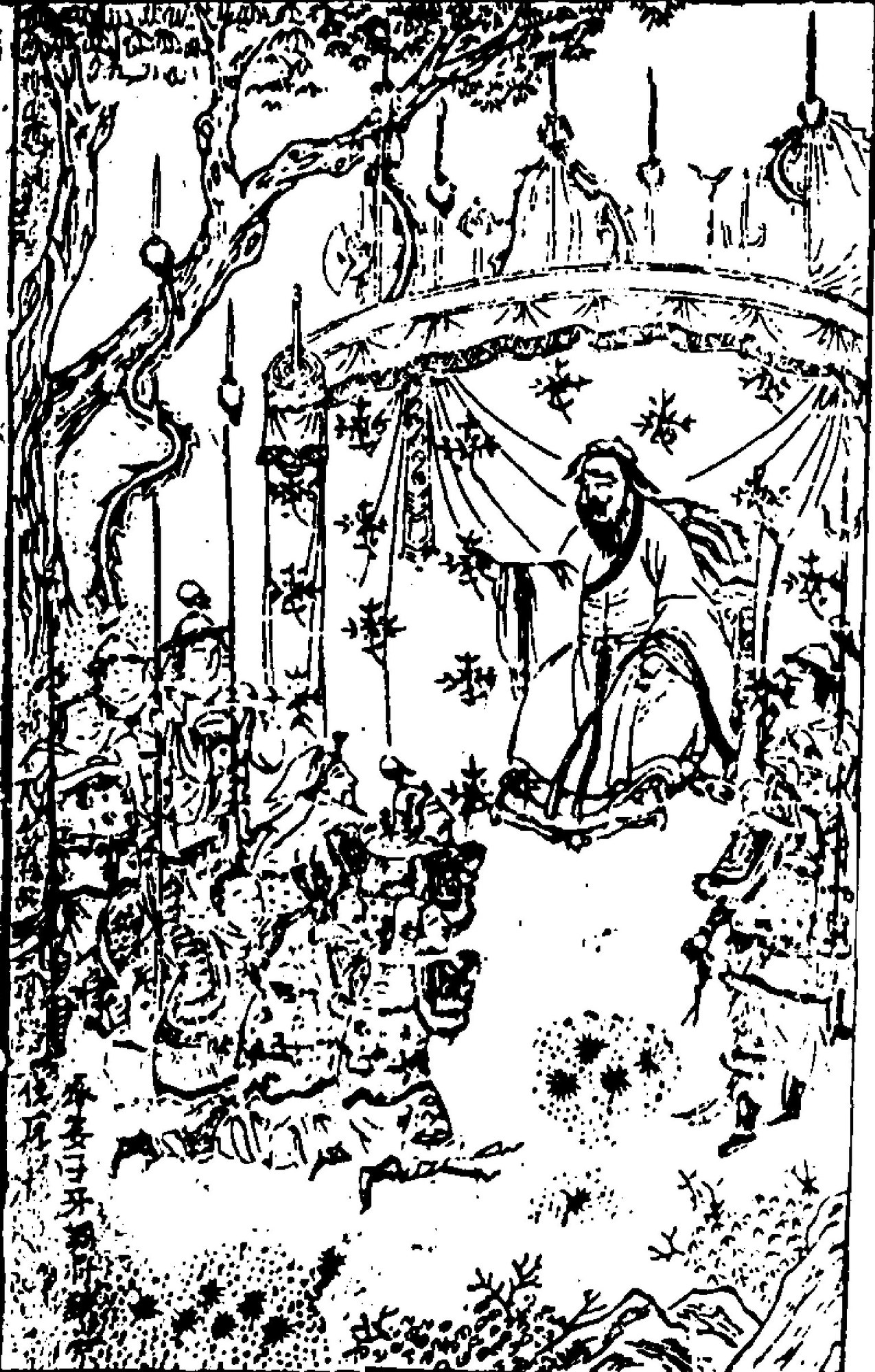
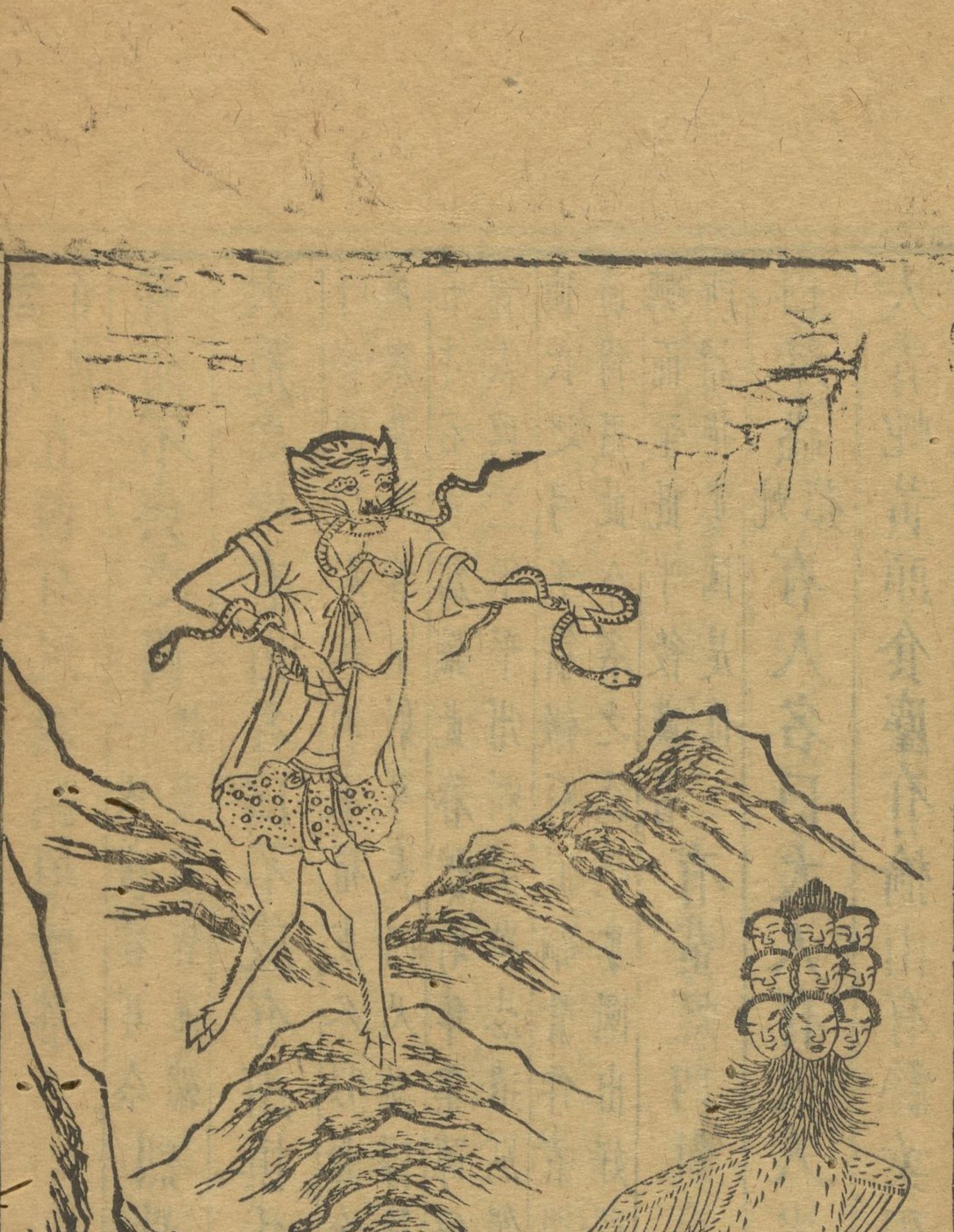
Before he marched on the man who would end the Qin, the Duke of Pei stopped to feed a demon. Liu Bang, not yet the founder of the Han, killed a beast at the altar of Chiyou, caught the blood of the offering, and had it smeared across the heads of his war-drums and along the staves of his banners until every flag in the host ran red. The god he was praying to was the losing side of the oldest war in the Chinese memory, the rebel the Yellow Emperor had captured and killed at the dawn of the ordered world. Six centuries of storytelling had turned that dead rebel into a monster of bronze and iron. It had also, without anyone quite deciding to, turned him into the god a founder of empires anointed his weapons to before he went out to win.
That is the strange arc worth following in Chiyou: not how he was beaten, which half a dozen other tellings already cover, but how the beaten thing rose from enemy to war-demon to the deity at whose shrine emperors sacrificed. The trail runs the wrong way, from defeat to worship, and it is stretched across a thousand years of sources that must not be quietly folded into one voice.
Sima Qian’s plain rebel, the later demon
Start with how far apart the witnesses stand, because the distance is the whole point. The earliest connected account, Sima Qian’s history from around 91 BCE, is almost brutally plain about Chiyou. Huangdi fought him in the wilderness of ZhuoluThe wilderness (涿鹿) where, in the Shiji, the Yellow Emperor captured and killed Chiyou; the battlefield of the founding war in the sober historical register., seized him, and killed him; the feudal lords then honoured the victor as Son of Heaven. That is nearly all of him in the sober register. There is no bronze skull in it, no army of brothers, no diet of stones. The historian gives a rebel put down and a throne won, and moves on.
The monster everyone pictures comes from a wholly different kind of book, and a much later one. The bronze head and iron forehead, the eighty-one beast-bodied brothers who spoke with human voices and swallowed sand and stone, the workshop turning out blades and halberds and great crossbows: all of it belongs to the Longyu hetu, the Dragon-Fish River Chart, one of the chenweiThe Han "weft" or apocryphal texts: prophetic and cosmological writings paired with the classics, most surviving only as fragments quoted in later works., the apocryphal weft-texts the Eastern Han produced alongside the classics.
That book is roughly a millennium younger than the war it describes and a good century or two younger than Sima Qian’s history. Worse for anyone chasing the original words, it does not survive. It reaches us only as a fragment copied into the Taiping yulan, a vast encyclopedia compiled in 983 CE, so the lurid image of the metal-headed demon comes to us through a tenth-century quotation of a second-century apocryphon about a war that even the second century placed in unreachable antiquity. The vivid Chiyou is the late Chiyou. The plain one is old.
Eighty-one brothers of bronze
Take the apocryphal portrait on its own terms, which are terrifying and deliberately so. Before Huangdi came to power, the fragment says, there was Chiyou, and he was not alone: he had eighty-one brothers, and they were all of a kind. Their bodies were beasts’ bodies, but they spoke in human speech. Their heads were bronze and their foreheads iron. They ate sand and stone and pebbles as a man eats grain, and their forge poured out the whole armoury of the metal age at once, the blades and the halberds and the great crossbows, and with these they terrorised the world and killed without mercy.
The reader used to a single fearsome champion should sit with the number. This is a whole brotherhood of eighty-one, all cast from the same metal, an assembly line of war made flesh. Some later readers, uneasy with so large a litter, have proposed that the eighty-one were never brothers at all but eighty-one clans marching under one banner, and modern writers with an interest in Chiyou as an ancestor of the Miao and Hmong peoples have leaned on that reading.
It is a re-reading, though, not a variant in the sources. The fragment says brothers, and it says eighty-one, and the honest thing is to report the strangeness the text actually preserves rather than the tidier number a later age would have preferred. (The fragment reads eighty-one; the seventy-two figure belongs to the later Shu Yi Ji account, told at length in the bestiary.)
Counsellor to the sovereign he fought
Even the enmity is not settled. The dominant strand makes Chiyou the arch-rebel, the enemy Heaven itself had to send a divine tally down to help subdue. But a quieter tradition, carried in the Guanzi and preserved in the same tenth-century encyclopedia that keeps the monster, turns the story inside out. There Chiyou is not the Yellow Emperor’s enemy but his aide, one of six ministers, and the line runs that Huangdi obtained Chiyou and thereby understood the Way of Heaven.
In one telling he is the chaos the sovereign must destroy to found the world. In another he is the counsellor who taught the sovereign how the world works. These do not reconcile, and they should not be made to. A figure who is both the thing order defeats and the wisdom order depends on is more interesting held in two hands than flattened into one.
Blood on the war-drums
Which brings the arc back to the altar where it began. However the war ended, in the ordinary run of things the losing rebel is forgotten or reviled. Chiyou was neither. By the time of Sima Qian’s history he was receiving sacrifice as the Master of War, the bingzhuThe Master of War (兵主), third of the Eight Spirits worshipped in the state of Qi; the war-god title under which the Shiji records Chiyou receiving sacrifice., the third of the Eight Spirits worshipped in the eastern state of Qi, his shrine standing on Qi’s western border.
When the First Emperor of Qin made his great progress east and sacrificed to those Eight Spirits, one of the powers he honoured was the demon Huangdi had killed. And when Liu Bang rose against the Qin, it was to Chiyou that he made his blood-offering, anointing his drums and banners until they ran red, and after his victory it was a shrine to Chiyou that he raised in the new capital at Chang’an. The rebel of the founding age had become the god an emperor prayed to at the founding of the next dynasty.
The apocryphal fragment, for all its lateness, understood this paradox before the historians did. It reports that even after Chiyou was dead the world would not settle, so Huangdi painted the dead rebel’s likeness and carried it as a standard to overawe the realms, and the realms, believing that Chiyou could not truly have died, submitted. The image did the work the corpse could not.
That is the whole secret of the war-demon’s afterlife in a single line: his enemies found him more useful terrifying than dead, and so they kept him, painted on their banners and fed at their altars, a god assembled out of a defeat because a defeated thing that still frightens everyone is exactly the thing a general wants marching at the head of his own column.
Before Huangdi came to power there was Chiyou, and he had eighty-one brothers, all beast-bodied but speaking with human voices, with bronze heads and iron foreheads, who ate sand and stone and forged blades and halberds and great crossbows, and terrorised the world. (Longyu hetu, quoted in the Taiping yulan; author’s rendering from the Chinese)
- Shiji (史記),
Fengshan shu
(封禪書, Treatise on the Feng and Shan Sacrifices), juan 28, Sima Qian (司馬遷), c. 91 BCE: the cult of Chiyou as war-god. Chiyou is named the third of the Eight Spirits of Qi, the Master of War (三曰兵主,祠蚩尤), his shrine standing at Dongpinglu on Qi’s western border (蚩尤在東平陸監鄉,齊之西境也); the First Emperor of Qin sacrificed to the Eight Spirits on his eastern progress. Chinese read verbatim; the wording above is the author’s own literal rendering. For a citable English sentence, quote a named translation (e.g. Watson, Records of the Grand Historian) and re-verify. - Shiji (史記),
Gaozu benji
(高祖本紀, Annals of Gaozu), juan 8, c. 91 BCE: Liu Bang (the future Han Gaozu), while Duke of Pei, sacrificed to Chiyou and smeared the blood of the offering on his drums and banners, so that all his flags were dyed red (祠蚩尤,釁鼓旗,幟皆赤); after victory he established a shrine to Chiyou at Chang’an (立蚩尤之祠於長安, recorded in Shiji juan 28). Chinese read verbatim. - Shiji (史記),
Wudi benji
(五帝本紀, Annals of the Five Emperors), juan 1, c. 91 BCE: the sober register of the war. Huangdi fought Chiyou in the wilderness of Zhuolu and there captured and killed him (與蚩尤戰於涿鹿之野,遂禽殺蚩尤); the feudal lords then honoured Huangdi as Son of Heaven. The Banquan (阪泉) war against the Flame Emperor is placed first and the Zhuolu (涿鹿) war against Chiyou second, keeping the two wars distinct. Chinese read verbatim. - Longyu hetu (龍魚河圖, Dragon-Fish River Chart), an Eastern Han apocryphal weft-text (chenwei), c. 1st–2nd c. CE: survives only as a fragment quoted in Li Fang et al., Taiping yulan (太平御覽), juan 79 (compiled 983 CE), roughly a millennium later than the events it describes and a century or two later than the Shiji. Before Huangdi held power there was Chiyou with eighty-one brothers, all beast-bodied but speaking human speech, with bronze heads and iron foreheads, who ate sand, stone and pebbles and forged blades, halberds and great crossbows, terrorising the world (蚩尤兄弟八十一人,幷獸身人語,銅頭鐵額,食沙石子,造立兵仗刀戟大弩,威振天下); Heaven sent down the Mysterious Lady (玄女) with a divine tally to let Huangdi subdue him; after Chiyou perished Huangdi painted his likeness to overawe the world, so that all the realms, believing Chiyou was not truly dead, submitted (黃帝遂畫蚩尤形象,以威天下,天下咸謂蚩尤不死). Read verbatim only as the Taiping yulan juan 79 quotation, not in a surviving original; re-verify the count 81 and the exact wording against a Taiping yulan edition before relying on specifics.
- **Shanhaijing (山海經),
Dahuang beijing
(大荒北經, Great WildsNorth) andDahuang nanjing
(大荒南經, South), c. 3rd–1st c. BCE:** the ancient strand. Chiyou made war and attacked Huangdi, who ordered the winged dragon Yinglong to attack him in the wilds of Jizhou (蚩尤作兵伐黄帝,黄帝乃令應龍攻之冀州之野); and, in the South chapter, the fetters (桎梏) Chiyou cast off after his defeat took root as the maple wood (蚩尤所棄其桎梏,是爲楓木). Chinese read verbatim. - Guanzi (管子), core Warring States with received Han text, quoted in Taiping yulan (太平御覽), juan 79: the minister variant.
Huangdi obtained Chiyou and thereby understood the Way of Heaven
(黃帝得蚩尤而明乎天道), listing Chiyou among the Yellow Emperor’s ministers rather than among his enemies — a tradition that makes Chiyou a counsellor, not a rebel. Chinese read verbatim as quoted in juan 79.