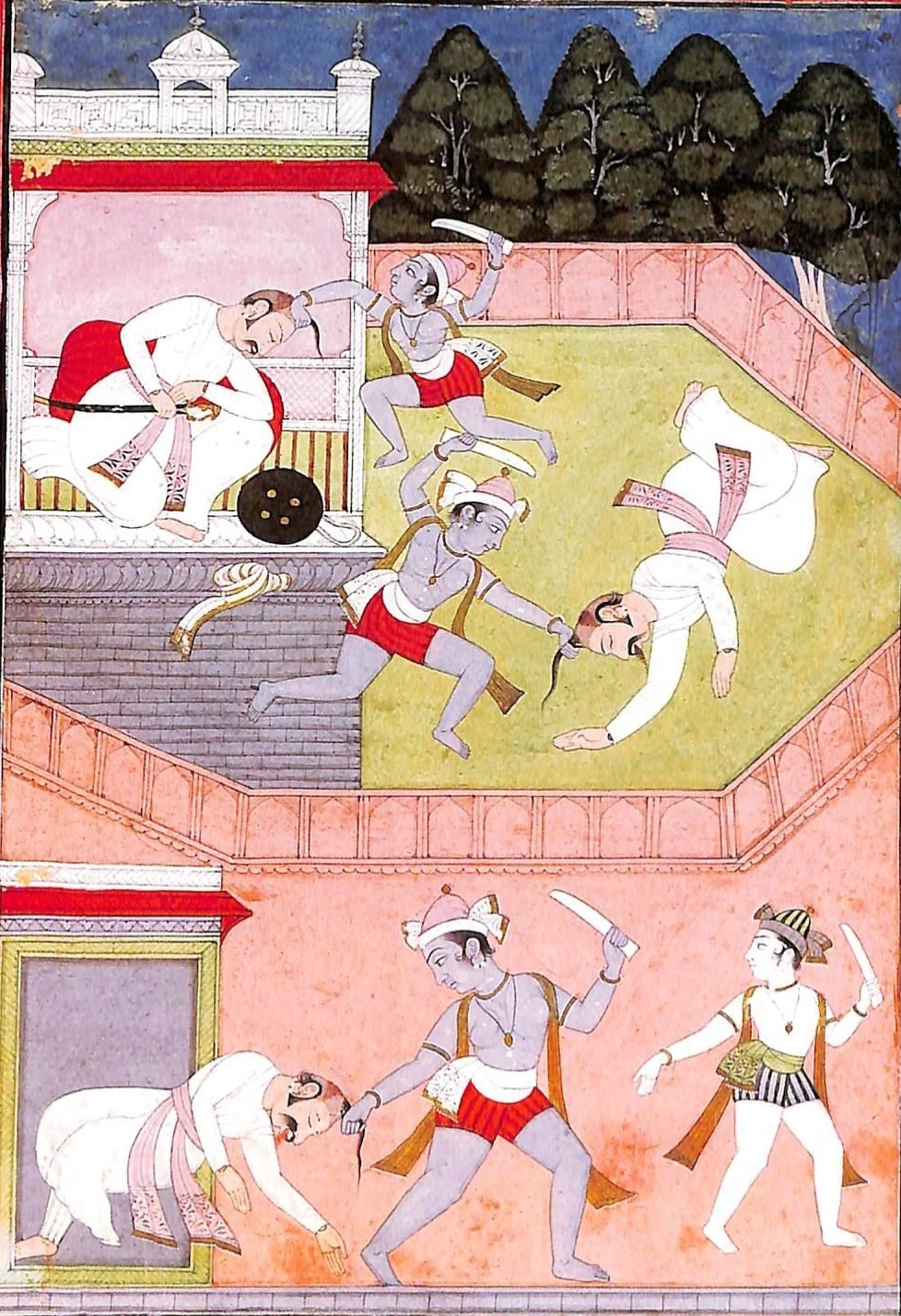
The chariot set them down outside the walls at the end of the day, and the two brothers went the rest of the way on foot, because they wanted to see the city. Akrūra, who had driven them from the cattle-country, asked Krishna to lodge at his house first. Krishna would not. ‘It is after slaying Kaṃsa, the enemy of our YādavaThe cattle-herding clan (the Yadu line) to which both Krishna and his enemy Kaṃsa belong; the tyrant is Krishna's own maternal uncle. clan, that I shall visit your house,’ he said. Then he walked into MathurāThe fortified city on the Yamuna ruled by the tyrant Kaṃsa, birthplace of Krishna and the seat he returns to reclaim for its rightful king. to look at the place his uncle had ruled while trying, since before Krishna was born, to have him killed.
A city dressed for a festival
Mathurā was built to be looked at. The Bhāgavata Purāṇa lingers over the fortifications: crystal gateways and golden doors, arched over with brass and copper, granaries and deep moats, the streets freshly sprinkled with water and strewn with flowers and parched grain for the coming games. Kaṃsa had proclaimed a great festival of the bow, the dhanur-yajñaThe bow-sacrifice, a royal rite centred on a great ceremonial bow; Kaṃsa's festival of it is the pretext that draws Krishna into Mathurā., and the whole town was turned out for it. Into this the cowherds walked, and the first thing Krishna did in his enemy’s capital was ask a royal washerman, one of Kaṃsa’s own servants, for something better to wear.
The man refused, and insulted them for asking. Here the two chronicles that carry this story part company on the manner of his death, though not the fact of it. In the later Bhāgavata Purāṇa, Krishna severs the man’s head from his trunk with the tips of his fingers. In the older and much barer Viṣṇu Purāṇa, translated by Horace Hayman Wilson in 1840, he simply strikes him down, head to the ground, and kills him.
These two are the pillars the whole episode rests on, and it is worth saying at the outset how far apart they stand: the Viṣṇu Purāṇa is usually placed around the fourth or fifth century of our era, the Bhāgavata perhaps four to six hundred years later, both drawing on older tellings now lost. The gap matters, because almost every vivid particular in what follows, the counted bow-lengths, the catalogue of omens, the named lesser wrestlers, belongs to the later and more elaborated of the two. Where the earlier text is silent, its silence is not the ancient truth against which the Bhāgavata embroiders; it is only terser.
A hunchbacked servant-woman came next, carrying sandal-paste for the king. She gave the brothers her unguent, and Krishna repaid her by setting a foot on her feet, lifting her chin with two fingers, and drawing her straight and beautiful. The Bhāgavata calls her Trivakrā, bent in three places; the Viṣṇu Purāṇa calls her Kubjā, the crooked girl. It is one woman under two names, and it is the last kindness before the killing begins.
The bow snapped like sugarcane
At the sacrificial hall the great bow lay guarded, a thing the Bhāgavata likens to the rainbow, studded with gems and taller than a man. It was the centrepiece of the whole rite, and no one was to touch it. Krishna took it up in front of the guards, bent it, strung it, drew it to its full stretch, and broke it in two, the text says, as easily as a rutting elephant snaps a stalk of sugarcane.
The crash of it went up and filled the sky. Kaṃsa, in his palace, heard the sound and was afraid. When the guards rushed the brothers, Krishna and Balarāma beat them down with the two broken halves of the stave, and scattered the troop the king sent after them.
That night the king could not sleep, and the Bhāgavata gives him a long, strange procession of death-omens that the leaner Viṣṇu Purāṇa never troubles to list. Kaṃsa looked at his reflection and it had no head. He saw the lamps and the planets doubled. His shadow was full of holes. He could not hear the sound of his own breath.
The trees seemed to him made of gold, and where he walked his feet left no print on the ground. In his dreams the dead embraced him, and he rode a donkey southward, naked and smeared with oil, garlanded in red flowers, drinking poison. He rose from that bed and gave the order for the games to begin, and posted his war-elephant at the gate of the arena.
Under the elephant at the gate
The beast was called Kuvalayāpīḍa, and the Bhāgavata credits it with the strength of a thousand elephants. Its driver goaded it straight at Krishna in the gateway. Here again the two texts tell one act two ways. Wilson’s Viṣṇu Purāṇa is quick and brutal: Krishna seizes the elephant by the tail, whirls it round, dashes it to the ground, and tears out its tusks so that blood runs from its mouth like a river.
The Bhāgavata slows the same moment into a wrestling bout, with Krishna slipping the curl of the trunk, ducking between the animal’s legs, then catching the tail and dragging it, it says, twenty-five bow-lengths across the ground, the way the eagle Garuḍa hauls a snake, before he pins it with a foot and pulls a tusk to finish it. Both agree on the trophy. Krishna walked into the arena with the tusk laid across his shoulder, his body, in the Bhāgavata’s phrase, stained with drops of the elephant’s ichor and blood, and his face beaded with sweat like pearls.
Boys against giants
Kaṃsa’s champion boxers were waiting for him. Cāṇūra called out the challenge, and the fighters were paired: Krishna against Cāṇūra, his elder brother Balarāma against Muṣṭika. The women in the stands cried out at the unfairness of it, boys set against giant professional wrestlers; the Viṣṇu Purāṇa puts their protest plainly, that it was a great sin to allow a contest between children and grown strong men. The gods themselves, the crowd said, must be against the king to permit it.
They were not wrong. Krishna took Cāṇūra up and whirled him and threw him down dead. Here the older, barer text is somehow the gorier one: where the Bhāgavata says only that Krishna spun him until the life went out of him and dashed him to the earth, Wilson’s Viṣṇu Purāṇa has Cāṇūra whirled a full hundred times and broken into a hundred fragments, the ground strewn with a hundred pools of blood.
Balarāma killed Muṣṭika, who vomited blood and fell like an uprooted tree. The Bhāgavata, never content with two when it can name five, adds three more that the Viṣṇu Purāṇa leaves out: Balarāma downing Kūṭa with his left fist, and Krishna splitting the heads of Śala and Tośala with kicks.
The king dragged by the hair
Kaṃsa lost his composure on the dais. He shouted for the two cowherds to be driven from the ring, for their father Nanda to be bound, for his own father Ugrasena, the old king he had imprisoned and displaced, to be put to death along with Krishna’s parents. It was the last order he gave.
Krishna sprang up onto the high seat, knocked the crown from the king’s head, took him by the hair, and threw him down from the dais to the floor of the arena, and came down on top of him. Wilson’s briefer Viṣṇu Purāṇa says only that Krishna leapt to where the king sat, seized him by the hair, and crushed him to death under his weight. Either way the tyrant was dead in a moment.
Then came the image the whole story is named for. In front of the packed and horrified arena, the Bhāgavata says, Krishna dragged the lifeless body across the ground the way a lion drags a dead elephant, and a great cry of grief broke from the crowd. Wilson’s Viṣṇu Purāṇa gives the detail that has fixed the scene in memory ever since: dragged by the hair of its head, the corpse carved a deep furrow in the floor of the arena as it went.
Krishna then dragged the dead body by the hair of the head into the arena, which made a deep furrow. A cry of grief arose from the assembly. (Viṣṇu Purāṇa 5.20, tr. Horace Hayman Wilson, 1840)
The killing did not quite end there. Kaṃsa’s brothers rushed the ring to avenge him, and Balarāma met them with the elephant’s tusk wielded as a club, the Bhāgavata naming Kaṅka and Nyagrodhaka and eight more among the dead. Above the arena, the gods rained down flowers and the celestial women danced; below it, the widowed queens beat their heads over the bodies. And Krishna and Balarāma went to the prison where their parents Vasudeva and Devakī had been held, and set them free. The old king Ugrasena, whom Kaṃsa had thrown down, was lifted back onto the throne of Mathurā that his son had stolen.
One thread runs only through the later Bhāgavata, and it is worth keeping as that text’s own reading rather than a fact of the story. Because Kaṃsa had spent his whole life fixed on Krishna, even if only in terror and hatred, the Bhāgavata says that at his death he took on the very form he had dwelt upon, a liberation won through enmity. The Viṣṇu Purāṇa, four to six centuries older, knows nothing of it, and simply lets the tyrant die.
- Bhāgavata Purāṇa, Skandha X, chapters 41–44, tr. G. V. Tagare (Motilal Banarsidass, Ancient Indian Tradition & Mythology series, 1950; the composed work commonly dated c. 9th–10th c. CE, the later and fuller of the two)the vow against lodging with Akrūra first,
It is after slaying Kaṃsa who is the enemy of our Yadu clan, that I shall visit your house
(10.41.17); the crystal-gated, moated city strewn with flowers and parched paddy (10.41.20–23); the washerman beheadedwith his finger-tips
(10.41.37); the hunchback Trivakrā straightened (10.42.6–8); the gem-studded bowlike the rainbow
strung and snappedas an intoxicated elephant would do to a sugarcane,
the crash that terrifies Kaṃsa (10.42.17–18); the omen-catalogue of the headless reflection, the holed shadow, the golden trees, the print-less feet and the donkey-ride dream (10.42.28–30); the elephant Kuvalayāpīḍa,the strength of a thousand elephants,
draggedtwenty-five bows… even as Garuḍa would do to a cobra
and killed with its own extracted tusk (10.43.8–14); Krishna enteringstained with drops of ichor and blood
(10.43.15); Cāṇūra whirled andextinguished
and Muṣṭika felledlike a tree uprooted
(10.44.22–25); the additional wrestlers Kūṭa, Śala, Tośala (10.44.26–28); Kaṃsa’s crown toppled, his hair seized, and his bodyhurled… from the high dais,
Krishna leaping upon him (10.44.37–38); the corpse draggedlike unto a lion dragging an elephant
(10.44.38); Balarāma clubbing Kaṅka, Nyagrodhaka and eight more brothers with the tusk-club (10.44.40–41); the freeing of Vasudeva and Devakī (10.44.50–51); and the devotional note that Kaṃsa, havingconstantly visualised
Krishna in fear,attained (identity with) that very form
(10.44.39), a Bhāgavata-only reading of liberation-through-enmity. - Viṣṇu Purāṇa, Book V, Chapter 20 (
Kubja straightened; the Games; Kansa slain
), tr. Horace Hayman Wilson (orig. 1840; this reading from the 1895 condensed English edition, archive.orgin.ernet.dli.2015.47536, pp. 60–61; the earlier and terser telling, the Purāṇa commonly dated c. 4th–5th c. CE, roughly four to six hundred years older than the Bhāgavata’s version of the same episode)the washerman struckdown, with his head to the ground
; Kubjā the crooked girl straightened; Krishna in yellow and Balarāma in blue; the bow broken and the guards killed; Kuvalayāpīḍa seized by the tail,whirling it round, dashed it on the ground,
its tusks pulled soblood streamed like a river from its mouth
; Cāṇūrawhirled… round a hundred times
and dashedinto a hundred fragments… a hundred pools of blood
; the women’s complaint that it wasa great sin… to suffer a contest between boys and strong men
; Krishna springing towhere Kansa was seated,
seizing his hair, and crushing himto death by his weight
; the corpse dragged by the hair so itmade a deep furrow
; and Ugrasena restored to the throne.