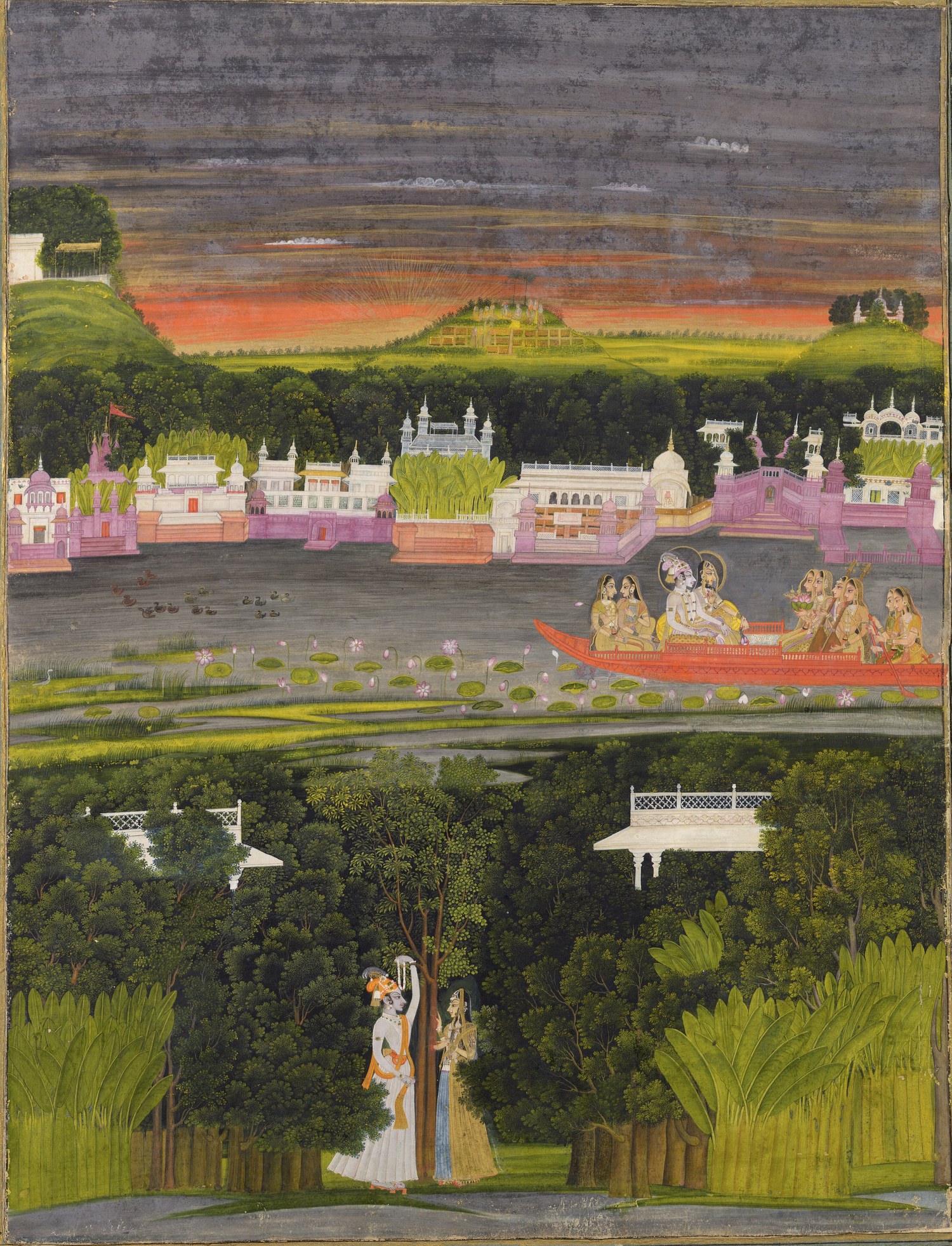
Ask anyone in northern India who Krishna loved, and the answer comes back in one word: Radha. Her name is spoken in the same breath as his, painted beside him in every bazaar print, sung in temples where the two are worshipped as a single divine couple. And yet the oldest surviving account of the moonlit dance that is supposed to be theirs, the great night in the pastures that every later poet and painter returns to, does not contain her name at all. Not once. The text speaks only of the cowherd women, and of one favoured among them whom it never troubles to call anything. The Radha the whole tradition adores was placed at the centre of that scene later, by other hands, across a stretch of time longer than the distance between us and the Norman conquest. Her story is not the story of a night. It is the story of what a thousand years did to a longing.
The night the flute called
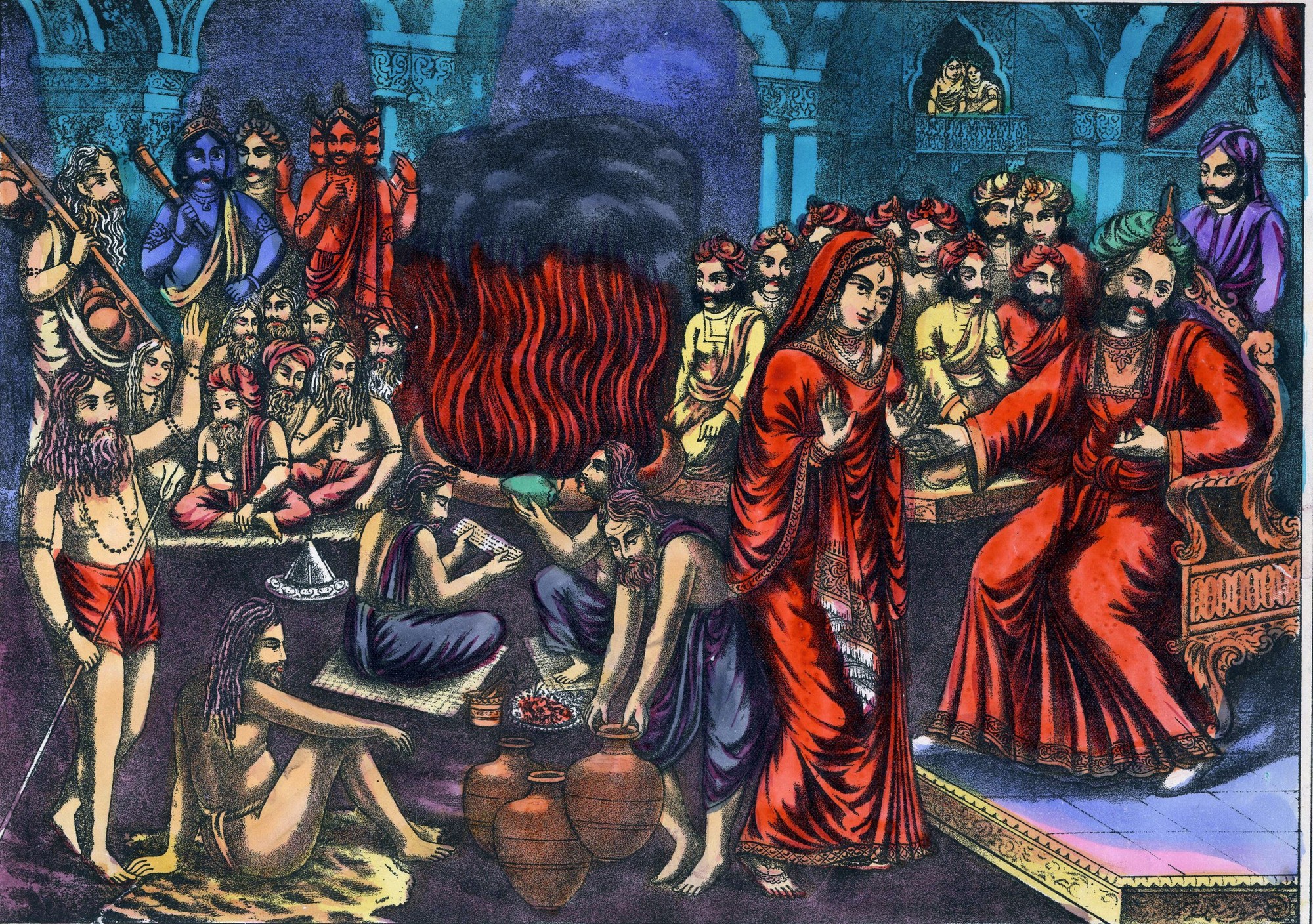
The scene the tradition cannot leave alone is set on an autumn night in the Bhagavata Purana, the ninth- or tenth-century text that is the oldest source for it. The nights were beautiful with full-blown jasmine, and Krishna, seeing them, resolved to play. He put his flute to his lips, and across Vrindavana the gopisThe cowherd women of Vraja who leave homes and husbands at the sound of Krishna's flute; their love becomes the model of the soul's love for God. heard it and could not stay. They left half-done chores and half-applied makeup, left husbands and homes, and ran to the forest where he was.
This is the rasa-lilaKrishna's moonlit circle-dance with the cowherd women on the autumn banks of the Yamuna, the scene at the heart of the Radha tradition., the great circle-dance on the sandy bank of the Yamuna. He tested the women first, told them a wife’s place was with her husband and they should go back; they refused, and declared their love, and he danced with them under the moon.
Then he did something crueller than any of them expected. Perceiving their pride, the pride of women who thought themselves fortunate above all others in having him, he vanished. The Bhagavata is blunt about the reason: he disappeared, it says, to cure them of that conceit and to show them grace. The gopis, bereft, wandered the forest calling for him, asking the trees and the flowering creepers whether he had passed, reading his footprints in the soil. And they found, printed beside his, a second set: the footprints of one woman he had taken away alone.
The gopi who asked to be carried on his shoulder
Here, in a handful of verses, is the seed of everything that came after. Krishna had singled out one gopi and led her away from the rest. And she, the text says, began to think herself the most fortunate of all women, that the Lord had abandoned every other woman for her alone. Swollen with that pride she asked him to carry her, and he told her, in effect, to climb onto his shoulder. When she reached for him he vanished, exactly as he had vanished from the others, and left her lamenting alone in the wood.
The Bhagavata never gives this woman a name. It is essential to be honest about this, because almost every retelling you will ever hear silently supplies one. To the Bengali devotional theologians who read the text centuries later she was obviously Radha, and they said so; the great commentator Viśvanātha Chakravartī, writing around the turn of the eighteenth century, is the named interpreter who identifies the unnamed favourite as her.
But the identification is theirs, not the text’s. G. V. Tagare, whose translation carries the scholarly weight here, notes plainly at this very verse that the Bhagavata Purana itself is silent, and that it was the commentators of the Bengal school who presumed she was Radha. The named beloved is a reading laid over a gap the scripture left open on purpose.
What the dance was for
Before we follow that name forward, it is worth seeing what the Bhagavata itself thought its night-dance meant, because it is not what the later love-poets made of it. When Krishna returns and comforts the grieving women, the great dance itself begins, and the text reaches for its most famous image.
He multiplied himself, it says, into as many forms as there were gopis, and stood between every pair of them at once, an arm around each neck, so that every single woman believed he was dancing with her alone. Heavenly chariots crowded the sky, kettle-drums sounded, flowers rained down; the women danced with loosening braids and jingling anklets and drops of sweat, and afterwards they sported with him in the Yamuna’s water like she-elephants around the king of the herd.
It is as sensuous a passage as Sanskrit scripture offers, and the Bhagavata knows it, and it pre-empts the obvious objection before a reader can raise it. The Lord enjoyed all those nights, the text says, but he controlled all his energy within himself, such was his mastery over desire.
Then it stages the question directly: the listening king Parikshit asks Shuka, the narrator, how the Lord could sport with other men’s wives, and Shuka answers that the deeds of the mighty are like fire, which is not stained by what it burns, and are not to be imitated by ordinary men. The dance, in its earliest telling, is not a romance. It is divine play, lila, and the meaning it claims for itself is that God is wholly present to every soul at once, and that the desire on display is not the desire it looks like.
The poet who gave her a face
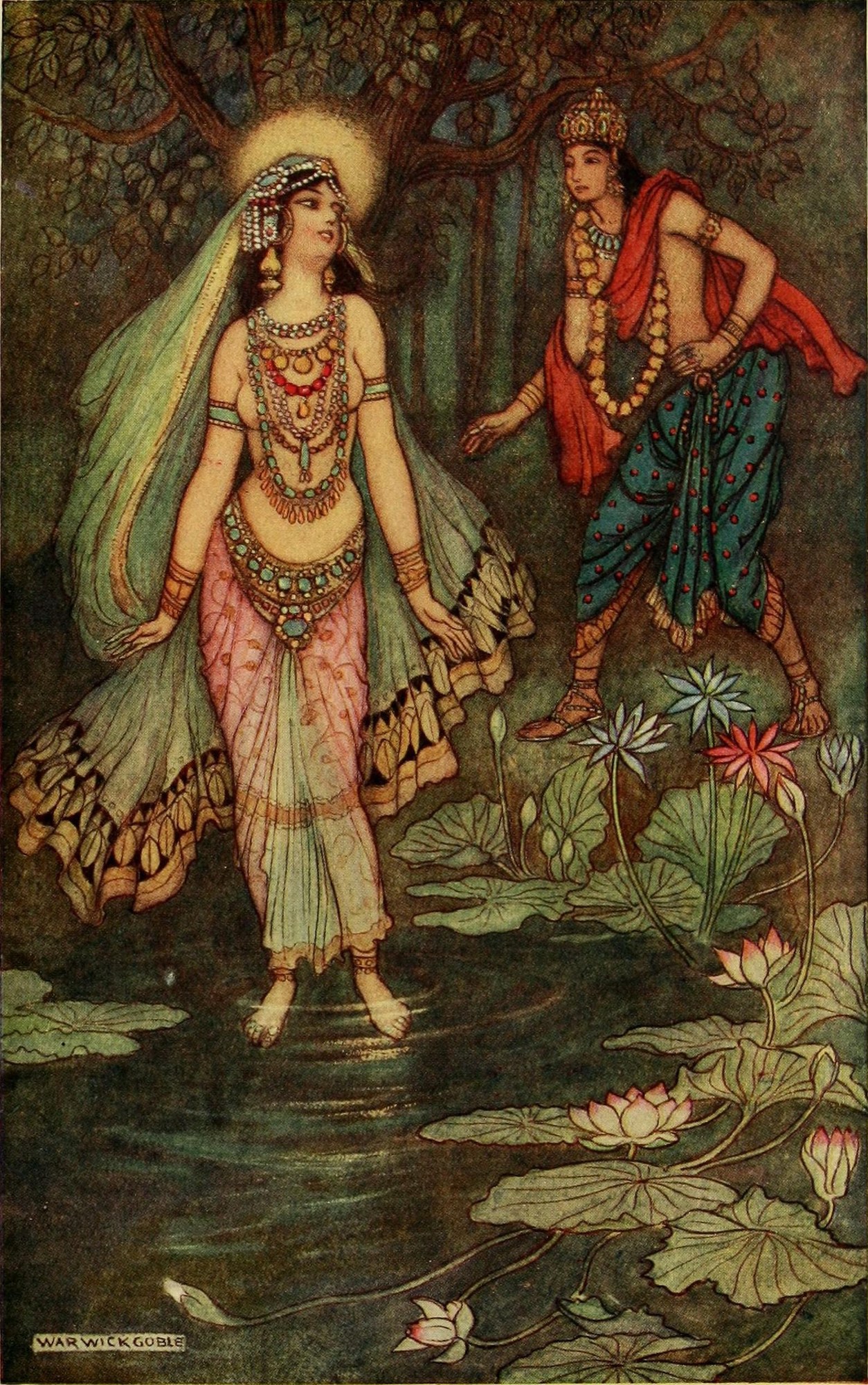
Two centuries and more after the Bhagavata was fixed, a Sanskrit poet at a Bengal court did what the scripture had refused to do. Jayadeva, writing around 1170, took the unnamed favourite out of the crowd, gave her a name and a voice and a whole poem, and made her co-protagonist with the God she loved. The Gita Govinda opens not in the pastures but on a dark, cloud-thick night, the sky arched with black tamala boughs, as the foster-father Nanda hands the boy Krishna into Radha’s keeping and, in Edwin Arnold’s Victorian rendering, cries: O Radha, Radha, take this Soul that trembles in life’s deep midnight to thy golden house.
The poem runs on absence, not union. Radha watches from the shadows while Krishna dances amorously with the other cowmaidens and, in a line that fixes her whole condition, thinks of her not at all: there he dances with the dancers, and of Radha thinketh none. Her whole state is virahaThe pain of love in separation: the longing of the parted lover, which the devotional poets made the highest and most fruitful state of love., the pain of love in separation.
The twelve cantos turn on that longing, and then on Krishna’s own answering remorse, a lovers’ quarrel, and at last the reconciliation and union of the final canto. What Jayadeva discovered, and what every devotional poet after him seized on, was that the most intense form of love is the wanting, not the having.
Radha apart from Krishna, burning for a God who seems to have forgotten her, turned out to be a more powerful image of the soul than any woman safe in the circle of the dance. And Jayadeva told his readers plainly not to mistake the surface for the substance: the poem seems of the earth, his own coda says, but is heavenly, telling darkly of delights. The erotic longing was always a vehicle. Its cargo was the divine.
The left side of God
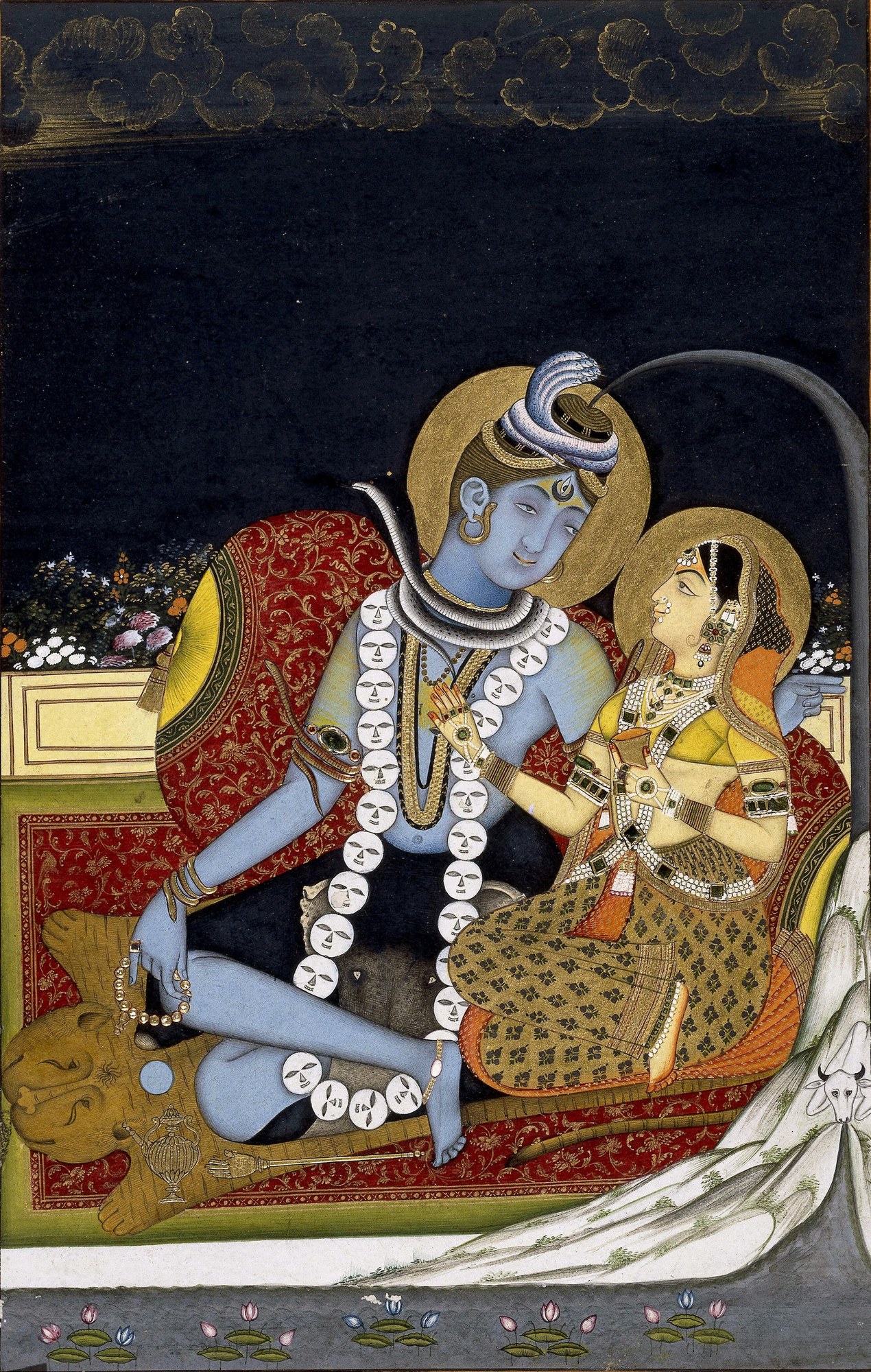
The last and boldest step took the longest to arrive. In the Brahmavaivarta Purana, a text whose surviving form is commonly dated to the fifteenth or sixteenth century, three or four hundred years after Jayadeva and some six hundred after the Bhagavata, Radha stops being a woman who loves Krishna and becomes a part of him. She sprang, this Purana says, out of half of the body of Krishna: Radha is the left side of his body, and Krishna is the right.
The one supreme Brahman, it explains, wilfully divided himself into two, and the force that came out of him is Nature herself, the mother of all other forces. Radha is named the presiding deity of Krishna’s life, dearer to him than his life, the mistress of the rasa-dance, Vrinda in Vrindavana. From her, the goddesses of the world emanate in turn.
Here the love story has become a theology. The distance between the lovers that Jayadeva made unbearable is reinterpreted as the play of a single divine reality with itself, splitting into two so that it may know the joy of reunion.
The disciples of the sixteenth-century Bengali saint Chaitanya gave the idea its technical name: Radha is Krishna’s hladini-shaktiRadha understood as Krishna's own 'energy of bliss', the feminine power through which the deity delights in himself, a late theological reading., his own power of bliss, the energy through which God delights in himself. It is worth being exact about the attribution, because it is often mistold. Chaitanya himself is not known to have worshipped the divine couple; it was the theologians who followed him, in and around Vrindavana, who built the doctrine. The longing of a cowherd woman, unnamed in the oldest text, had become the mechanism by which the absolute experiences its own joy.
Reading the gap
Set the three witnesses side by side and the shape of the thing is unmistakable. The Bhagavata gives an unnamed favourite and a dance that means divine self-mastery. Jayadeva, well over two centuries later, gives a named Radha and a love whose whole force is separation. The Brahmavaivarta, perhaps six centuries after the Bhagavata, gives a Radha who is God’s own feminine half.
These are not three reports of one event, agreeing across the years. They are three different acts of imagination, each building on the last, spread across a millennium of devotional thought. The famous formula, that Radha’s love is the model of the soul’s yearning for the divine, and that she is the deity united with his own energy of bliss, is the newest layer, not the meaning the oldest scene declared for itself.
None of which makes the love less real to those who hold it. If anything the layering is the point. A tradition that could not stop returning to a single autumn night kept finding more in it, kept pressing an unnamed woman’s footprints in the soil until they became the path the whole soul walks toward God. Radha is not less true for having been made. She is what devotion looks like when it works on a story for a thousand years, and does not let go.
O Radha, Radha! take this Soul, that trembles In life’s deep midnight, to Thy golden house. (Gita Govinda, Introduction, tr. Sir Edwin Arnold, 1875)
- Bhagavata Purana 10.29–33 (the rāsa-pañcādhyāyī, the five rasa-lila chapters), trans. G. V. Tagare, The Bhāgavata Purāṇa (Motilal Banarsidass, 1950); read via wisdomlib. Krishna’s autumn night-dance with the gopis, the jasmine nights and the flute-call (10.29.1); the testing and their refusal; his disappearance
for curing them of that pride and showering Grace on them
(10.29.48); the ONE favoured gopi taken off alone, filled with pride, then abandoned lamenting (10.30.35–38); the gopis questioning the trees and reading the footprints (10.30); the dance in which Krishnaassumed as many forms as there were Gopīs
so eachconsider[ed] [herself] to be nearest to him
(10.33.2–3, 20); the Yamuna water-playlike a king-elephant… in the company of she-elephants
(10.33.23); and the moral frame,he controlled all his energy within himself,
with Shuka’s answer to Parikshit that the deeds of the mighty are not to be imitated (10.33.26–33). The favoured gopi is NOT named Rādhā in the text. Bhagavata c. 9th–10th c. CE. - Tagare’s note to 10.30.36
the text of the Bhāgavata Purāṇa is silent on this point,
andall commentators of the Bengal school of Vaiṣṇavism presumed that she was Rādhā.
Viśvanātha Chakravartī (c. 1626–1708) is the named Gauḍīya interpreter who reads the unnamed favourite as Radha. - Jayadeva, Gita Govinda (c. 1170 CE), trans. Sir Edwin Arnold, The Indian Song of Songs, 1875 (Project Gutenberg #25965). The twelve-canto love-cycle of the named Radha and KrishnaNanda’s charge,
O Radha, Radha! take this Soul
(Introduction); Krishna dancing whileof Radha thinketh none
(Sarga 1); Radha’s longing in separation;The Union of Radha and Krishna
(Sarga 11); and the coda that the poemseemeth of the earth
yet isHeavenly… telling darkly of delights
(Sarga 2). Arnold is an expurgated Victorian paraphrase (his own footnote drops the consummation and the entire final canto); used here for imagery and narrative shape, not for the exact wording of any Sanskrit verse. For precise wording the standard scholarly translation is Barbara Stoler Miller, Love Song of the Dark Lord (1977), in copyright and not consulted. - Brahmavaivarta Purana, Krishna-Janma-Khanda, trans. Rajendra Nath Sen, The Brahma-Vaivarta Purāṇa Part IV (Sacred Books of the Hindus Vol. XXXIV, Panini Office, Allahabad, 1920–22); read via archive.org. Radha
sprang out of half of the body of Krisna
; “Radha is the left side of his bodyand Krisna is the right side of his body”;In the cow-world, you are Radha, the presiding deity of the life of Krisna… the mistress of the Rasa
; the supreme Brahmanwilfully divided himself into two parts. That force is Nature (Prakriti)
; the two-armed Lord who presidesover the Goloka with the cow-heards and Radha.
Extant form commonly dated late, c. 15th–16th c. CE (the Purana is composite; a firm century is disputed). Cited by khanda and episode, not by shloka. - Radha as hladini-shakti (
energy of bliss
) is the theological formulation of the Gauḍīya (Chaitanya) school; the doctrine was developed by Chaitanya’s disciples around Vrindavana, not by Chaitanya himself, who is not known to have worshipped the couple. Reported by Charlotte Vaudeville, in Hawley & Wulff (eds.), *The Divine ConsortRādhā and the Goddesses of India* (1982), pp. 9–12. This entry is reported from the citation apparatus rather than read word-for-word; re-verify page and wording before any direct quotation.