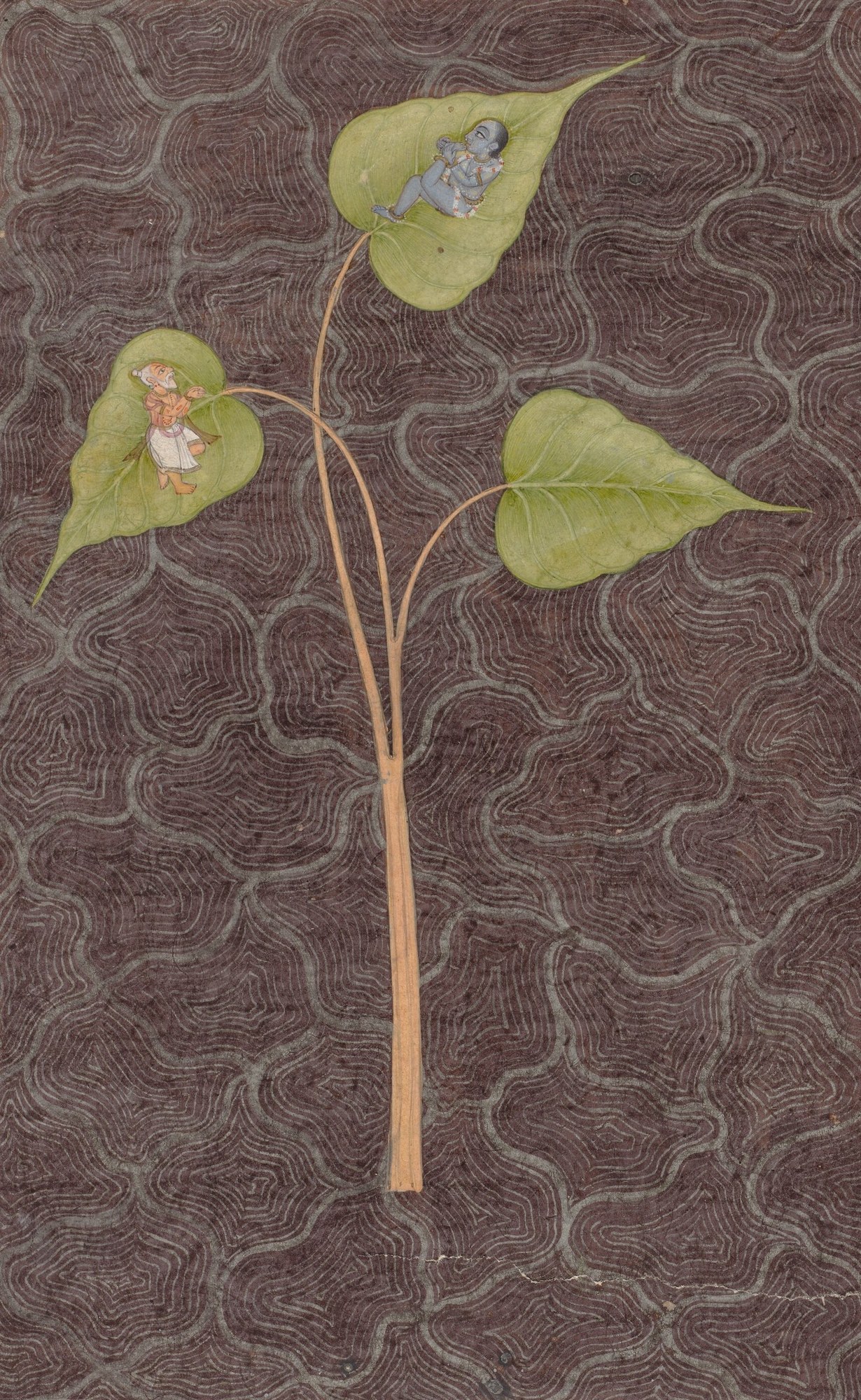
Begin, as the hymn does, with a sentence that takes almost everything away. There was not the non-existent, it says, and there was not the existent either; not being, not its opposite. There was no realm of air and no sky arching beyond it. And then the poem does not steady itself on solid ground but asks a question into the dark: what covered all this in, and where, and what gave it shelter? Was there water, an unfathomed depth of water?
This is the opening of the Nāsadīya Sūkta, the poem read under the heading Creation,
and it is the most famous cosmic meditation in the whole of the Ṛgveda. It is also, on any honest reading, not a creation story at all. Strip away the heading ‘Creation’, and what remains is a poem about whether the question can be answered. This retelling draws on two late-Ṛgvedic hymns — 10.129, the Nāsadīya (c. 1200–1000 BCE), set against 10.190’s ordered cosmogony — in Griffith’s translation, IAST cross-checked against Thomson and Slocum.
Neither being nor non-being
The Hindu tradition holds other, tidier accounts of how everything began: a golden egg cracked on the primeval waters, a self-existent lord who splits his own body into heaven and earth. This is not one of them. It has no maker who acts, no cast of gods doing things, no sequence of events you could draw as a diagram. What it has instead is a method, and the method is subtraction.
The first verse removes being and non-being together. The second removes the last measures a listener might cling to: death was not then, nor anything immortal; there was no sign to divide the day from the night. Everything by which a mind orients itself has been quietly withdrawn before the poem will say what, if anything, remained.
What remained is named with deliberate vagueness. Not a god, not a lord, only That One, the single reality that was there before there was a there. And the hymn’s most arresting image describes what this One did, which was almost nothing: it breathed, breathless, by its own nature, and apart from it there was nothing whatsoever. Breath without air, a stirring of life in a place with no wind to carry it and no lungs to move it, self-sustaining and utterly alone. Over it, the poem says, lay darkness hidden inside darkness, and all that would become the world was an unilluminated water, formless and indistinct.
The heat and the desire
Only now, three verses in, does anything begin to move, and even this is described with a caution that refuses to name an agent. By the great power of tapasFervid heat, the impersonal generative power by which the pre-cosmic One is born in 10.129; Griffith renders it 'Warmth', later translators 'heat' or 'ardour', and Sāyaṇa reads it as ascetic austerity., the hymn says, that One was born. The word carries a charge the English cannot fully hold. Griffith, translating in 1896, rendered it Warmth
; modern scholars give heat
or ardour
; the mediaeval commentator Sāyaṇa read it as ascetic austerity, the self-generated heat of contemplation. The difference matters, because it decides whether the first cause is a physical warmth in the primeval water or something closer to a mind straining at itself. The Sanskrit permits both, and the hymn does not choose.
Then comes the first thing that is unmistakably an inward event. Upon that One, in the beginning, arose kāmaDesire: in 10.129 the first stirring of mind upon the One, 'the primal seed and germ of Spirit', the earliest movement toward creation., desire, and the poem calls it the primal seed and the first germ of spirit, the earliest movement of mind.
Not desire for anything in particular, since nothing yet existed to be desired, but the bare stirring of want, the first lean toward creation before there was a creation to lean toward. And it is here, at this exact hinge, that the human enters the hymn for the only time. The poet-seers, searching with the thought of their own hearts, found the bond that ties the existent to the non-existent. They did not receive it from a god or read it off the sky. They found it by looking inward, and the poem trusts that inward search as the only instrument fit for a question this deep.
Who could possibly know
If the hymn ended there it would still be remarkable. What makes it unlike almost anything else in ancient religious literature is where it goes next, which is straight into doubt. The fifth verse, notoriously obscure, gestures at a line stretched across the newborn world, at powers above and forces below, and then gives up the pretence of description.
The sixth asks the question the whole poem has been circling: who really knows, and who could here declare it, from where this creation came? And it drives the doubt home with a claim that quietly dismantles every neat cosmogony ever told. The gods, it says, came after this world’s making. They are later than creation, and so they cannot be its cause, and they cannot be its witnesses either. There is no divine informant to appeal to. The usual authorities were not there.
Which leaves one last possibility, and the seventh verse reaches for it and then lets it fall. There is, perhaps, an overseer in the highest heaven, one whose eye controls this world, who might know how it all began, whether he made it or did not make it. Even the grammar here stays open: the line can be read as a confident creator whose knowledge is merely beyond our reach, or as leaving open that the world was never made
at all.
And then the hymn ends on the sentence that has kept it alive for three thousand years. He, the overseer in the highest heaven, he alone knows. Or perhaps even he does not know. The poem’s last word is not an answer but a shrug of the profoundest kind, refusing certainty at the very summit of the cosmos.
The other hymn, which does not doubt
Set beside this a second poem from the same late layer of the Ṛgveda, and the contrast is the sharpest lesson the two can teach together. The Nāsadīya sits in Maṇḍala X, the tenth and latest book of the Ṛgveda, added after the older family books and dated by scholars to roughly twelve hundred to a thousand years before the common era.
A few hymns further on in that same book stands a short, confident cosmogony that shares the Nāsadīya’s key word and almost nothing of its temper. From fervour kindled to its height, it declares flatly, eternal law and truth were born, ṛtaEternal Law and Truth born of tapas in 10.190, the ordered pair the Nāsadīya withholds. and satya together, the cosmic order and the real; and from them the Night, and from the Night the billowy flood of the sea. From that flood came the Year, ordainer of the days and nights, lord over all who close the eye.
And then a maker steps forward and does his work in plain order: DhātarThe Ordainer or Establisher, 'the great Creator' who forms Sun, Moon, Heaven and Earth in due order in 10.190; present there, and pointedly absent from 10.129., the great Creator, formed the Sun and the Moon, and formed Heaven and Earth, and the regions of the air and the light between.
Here is everything the Nāsadīya withholds. There is a sequence you could number. There is a first principle, tapas, that produces named things in order. There is, at the end, an actual creator with a name, who arranges the cosmos as a craftsman arranges his materials. The two hymns are close kin, composed in the same stratum and reaching for the same generative heat, and it is precisely because they are so close in time that their difference in stance is so striking.
This is not an old confident myth being replaced by a later sceptical one, nor the reverse. Within a single book, on adjacent pages, one Vedic poet was content to name Dhātar as the maker of sun and moon while another looked at the same origin and concluded that not even the highest god might know how it came to be. The tradition held both, side by side, and did not resolve them.
A doubt kept, not softened
It is tempting, and common, to modernise the Nāsadīya, to read its abyss of unfathomed water as a premonition of physics and its final doubt as the first stirring of unbelief. Carl Sagan quoted its closing verses on television for their unselfconscious humility before the cosmic mysteries, and the label the oldest agnostic text
is often hung on it. These are readings from our own age, and they say more about us than about a poet who lived three millennia before them. The hymn is not doctrine.
It does not deny the gods; it merely places them after the event they are usually said to have caused, and then asks, with genuine and unforced humility, who could possibly know. Its greatness is that it refuses to close the question it opens. Every impulse in a reader, and in most of the tradition that followed, is to supply the missing answer, to name the maker, to crack the egg and find the god inside. The Nāsadīya declines. It ends, deliberately, on the word that means or perhaps not,
and it is that refusal, held steady for three thousand years, that has made it immortal.
Who verily knows and who can here declare it, whence it was born and whence comes this creation? / The Gods are later than this world’s production. Who knows then whence it first came into being? (Ṛgveda 10.129.6, tr. Ralph T. H. Griffith, The Hymns of the Rigveda)
- Ṛgveda 10.129 (Nāsadīya Sūkta,
Hymn of Creation
; Griffith trans., The Hymns of the Rigveda, vol. 2, 1896)the seven-verse meditation on the pre-cosmic state —Then was not non-existent nor existent: there was no realm of air, no sky beyond it
;Death was not, then, nor was there aught immortal: no sign was there, the day’s and night’s divider
;That One Thing, breathless, breathed by its own nature: apart from it was nothing whatsoever
;Darkness there was: at first concealed in darkness this All was indiscriminated chaos… by the great power of Warmth was born that Unit
;Thereafter rose Desire in the beginning, Desire, the primal seed and germ of Spirit. Sages who searched with their heart’s thought discovered the existent’s kinship in the non-existent
;The Gods are later than this world’s production
; and the closingHe, the first origin of this creation, whether he formed it all or did not form it… he verily knows it, or perhaps he knows not.
Griffith renders tapas asWarmth
; standard modern translations giveheat
/ardour,
and Sāyaṇa (via H. H. Wilson) reads ascetic austerity — the same Sanskrit word, a materially different theological flavour. Maṇḍala X is the latest layer of the Ṛgveda; the hymn is commonly dated c. 1200–1000 BCE (a scholarly convention, not a claim of the text). - Ṛgveda 10.190 (Griffith trans., same volume)the three-verse ordered cosmogony —
From Fervour kindled to its height Eternal Law and Truth were born: thence was the Night produced, and thence the billowy flood of sea arose
;From that same billowy flood of sea the Year was afterwards produced, Ordainer of the days and nights, Lord over all who close the eye
;Dhatar, the great Creator, then formed in due order Sun and Moon. He formed in order Heaven and Earth, the regions of the air and light.
Fervour
is tapas,Eternal Law and Truth
are ṛta and satya,Dhatar
the Ordainer. From the same late (Book 10) stratum as 10.129, and sharing the tapas motif, but confidently narrating an ordered creation with a named maker where 10.129 refuses one. - **Karen Thomson & Jonathan Slocum, *Rig VedaA Metrically Restored Text*** (1994): cross-checked for the IAST transliteration underlying the two padas quoted in transliteration above — the incipit nā́sad āsīn nó sád āsīt tadā́nīṃ (
not the non-existent was, nor the existent, then
) and the closing só aṅgá veda yádi vā ná véda (he indeed knows, or maybe he knows not
). Griffith’s own text is English only. - *A note on later receptionthe
Big Bang anticipated
framing and Carl Sagan’s television quotation (Cosmos, ep. 10) are twentieth-century responses to the hymn, not its own meaning; the descriptionoldest agnostic text
is a modern interpretive label. The traditional Anukramaṇī ascription of the hymn to a seer named Prajāpati Parameṣṭhin is a later index tradition, not internal to the poem, and is not asserted here as fact.*