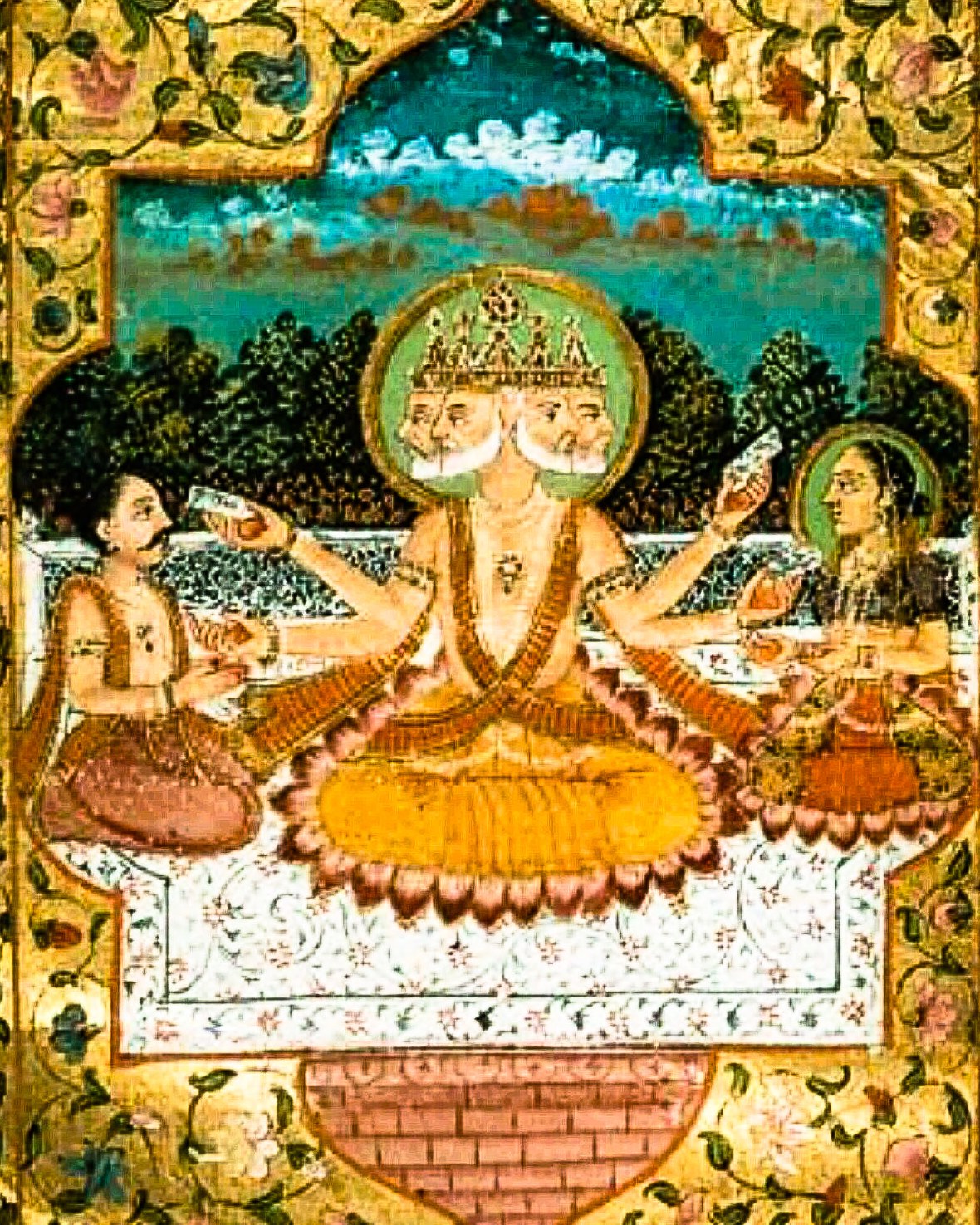
At the end of a year, a god tried to speak. He had been born from a golden egg floating on a sea of water that was the whole of everything, and there was nothing yet for him to name. So the first thing he did with his mouth was make three sounds. He said bhūḥ, and the word became this earth. He said bhuvaḥ, and it became the air. He said svaḥ, and it became the sky overhead. The oldest surviving account of the threefold cosmos in this tradition does not describe a builder laying courses of stone or a warrior splitting a monster. It describes an infant learning to talk, and the three worlds are his first three words. This piece traces the three world-words across four witnesses a millennium apart — Śatapatha Brāhmaṇa 11.1.6 (c. 800–600 BCE, Eggeling), Taittirīya Upaniṣad 1.5 (Müller), Ṛgveda 3.62.10 (Griffith) and Manu 2.76–81 (Bühler).
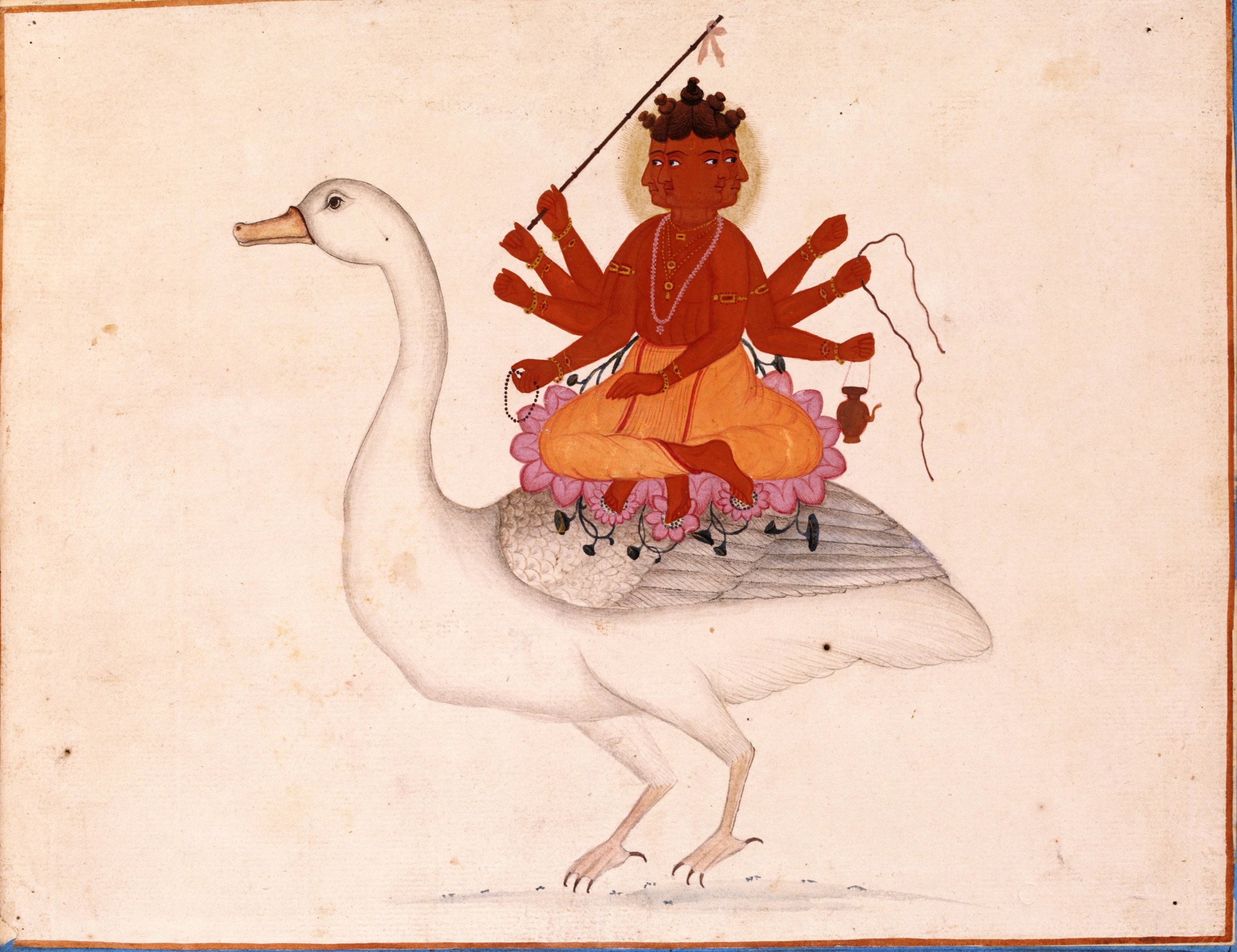
This is PrajāpatiThe 'lord of creatures', a creator god who in the Brāhmaṇa is born from the golden egg on the first waters and speaks the three worlds into being., the lord of creatures, in the Śatapatha Brāhmaṇa, and the passage is the load-bearing one for the whole idea of a spoken cosmos. Each of the three worlds does not merely get a name; the name is the world. Utterance and creation are the same act. And the text drives the strangeness home by turning it back on us: therefore, it says, a child tries to speak at the end of a year. Every human baby’s first stammer is placed inside the same frame as the making of the world.
A ladder with nothing between the rungs
The three sounds have a name of their own. Each is a vyāhṛtiA 'sacred utterance': one of the ritual words Bhūḥ, Bhuvaḥ, Svaḥ (a fourth, Mahas, is added in some texts) prefixed to the Gāyatrī in daily recitation., a sacred utterance, and the middle Vedic texts pin down exactly what each one holds. The Taittirīya Upaniṣad, from the layer that follows the Brāhmaṇa’s cosmogony and draws on it, lays them out as a set: Bhūḥ is this world, the earth under the feet; Bhuvaḥ is the antarikshaThe intermediate space between earth and sky, the middle of the three worlds; rendered by translators as air, atmosphere or sky., the mid-space of air and cloud; Svaḥ is the far world, the sky where the gods and the sun are. It is a strict vertical ladder, bottom to top, and nothing is left over between the rungs.
Then the Upaniṣad does what these texts love to do: it makes the ladder rhyme with everything else. Each world is tuned to an element that belongs to its level. Bhūḥ is Agni, fire, which sits on the earth. Bhuvaḥ is Vāyu, the wind that moves in the middle air. Svaḥ is Āditya, the sun that rides the top of the sky.
Read upward, the three are a genuine sensory climb: flame at the ground, wind in between, the sun at the crown. The same three then map onto the three kinds of Vedic verse, Ṛk and Sāman and Yajus, and onto the three breaths that move in a living body, prāṇa and apāna and vyāna. The cosmos, the fire on the hearth, the chant in the mouth and the breath in the chest are all made to run on the same three-part scale.
Three words, five syllables, five seasons
The Brāhmaṇa’s own account does not stop at the moment of speech. It keeps counting. The three world-words, it observes, consist of five syllables, and Prajāpati made those five syllables into the five seasons of the year. Here the reckoning runs from language into time. First there are three worlds, one for each word; then the syllables of those same words are told over and found to be five; and the five become the divisions of the year, so that the shape of the sentence Prajāpati spoke is also the shape of the calendar he set turning.
It is a habit of thought worth pausing on. These texts do not treat the count of a thing as an accident. A number that recurs is taken to be a hidden seam where two orders of reality are stitched to each other, and here the seam joins the utterance, the cosmos and the year in a single knot of syllables.
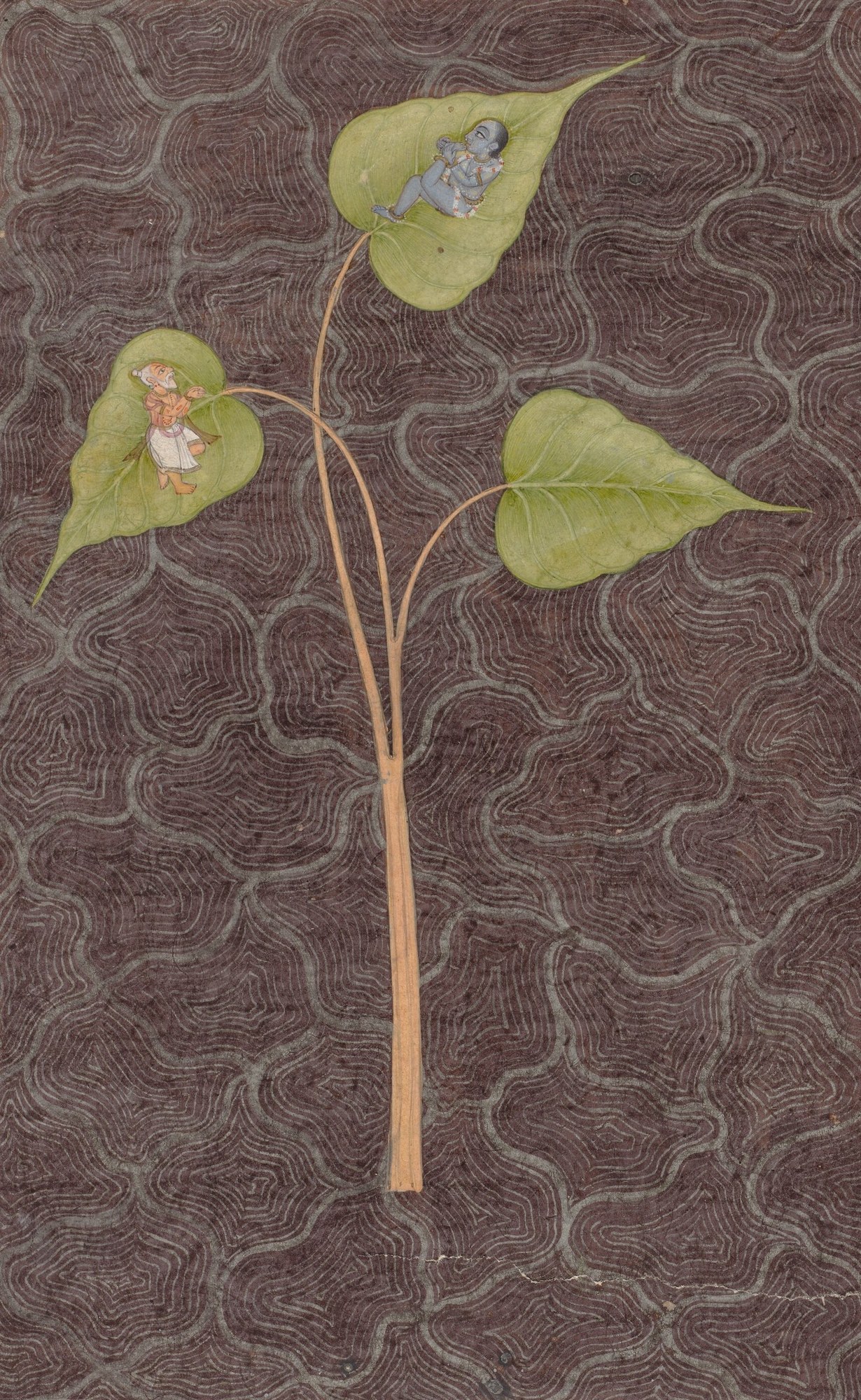
The setting of the whole event is worth holding in view, because it is the frame the speech-act happens inside. Before Prajāpati there is only water, nothing but a sea of water,
the Brāhmaṇa says, and on that sea a golden egg forms and floats for the space of a year before the god within breaks it open.
He does not step out into a furnished world and start labelling it. He steps out into undivided water and speaks the divisions into being. There is a year of gestation, then a first sound, then a made world, and the human echo the text insists on, the child who first speaks at a year old, keeps the cosmic scene tethered to something every parent has watched.
A fourth word, and which spelling
It is tempting to call this a tidy triad and leave it there, but the texts themselves will not let the number sit still. In the very same passage the Taittirīya Upaniṣad records a dissenting teacher. A man called Māhāchamasya, otherwise almost unknown, taught a fourth utterance: Mahas, which the text equates with Brahman itself, the ground of which the other three are only the limbs.
So the oldest witnesses hand us not one count but two, three worlds or four, and the fourth is the greatest of them. The familiar three-word invocation is a choice among the sources, not the only Vedic reckoning. Later tradition would run the list out further still, to seven upper worlds, but that expansion belongs to the Puranas and is not in these early texts.
The spelling wobbles too, and honestly so. Müller, translating the Upaniṣad, prints the third word as Suvas and warns in a footnote that his text varies between Bhūḥ Bhuvas Suvas and Bhūḥ Bhuvar Suvar; Griffith and the translators of Manu print Svaḥ. There is no single correct spelling to recover, only a family of closely related forms. This retelling uses Bhūr Bhuvaḥ Svaḥ, the commonest modern shape, while noting that the manuscripts do not agree with each other or with us.
The verse the three words open
Anyone who has heard the words bhūr bhuvaḥ svaḥ has almost certainly heard what comes after them: the Gāyatrī, the most recited verse in the whole tradition. Here the history has to be told carefully, because the two halves of that famous formula are separated by something close to a thousand years.
The verse itself is Rigveda 3.62.10, and it is ancient, from one of the family books of the oldest Veda, composed perhaps fifteen centuries before the common era. Griffith renders it plainly: May we attain that excellent glory of Savitar the god: so may he stimulate our prayers.
It is addressed to SavitṛThe Impeller, the sun-god in his rousing aspect; the deity to whom the Gāyatrī verse (Rigveda 3.62.10) is addressed., the Impeller, the sun in his aspect as the one who sets things moving, and its neighbours in the hymn ask the same god for prosperity and for urged, quickened thought. Griffith’s own footnote calls it the Sāvitrī, the Gāyatrī par excellence, the verse that forms part of the daily devotions of the Brahmans.
What the verse does not contain, in its Rigvedic form, is the three worlds. There is no bhūḥ, no bhuvaḥ, no svaḥ in the ancient ṛc. The three world-words are a prefix bolted on in front of it by the later liturgy, and every text that shows us the join, the Brāhmaṇa, the Upaniṣad, the law-book of Manu, comes centuries to a full millennium after the verse was composed.
Manu, our latest witness at roughly the turn of the common era, is separated from the Gāyatrī he quotes by well over a thousand years. So when people say the Gāyatrī invokes the three worlds, what they mean is the ritual Gāyatrī, the assembled formula of Om, the three utterances and the verse. The archaic core underneath addresses the sun-god and says nothing of any triple cosmos. The gap matters, and flattening it would credit the Rigveda with a scheme its heirs invented.
The gate made of three words
Why fasten the three worlds to the front of a sun-hymn at all? Because by the time of Manu the utterances had become a threshold. Manu tells it as another act of extraction: Prajāpati, he says, milked out from the three Vedas the sounds A, U and M and the three utterances Bhūḥ, Bhuvaḥ, Svaḥ, and drew off the Sāvitrī verse as well, one foot from each Veda. Creation here is not fabrication but pressing the essence out of what already is, the way milk is drawn from a cow.
And the assembled thing has a shape, an architectural one. The three imperishable utterances, Manu says, preceded by the syllable Om and followed by the three-footed Sāvitrī, are the portal of the Veda and the gate leading to union with Brahman. The three worlds, spoken, become a doorway. What Prajāpati once said to bring earth and air and sky into being, the reciter now says each day to pass through them and out the far side.
The same three syllables that were the first architecture of the cosmos are the last architecture the devotee steps through, and the distance between the god’s first speech and the worshipper’s daily one is the whole span of these texts, a thousand years and more, holding the same three words open like a gate.
He said “bhūḥ”: this (word) became this earth; “bhuvaḥ”: this became this air; “svaḥ”: this became yonder sky. (Śatapatha Brāhmaṇa 11.1.6.3, tr. Julius Eggeling)
- Śatapatha Brāhmaṇa 11.1.6.1–5 (Mādhyandina recension), trans. Julius Eggeling, The Śatapatha-Brāhmaṇa, Part V (Sacred Books of the East, vol. 44, 1900), public domain. The speech-act cosmogonyin the beginning
this (universe) was water, nothing but a sea of water,
a golden egg forms on it and after a year’s time Prajāpati is produced and breaks it open; his first speech,He said ‘bhūḥ’: this (word) became this earth; ‘bhuvaḥ’: this became this air; ‘svaḥ’: this became yonder sky,
followed byTherefore a child tries to speak at the end of a year
; and the three words asfive syllables
made intothe five seasons.
The key witness that a god utters the three world-words and each word is a world. Composed c. 800–600 BCE. - Taittirīya Upaniṣad 1.5.1–3 (Śīkṣāvallī, Fifth Anuvāka), trans. F. Max Müller, The Upanishads, Part II (Sacred Books of the East, vol. 15, 1884), public domain. The three interjections defined,
Bhūḥ is this world, Bhuvas is the sky, Suvas is the other world
; Māhāchamasya’s fourth utterance,Mahas, which is Brahman, which is the Self
; and the fourfold correspondences of the utterances to deities (Agni, Vāyu, Āditya, moon), to the Vedas (Ṛk, Sāman, Yajus) and to the breaths (prāṇa, apāna, vyāna). Müller’s footnote records thatthe text varies between Bhūḥ, Bhuvas, Suvas… and Bhūḥ, Bhuvar, Suvar.
Composed c. 6th century BCE. The primary authority for which word maps to which world. - Rigveda 3.62.10–12, trans. Ralph T. H. Griffith, The Hymns of the Rigveda (2nd ed., 1889/1896), public domain. The Sāvitrī / Gāyatrī, “May we attain that excellent glory of Savitar the godso may he stimulate our prayers” (3.62.10), with its two companion verses (3.62.11–12), all addressed to Savitṛ; the first verse of the fourth of the hymn’s six triplets, as Griffith’s headnote sets out. Griffith’s footnote names it
the Sāvitrī, the Gāyatrī par excellence… part of the daily devotions of the Brahmans.
From Maṇḍala III (the Viśvāmitra family book), c. 1500–1200 BCE. The verse addresses Savitṛ and does not itself contain the three world-words; the vyāhṛti-prefix is a later liturgical addition, roughly a millennium younger than the ṛc. - Manu-Smṛti 2.76–81, trans. Georg Bühler, The Laws of Manu (Sacred Books of the East, vol. 25, 1886), public domain. Prajāpati
milked out (as it were)
the sounds A, U, M and the Vyāhṛtis Bhūḥ, Bhuvaḥ, Svaḥ from the three Vedas (2.76), and drew off the Sāvitrī verseone foot from each
(2.77); the three imperishable Mahāvyāhṛtis,preceded by the syllable Om, and (followed) by the three-footed Sāvitrī,
namedthe portal of the Veda and the gate leading (to union with) Brahman
(2.81). Bühler’s note to 2.77 identifies the Sāvitrī withtat savitur vareṇyam, Rig-veda III, 62, 10,
an independent confirmation of the equation Gāyatrī = RV 3.62.10. Composed c. 200 BCE–200 CE, the latest of the four witnesses and separated from the Gāyatrī it quotes by well over a thousand years.