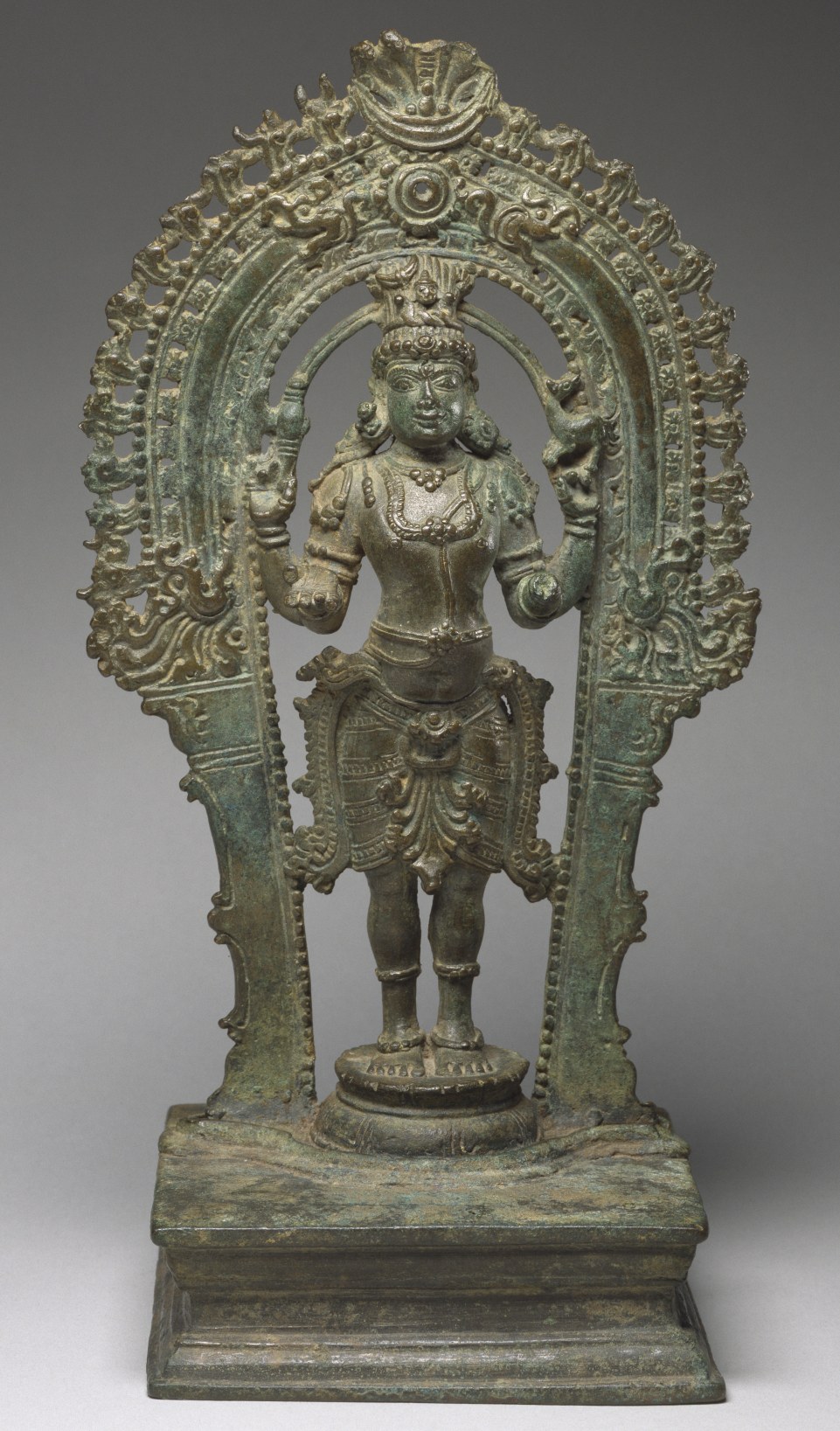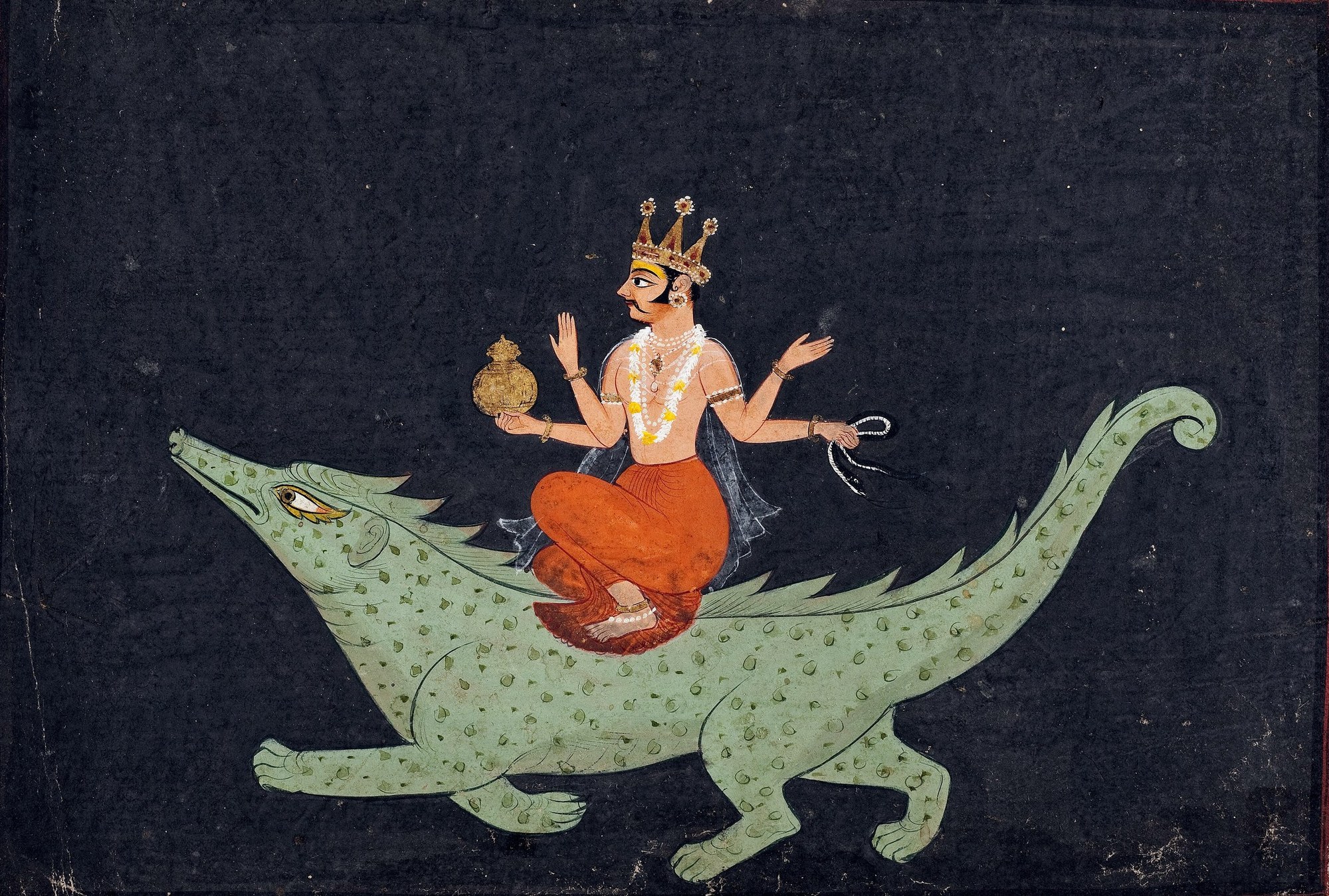
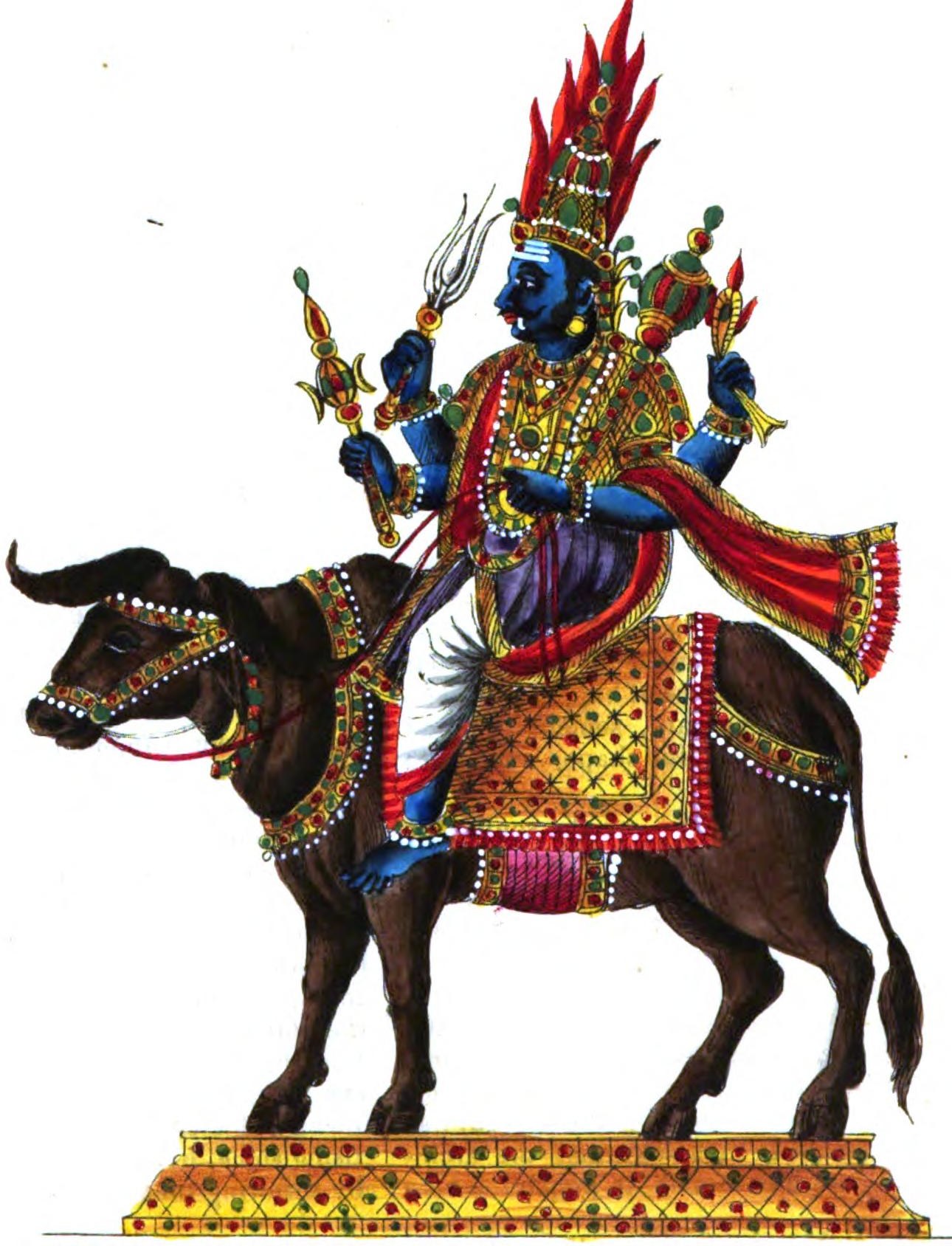
Someone had to be the first to die. The oldest Indian scripture knows his name, and it is not the name of a grim reaper. He is Yama, son of the Sun, and before he was anything else he was a man who died and, dying, found a road where none had run before. The Rigveda puts it in a single unforgettable line: Yama first found for us the road to travel; this pasture never can be taken from us. He did not make death. He walked into it ahead of everyone, and the path his feet wore is the one every mortal born on earth has trodden since, whither our ancient Fathers have departed.
That is the whole of Yama at the beginning, and it is worth naming which beginning, because he does not stay this figure. Those first hymns belong to the Rigveda, composed by oral poets between roughly 1500 and 1200 BCE. The dreaded judge with his ledger of sins and his river of blood belongs to the Garuda Purana, a medieval text set down something like two thousand years later, a gap wider than the one between Homer and the fall of Rome. To read them as one figure is to miss the most interesting thing about him: he changed almost completely and kept the same name.
The first to walk the road
The Vedic Yama is a host, not a punisher. His country is a place of light and reunion, and the dead are sent toward it with welcome rather than dread. Come, seat thee on this bed of grass, the funeral hymn says to him, in company with the Angirasas and the Fathers; and there, at his side, sits Varuna, the two of them kings enjoying their sacred food.
To the man newly dead the poet gives an instruction that no later hell would tolerate: leave sin and evil, seek anew thy dwelling, and bright with glory wear another body. There is no scale here, no accounting, no fire. There is a king, an old company of the honoured dead, and a seat kept warm.
Two guardians patrol the way to that company of the Fathers, the pitṛsThe Fathers: the ancestral dead who have gone before along Yama's road and dwell in his realm, honoured with offerings by the living., and they are the single most vivid thing the Rigveda gives us. Run and outspeed the two dogs, the hymn urges the traveller, Sarama’s offspring, brindled, four-eyed, upon thy happy pathway. They are Yama’s envoys, dark-hued and insatiate, with distended nostrils, and they roam among the people, watching over the road of the dead. The dead man is entrusted to their protection. These dogs are genuinely ancient, older than any hell, and they belong to a Yama who guards the road rather than guarding a prison.
Death sits down to teach
Centuries pass, and the same god turns up wearing a stranger face. In the Katha Upanishad, composed perhaps eight hundred to a thousand years after those funeral verses, Death has become a teacher, and the man who confronts him is a boy. Nachiketas is given to Yama in a fit of temper by his own father, and when he arrives at Death’s house he finds it empty and waits three nights without food. Yama, returning, is ashamed to have left a Brahmin guest unfed under his roof, and grants the boy three boons to make it good.
The boy spends the first two lightly and saves the hardest for last. There is a doubt, he says, about a man who has died: some say he still is, and some say he is not; this I wish to know. Yama tries every evasion. Even the gods once doubted this, he warns; ask instead for sons and cattle and gold, for fair maidens with their chariots and instruments of music. The boy will not be bought. No man can be made happy by wealth, he answers, and keeps his question.
So Death teaches him what he asked, and what he teaches is that the thing which dies is not the thing that matters. The knowing Self is not born and does not die; it is unborn, eternal, everlasting, and is not killed though the body is killed. If the slayer thinks he slays, Yama tells the boy, and the slain thinks he is slain, both are mistaken. The lord of the dead is made the one who explains that in the deepest sense no one truly dies.
He gives the boy an image that has outlived its scripture. Know the Self to be the rider in a chariot, Yama says, the body the chariot, the intellect the charioteer, the mind the reins; the senses are the horses, and their roads the objects of sense. Master the reins and you reach the journey’s end. And he sends Nachiketas back to the living with a warning: the sharp edge of a razor is difficult to pass over; thus the wise say the path is hard.
The King of Justice and his river
The Yama that most people picture today is neither the host of the Fathers nor the teacher of the razor’s edge. He is DharmarājaKing of Justice, the epithet of the later Yama as impartial judge of the dead; a post-Vedic title absent from the earliest hymns., the King of Justice, and everything that makes him fearsome, the ledger, the hells, the messengers with nooses, arrives in the late Puranic death-books, two millennia downstream of the Rigveda. To read that apparatus back into the Veda is the commonest error told about him, and it is worth resisting flatly: the Rigveda has no hell, no accountant, and no torture at all.
The Garuda Purana supplies the machinery in grim detail. At death two messengers come, black as crows, teeth grinding, bearing nooses and rods, and drag the soul out the size of a thumb, crying out and looking back at its own body. The road to Yama’s abode runs across burning sand, shelterless and waterless, the traveller struck upon the back with whips.
Across the way flows the VaitaraṇīIn the Puranic death-lore, the hundred-league river of pus and blood the dead must cross on the road to Yama's city; only the sinful fall in., a hundred leagues of pus and blood, its banks heaped with bones, choked with crocodiles; it was created, the text says, only that the sinful should fall into it, and the righteous cross by the merit of a gift of a cow. Beyond lies the four-gated city of the King of Justice, where the recorder Chitragupta reads out each soul’s account of good and evil deeds before the throne.
And even here the living are not helpless on the dead’s behalf. The soul depends on the rice-balls its sons offer for it, the piṇḍa laid down at the funeral rites; the Garuda Purana is used across India for exactly those ceremonies to this day. It is a long journey from the bed of sacred grass to the river of blood. The same god presides at both ends of it, and the distance between them is the distance the idea of death itself travelled in Indian thought.
Yama first found for us the road to travel: this pasture never can be taken from us. Men born on earth tread their own paths that lead them whither our ancient Fathers have departed. (Rigveda 10.14.2, tr. Griffith)
One caution runs through all of it. The confident claim that Yama was the first mortal to die
is truer of the tradition than of the Rigveda’s own words, which say only that he first found the road. The flat statement that he was the first of men to die comes from the slightly later Atharvaveda, and even in antiquity scholars disagreed about how much the earliest hymns meant by it. What is not in doubt is the shape of the whole: a man went first into the dark, and a people spent two thousand years deciding what kind of king he became once he got there.
- Rigveda 10.14 (
To Yama
; trans. Ralph T. H. Griffith, The Hymns of the Rigveda, Vol. IV, BenaresLazarus, 1892): the funeral hymn. Yama, son of Vivasvan,first found for us the road to travel
; the Fathers’ realm of light where he sits on a bed of sacred grass beside Varuna; the injunction to the dead toleave sin and evil
andwear another body
; the two brindled, four-eyed dogs of Sarama whoguard the pathway
; and the soma and butter oblations poured to him. Composed c. 1500–1200 BCE; this translation is Victorian, roughly three millennia later. - Rigveda 10.10 (the Yama–Yami dialogue; Griffith, Vol. IV)Yama and Yami as the twin son and daughter of Vivasvan the Sun; Yami’s plea that they unite to father the human race and Yama’s refusal on grounds of kinship. Griffith’s headnote quotes Atharvaveda XVIII.3.13 for the explicit claim that Yama was
the first of men that died
— a line read here only as reported in that note, not from the Atharvaveda directly, and one whose reach earlier scholars (Roth against Max Müller) already disputed. - Katha Upanishad (trans. F. Max Müller, The Upanishads, Part II, Sacred Books of the East Vol. 15, Oxford, 1884)the dialogue of Nachiketas and Death, composed c. 5th–3rd c. BCE, some eight hundred to a thousand years after the funeral hymn. The three nights unfed and the three boons; the boy’s refusal of wealth for his question about survival; the deathless Self that
is not born
anddies not
; the chariot of the body; andthe sharp edge of a razor is difficult to pass over.
- Garuda Purana Saroddhara (the digest compiled by Naunidhirama; trans. Ernest Wood & S. V. Subrahmanyam, The Garuda Purana (Saroddhara), Sacred Books of the Hindus Vol. 9, Allahabad, 1911)the medieval death-lore behind the popular judge. The base Garuda Purana is dated c. 900–1000 CE and this digest later — some two thousand years downstream of the Rigveda, and none of its apparatus should be called
ancient Vedic.
The noose-bearing messengers and the thumb-sized soul; the road of burning sand; the river Vaitaraṇī of pus and blood, crossed only by the gift of a cow; the four-gated city of the King of Justice and the recorder Chitragupta; and the rice-balls (piṇḍa) offered by the sons, for which the text is still used at Indian funerals.