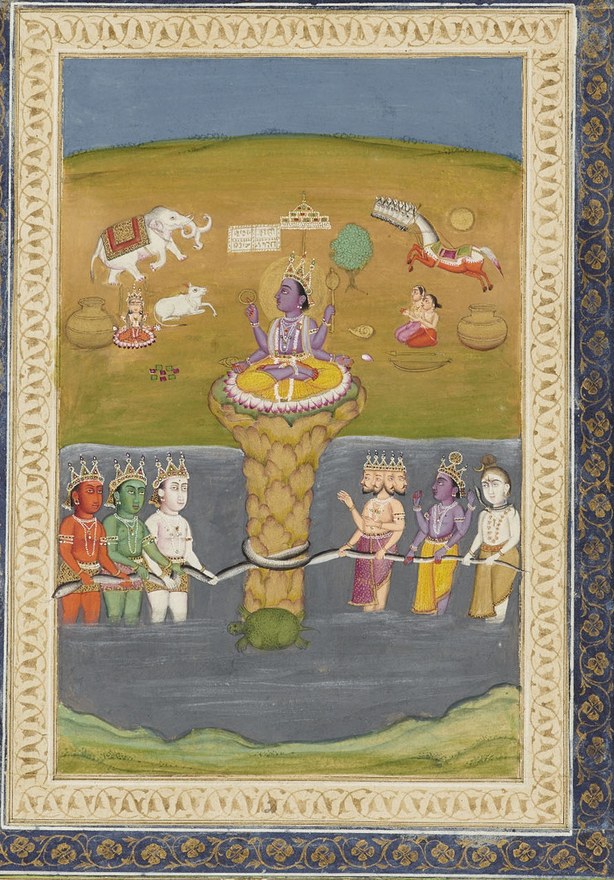
Under a whole world of stone, the tortoise is comfortable. Mount Mandara turns on his back with the full weight of a churning-machine spinning above him, and the Bhagavata Purana records what the load feels like to the god who bears it: the revolving mountain is a pleasant scratching of his back.
That single filmable image is the whole of Kurma in miniature. The most famous rescue in Hindu myth, the churning that wins the nectar of the deathless, rests on a pivot who finds the job an idle comfort. The worshippers who address him as AkūpāraA name of the cosmic tortoise, read in the Kurma Purana as 'the Unbounded One'; the mantra-form under which the Divine Tortoise is worshipped., the Unbounded One, know a secret the machine above does not: this is not, in the developed tellings, a tortoise at all. He is Vishnu, wearing the shell.
An animal the gods petition
The oldest version knows nothing of that. In the Mahabharata, when the unsupported churning-staff will not stand upright in open sea, the gods simply go looking for a base and find one. The gods then went to the king of tortoises and said to him, ‘O Tortoise-king, thou wilt have to hold the mountain on thy back!’
The tortoise-king agrees, Indra sets Mandara on his shell, and the work goes on. There is no divinity in him. He is a large and obliging animal the gods approach with a request, no more a form of the supreme god than the serpent they use for a rope. This is the pivot before anyone thought to make it an avatar.
Hari himself, in the form of a tortoise
By the time of the Vishnu Purana, centuries later, the animal has become the god. The gap is not small: the epic layers that carry the king of tortoises
are conventionally placed between the fourth century BCE and the fourth CE, while the Vishnu Purana belongs to the fourth or fifth century CE and the fullest tortoise-theology, in the Bhagavata, to the ninth or tenth.
A thousand years or more separates the obliging animal from the god who narrates his own scripture. Across that span the pivot is theologised. In the midst of the milky sea, Hari himself, in the form of a tortoise, served as a pivot for the mountain,
Wilson’s Vishnu Purana has it, and the tortoise is no longer petitioned from outside. He is the deity, sunk to the seabed in a borrowed body.
The Vishnu Purana goes further and makes him many bodies at once. The same god who is the tortoise below is also, unseen, the strength dragging the serpent-rope, a second figure seated on the mountain’s summit, one hidden portion sustaining the serpent-king, another pouring vigour into the failing gods. The Bhagavata renders the same multiplication as theology: Vishnu enters the demons in his passionate nature, the gods in his lucid nature, the serpent as suspended consciousness, while the tortoise presses the churning-rod from beneath and a thousand-armed form steadies Mandara from above with a single hand. The tortoise is not one actor in the scene. He is the scene, dispersed through every part of it.
The weight of a small continent
The scale of the load is stated plainly. The mountain on his back was, like another big continent, eight hundred thousand Yojanas in extent,
and the tortoise who dives to bear it is the First Tortoise of immeasurable power.
When it is steadied from above, Brahma, Shiva and Indra shower the god with flowers. It is worth being exact about what he holds, because the popular imagination has quietly swapped the object.
Kurma bears Mandara, a mountain being used as a churning-rod, for the duration of one labour. He does not bear the earth, and he does not bear it for ever. The image of a world resting eternally on a tortoise’s back is a separate cosmology altogether, and the only tortoise-shaped world the sources here offer is a map: the Vishnu Purana likens the outline of Bhārata-varshaThe Indian subcontinent, or known world, of the Puranas; the Vishnu Purana likens its shape to a tortoise, head to the east. to a tortoise with its head to the east, a geographer’s simile with nothing to do with the avatar.
The god who tells his own book
There is a text that takes the identification to its limit. The Kurma Purana is narrated by the tortoise. While the ocean was being churned, Lord Janardana assumed the form of a divine Tortoise and bore the mountain Mandara on his back,
and it was in that form, the scripture says, that Vishnu spoke the entire Purana from my mouth,
first to King Indradyumna and afterwards, retold, to an assembly of sages. The pivot that began as a mute animal ends as the author of a book about itself.
Between the waters, the tradition adds, he never left: the Divine Tortoise still resides in the Hiraṇmaya continent,
worshipped there by Aryaman, lord of the ancestors. He is a standing god with his own cult, not a one-off rescue, and his worshippers address the shell as they would the highest deity, great Atman of the form of the tortoise,
of concealed body,
the attributeless one, the ancient Purusa with a thousand heads, a thousand eyes, a thousand hands and a thousand feet.
Second, or eleventh
Even the tortoise’s rank is unsettled, and the disagreement is written into the texts rather than smoothed over by them. Devotion counts him the second of the ten DashavataraThe devotional sequence of Vishnu's ten descents, in which Kurma is usually counted the second, after the fish and before the boar; a cross-Puranic harmony, not one scripture's list. descents, after the fish and before the boar, and the Kurma Purana’s editor allows that he is normally regarded as the second incarnation.
But that tidy ordering is a later harmony sung across many Puranas, not a line from any one of them.
The Bhagavata, which drives the richest tortoise-theology of all, keeps its own longer roll of incarnations, and there Kurma is the eleventh: In the eleventh incarnation in the form of a tortoise, the omnipresent Lord supported the Mandara mountain on his back.
The same scripture that most fully makes the tortoise into God declines to place him second. He is the pivot of the myth and unsettled in his own catalogue, an animal in the oldest telling and the supreme deity in the latest, comfortable under a mountain and unfixed in his rank.
Supporting on his back the revolving mountain, the First Tortoise of immeasurable power regarded the circular motion of the mountain as pleasant scratching of his back, Oh dear King! (Bhāgavata Purāṇa VIII.7.10, trans. G. V. Tagare)
- Mahābhārata, Ādi Parva, Āstīka Parva, Section XVIII (trans. Kisari Mohan Ganguli, ed. Pratap Chandra Roy)the oldest stratum, in which the pivot is an impersonal
king of tortoises
whom the gods petition and who consents, Indra then placing Mandara on his back. The tortoise is not identified as Vishnu here; this is the pre-avatar form of the motif. - Vishnu Purāṇa, Book I, Chapter IX (trans. H. H. Wilson, 1840)the theological turn,
Hari himself, in the form of a tortoise, served as a pivot for the mountain,
and the multiplied presence (the strength dragging the serpent, the body on the summit, the hidden portions sustaining Vāsuki and infusing vigour into the gods,unseen by gods or demons
). Also, distinctly, the geographic simile likening Bhārata-varsha to a tortoise with its head to the east, a map metaphor unrelated to the churning avatar. - Bhāgavata Purāṇa (Śrīmad Bhāgavata), Skandha VIII, Chapter 7, and Skandha I, Chapter 3 (trans. G. V. Tagare, Motilal Banarsidass)the fullest figure-passage, the gigantic tortoise diving to bear up Mandara (VIII.7.8), the
eight hundred thousand Yojanas
loadlike another big continent
(7.9), the revolving mountain aspleasant scratching of his back
(7.10), the threefold sāttvic/rājasic/tāmasic entry and the thousand-armed steadyingone hand over it
(7.11–13); and the master avatar-list ranking Kurma the eleventh incarnation (I.3.16). - Kurma Purāṇa, Book I, Chapter 1 (trans. under A. S. Gupta / G. V. Tagare, Motilal Banarsidass, AITM series)the tortoise as narrator of the Purana, first to King Indradyumna
from my mouth
and then to the sages (I.1.9–11, 28–29, 42–45); the residence in the Hiraṇmaya continent worshipped by Aryaman; the tortoise-eulogy (verses 54–58); and the editor’s cross-Puranic apparatus, naming the Bhāgavata adeveloped stage of the Kurma-legend
and Kurmanormally regarded as the second incarnation.
Extant text before c. A.D. 900; a portion assigned by R. C. Hazra to c. A.D. 550.