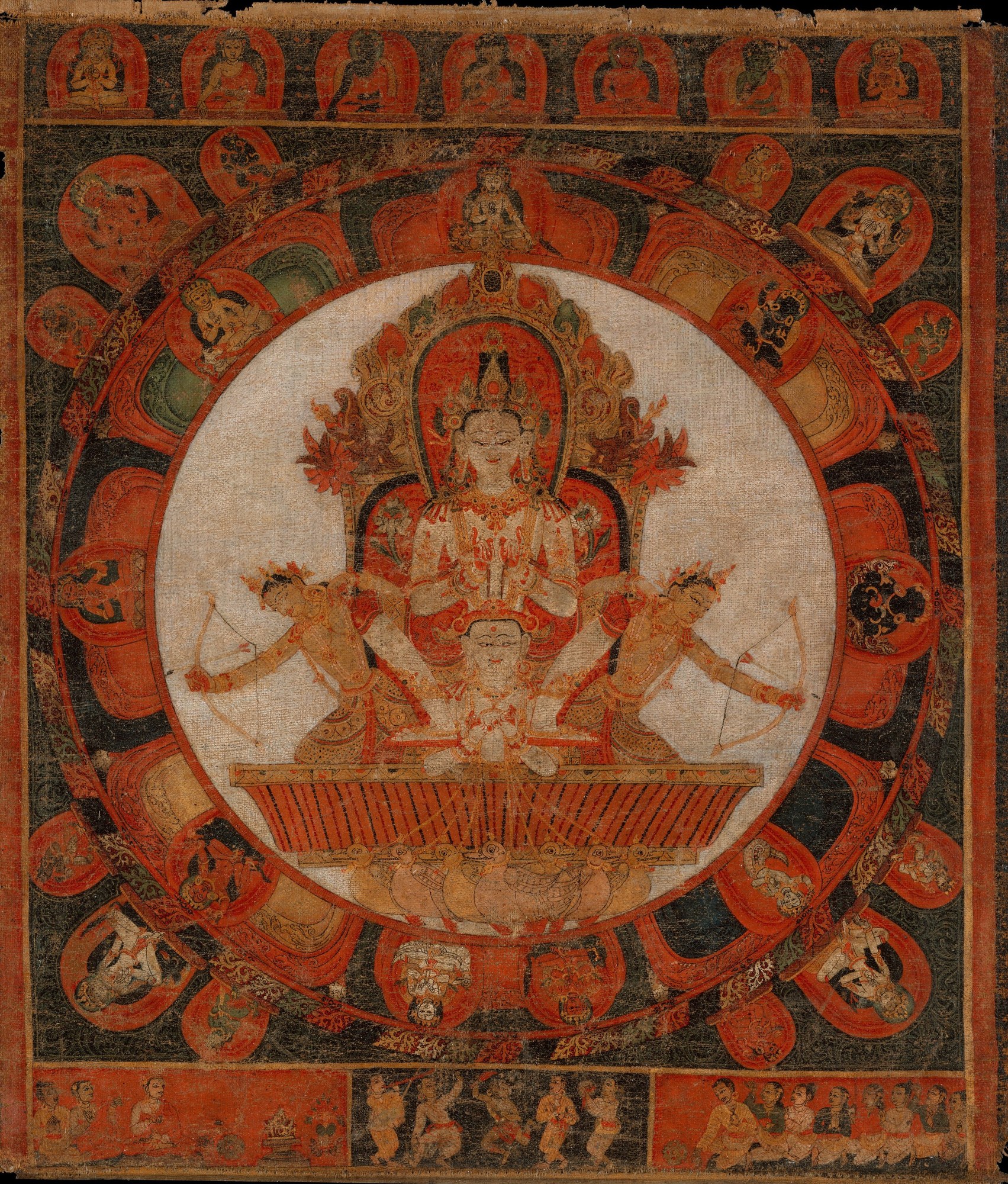
He was born from the eyes of a sage. Atri, mind-born son of Brahmā, sat in such long austerity that a light gathered and spilled out of him, and from that effusion the moon came into being. The Bhāgavata makes it gentler and stranger at once: Soma was born out of Atri’s tears of joy, and so the child was an embodiment of nectar, the cup of amṛta that the gods drink down and that fills again. Brahmā set him over the growing things and the night sky at once, protector of the herbs, the plants, the Brāhmaṇas, and the whole host of constellations and stars. This is the god the oldest texts call Soma and the later ones call Chandra, the moon: the same deity under two names, and the sources you meet him in speak of Soma while the name Chandra, the moon,
settles on him afterward.
From the tears of Atri
The manner of that birth is already contested, and it is worth saying so at the outset, because a moon-god is a thing the tradition told and retold across a span of years wide enough to hold whole other mythologies. The Viṣṇu Purāṇa’s own body simply calls Soma the son of Atri and leaves it there. Its editor records that the Vāyu Purāṇa says the essence of the moon issued from Atri’s eyes and impregnated the ten quarters of space, while the Bhāgavata gives the tears.
The mechanism differs by text, essence or tears or something less delicate still, but the eye of the sage is the constant. What all of them refuse is the tidier modern story that has the moon rise from the churning of the ocean of milk. That is a real tradition, but it is not this one, and the two ought not to be quietly folded together.
War on account of Tārā
He rose fast and badly. Soma conquered the three worlds and performed the RājasūyaThe great royal consecration-sacrifice by which a king claimed paramount dominion; Soma performs it before his fall into arrogance., the sacrifice that crowns a paramount king, and the glory of it made him arrogant and licentious. What he did with that arrogance was to carry off Tārā, the wife of Bṛihaspati, and Bṛihaspati was no ordinary husband to wrong: he is the preceptor of the gods, the guru of heaven itself. Soma would not give her back. Not to Bṛihaspati, not to the sages sent to plead, not to Brahmā.
So heaven split. Uśanas, called Śukra, the teacher of the demons and Bṛihaspati’s old rival, took Soma’s side out of sheer enmity to his opposite number, and the Daityas and Dānavas, the whole demon host, came with him. Rudra, who had studied under Bṛihaspati’s own father, ranged himself against them, and Indra and all the gods stood with the wronged husband. The struggle was so violent that the Earth, shaken to her centre, fled to Brahmā for protection, and only then did the creator force the two armies apart and compel Soma to give Tārā back. The war carries her name: the Tārakāmaya, the war on account of Tārā.
A child who named his own father
She went back to her husband carrying a child, and when the boy was born he shone with a splendour that dimmed every other divinity, so that both Bṛihaspati and Soma claimed him. The dispute was precise in its cruelty. Bṛihaspati claimed the boy as a son born of his field,
his wife’s child and therefore his; Soma claimed him as a son of his own seed. Asked to settle it, Tārā stood silent from shame, until the newborn himself, losing patience, threatened to curse his mother unless she named his father.
Brahmā quieted the child and pressed her, and she confessed at last: Of Soma.
The delighted moon-god embraced the boy and called him wise, and from that the child took the name Budha, he who knows.
He became the regent of the planet Mercury, and he must not be mistaken for the Buddha, the awakened teacher of a wholly different tradition; the names are spelled apart and share nothing but a surface.
Wasting away in the sky
His most famous affliction comes from a different quarter of the tradition and a different, older book. In the Mahābhārata’s telling, Dakṣa the progenitor gave Soma his twenty-seven daughters in marriage, and those wives were the nakṣatrasThe lunar mansions, the twenty-seven star-groups the moon passes through in a month, which the Mahābhārata makes the twenty-seven wives of Soma., the lunar mansions, the star-groups by which men reckon time, so that the moon passing nightly from one wife to the next is the moon crossing the sky.
But of all of them Soma loved only Rohiṇī, the brightest, and lay with her alone. The neglected wives complained to their father. Twice Dakṣa warned his son-in-law to deal evenly with them all; twice Soma ignored him and kept to Rohiṇī. On the third complaint Dakṣa’s patience broke, and he cursed the moon with phthisis, the wasting consumption, so that Soma began to sicken and thin from the sky night by night.
The horror of it was not confined to heaven. Soma is the lord of plants, and as the moon-god wasted the herbs wasted with him: the deciduous plants failed, their juices dried and lost all savour, and living creatures everywhere began to decay. The whole world starved as the god died in the sky. The gods went to Dakṣa. He could not unsay his own word, but he could halve it. For half of every month, he decreed, Soma would wane a little each day, and for the other half he would wax again, and he sent the moon to bathe where the Sarasvatī pours into the ocean and there to worship Mahādeva.
Soma bathed at the new moon and got back his cool rays and rose once more to light the worlds. The place is called PrabhāsaThe pilgrimage-place where the Sarasvatī meets the western ocean; named, the epic says, from prabhā, the effulgence the moon regains by bathing there., effulgence,
because there the hare-marked god regained his shine. This is the Mahābhārata’s account of why the moon wanes, and it is worth holding it whole. The tidy one-liner keeps the curse and drops the mercy, but the epic’s own ending is a compromise redeemed by a bath and a rite, not a punishment left to run.
The line of the moon
Everything above is prelude to the reason the moon matters to the poets who told it: he is the head of a dynasty. Through Budha, who married Ilā, a daughter of the Manu, came Purūravas, and from Purūravas the whole Lunar line of earthly kings descends, the Somavaṃśa that in time produces the warring houses of the great epic itself. Purūravas is remembered for his love of the nymph Urvaśī, who took him on conditions as odd as they were strict: two pet rams were to be kept always by their bed, she was never to see him naked, and she ate only clarified butter.
The conditions held until the night celestial musicians stole the rams; Purūravas sprang up in the dark to save them, a flash of their lightning caught him bare, the pact was broken, and Urvaśī vanished. He wandered mad for her and found her again, and after their measured reunions the musicians gave him sacred fire, so that he became the founder of the three ritual hearths. That story is far older than the books that carry it here; it goes back to a dialogue-hymn of the Ṛgveda, sung perhaps two thousand years before the Purāṇas that retell it.
That distance is the thing to keep in mind about all of it. The Purūravas and Urvaśī hymn is late Ṛgvedic, conventionally placed around 1500 to 1200 before the common era, and in that oldest layer the moon-god is Soma, not yet Chandra. The Mahābhārata’s curse of Dakṣa belongs to the long epic centuries, roughly 400 BCE to 400 CE. The Viṣṇu Purāṇa is later again, of about the fourth or fifth century of our era, and the Bhāgavata later still, perhaps the ninth or tenth.
When these last two agree
about Soma’s tears and his stolen bride, they are two witnesses some five hundred years apart, and both stand well over a millennium downstream of the Vedic hymn they are elaborating. These are scholars’ approximations, not dates carved in a temple, but the shape they make is real: not one flat ancient voice but a tradition talking to itself across two thousand years, and the moon it describes is the sum of all that talking.
For half the month Soma shall wane every day, and for half the month following he will wax every day. (Mahābhārata, Śalya Parva, tr. Kisari Mohan Ganguli)
- Viṣṇu Purāṇa, Book IV, Chapter 4 (H. H. Wilson trans., 1840)the origin of Soma as son of the sage Atri; the Rājasūya sacrifice and the arrogance that follows; the abduction of Tārā, wife of Bṛihaspati; the war on her account, with Uśanas/Śukra and the Daityas and Dānavas on Soma’s side and Rudra, Indra and the gods on Bṛihaspati’s; the Earth
shaken to her centre
fleeing to Brahmā, who compels the restoration of Tārā; the disputed birth and naming of Budha,he who knows,
regent of Mercury — expressly distinguished from the Buddha in Wilson’s note 2; the descent Soma → Budha → (by Ilā) Purūravas and the Lunar Dynasty; the Purūravas and Urvaśī episode and the institution of the three sacred fires. Wilson’s note 1 records the birth-variants (essence of Soma from Atri’s eyes in the Vāyu Purāṇa; tears in the Bhāgavata), and note 4 the textually unstable length of the Urvaśī union (sixty-one thousand years,
against sixty-one and fifty-nine in other copies). [Purāṇa, c. 4th–5th century CE.] - Bhāgavata Purāṇa, Ninth Skandha, Chapter 14 (
The Description of the Lunar Race,
G. V. Tagare trans., 1950)the parallel account — Soma bornout of [Atri’s] tears of joy
and hencean embodiment of nectar (amṛta),
appointed by Brahmāprotector of Brāhmaṇas, plants and herbs and hosts of constellations and stars
; the abduction of Tārā and the allies of the war; the dispute over Budha’s paternity, in which Bṛihaspati claims him as a sonborn of his field
and Soma as a son of his own seed, settled by Tārā’s confessionOf Soma.
Its footnotes tie the Purūravas dialogue to Ṛgveda X.95 and Śatapatha Brāhmaṇa 11.5.1. [Purāṇa, c. 9th–10th century CE.] - Mahābhārata, Śalya Parva, Book 9 (Kisari Mohan Ganguli trans., P. C. Roy edition)the Sarasvatī pilgrimage episode at Prabhāsa, the load-bearing source for the waxing-and-waning myth — Dakṣa’s
seven and twenty daughters,
bestowed on Soma andconnected with the several constellations,
whoserved to help men in calculating time
; Rohiṇīthe foremost of them all
and the neglect of the rest; Dakṣa’s twice-ignored warning (Behave equally towards all thy wives!
) and the curse of phthisis (kṣaya), under whichSasin began to waste away day by day
; the ecological consequence, the deciduous herbs failing and theirjuices dried up
as living creaturesbegan to decay
; the tempering of the curse,for half the month Soma shall wane every day, and for half the month he will wax every day
; the new-moon bath wherethe Sarasvatī mingles with the Ocean
and the worship of Mahādeva; and the etymology of Prabhāsa from prabhā,effulgence.
[epic, c. 400 BCE – 400 CE.] - Ṛgveda X.95 (the Purūravas–Urvaśī dialogue)named here as the Vedic root of the Urvaśī episode, in which the moon-god is Soma and the proper name
Chandra
is not yet fixed; known for this piece only through the Bhāgavata IX.14 footnotes (Tagare), which quote fragments, and not read verbatim. [late Ṛgveda, c. 1500–1200 BCE.]